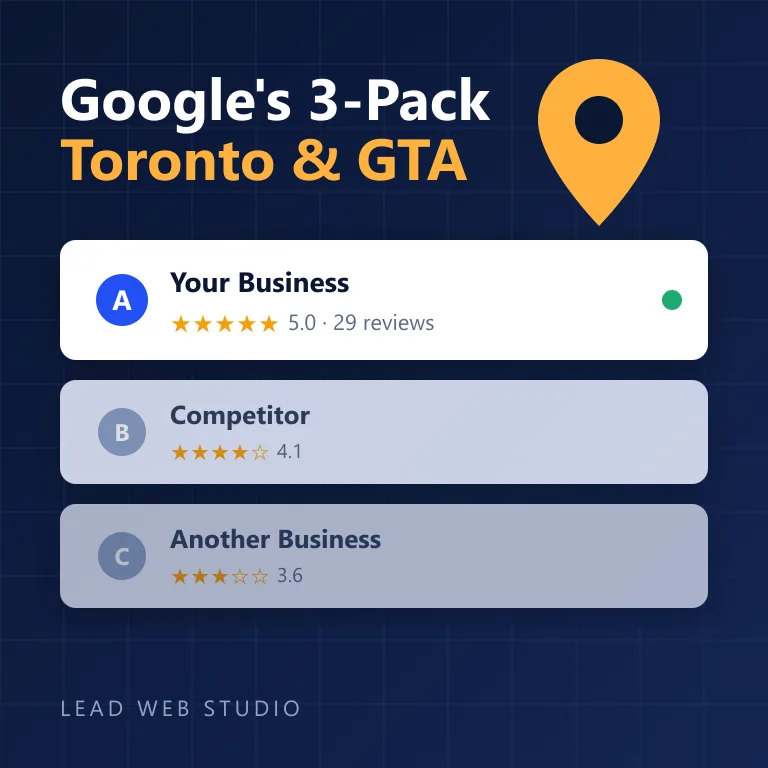
Search for any local service in the GTA — "notary scarborough," "restaurant thornhill," "hvac richmond hill" — and before a single regular result, Google shows a map with three businesses. That's the local 3-pack, and for local businesses it's the most valuable real estate on the internet. Here's how you get into it, based on what Google itself confirms and what I've done for GTA clients' Google Maps profiles.
The short version
- The 3-pack is ranked on three factors Google confirms: relevance, distance, and prominence.
- Your biggest levers: a complete, correctly categorized Google Business Profile, a steady flow of reviews, consistent name-address-phone everywhere, and a fast website.
- You can't pay for the organic 3-pack — but you can absolutely out-optimize the businesses currently in it.
- Professional Google Maps setup starts at $149 — it's the highest-ROI local visibility work I do.
What is the Google 3-pack?
The 3-pack (or "map pack") is the block Google shows for searches with local intent: a map plus exactly three business listings with ratings, hours and directions. It sits above the regular organic results, which is why those three spots collect the majority of local clicks and calls — most people never scroll past them.
In a market like Toronto, being in the pack versus just below it is often the difference between a phone that rings and one that doesn't. And unlike regular rankings, the pack changes by the searcher's location — someone in Woodbridge and someone in Maple see different results for the same search, which is exactly why local optimization in Vaughan is a different job than in downtown Toronto.
How does Google decide who ranks in the 3-pack?
Google publishes its three local ranking factors openly: relevance (how well your profile matches the search), distance (how close you are to the searcher), and prominence (how well-known and well-reviewed your business is, online and offline). You can read them in Google's own documentation.
You can't change your distance to a searcher — but the other two factors are fully in your control. Here's what each one means in practice:
| Google's factor | What it actually means | What you do about it |
|---|---|---|
| Relevance | Does your profile clearly say what you do? | Right primary category, complete services list, keyword-clear description |
| Distance | How close you are to the searcher | Accurate address or service areas; you compete in your own neighbourhood first |
| Prominence | How trusted and established you look | Reviews and responses, consistent citations, a strong website, real photos |
Step 1: Get your Google Business Profile complete and correct
Most GTA businesses I audit lose the pack before the competition even starts: wrong primary category, missing services, three photos from 2019. Google rewards completeness — every empty field is a relevance signal you're not sending. The essentials: verified listing, the right primary category (this is the single biggest lever), secondary categories, services with descriptions, accurate hours, and real photos of your business, team and work.
The primary category is worth more than everything else on your profile combined. "Notary public" vs "Legal services" can be the whole difference between ranking and not existing.
Step 2: Build a steady flow of reviews — and answer them
Reviews feed prominence, and Google says so directly. What matters is quantity, quality, and freshness — five reviews from three years ago lose to a steady monthly flow. Just as important: respond to every review, positive or negative. It signals an active business to Google and to the customer reading it.
The simplest system that works: after every completed job, send the customer your review link by text or email while the experience is fresh. That one habit, kept up for six months, beats almost anything else you can do for local ranking.
Step 3: Make your name, address and phone consistent everywhere
Google cross-checks your business details across the web — directories, social profiles, your website. If your listing says "18 Cedarcroft Blvd" but an old directory says a previous address, that inconsistency erodes trust. Fix your NAP (name, address, phone) everywhere it appears, starting with the big Canadian directories and your own site's footer. The two people forget are the other maps — your Apple Maps and Bing listings already exist, filled in by a data broker, and they are free to claim and correct.
Step 4: Back the profile with a fast, local website
Your website feeds both relevance and prominence. A fast site with clear service pages — ideally ones that name your actual city, like a dedicated Toronto Google Maps page — gives Google the context to trust your listing. A slow template site with no local signals does the opposite. This is why Maps work and local SEO reinforce each other rather than compete for budget.
The mistakes that keep GTA businesses out of the pack
| Mistake | Why it hurts | The fix |
|---|---|---|
| Wrong or vague primary category | Kills relevance for your money searches | Match the category to what customers actually search |
| Keyword-stuffed business name | Against Google's rules — risks suspension | Use your real business name only |
| Ignoring reviews | Stale profile, weak prominence | Ask after every job, respond to every review |
| Inconsistent address/phone across the web | Erodes Google's trust in your data | Audit and align your citations |
| Stock photos instead of real ones | Customers and Google both discount them | Real photos of your location, team and work |
Real example: for a family farm near Caledon, I set up the profile, categories and map presence alongside their website and online store — and their own 5-star Google review of the work says more than I could. Local map visibility works for rural businesses just as it does for a shop on Yonge Street.
Frequently asked questions
What is the Google 3-pack?+
It's the map plus three local business listings Google shows above regular results for local searches. Those three spots collect the majority of local clicks and calls.
How long does it take to rank in the 3-pack in Toronto?+
In less competitive suburbs and niches — weeks. In crowded Toronto categories, usually a few months of steady work on your profile, reviews and citations. Verification alone can take from days to two weeks.
Can I pay Google to be in the 3-pack?+
No — the organic pack is ranked on relevance, distance and prominence. Ads can appear above it, but they're labelled, and most local clicks still go to the organic listings.
Do Google reviews affect ranking?+
Yes — Google confirms review count and score factor into local ranking. A steady flow of genuine reviews with owner responses improves both position and conversion.
Do I need a website to rank in the map pack?+
You can appear without one, but a fast, optimized website strengthens relevance and prominence — and it's where the map click actually turns into a customer. See web design.
Want your business in the map pack?
Get a free Google Business Profile review — I'll tell you exactly what's holding your listing back. Setup from $149.
Get My Free Profile Review
10+ years getting GTA businesses found on Google — 120+ websites and profiles. Read my full bio · Get in touch