Every single quote conversation eventually gets to this question, usually phrased as "so... should this be WordPress?" — asked in the same tone people use to ask if they need travel insurance. Here's my honest answer, from someone who builds both: it's not about which one is "better," because that question doesn't have an answer. It's about one thing only — will you be the one updating this website after I hand it over? Answer that honestly and the rest of this decision makes itself. This page you're reading right now, by the way, is hand-coded, not WordPress. I'll explain why that matters in a minute.
The short version
- Custom-coded is faster, cheaper to run long-term, and has no plugins to patch. Pick it if a designer will be the one making changes.
- WordPress gives you a login screen to write posts or swap products yourself, without calling anyone. Pick it if you want your hands on the keyboard.
- The real cost of WordPress isn't the theme — it's the ongoing plugin and security upkeep, and it's rarely mentioned upfront.
- You can switch later, but it's a rebuild, not a setting toggle — see website migration before you assume it's easy.
- Neither choice is a mistake. The mistake is picking one without asking who's actually going to log in and use it.
Custom-coded vs WordPress — which one is actually right for you?
Choose custom-coded if you want the fastest, cheapest-to-run site and won't personally be the one adding content — a designer or developer handles updates for you. Choose WordPress if you want to log in yourself and write blog posts, swap products, or edit pages without calling anyone. It genuinely comes down to one question: will you be the one editing it?
Everything else — SEO, speed, security, cost — flows downstream from that one answer. I've watched business owners agonize over this for weeks when the honest answer was sitting in front of them the whole time: they either wanted control, or they wanted to never think about their website again. Both are completely valid. Just pick based on the real one, not the one that sounds more "professional" at a dinner party.
What "custom-coded" actually means
A custom-coded site is hand-written HTML, CSS and JavaScript (sometimes backed by a small script for a contact form or a database), with nothing else installed underneath it. No content management system, no plugin marketplace, no admin dashboard rendering the page on every visit. The page a visitor gets is close to the exact file sitting on the server — which is precisely why coded sites load fast: there's no CMS engine assembling the page from a database query every time someone lands on it.
The trade-off is obvious and I won't pretend otherwise: changing anything — a sentence, a phone number, a new service — usually means going back to whoever built it, or knowing enough code to do it yourself. There's no "Edit Page" button for a business owner to click. That's the entire cost of the speed you're buying.
What WordPress actually is, and why so much of the web runs on it
WordPress is a content management system: software installed on a server that gives you a login, a dashboard, and an editor for writing pages and posts without touching a line of code. It runs a genuinely enormous share of the internet — W3Techs tracks it at well over 40% of all websites whose CMS is known, which is a wild number until you remember that "let a non-technical person publish content themselves" is one of the most common needs on the entire web. That popularity is also its biggest strength: a plugin exists for almost anything you could want — booking systems, membership areas, storefronts — usually within a weekend's search.
The catch is that popularity cuts both ways. WordPress and its plugin ecosystem are the single most-targeted software combination for automated attacks online, precisely because so many sites run it. That's not a knock on WordPress itself — it's a mature, well-maintained project — it's a fact about running any software that half the internet also runs: it needs to be kept current, always.
Nobody warns you about the plugin. Everybody warns you about the theme. The theme is the part you'll never think about again after launch — the plugins are the part you'll be patching for the rest of the site's life.
The real decision: will you be the one updating the site?
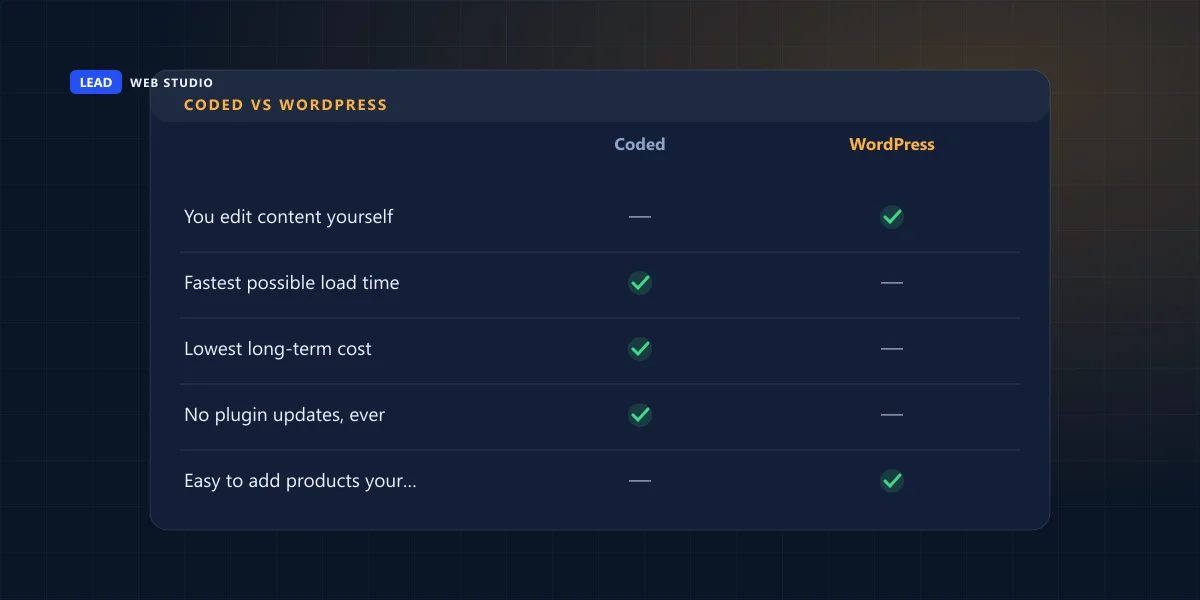
Strip away the SEO debates and the security lectures, and this is the only question that actually predicts whether you'll be happy in a year. If you're a service business that updates its site twice a year — a new testimonial, a phone number change, a seasonal banner — you do not need a login screen sitting there collecting dust and security patches between those two edits. If you're publishing weekly, running a product catalog you update yourself, or managing a team that needs to post without you in the loop, a static coded page becomes a bottleneck fast, and every edit turns into an email to a developer and a wait.
| What matters to you | Custom-coded | WordPress |
|---|---|---|
| You'll edit content yourself | Needs a developer | Built for exactly this |
| Page load speed | Fastest possible | Good, if kept lean |
| Lowest long-term running cost | Flat, predictable | Hosting + licenses + upkeep |
| Security patching required | Effectively none | Core, theme & every plugin |
| Add products/posts without a developer | Not really | Yes, that's the point |
When custom code is the right call
Pick coded when the site is mostly a digital brochure that sells, not a publishing platform. A service business, a contractor, a clinic, a law office, a restaurant — pages that describe what you do and get someone to call or book, updated a handful of times a year by whoever built it. You want the fastest possible load (which matters directly for SEO and for how many visitors bounce on mobile), the lowest ongoing bill, and zero plugin vulnerabilities to lose sleep over. I build coded sites for exactly this reason for most of my own clients, and this very blog post is running on one — no WordPress underneath any of leadlls.com.
When WordPress is the right call
Pick WordPress when the honest plan is "I want to log in and do this myself." That's a real, common, completely legitimate need — a business publishing a blog every week, a shop owner adding new products constantly, a nonprofit with volunteers who need to update event pages without emailing a developer every time. If your business genuinely runs on frequent self-serve content changes, the dashboard isn't overhead, it's the whole point, and fighting that with a coded site just means you become the bottleneck instead of the plugin update screen.
The hidden cost nobody mentions: ongoing plugin maintenance
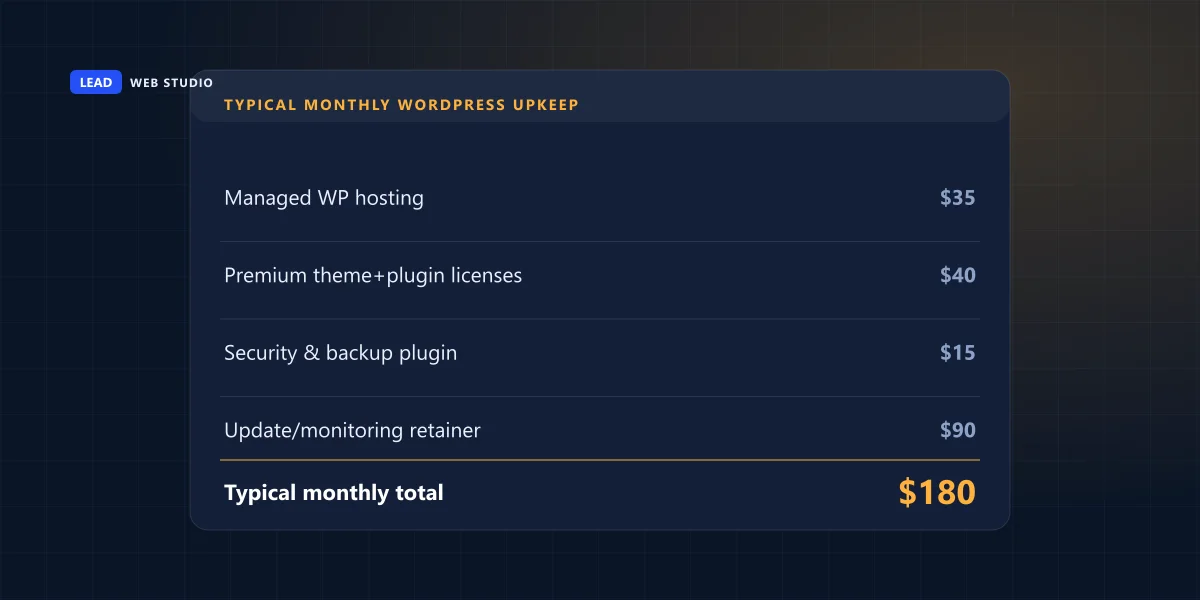
This is the part that never makes it into the sales pitch, because "and then you'll need to keep patching it forever" doesn't close deals. A real WordPress site that does anything beyond a static brochure — forms, a shop, booking, a page builder — typically needs managed hosting built for WordPress, premium licenses for the plugins doing the actual work, a security and backup plugin, and either your own time or a retainer to apply updates without something breaking. Add it up and a modest business site regularly lands around $150-$200 a month in real upkeep, on top of whatever the site cost to build. A coded site under a flat maintenance plan skips almost all of that, because there's no plugin ecosystem underneath it to patch in the first place.
Can I switch later if I pick wrong?
Yes, and this is the part that should take the pressure off. Nothing here is permanent. Moving from WordPress to custom code, or the other way around, is a real project — done properly with a careful migration and 301 redirects so you don't lose the Google rankings you've already earned — but it's absolutely doable at any point once you know more about how you actually use the site. I'd rather you pick the right tool for today and switch once in three years than agonize over a "permanent" decision that was never permanent to begin with.
A quick gut-check before you decide
- Will I personally log in and edit this? If yes, lean WordPress. If "someone else will," lean coded.
- How often does content actually change? A handful of times a year points to coded; weekly or more points to WordPress.
- Do I want the lowest possible monthly bill? Coded almost always wins here once plugin licenses are counted honestly.
- Do I need a specific plugin feature — booking, membership, a big product catalog? WordPress's ecosystem often solves it faster than custom-building the same thing.
- Who's patching security updates in two years? If the honest answer is "nobody," that's a vote for coded, or for budgeting a real maintenance retainer either way.
If you only take one thing from this: decide based on who's clicking "publish" next year, not on which platform sounds more impressive. I've built both for happy clients — the unhappy ones are always the ones who picked the platform that matched someone else's business, not theirs.
Frequently asked questions
Is a custom-coded website better than WordPress?+
Better for what? Coded is faster to load, cheaper to run long-term, and has no plugin vulnerabilities to patch. WordPress is better if you want to log in and edit your own content without calling a developer. Neither wins in a vacuum.
Is WordPress bad for SEO?+
WordPress itself isn't bad for SEO, but a bloated theme loaded with 20 plugins usually is — every plugin adds scripts that slow the page, and speed is a ranking factor. A lean coded site avoids that by never having the bloat.
Can I switch from WordPress to custom code later?+
Yes. It's a rebuild using your existing content, done with 301 redirects so you keep your rankings. See website migration. It costs more than building it right the first time.
How much does WordPress maintenance actually cost?+
Realistically $150-$200 a month once managed hosting, premium plugin licenses, security/backup tools and someone applying updates are all counted. A coded site under a flat maintenance plan usually skips most of that.
Do I need WordPress to have a blog?+
No. A custom-coded site can absolutely have a blog — this article is proof, running on hand-written code, not WordPress. You need WordPress specifically to publish new posts yourself through a login, without asking a developer.
Not sure which one fits your business?
Tell me how you actually plan to use the site and I'll give you a straight answer — coded or WordPress, whichever is honestly right for you. See real numbers on pricing.
Get My Free Quote
120+ sites built across coded and WordPress since 2015 — I recommend whichever one actually fits, not whichever I feel like building that week. Read my full bio · Get in touch