Two languages, one structure
Every English page has a Russian twin under /ru/, a switch in the header moves between them, and hreflang tells Google which one to show. One set of templates builds both, so nothing drifts apart.
An entrepreneur and investor with two YouTube channels had a one-page WordPress site. It became a hand-coded site of six pages in English, each with a Russian twin: his story, a press archive, articles, his videos and a contact form for interview and speaking requests.
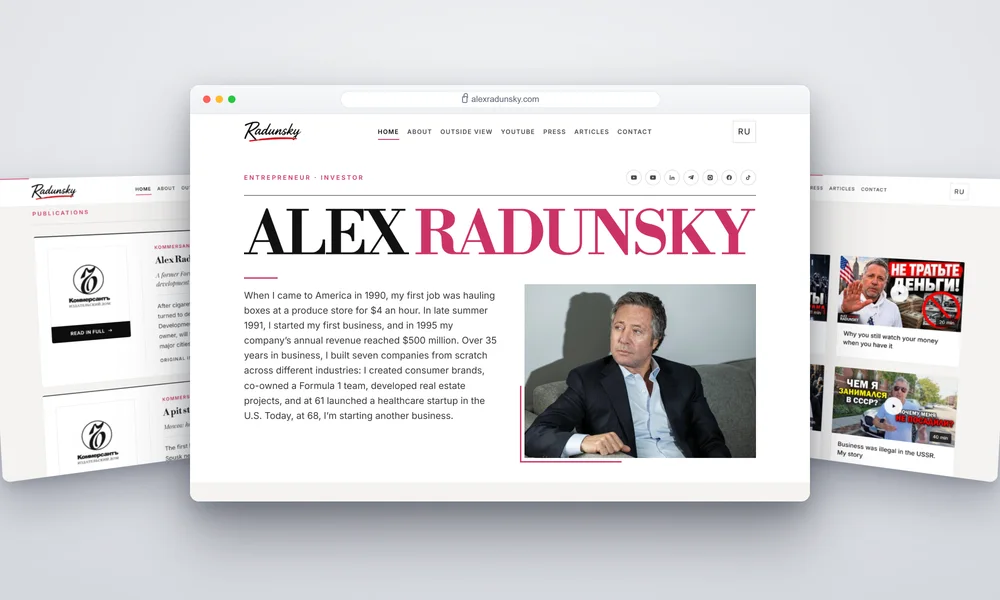
His story was already told, just not in writing. It sat in years of interviews and videos, mostly in Russian: emigrating as a refugee, a first job hauling boxes for $4 an hour, seven companies built from scratch. The old site was a single WordPress page that said almost none of it.
His readers come in two languages. People who watch his channels read Russian; journalists, partners and event organisers read English. A site in one language would have served only half of them, and a Russian speaker spots machine translation in the first line.
A personal website for an entrepreneur and investor who runs two YouTube channels. Six hand-coded pages in English plus a Russian version of each, linked for search with hreflang: home, a biography with key milestones, an outside view, a press room grouped by subject, articles and contact. Person structured data, Google Analytics, and a contact form behind Cloudflare Turnstile. Designed and built by Lead Web Studio, replacing a one-page WordPress site. A build of this scope is $899–$2,999 one-time.
The text was built from his own interviews and videos, not from a questionnaire. A date, a city or a number went on the page only if he had said it himself or a publication had printed it; anything that merely sounded right stayed off. He read every line before launch, and when he changed a word back to his own, that word went on a list the build checks — if a later edit ever alters it again, the site refuses to build.
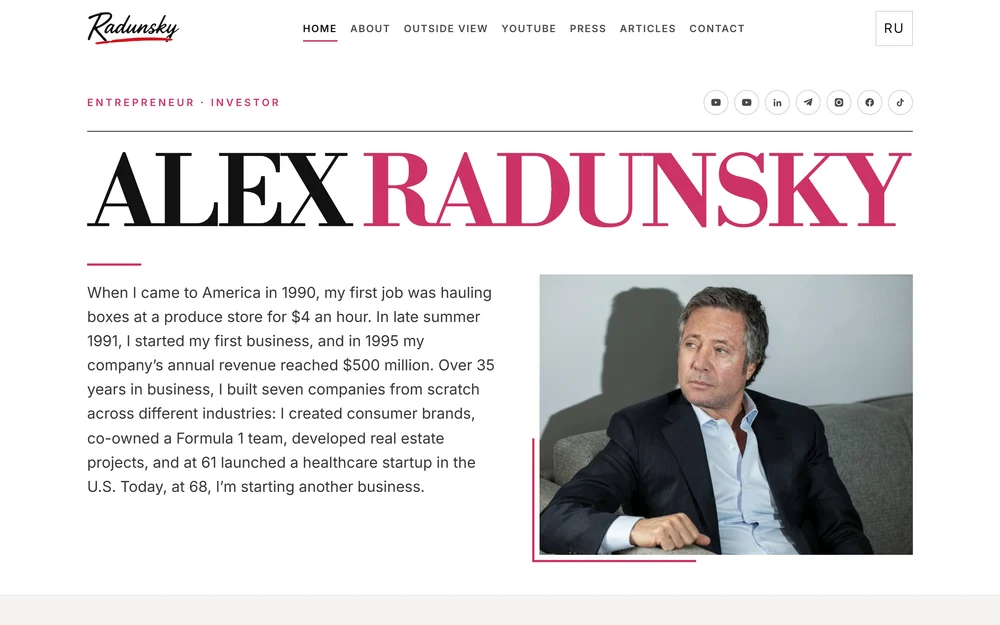
Large serif headlines, one accent colour and plenty of white space, laid out like a magazine profile.
Every English page has a Russian twin under /ru/, a switch in the header moves between them, and hreflang tells Google which one to show. One set of templates builds both, so nothing drifts apart.
The business channel, the Russian-language channel and the interviews he gave elsewhere, each as a row of thumbnails with its running time. He picked every video; nothing is shown that he did not name.
Articles are grouped by subject. Each card names the outlet and the date, summarises the piece, links to the original and says when the original is in Russian.
Instead of a long biography, a timeline of key milestones on the home page and on About — the path from the first job to the latest company.
A contact form written for interview, media and speaking requests, with a call to it at the foot of every page. Cloudflare Turnstile stops the bots before a message is sent.
Structured data tells search engines who the site is about — a Person, with place of birth and the profiles that belong to him — rather than leaving them to guess from the text.
The old WordPress site had articles that other pages on the web pointed to, so switching it off on a whim would have broken those links. Before anything moved, it was backed up in full — 24,629 files and its database — and checked file by file against the original.
The new site meanwhile ran on a hidden address with search indexing switched off, where he could read it, correct it and approve it. The domain moved only after his yes, and indexing was switched on in the same step. If you are replacing a site that already has a history, that order — back up, build in private, switch on approval — is what website migration covers.
A hand-coded build of this scope is $899 to $2,999 one-time, depending on the number of pages and working parts. This one is six pages in English with a full Russian version of each, a press room, a contact form and his video channels on the home page — the full range is on the pricing page.
Yes. Here every English page has a Russian twin under /ru/, a switch in the header moves between them, and hreflang tags tell Google which version to show to which reader. One set of templates builds both, so a design change lands in both languages at once.
Yes. The home page shows his business channel, his Russian-language channel and the interviews he gave to other channels. He chose every video himself; nothing appears on the page that he did not name.
It is written from your own words. Here the story came from his own interviews and videos, and he read every line before launch. When he changed a word back to his own, it went on a list the build checks, so a later edit cannot quietly change it again.
Send me your interviews, press and a few photos — I will show you what the site can be built from. See my website design packages from $899.
I work in English, Russian and Ukrainian, so a second language is written, not machine-translated. More on that on Russian-speaking web designer in Toronto and Ukrainian web designer in Toronto, and the full service on web design.
For a planning session or on-site business photos, I'll come to you. Pick your city: