Most small businesses sign a web design contract after reading exactly one line of it: the price. The lines that decide what happens when a project goes wrong — who owns the code, whose name the domain is in, how either side walks away — get read later, usually on the day the designer stops answering.
I write these contracts for my own clients, and I have read plenty of other people's while cleaning up after them. The useful ones answer ten specific questions before any money moves: who owns what, what the deposit buys, how changes are priced, and how either side walks away.
I am a web designer, not a lawyer. Every legal point below links to the statute it came from, and I use my own published terms as the worked example so you can compare real wording rather than my paraphrase of it.
The short version
- In Canada a designer who is not your employee owns the code they write until a document they sign says otherwise. Paying is not the same as owning.
- The domain goes in your name, in your own account. No clause protects you as well as that does.
- A deposit should buy a stage, not the whole project. Money should move when you can see something.
- "2% per month" is a weak clause unless the yearly rate is written next to it. Otherwise federal law limits what is recoverable to 5% a year.
- Revisions need a definition, not just a number. "Unlimited revisions" usually means unlimited arguments.
- Any ranking guarantee is a red flag. Google says nobody can promise first place.
- Read the exit clause first. It is the one you will actually use if things go wrong.
What should a web design contract include?
At minimum: the exact scope, a payment schedule tied to stages, who owns the finished code and design, whose name the domain and hosting are in, how revisions and changes are handled, a timeline, what happens when a payment is late, a warranty period, a liability limit, and how either side can end the agreement.
That is ten clauses. Here is what each one should say, and the version that should make you put the pen down.
| Clause | What it should say | Red flag |
|---|---|---|
| 1. Scope | Pages, features and integrations, listed | "A modern website for your business" |
| 2. Payment schedule | Amounts tied to stages you can see | Most of the fee before any design exists |
| 3. Ownership | Custom work transfers to you on full payment | Silent on ownership, or "licensed" to you |
| 4. Domain and hosting | Registered in your name and account | "We'll register it for you" with no detail |
| 5. Revisions | What a round is and how many are included | "Unlimited revisions" |
| 6. Change requests | Priced in writing before the work is done | Extra work billed after the fact |
| 7. Timeline | Estimated dates that move if you are late | No dates at all |
| 8. Late payment | Monthly rate and the yearly equivalent | A monthly rate on its own |
| 9. Warranty and liability | A fix period for their bugs, a stated cap | A guaranteed Google ranking |
| 10. Termination | Notice, time to fix, pay for work done, handover | No way out for either side |
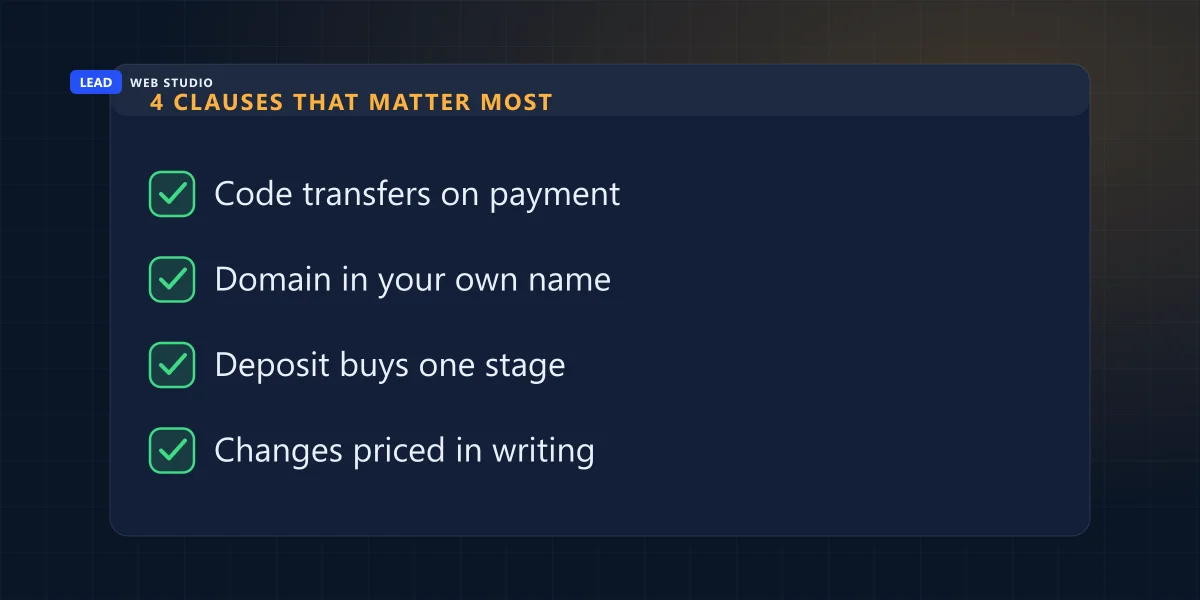
If you only have ten minutes, read clauses 3, 4 and 10. Those three decide whether a bad project costs you money or costs you the website.
Who owns the website after it is built?
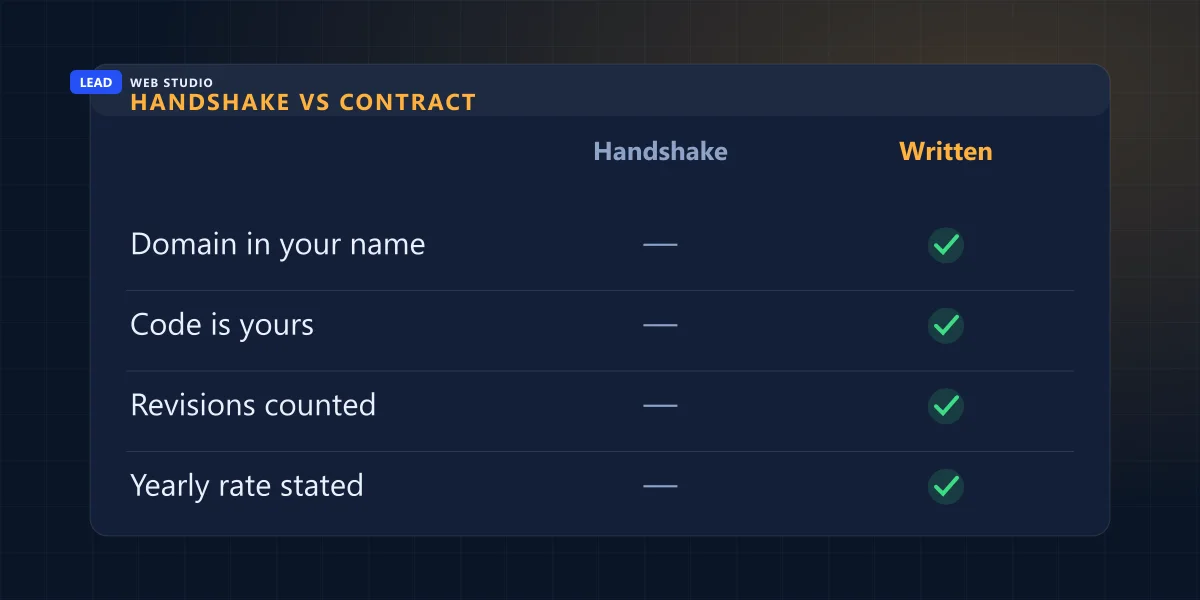
Whoever the contract says, and if it says nothing, probably not you. Under Canada's Copyright Act the author of a work is its first owner, and a designer who is not your employee is the author of what they write. Ownership only moves to you by an assignment in writing, signed by the designer.
The wording is short enough to quote. Subsection 13(1) of the Copyright Act: "the author of a work shall be the first owner of the copyright therein." The exception in 13(3) covers people working for you under a contract of service, meaning employees. An agency or a freelancer is not that. Subsection 13(4) then says no assignment "is valid unless it is in writing signed by the owner of the right".
Most owners assume that paying the invoice settles it. It does not settle it on paper. What a court would make of a paid-for site with no written assignment is a question for a lawyer — and the entire point of the contract is that you never need to ask it.
Two refinements a good ownership clause handles:
- Background code. Every designer reuses their own frameworks and components. It is normal for the designer to keep those and give you a permanent licence to use them inside your site. Mine says exactly that in section 13: the custom design and code transfer to you on payment in full, and the reusable parts come with a perpetual, royalty-free licence.
- Third-party parts. Themes, fonts, plugins and stock photos belong to their makers. The contract should say those licences pass to you where the licence allows it, and who pays for renewals.
One more line from the Act worth knowing: "Moral rights may not be assigned but may be waived in whole or in part." That is the designer's right to be credited and to object to changes that damage their work. For a business website it rarely matters, but if you plan to rework the site heavily later, a waiver costs nothing to ask for.
Whose name should the domain be in?
Yours. Registered in your own account at the registrar, with your own email address as the contact. This is the one clause you can satisfy without trusting anybody, because you do it yourself before the designer touches anything.
Most of the "my designer has disappeared" calls I take come down to this. The site can be rebuilt; Google can be re-verified; a domain held in someone else's account is a negotiation. I wrote up what to do when a designer stops replying, and step one there is finding out who holds the domain, because everything else waits on it.
A fair disclosure about my own terms, since I am telling you to read everyone else's. Section 15 lets me suspend work and withhold access to "accounts we control" when an invoice is unpaid. It is a reasonable clause: nobody should have to keep working against an unpaid invoice. The protection on your side is simply to make sure the accounts that matter most — the domain above all — are not in that category. Then the worst that clause can do is pause the project, not take your website and email offline.
How much deposit is normal for a web design project?
There is no legal figure and no honest industry one. The better question is what the deposit buys. A sound schedule makes money follow visible progress: you pay to start, pay again when you approve something you can see, and pay the balance when the finished site is ready to launch.
Here is the shape I would look for. The stages are an example, not a market rate — the point is that each payment has something on the other side of it.
| Stage | Money moves when | What you should be holding |
|---|---|---|
| Start | The written scope is signed | The scope document and your own domain login |
| Design | You approve the page designs | The designs themselves, not a description of them |
| Build | The site works on a test address | A link you can click through on your phone |
| Launch | The site is live on your domain | Admin access, hosting login, and the files |
If the contract wants almost everything up front, ask one question: "What do I receive before the next payment?" A good designer answers it in a sentence. For what the total should be in the first place, my pricing page lists real numbers, and this breakdown of Toronto website costs explains where the range comes from.
The late-fee clause most small contracts get wrong
If a contract charges interest by the month, it must also state the yearly equivalent, or the recoverable rate drops to five per cent a year. That is section 4 of the federal Interest Act, it covers written and printed contracts other than mortgages on real property, and a monthly-only rate is an easy line to copy without noticing.
The Interest Act says that where interest is payable "per day, week, month, or at any rate or percentage for any period less than a year", no more than five per cent a year is recoverable "unless the contract contains an express statement of the yearly rate or percentage of interest to which the other rate or percentage is equivalent."
| What the contract says | Yearly rate stated? | What section 4 allows |
|---|---|---|
| "1.5% per month" | No | No more than 5% a year |
| "18% per year" | It is already yearly | Section 4 does not apply |
| "1.5% per month, being 19.56% per annum" | Yes | The stated rate |
So "1.5% per month" on its own is a clause that sounds like 18% and may be worth 5%. It is also not quite 18%. Compounded monthly, 1.5% works out to 19.56% a year, which is why my own section 14 reads "1.5% per month, being 19.56% per annum". You are the one paying late fees in this relationship, so this clause works slightly in your favour when it is missing — but it is a quick test of how carefully the rest of the contract was written.
Paying the invoice does not make you the owner. A signature does. Make sure it is on the right piece of paper.
Revisions, changes and silence
"Unlimited revisions" sounds generous and works as an invitation to argue. A useful contract defines a round — one consolidated list of changes, sent once — and says how many are included. Anything that changes the agreed scope is a change request, priced in writing before the work starts.
The clause people skip is deemed approval. Mine treats content as approved when you confirm it in writing or when seven days pass after I send it for review without comments. That sounds harsh until you picture the alternative: a project with no end date because nobody replied. What matters for you is the practical consequence — once you approve a phone number or a price, fixing it later is a support request, not the designer's mistake. Read every page before you say yes to it.
The timeline clause should work the same way in both directions. Mine says that delay in your content or feedback moves my dates by at least the same amount. If a contract holds the designer to fixed dates regardless of how late you are, it invites a dispute the first time your content is late; if it holds you to nothing and them to nothing, you have no timeline at all. For realistic numbers, see how long a website actually takes to build.
Warranty, liability and the ranking promise
A warranty clause should promise to fix defects in the designer's own code for a stated period after launch. A liability clause will cap what you can claim — that is normal and not sinister. A clause promising a Google position is the one to worry about, because Google says nobody can deliver it.
For scale, mine gives ninety days of free fixes for defects in code I wrote, and caps liability at the greater of the fees paid in the previous twelve months or $2,500. Caps are normal in service contracts. What you are checking is that the warranty exists and covers the designer's own work, and that the cap is not a token amount.
On rankings, Google's Search Central documentation is blunt: "No one can guarantee a #1 ranking on Google." A contract that guarantees one was written by someone who either does not know that or is counting on you not knowing it. Pay for defined work — pages built, fixes made, a maintenance plan with a list of tasks — and judge results separately.
What happens if the work stalls?
Whatever the termination clause says, so read it before any other. A fair one lets either side end the agreement after written notice and a fixed period to fix the problem, makes you pay only for work actually performed, and obliges the designer to hand over what you have paid for.
Mine gives fourteen days to remedy a material breach after written notice, and on termination you pay for the work performed up to that date plus third-party costs already committed. The things to check in anyone's version: a real notice period, a real cure period, payment for work performed rather than for the whole project, and a handover list — files, logins, and anything registered on your behalf.
If your designer has already gone quiet and the contract is thin, the order of operations is in that guide. If you have not hired anyone yet, vet the designer before you read their contract. A good contract with a bad designer is still a bad project.
Ten minutes before you sign
- Register the domain yourself if you have not already, in your own account, with your own email.
- Find the ownership clause and check it says the custom work becomes yours, and when.
- Match every payment to a stage you will be able to see with your own eyes.
- Check the scope is a list, not an adjective. Count the pages.
- Find the definition of a revision round and the rule for anything outside scope.
- Read the late-fee line for a yearly rate next to any monthly one.
- Look for a warranty period and delete any sentence promising a ranking.
- Read the termination clause twice: notice, cure period, what you pay, what you get back.
One honest limit. I build websites and write my own terms; I do not practise law. The statute quotes above link to the official text, and my own terms are there to compare against, not to copy. If your project is large, involves software you plan to sell, or the contract you were handed has clauses you do not understand, a short consult with a business lawyer costs less than the dispute it prevents. The same goes for the privacy obligations your new site will carry once it collects its first enquiry.
Frequently asked questions
Who owns my website if there is no written contract?+
In Canada the author of a work is the first owner of its copyright, and a web designer who is not your employee is the author of the code and design they write. Under subsection 13(4) of the Copyright Act, an assignment of that copyright is not valid unless it is in writing and signed by the owner. Without that document you are relying on whatever permission can be read into the deal, which is a question for a lawyer rather than a comfortable place to stand.
How much deposit should a web designer ask for?+
No Canadian law sets a number. The useful test is what the deposit buys: it should cover the work done before your next checkpoint, not the whole project. If a designer wants most of the money before you have seen a single design, ask what you receive at each stage and when the rest becomes payable.
Should the domain be in my name or the designer's?+
Yours, always, in your own registrar account with your own email as the contact. A contract can promise to hand a domain over, but a domain registered in your name does not need a promise. It is the single clause that decides how bad a falling-out can get.
Can a web designer charge interest on a late invoice?+
Yes, if the contract says so, but the wording matters. Section 4 of the federal Interest Act says that when interest is stated per month, or for any period shorter than a year, no more than five per cent a year is recoverable unless the contract also states the equivalent yearly rate. A clause that says only 2% per month is weaker than it looks.
What is a reasonable number of revisions in a web design contract?+
There is no standard number, and the number matters less than the definition. A good contract says what one round of revisions is, how many are included, and that anything beyond them, or any change to the agreed scope, is quoted in writing before the work is done.
Can a web designer guarantee first place on Google?+
No. Google's own Search Central documentation says that no one can guarantee a number one ranking on Google, and warns against anyone who claims to. A contract that promises a ranking is either unenforceable in practice or written by someone who does not know how search works. Pay for defined work, not for a position.
What happens to my money if the designer stops working halfway?+
That depends entirely on the termination clause. A fair one lets either side end the agreement after written notice and a fixed time to fix the problem, requires you to pay only for work actually performed, and requires the designer to hand over the files and accounts you have paid for. If your contract has no such clause, you are negotiating from scratch.
Sources, read on 17 September 2026: Justice Laws — Copyright Act, subsections 13(1), 13(3), 13(4) and 14.1(2) for first ownership, the employment exception, the signed-writing requirement for assignments and the waiver of moral rights; Justice Laws — Interest Act, section 4 for the yearly-rate requirement and the five per cent limit; Google Search Central — Do you need an SEO? for the ranking-guarantee warning. Every clause quoted from my own practice is on my published Terms of Service, version 1.0, effective 21 August 2026.
Want a second pair of eyes on a web design contract?
Send me the one you were handed. I will tell you which of the ten clauses are missing and which ones I would ask about — in plain English, no invoice attached.
Get My Free Quote
10+ years building websites for GTA trades, clinics and service businesses — and writing the contract that goes with each one. Read my full bio · Get in touch