Every client asks me the same question in the first five minutes: "how long will this take?" The honest answer is two numbers, not one. There's how long I take to build the site — 5–7 days for a small-business website. And there's how long it takes to launch it, which also depends on your words and photos, on Google verifying your business, and on a domain registrar somewhere getting round to its inbox. The first number is mine to promise. The second one is shared custody. This guide covers both: the waits nobody can rush, and the ones you can.
The short version
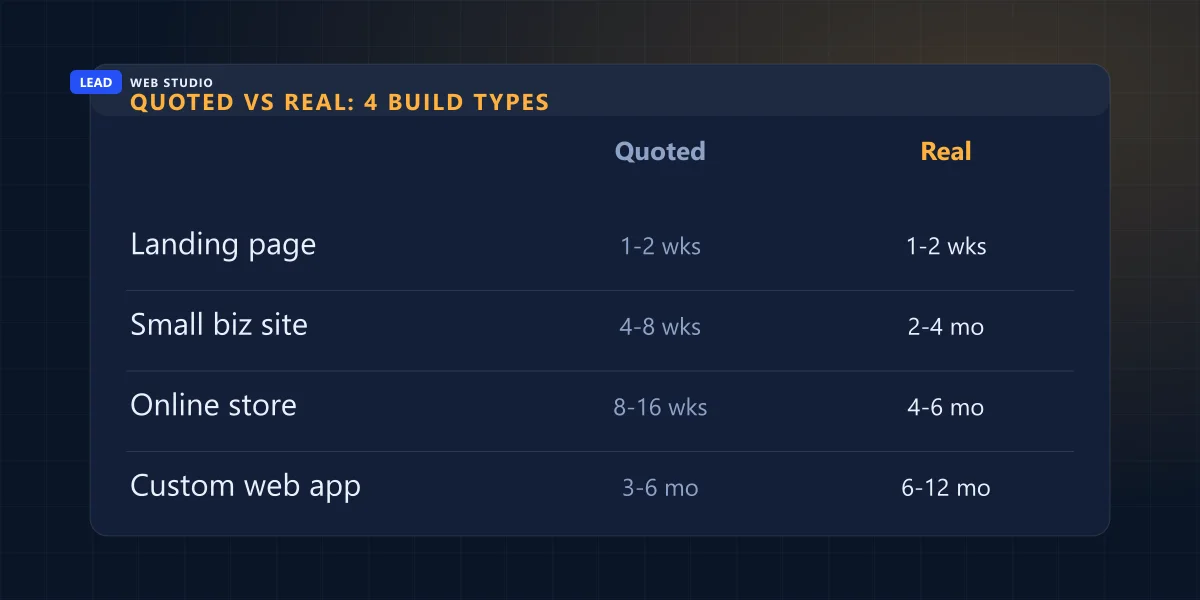
- What professionals quote: Elementor's 2026 timeline guide puts a professional small-business site (5–15 pages) at 4–8 weeks, a simple 1–5 page site at 1–2 weeks and an online store at 8–16 weeks. My own build: 5–7 days for a small-business site, 2–3 days for a landing page.
- The build is rarely the slow part. Content is. The same guide names missing text and images as the number one reason projects stall.
- Some waits have fixed clocks: Google Business Profile verification (up to 5 business days), a domain transfer (up to 5 calendar days), Google crawling a new site (a few days to a few weeks).
- Start those on day one, in parallel with the build, and they cost you nothing. Start them in launch week and they become launch week.
- A 48-hour single page is possible when everything is ready — but no designer can compress Google's clock or a registrar's.
How long does it actually take to build a website?
A professionally built small-business website of 5–15 pages is typically quoted at 4–8 weeks, according to Elementor's 2026 timeline guide; a simple 1–5 page site at 1–2 weeks; an online store at 8–16 weeks. My own build takes 5–7 days for a small-business site and 2–3 days for a landing page, once your content is ready.
Here are those numbers side by side. The first two columns are from Elementor's guide, fetched today; the last column is mine.
| Project type | Professional (Elementor) | DIY (Elementor) | My build |
|---|---|---|---|
| Landing page (1 page) | Not listed | Not listed | 2–3 days |
| Simple site (1–5 pages) | 1–2 weeks | 1–3 days | 5–7 days |
| Small-business site (5–15 pages) | 4–8 weeks | 1–2 weeks | 5–7 days, up to 10 pages |
| Online store (10–100 products) | 8–16 weeks | 3–6 weeks (small store) | Quoted after we scope the catalogue |
Why is my column shorter? Not because I type faster than everyone in Ontario. It's one person with no handoffs between an account manager, a designer and a developer, and a hand-coded site has no plugins to install, update and argue with. I explain what you give up for that speed in custom-coded vs WordPress.
But notice what every number in that table quietly assumes: that your copy, photos and logo are ready on day one. A one-week build does not guarantee a one-week launch, because the build is only one of the clocks running.
What actually controls the timeline? (It's not the code)
Four things decide the launch date, and code is the smallest of them: whether your words, photos and logo are ready; how quickly one person approves the drafts; fixed third-party waits like Google Business Profile verification and domain transfers; and, after launch, how long Google takes to crawl the new site. Only the first two are in your hands.
On the content point I'll let a website-builder company say it, because they have every reason not to. Elementor's guide: "The number one reason projects stall is a lack of prepared content (text and images)," and "Writing, sourcing, and approving content often takes longer than the design and build phases combined." A company that sells the building tool, telling you the building isn't the bottleneck. Rare honesty in this industry; I'll take it.
Writing about your own business is slow for a good reason: it makes you decide what you actually sell, to whom, and why they should pick you over the guy who undercuts you on price. Running the business never forces that question. A homepage does. I keep the full list of what to have ready in what to prepare before your website build.
Which launch steps run on someone else's clock?
Three common launch steps have waits set by someone other than you or your designer: Google Business Profile verification (Google says up to 5 business days), a domain transfer between registrars (up to 5 calendar days before it approves itself), and Google crawling your new pages (a few days to a few weeks). Start them early and in parallel.
| Step | Whose clock | How long | Source |
|---|---|---|---|
| Google Business Profile verification | Up to 5 business days after you finish the verification steps | Google Business Profile Help | |
| Domain transfer (.com and other generic domains) | Your old registrar | Up to 5 calendar days; no reply counts as approval | ICANN Transfer Policy |
| Switching DNS to the new site | Other servers' caches | Up to the old record's TTL | Your own DNS panel |
| Google crawling the new pages | "A few days to a few weeks" | Google Search Central | |
| Your copy, photos and logo | You | Unknown until you start | — |
Google Business Profile verification
Verification does not need the website to be finished. It needs your business details, and then Google reviews them — up to 5 business days, in Google's own words, and occasionally longer. Google also lists cases where verification is instant, such as a business whose website is already verified in Search Console. If you don't have a profile yet, start it in week one of the build, not the week you want to be found. It's the part of Google Business Profile setup that I can't make go faster, so I make it go first.
Domain transfers
Under ICANN's Transfer Policy, the old registrar has 5 calendar days to respond to a transfer, and silence counts as a yes. Two catches. A domain that was registered or transferred recently can be locked against moving at all, so check before you plan around it. And .ca domains follow CIRA's rules, not ICANN's. The good news: a launch rarely needs a transfer. Pointing the domain's DNS at the new site works fine while the domain stays exactly where it is, GoDaddy cart and all.
The DNS switch
Every DNS record has a TTL — the number of seconds other servers are allowed to keep a cached copy. If yours says 86400, that's a full day in which some visitors may still see the old site. Lower it to 300 at least one old TTL before launch (so a day ahead, in that example), and the switch itself takes minutes. It costs nothing and takes one field in your DNS panel, which makes it the cheapest trick in this whole guide.
Google finding the new site
Launch day is not the day customers find you. Google's documentation says crawling can take anywhere from a few days to a few weeks. On sites that already had history, I measured a median of 2 days from publishing a page to its first Google impression across 218 pages — the full numbers are in how long Google takes to index a new page. A brand-new domain has no history, so plan for the slower end of Google's range.
DIY vs freelancer vs agency vs custom-coded — what actually sets the speed of each?
The route matters less than the queue. A DIY builder moves as fast as your free evenings allow, a freelancer as fast as their other clients allow, and an agency as fast as the handoffs between its people allow. None of them can move faster than your content, and none of them can shorten Google's or a registrar's wait.
| Route | What sets the speed | The real trade-off |
|---|---|---|
| DIY builder (Wix, Squarespace) | Your free evenings | You're now doing the labour, forever |
| Freelancer | How many clients are ahead of you | Ask where you are in the queue before you sign |
| Agency | Handoffs between account manager, designer and developer | Real milestones, more meetings |
| Custom-coded (what I build) | One person; 5–7 day build | Faster to launch, less "click to edit" later |
If you want to hunt for the right studio before you start any of this, my guide to choosing a web design agency in Toronto covers what each provider tier costs and delivers.
A one-week build and a one-week launch are two different promises. Only one of them is mine to make.
Can you actually get a website built in 24–48 hours?
Yes, for one page, if every word, photo and logo file is ready and one person approves it. My normal landing page already takes 2–3 days, so a 48-hour page is a tight version of an ordinary job, not a miracle. What no designer can compress is Google verification, a domain transfer or Google's crawl of the new page.
So if you need to be found on a specific date — a trade show, an ad campaign, a grand opening — the order matters more than the speed. The page can be built in two days. Verification and crawling can't. Start those first, then build. If a single focused page is really what the deadline needs, that's what a landing page build is for.
How do you shorten your own website timeline?
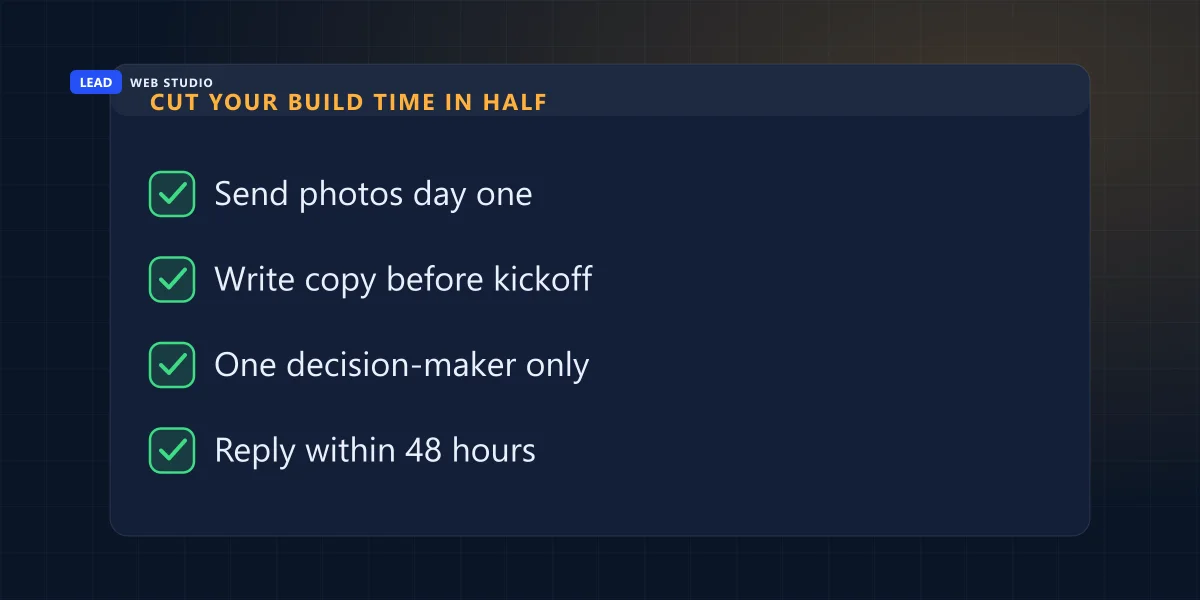
Do the slow things first and in parallel: write your copy and gather your photos before kickoff, start Google Business Profile verification in week one, check whether your domain can move, and lower your DNS TTL a day before launch. Then keep one decision-maker and answer drafts within 48 hours. Momentum dies in the gaps.
- Write your own words before kickoff — rough, ugly notes beat a blank page on day one.
- Put every photo, logo file and login you'll need into one shared folder.
- Start Google Business Profile verification in week one, not launch week.
- Find out who holds the domain login, and whether the domain is locked against transfer.
- Lower the DNS TTL at least a day before the switch.
- Pick ONE person who gives final sign-off — not a committee of four with four opinions.
- Reply to design drafts within 48 hours, not eight days.
- Put the milestones in writing — a web design contract is where both sides agree what "late" means.
If you only do one thing this week: open a blank document and write three honest paragraphs about your business — what you do, who it's for, and why you're better than the guy who undercuts you on price. That file decides more of your launch date than anything I do with code.
Frequently asked questions
How long does it take to build a small-business website?+
Professionals typically quote 4–8 weeks for a 5–15 page small-business site, according to Elementor's 2026 guide. My own build takes 5–7 days for up to 10 pages once your content is ready. The same guide names missing content as the number one reason projects stall, so the launch date depends on it more than on the code.
How long after launch will my website show up on Google?+
Google's own documentation says crawling can take anywhere from a few days to a few weeks. On sites that already had history, I measured a median of 2 days from publishing a new page to its first Google impression. A brand-new domain has no history, so expect the slower end of Google's range.
How long does a domain transfer take?+
For .com and other generic domains, ICANN's Transfer Policy gives the old registrar 5 calendar days to respond, and no response counts as approval. A recently registered or transferred domain can be locked against moving, and .ca domains follow CIRA's rules. A launch rarely needs a transfer: pointing the DNS at the new site is enough.
Can I get a website built in 24–48 hours?+
For a single page, yes, if your text and photos are ready and one person approves it; my normal landing page takes 2–3 days. A 48-hour build cannot shorten Google Business Profile verification, a domain transfer or Google's crawl of the new page, so start those first.
Why is my web designer taking longer than they quoted?+
Usually one of three things: content that hasn't arrived, feedback that takes a week instead of two days, or a third-party wait such as verification or a domain transfer. Ask which one it is. If the answer is none of those, ask for the next milestone date in writing.
Does a WordPress site take longer to build than a custom-coded one?+
A custom-coded site is usually faster to launch because there's no plugin setup or page-builder bloat to fight through. WordPress can still be worth the extra build time if you plan to edit the site yourself afterward through an admin panel.
Want a real timeline for your own project?
Tell me what you actually have ready — content, photos, none of it yet — and I'll give you the honest number, not the brochure one.
Get My Free Quote
10+ years building websites for GTA businesses, and quoting real timelines instead of brochure ones. Read my full bio · Get in touch