Every client asks me the same thing within a week of a site going live: how long until Google indexes a new page? Usually with a slightly panicked edge, because they published on Monday, searched their own headline on Wednesday, found nothing, and decided the website is broken. For years I answered with the industry's favourite non-answer — "a few days to a few weeks, it depends." This month I stopped guessing and went and measured it.
Between 12 July and 5 September 2026 I published 218 pages across four sites I look after: this one, a stucco contractor in Ontario, an art gallery's journal, and a claims-software blog. I know the exact day every single one went live, because the publishing is logged as it happens rather than reconstructed afterwards. So I pulled the daily Search Console history for all 218 URLs and asked one question of each: what is the first day a human being was shown this page?
The median answer is two days. The rest of what I found was considerably less comfortable.
The short version
- Median time to first appearance: 2 days. 70% of pages that ever appeared did it within 3 days, 85% within a week, 99% within 30.
- Indexing is almost never the problem. Of 21 pages here with zero impressions after two weeks, 19 came back "Submitted and indexed", verdict PASS in Google's own inspection.
- 22% of pages older than two weeks have never been shown once. Not broken. Just answering a question nobody types.
- The real wait is the first click: median 22 days, and only 9% of the 218 pages have ever had one.
- Competition decides everything. On the niche contractor site, 46% of pages have been clicked. On my own Toronto web-design site: 3%.
How long does it take Google to index a new page?
Two days, at the median. Of the 218 pages, 159 have appeared in a Google results page at least once. Half of those did it within two days of going live, 85% within a week, and 99% of the ones that ever appeared appeared inside 30 days. The slowest single page took 34 days. If a month has passed and nothing has happened, waiting longer is rarely what fixes it.
Here is the whole distribution, counted cumulatively. Each row includes everything above it.
| Days after publishing | Pages first shown by then | Share of the 159 |
|---|---|---|
| Within 1 day | 55 | 35% |
| Within 3 days | 112 | 70% |
| Within 7 days | 135 | 85% |
| Within 14 days | 148 | 93% |
| Within 30 days | 157 | 99% |
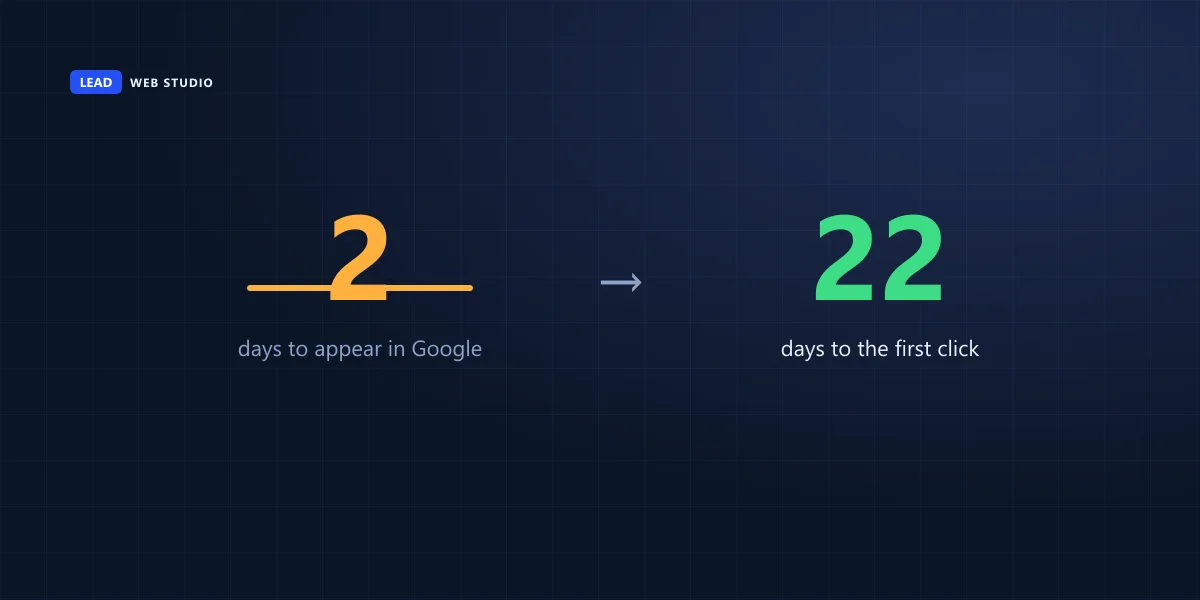
The number I trust most here is not the median itself but the fact that it repeated. Three of the four sites came in at a median of exactly two days and the fourth at three — and these sites have nothing in common. Different countries, different industries, different ages, one of them a brand-new domain. Whatever is going on, it is not a quirk of one website's setup.
One honest caveat about the method. Search Console counts an impression when, in Google's words, "a user has seen (or potentially seen) a link to your site in Search, Discover, or News". So the first impression is the first time the page was actually served to somebody, which is a slightly later and much more useful milestone than "the day Google filed it away". It is also a lower bound: a page can be perfectly indexed and never be served once, which turns out to be the whole story.
Why is my new page indexed but still not showing up?
Because indexing and appearing are different events, and only one of them is under your control. On this site 32 pages have never had a single impression. I ran Google's URL Inspection on the 21 of them that are at least two weeks old — old enough that silence means something. Nineteen came back "Submitted and indexed" with a verdict of PASS. Google has them. Nobody searched them.
| What Google says about the page | Pages | What it actually means |
|---|---|---|
| Submitted and indexed (PASS) | 19 | Indexed and fine. It has never matched a real search. |
| Discovered – currently not indexed | 2 | Google knows the URL exists and has not crawled it yet. |
| Anything genuinely broken | 0 | No blocked pages, no noindex, no crawl errors. |
This is the part I would rather not publish, so let me be specific about it. My guide to Core Web Vitals has been indexed since 18 August, is 49 days old, and has been shown to a human being exactly zero times. The one on building a site that ranks and converts: 45 days, same result. Both are, I think, genuinely good pages. Both answer a question that, in this market, almost nobody types into Google.
The distinction matters because the two diagnoses have opposite fixes. "Not indexed" is a crawling or quality problem — you go and look at robots.txt, canonicals, thin content, internal links. "Indexed and silent" is a demand problem, and no amount of technical work touches it. You wrote a good answer to a question that isn't being asked. That is a research mistake, not an engineering one, and I have made it nineteen times this summer.
Google's definition of the other state is worth having in front of you, because it is quoted wrongly everywhere: "The page was found by Google, but not crawled yet. Typically, Google wanted to crawl the URL but this was expected to overload the site; therefore Google rescheduled the crawl." That is a capacity decision about your server, not a verdict on your writing. Two pages out of 218.
Can you make Google index a page faster?
No, and Google is unusually blunt about it in its own documentation. Three sentences from the page on asking Google to recrawl, which is the closest thing to a speed-up button that exists: "Crawling can take anywhere from a few days to a few weeks." Then: "Requesting a crawl does not guarantee that inclusion in search results will happen instantly or even at all." And finally, for anyone who has been mashing the button: "requesting a recrawl multiple times for the same URL won't get it crawled any faster."
So request it once if it makes you feel better — it is free and it does no harm. Requesting it every morning for a week is a ritual, not a lever. What genuinely moves the needle is duller: the URL being in your sitemap on the day it goes live, and being linked from a page Google already visits often. My 218 pages all had both, which is very likely why the median is two days rather than two weeks. It is also why I stopped submitting URLs by hand entirely — the machinery did the job better than the button.
How long until somebody actually clicks it?
Much longer, and for most pages, never. Nineteen of the 218 pages have ever received a single click — 9%. Where a first click did arrive, the median wait was 22 days after publishing, roughly three weeks after the page first appeared. Across all 218 pages: 5,896 impressions, 52 clicks. A click-through rate of 0.88%.
That number is the honest answer to "when will this page start bringing me customers", and it is nothing like the answer to "when will it be indexed". Indexing is a two-day formality. Being chosen is a different game, played against everyone already on that results page.
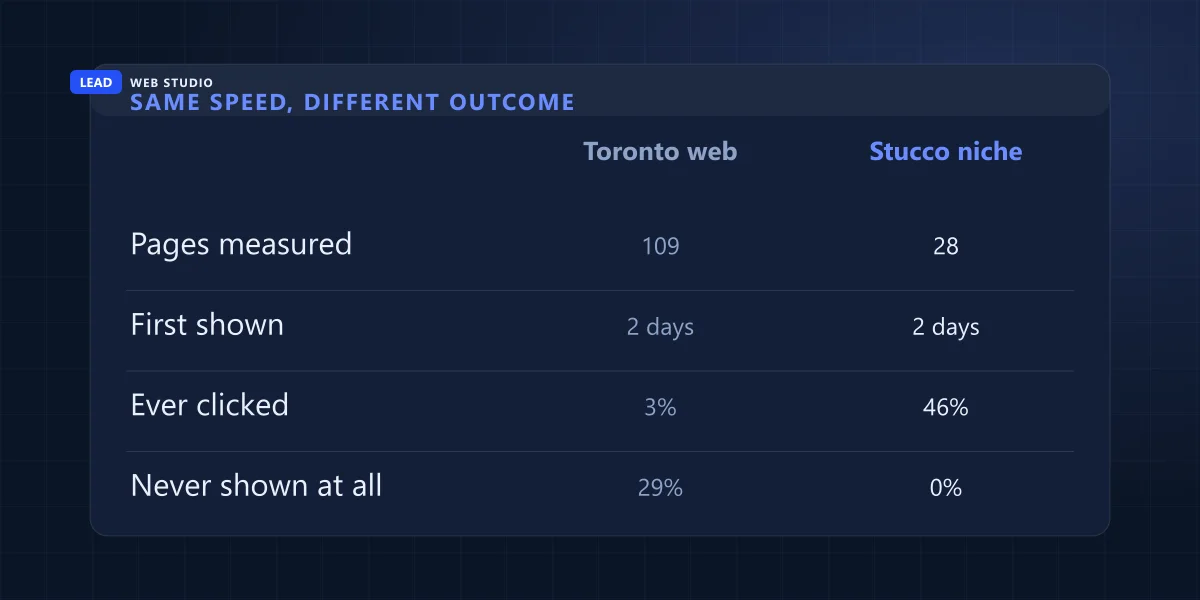
Splitting the four sites apart is where it gets useful, because the speed of appearing is nearly identical everywhere and the outcome is not remotely.
| Site | Pages | Median first appearance | Pages ever clicked | Never shown at all |
|---|---|---|---|---|
| This one — Toronto web design | 109 | 2 days | 3% | 29% |
| Stucco contractor, Ontario | 28 | 2 days | 46% | 0% |
| Art gallery journal | 36 | 2 days | 6% | 42% |
| Claims software blog | 45 | 3 days | 2% | 27% |
Same publishing machine. Same schema, same internal linking, same person writing. Every page on the stucco site has been shown to somebody, and nearly half have been clicked. Every one of those queries has a handful of decent answers and a contractor who wants one. Meanwhile my own web-design pages are competing with every agency in this city on a results page that is mostly ads and a map — which, incidentally, is the entire argument for taking the map pack seriously rather than out-writing thirty competitors.
If you sell something specific in a place, this is very good news. The reason your competitors' blogs look like they're working is rarely that they write better. It is that they picked queries with less traffic and far fewer rivals — which is exactly what the SEO work I do spends most of its time on, well before anybody writes a word.
What actually decides whether a new page gets seen
Five things, in the order they bite. None of them is "wait longer", and only the first two are technical.
| Check | Why it matters | How you know |
|---|---|---|
| In the sitemap the day it publishes | It is how Google learns the URL exists at all | Open /sitemap.xml and search for the slug |
| Linked from a page Google visits | An orphan page waits on the sitemap alone | At least one real in-content link to it |
| Somebody searches this | A zero-demand topic sits indexed and silent forever | Zero impressions at 30 days is your answer |
| You are not the tenth-best answer | Impressions with no clicks means you rank on page 3 | Impressions climbing, clicks flat |
| The title matches the actual search | Being shown and not chosen is a title problem | Search Console queries vs your title tag |
The fourth row is the one people miss. Impressions going up with clicks staying at zero is not "it's still warming up" — it means Google is showing you somewhere nobody reaches. On this site, 96% of the pages that get impressions have never been clicked. That is not a patience problem.
What I do now, in order
The measurement changed my own process, so here is the version I actually follow.
| When | What I check | What I do about it |
|---|---|---|
| Day 0 | Sitemap entry and one internal link exist | Fix before publishing, not after |
| Day 3 | Any impressions at all | Nothing. Half of everything is slower than this |
| Day 14 | Still zero impressions? Run URL Inspection | Indexed = topic problem. Not indexed = crawl problem |
| Day 30 | Impressions but no clicks | Rewrite the title against the real queries |
| Day 60 | Still silent and indexed | Merge it into a stronger page. Do not rewrite it |
And the one thing I stopped doing: refreshing Search Console daily for the first week. The data lags about two days anyway, so what you are staring at on Tuesday is Sunday's silence.
Published a page and heard nothing back?
Send me the URL and I will tell you which of the two problems you have — Google hasn't got it, or Google has it and nobody is searching for it. They look identical from the outside and have completely different fixes. Free, and if the answer is "give it another two weeks", that is what you will get.
Get My Free QuoteFrequently asked questions
How long does it take Google to index a new page?+
Across 218 pages I published between July and September 2026, the median time from publishing to the page first appearing in Google results was two days. Seventy per cent appeared within three days and 85 per cent within a week. Google itself says crawling can take anywhere from a few days to a few weeks.
Why is my page indexed but not showing in search results?+
Because being indexed only means Google has stored the page. It still has to match something a person actually types. I inspected 21 of my own pages that were over two weeks old with zero impressions: 19 came back Submitted and indexed with a PASS verdict. They were not broken, they were answering questions nobody searches.
Does requesting indexing in Search Console make a page appear faster?+
Not reliably, and not more than once. Google states plainly that requesting a crawl does not guarantee that inclusion in search results will happen instantly or even at all, and that requesting a recrawl multiple times for the same URL will not get it crawled any faster. Ask once if you want to. Asking twelve times is a ritual.
How long before a new page brings in traffic?+
Far longer than indexing. Of my 218 pages, 19 have ever been clicked, which is 9 per cent, and where a first click did arrive the median wait was 22 days from publishing. Together those pages collected 5,896 impressions and 52 clicks, a click-through rate of 0.88 per cent.
What does "Discovered - currently not indexed" mean?+
Google defines it as: the page was found by Google, but not crawled yet. Typically Google wanted to crawl the URL but this was expected to overload the site, so the crawl was rescheduled. Only 2 of my 21 silent pages were in this state, so it is much rarer than the internet suggests.
Should I delete pages that never get impressions?+
Not straight away. Give a page 30 days, because 99 per cent of the pages that ever appeared did so inside that window. After that, check Search Console: if it is indexed and silent, the topic has no demand and the fix is a better topic or a merge into a stronger page, not a deletion.
Sources, all read in full on 7 September 2026: Google — Ask Google to recrawl your URLs · Google — Page Indexing report · Google — Search Console performance report metrics. The 218-page dataset is my own: every page my publishing agents put live between 12 July and 5 September 2026 across four sites, matched against their daily Search Console history for 8 January to 5 September 2026, plus a read-only URL Inspection run on 7 September 2026. Two URLs were dropped from the sample because they had impressions predating their log entry, which means they were rebuilds of older pages rather than new ones.

10+ years building websites for GTA trades, clinics and service businesses. I run the publishing for several of them, which is the only reason I know the exact hour 218 pages went live — and why I could finally answer a question I had been fudging for years. Read my full bio · Get in touch