A client called me last month convinced Google had it out for him personally. His site had been live for eight months, he'd shared it on Facebook a dozen times, and Google Analytics showed exactly one visitor a day — him, refreshing Google Analytics. He wanted to know who to call at Google to fix the algorithm. Nobody answers that phone. Twenty minutes into his site's source code, I found the actual reason his website was getting no traffic: one leftover line from when his old developer built the site on a staging server, still quietly telling every search engine on earth "please don't index this." Eight months, zero traffic, one forgotten checkbox. That's the real story behind almost every dead-quiet website I've opened — it's rarely mysterious, it's just never been diagnosed in order.
The short version
- 96.55% of all pages in Ahrefs' index get zero traffic from Google (Ahrefs, 2023) — you're not uniquely cursed, but that's not an excuse to stay in that group.
- The #1 real cause I find isn't bad SEO — it's a page that was never indexed at all, often a leftover noindex tag or a broken robots.txt.
- A brand-new site can legitimately take weeks to months to be fully evaluated — before assuming the worst, run a free website audit.
- Traffic that used to be fine and dropped is a different, more urgent diagnosis than a site that's never had any.
- Sometimes the website is fine and Google Analytics is the thing lying to you — rule that out before touching your SEO.
Why is my website getting no traffic?
Almost always one of six things, checked in this order: the page was never indexed, it's too new to have earned trust yet, it duplicates other pages so Google won't pick it, it targets keywords nobody actually searches, something recently broke a site that used to rank, or your analytics — not your traffic — is the thing that's actually broken.
The uncomfortable stat to start with
Ahrefs pulled roughly 14 billion pages from its index in 2023 and found that 96.55% of them get zero organic traffic from Google. Read that number twice. It should make you feel better and worse at the same time — better, because a quiet website isn't proof you personally did something uniquely wrong; worse, because "everyone's like this" isn't a strategy, it's just the default outcome of publishing a page and walking away. The businesses that land in the other 3.45% aren't lucky. They worked through a list like this one until they found their actual reason and fixed it.
Step 1: Is your site actually indexed?
Search site:yourdomain.com in Google right now. If nothing comes up — or only a handful of pages show when you have dozens — your site isn't indexed, and no amount of content or SEO work matters until that's fixed. For the exact reason, open Google Search Console, go to Page Indexing, and read the status next to each URL. Google's own documentation lists five recurring reasons a page sits unindexed, and I check every one of them before I look at anything else:
| What Search Console says | What it actually means | The fix |
|---|---|---|
| Crawled — currently not indexed | Google looked at the page and chose not to include it, usually for being thin or low-value | Add real, unique substance — don't just resubmit |
| Discovered — currently not indexed | Google knows the URL exists but hasn't crawled it yet | Usually a new or low-authority site; add internal links and be patient |
| Duplicate, no user canonical | Two or more pages look alike; Google picked one and skipped the rest | Set explicit canonical tags and differentiate the content |
| noindex detected | A meta tag or HTTP header is telling Google to skip the page | Remove it — check for leftover staging/dev code first |
| Blocked by robots.txt | Your own robots.txt file is turning crawlers away | Edit robots.txt to allow the page |
Source: Google's own Page Indexing report documentation. Notice that three of the five reasons are things you (or a past developer) did to your own site, not something Google did to you.
The 10-minute self-check before you touch anything else
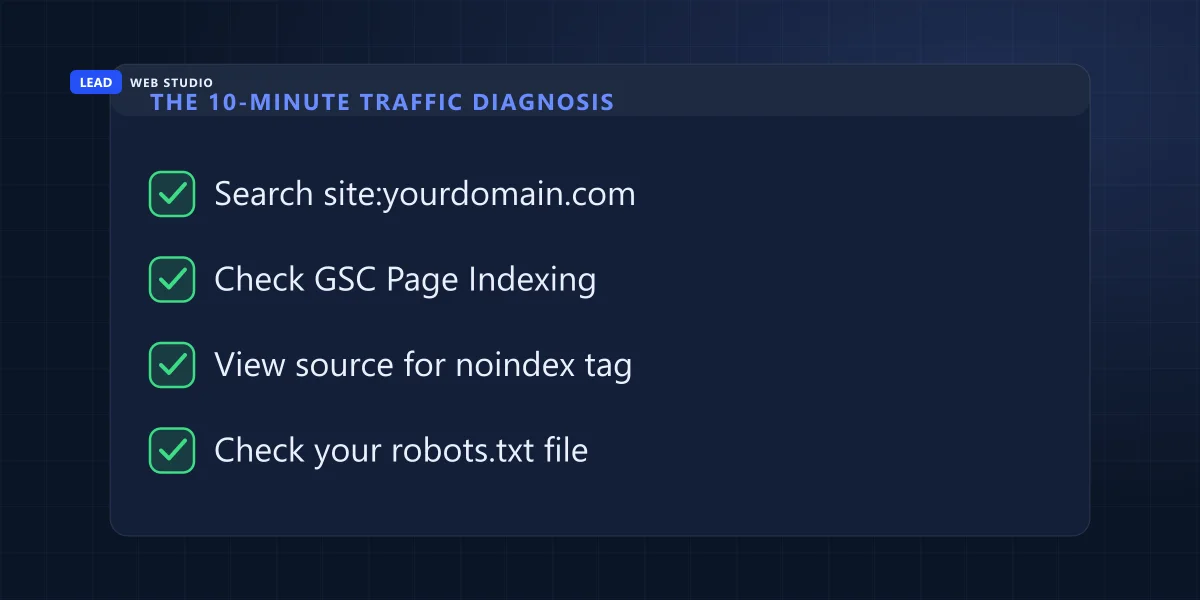
Before you rewrite a single page or panic-buy an SEO package, run this — it takes less time than the phone call my client made:
- Search
site:yourdomain.comin Google and count what shows up against what you actually have. - Open Google Search Console → Page Indexing and read the status for your homepage and top pages.
- Right-click your homepage → View Page Source → search for the word "noindex". It should not be there.
- Visit
yourdomain.com/robots.txtdirectly and make sure it isn't disallowing the pages you want found.
Nobody's website has a "Google problem." It has an indexing problem, a trust problem, a content problem, a keyword problem, a recent-break problem, or a measurement problem — and it's always exactly one of those five, not a mystery.
The quick self-diagnosis
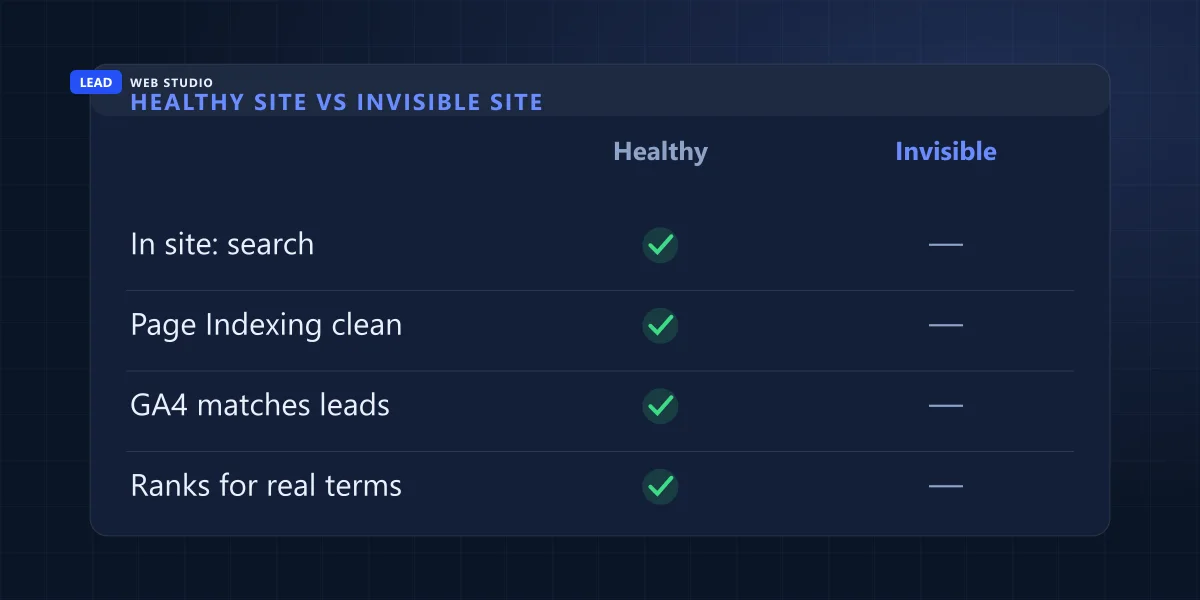
Before the deeper causes below, here's the fast version — tick these off and you already know roughly where your problem lives:
| Check | Healthy site | Invisible site |
|---|---|---|
| site: search shows your pages | Yes | No |
| Search Console Page Indexing is clean | Yes | No |
| Analytics roughly matches real calls/leads | Yes | No |
| You rank for terms people actually type | Yes | No |
Step 2: Is it just too new to have earned trust yet?
Google has never confirmed a formal "new site penalty," but it is upfront that a brand-new domain starts with zero history — no backlinks, no click data, no track record with real users — and building that record takes real time. In my own experience, a new page usually settles into the index within a couple of weeks; a whole new domain earning meaningful organic rankings is more realistically a matter of months, not days. If your site is under three months old and otherwise passes Step 1, the honest answer is "keep doing the work and give it time," not "something is broken."
Step 3: Are you invisible because every page looks the same?
This is the quiet killer for template-heavy sites — a page for every city, every product, every service, each one built from the same skeleton with a few words swapped. To a reader that looks organized. To Google it can look like the same page published forty times, and per the table above, duplicate content without a clear canonical is one of the top reasons pages sit unindexed. The fix isn't fewer pages — it's making each one genuinely earn its own existence: a real difference in the content, not just the place-name in the heading. If that's the shape of your site, it's worth reading how local SEO actually differentiates location pages instead of cloning them.
Step 4: Are you ranking fine — for a keyword nobody searches?
This one feels like winning while producing exactly zero clicks. A business ranks #1 for a phrase that perfectly describes what they do in their own words — and nobody on earth searches it that way. The reverse is just as common: you rank badly for the phrasing people do use, which is why it pays to check who is beating you on each individual search rather than on your industry as a whole.
| What the business assumes people search | What people actually type |
|---|---|
| "Artisanal small-batch hand-poured soy candles" | "candle shop near me" |
| "22 years of master electrical craftsmanship" | "emergency electrician toronto" |
| Their own business name, assumed to already be known | "[service] + [city]" |
Nobody searches in brochure language. If your content only uses the words you'd use to describe yourself at a networking event, you can rank perfectly and still get zero real traffic, because you never wrote down the words your actual customer types into the search bar.
Step 5: Did your traffic used to be fine, and then it wasn't?
This is a different diagnosis than a site that's never had traffic, and it deserves urgency. Check, in order: did you recently redesign or migrate domains (I cover the real SEO risk of that in when a redesign is worth it); does Search Console's Manual Actions report show anything; and does the drop line up with a confirmed update on Google's own Search Status Dashboard. A sudden cliff has a specific trigger — it's rarely "SEO just stopped working."
Step 6: Is your traffic real, but your analytics is lying to you?
Before you conclude the website has a marketing problem, rule out a measurement problem. A cookie-consent banner that blocks your tracking tag until a visitor clicks accept, an ad blocker, a misfired event, or an accidentally narrow filter can all make Google Analytics report near-zero while real people are actually landing on your site and calling you. Cross-check against Search Console's Performance report — it counts impressions and clicks independently of whatever's happening in your GA4 setup — and against your own contact-form log or call history. If the phone is ringing but the dashboard says zero, you don't have a traffic problem; you have a broken dashboard.
If you only do one thing this week: search site:yourdomain.com and open Search Console's Page Indexing report. That's the cause behind the majority of "no traffic" websites I've ever diagnosed, and it costs nothing to check. Want the whole site checked properly? Run the free website audit — it covers indexing, speed and the other on-page basics in about 60 seconds.
Frequently asked questions
Why does my website get zero traffic even though it's live and I've shared it?+
Sharing a link on social media doesn't make Google index it. The most common cause of persistent zero traffic is a page that was never indexed at all — often a leftover noindex tag from development, or a robots.txt file blocking crawlers. Check Search Console's Page Indexing report before assuming an SEO problem.
How do I check if Google has actually indexed my website?+
Search site:yourdomain.com in Google. If nothing shows up, or far fewer pages than you actually have, your site isn't fully indexed. For the exact reason, open Google Search Console, go to Page Indexing, and read the specific status Google gives for each URL.
How long does it take for a new website to start getting organic traffic?+
Google has never confirmed a formal waiting period, but a brand-new domain has no history — no backlinks, no click data, no track record — and building that takes real time. In practice, expect weeks before new pages settle into the index and months before organic rankings meaningfully compound.
Why did my website's traffic suddenly drop to zero?+
A sudden drop is a different diagnosis than traffic that was never there. Check for a recent redesign or domain migration, a manual action in Search Console, or timing against a known Google algorithm update on Google's Search Status Dashboard, in that order.
Can Google Analytics show 0 visitors when people are actually visiting?+
Yes. A cookie-consent banner blocking the tag before consent, an ad blocker, a misconfigured event, or an accidental filter can all make GA4 undercount real visits. Cross-check against Search Console's Performance report or your own contact-form log before concluding traffic is really zero.
Want someone to actually diagnose it for you?
I'll check indexing, speed, keywords and analytics on your real site — not a generic checklist — and tell you exactly which of these six it is. Free to start.
Get My Free Diagnosis
10+ years diagnosing why GTA business websites don't show up on Google — and fixing it. Read my full bio · Get in touch