I've got two kinds of clients who both call me convinced their website is broken, for opposite reasons. The first one ranks #1 for "plumber in Vaughan" and swears the site "isn't working" — meanwhile the phone never rings, because the page is a wall of keyword-stuffed paragraphs with the contact info buried three taps deep in a hamburger menu. The second one has a gorgeous single-page site, bold buttons, a slick hero video — and it's never converted a single visitor because it also never shows up on Google, since every word is baked into a background image with nothing for a crawler to read. Both of them think their website "doesn't work." Neither one is wrong. They both built exactly half a website.
The short version
- Ranking and converting are two separate jobs. Most small-business sites are quietly optimized for only one of them.
- The math is brutal. The average landing page converts around 2.35% of visitors — the top 10% convert at 11.45%, roughly five times more calls from the exact same traffic.
- An 8-point audit catches almost every site that's leaking on one side or the other.
- If you can only fix one thing, fix whichever side is currently at zero — a perfect conversion rate on no traffic still books nothing, and a page-one ranking with no CTA is just an expensive parade of visitors who leave.
What does a website that "ranks and converts" actually mean?
It means two separate systems doing their own job on the same page: the SEO layer that gets your business found in a Google search, and the conversion layer that turns that visitor into a phone call or a booked job. A site can nail one and still lose money failing the other — you need both running at the same time, not one propping up for the other.
Most of the small-business sites I audit are built by people who only think in one of those two languages. Someone who thinks in SEO stuffs the page with keyword-heavy paragraphs and calls it done. Someone who thinks in design builds a beautiful, image-heavy page and never asks whether Google can even read it. Neither one asked the other question.
The two ways small-business sites waste money
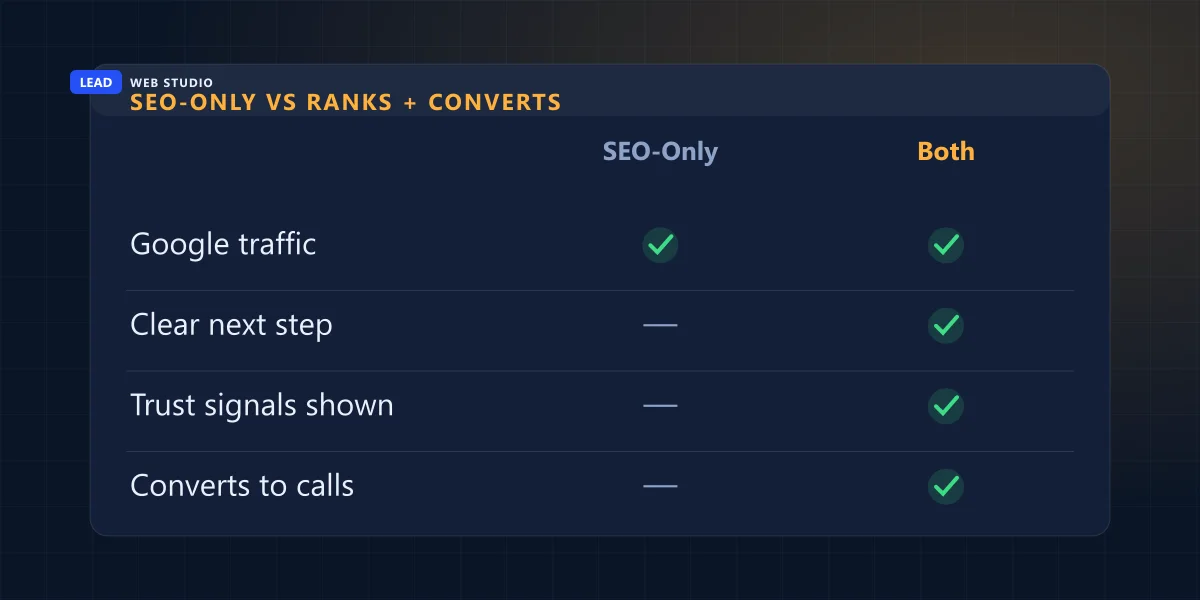
I see the same two failure patterns on almost every audit, and a healthy site avoids both at once.
| What you'd see | Ranks, doesn't convert | Converts, doesn't rank |
|---|---|---|
| Google traffic | Steady, sometimes strong | Almost none — invisible to search |
| Phone calls booked | Rare, despite the traffic | Rare, because nobody arrives |
| Typical symptom | CTA buried, no click-to-call, wall of text | Text baked into images, one page, no headings |
| What's actually missing | A conversion layer | An SEO layer |
The real numbers: why "more traffic" isn't the same as "more customers"
According to WordStream's analysis of Google Ads accounts representing a combined $3 billion in annual spend, the average landing page converts around 2.35% of visitors. The top 25% convert at 5.31% or higher. The top 10% hit 11.45% or higher — roughly five times the average, from the exact same amount of traffic.
Run that math on a real number. Say your SEO work earns you 1,000 visits a month to a service page — a genuinely good result for a local business. At the average 2.35% conversion rate, that's about 23 leads. At the top-10% rate of 11.45%, the identical 1,000 visits produces about 114 leads. You didn't spend a dollar more on ads or ranking. The only thing that changed is whether the page itself does its job once someone lands on it.
Ranking gets people to your door. Converting is whether they actually walk in.
The 8-point audit I run on every site
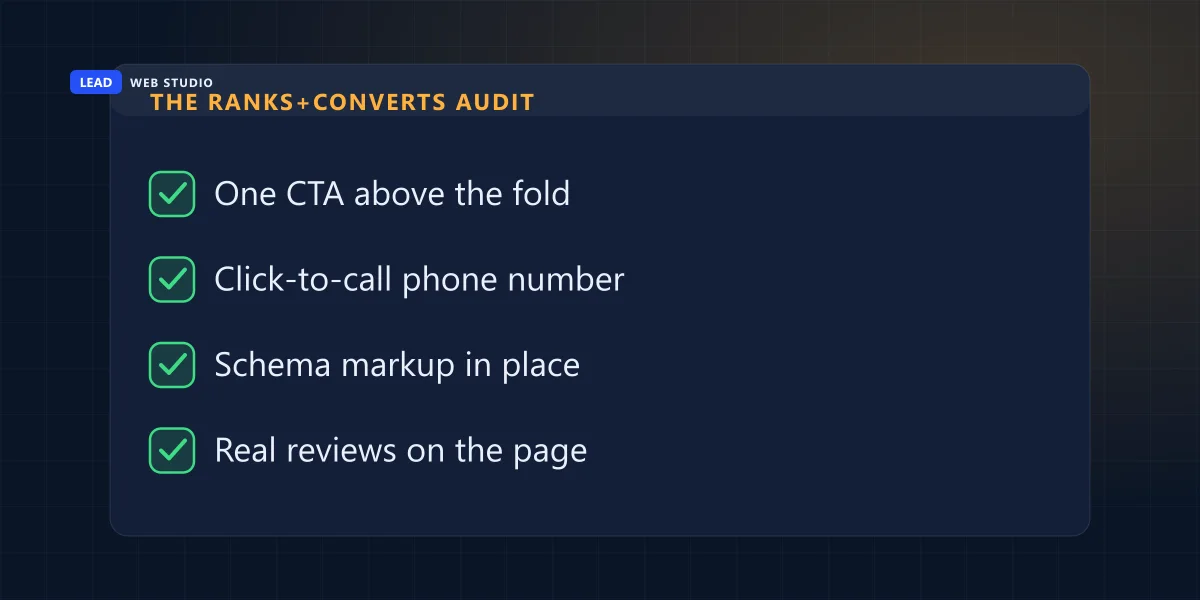
This is the same checklist I go through on every new client audit — half of it is SEO, half is conversion, and a site that's only strong on one side always shows up clearly.
- One clear call-to-action visible above the fold, not buried in a menu.
- Your phone number is a real
tel:link, not styled text. - Schema markup describes your business, not just a generic template.
- Real reviews or trust signals are visible on the page, not just linked off-site.
- Every important page has a unique H1 with an actual keyword in it.
- The contact form has 5 fields or fewer — every extra field costs you leads.
- The page loads fast enough that nobody bounces before it renders (see my Core Web Vitals guide for the exact thresholds).
- Content exists as real, crawlable text — not text baked into a background image.
If you can only fix one thing first, fix this
Look at your Google Search Console or your analytics before you touch anything. If your organic traffic is close to zero, your SEO layer is the problem — fix that first, because a perfect conversion rate has nothing to convert. If you already get visitors and the phone still doesn't ring, your conversion layer is leaking, and that's almost always the cheaper, faster repair: a click-to-call link, a shorter form, a CTA moved above the fold. I've fixed that second kind of leak in an afternoon more times than I can count.
If you're not sure which bucket you're in, that's exactly what a SEO audit paired with a web design review is for — you want someone checking both halves, not just the half they happen to sell.
| Your situation | Fix | Rough cost |
|---|---|---|
| Near-zero organic traffic | SEO foundation: titles, schema, content depth | $400–$1,200 |
| Traffic exists, phone rarely rings | CTA, forms, click-to-call, trust signals | $150–$500 (quick job) |
| Both are weak | Full rebuild on a mobile-first, schema-ready foundation | $900+ (see redesign guide) |
If the honest answer is "both are weak," that's a bigger conversation — I laid out the full decision framework in when a redesign is actually worth it versus when it's a waste of money, and whether coded or WordPress is the better foundation for the rebuild.
If you only do one thing this week: pull up your own site on your phone, on real data, and time how long it takes you to find your phone number. If it's more than 3 seconds, that's a conversion leak costing you calls right now — independent of how well you rank.
Frequently asked questions
What's the difference between an SEO-focused website and a conversion-focused website?+
An SEO-focused site is built so Google can find and understand it — real text, headings, schema, fast load times. A conversion-focused site is built so a visitor takes action once they arrive — clear CTAs, click-to-call, short forms, visible trust signals. A site that only does one job leaves money on the table.
What is a good conversion rate for a small-business website?+
Across industries the average landing page converts around 2.35% of visitors, according to WordStream's analysis of Google Ads accounts. The top 25% convert at 5.31% or higher, and the top 10% hit 11.45% or higher — roughly five times the average from the same traffic.
Should I fix my SEO or my conversion rate first?+
If your site gets close to zero organic visitors, fix the SEO layer first — a perfect conversion rate on no traffic still books nothing. If you already get visitors but the phone rarely rings, your conversion layer is the leak, and that's usually the cheaper, faster fix.
Can a website rank well on Google and still lose money?+
Yes, and I see it constantly. Ranking #1 puts visitors on the page — it says nothing about whether they can find your phone number, trust you, or figure out what to do next. Traffic without a conversion path is just an expensive parade of visitors who leave.
Want the 8-point audit run on your own site?
I'll check both halves — the SEO layer and the conversion layer — and hand you the honest list of what's actually costing you calls. Free, no pressure.
Get My Free Quote
10+ years building websites for GTA businesses that do both jobs at once — found on Google, and built to turn that visitor into a booked job. Read my full bio · Get in touch