There is one piece of SEO advice that costs nothing, sounds sensible, and gets handed out for every problem a website has: add more internal links. Page not indexed? Add links. Page stuck on page three? Add links. My own rulebook says to do exactly that, in those words, and I am the one who wrote the rulebook.
So I counted them. Every internal link on leadlls.com — 356 pages, every <a href> on every one of them — sorted by whether the link sits inside a sentence, inside a card or button, or inside the menu that repeats on every page. Then I put that count next to six months of Search Console data and asked what each link had bought.
The first table looked like a clean win for internal linking. The second one took it away. And there is one page on my site with eight internal links written into eight different sentences on eight different pages that Google has never once bothered to fetch.
The short version
- 24,250 internal links on 356 pages. 16,603 of them are the same menu and footer, repeated.
- Pages with 13+ in-sentence inbound links were shown by Google 96% of the time; pages with none, 69%. That gradient is real, and it does not show what it looks like.
- 83 of my pages earned zero impressions in six months. 71 of them already had an internal link pointing at them.
- One page, eight links, in the sitemap, in the feed, indexable: "Discovered — currently not indexed", last crawled: never. Siblings published the same week with two links each were crawled in two days.
- Google's own definition of that status is about crawl scheduling, not about links. The standard fix is aimed at the wrong thing.
Do internal links help SEO?
They do a specific, narrow job: they give Google a route to a page and a piece of text describing it. That is worth having, and one link does it. What they do not do is create demand: across 356 of my own pages I cannot find a single case where adding another link moved a page that was already reachable from somewhere.
Everything below is my own measurement of one site — leadlls.com, 356 published pages — against Search Console data for 14 March to 10 September 2026, pulled read-only on 13 September 2026. The link graph was built from the files on disk the same day. Where I quote Google, I link the exact page.
What I actually counted, and why the zones matter
Most advice about internal links treats them as one thing. They are not. A link in your footer appears on every page of the site, so every page that has one has exactly the same number. A link inside a paragraph appears once. Counting them together produces a number that cannot mean anything, so I split every link into three zones before counting.
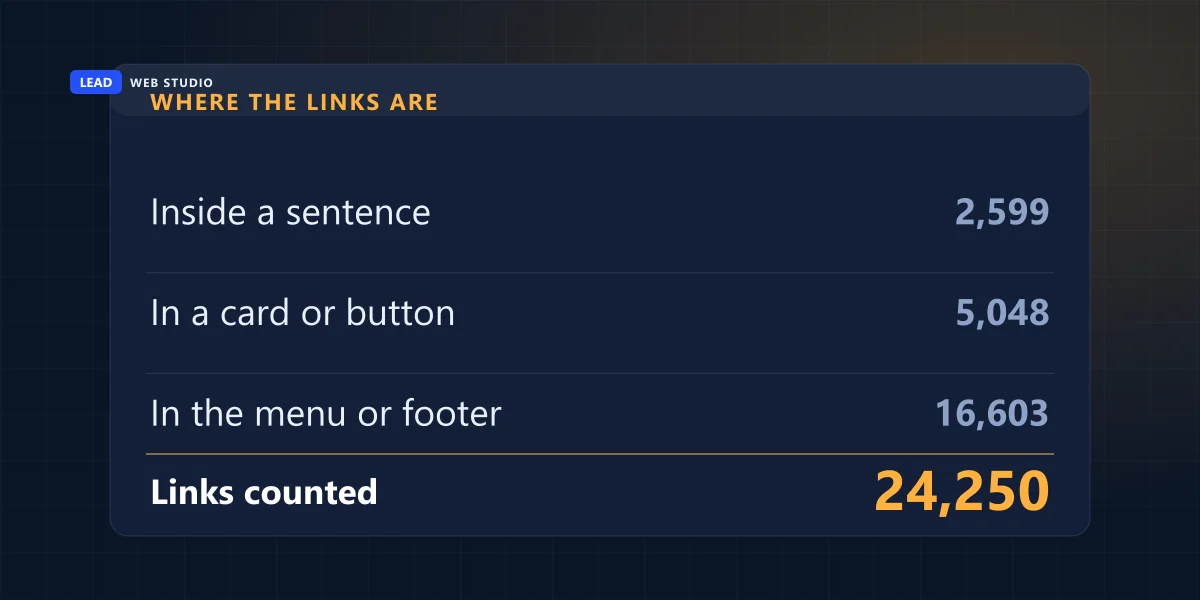
| Where the link sits | Links | Share | Can it vary between pages? |
|---|---|---|---|
| Inside a sentence or list item | 2,599 | 10.7% | Yes — this is the one you control |
| Inside a card, tile or button | 5,048 | 20.8% | Partly — it comes with the template |
| In the header menu or the footer | 16,603 | 68.5% | No — same menu, 356 times |
| Total internal links on the site | 24,250 | 100% | — |
Two thirds of the internal links on my website are one menu, copied onto every page. Forty-seven pages sit in that menu or the footer and collect between 343 and 355 inbound links each; the other 309 get none from it. Nobody can turn that into a dial. A page is in the menu or it is not, and that was decided the day the menu was designed. Any honest question about internal linking has to be asked of the 2,599 links that live inside sentences.
The table that looks like proof
Here is every one of the 356 pages, grouped by how many in-sentence internal links point at it, against whether Google showed the page to anybody at all in six months. The pattern is exactly what the advice predicts, and it is steep.
| In-sentence inbound links | Pages | Shown by Google at all | Median impressions in 180 days |
|---|---|---|---|
| None | 39 | 69% | 3 |
| 1 | 51 | 71% | 3 |
| 2–3 | 120 | 75% | 5 |
| 4–6 | 79 | 80% | 6 |
| 7–12 | 43 | 79% | 8 |
| 13 or more | 24 | 96% | 104 |
Ninety-six per cent versus sixty-nine. A median of 104 impressions versus 3. If I wanted to sell internal linking as a service, I would put that table on a slide and stop talking.
Why that table cannot mean what it looks like
Because I know which pages are at the top of it. The most-linked page on my site is the pricing page, with 301 inbound links written into sentences. Then contact at 279 and about at 207. Those pages are not doing well because I linked to them. I linked to them 301 times because they are the pages I want every reader to reach.
The links did not make those pages important. The pages being important is why they have the links.
To see whether the pattern survives with the page type held still, I looked at the one cohort where everything else really is the same: my 86 city service pages. Same four templates, same 21 cities, all built by the same script. The gradient survives — and so does the problem.
| In-sentence inbound links | City pages | Median impressions in 180 days |
|---|---|---|
| None | 9 | 6 |
| 1 | 12 | 7 |
| 2–3 | 34 | 27 |
| 4–6 | 19 | 42 |
| 7–12 | 8 | 89 |
| 13 or more | 4 | 1,259 |
Two hundred times the impressions at the top of that table. Now look at which four pages are in the top row: Toronto web design, Toronto SEO, Toronto Google Maps and Vaughan web design. Toronto pages have the most internal links because every other city page mentions Toronto, and Toronto has the most people searching. The same fact sits on both sides of the comparison, so the comparison cannot separate them. If somebody shows you a chart like this about your own site, that is the question to ask about it.
What survives: 86% of my invisible pages already have links
Eighty-three of my 356 pages earned zero impressions in six months — Google never showed them to a single person. If too few internal links were the reason, those pages would be the ones with no links. They are not. Seventy-one of the 83 already have at least one link written into a sentence on another page, and the median silent page has three.
| Measure | Pages Google never showed | Pages Google showed |
|---|---|---|
| How many | 83 | 273 |
| Have an in-sentence inbound link | 71 (86%) | 246 (90%) |
| Median in-sentence inbound links | 3 | 3 |
| Most links on one silent page | 15 | — |
It runs the other way too. Thirty-nine of my pages have no in-sentence inbound link at all, and Google showed 27 of them anyway — it found them through the sitemap, the menu and the article grid, which is exactly what it says it does. A page with fifteen links and no traffic and a page with none and some traffic are both in my data, and neither is rare.
The one page where I changed only the links
A cross-section cannot prove cause, so here is the one case on my site where the links are the only thing that changed. On 26 August my weekly planner queued /email-not-delivered/, published six days earlier, because Search Console had it as "Discovered — currently not indexed". It had two inbound links at that point, both of them card links in a grid, and nothing written into a sentence anywhere. My rulebook calls that status a linking problem, so I added four links from four existing pages about email, each one inside a sentence that already made the point. Nothing on the page itself was touched, then or since.
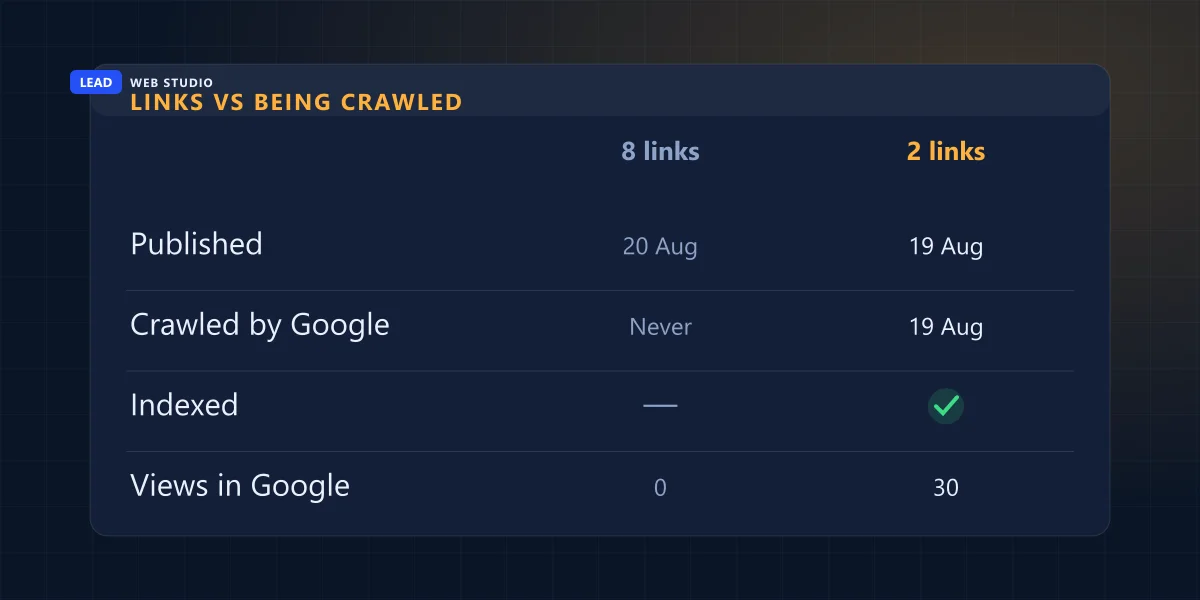
Later posts in the same cluster added four more of their own. It now carries eight in-sentence inbound links from eight different pages, plus four card links, plus a sitemap entry, plus a place in the RSS feed. It returns HTTP 200, it is index, follow, it canonicals to itself and robots.txt allows it. Twenty-four days after publication, this is what Search Console says about it — next to the pages published in the same week.
| Page | Published | In-sentence links | Google's status | Last crawled |
|---|---|---|---|---|
| Email not delivered | 20 Aug | 8 | Discovered — not indexed | Never |
| Designer stopped replying | 19 Aug | 2 | Submitted and indexed | 19 Aug |
| Employee access checklist | 18 Aug | 2 | Submitted and indexed | 19 Aug |
| How to read DMARC reports | 21 Aug | 2 | Submitted and indexed | 22 Aug |
| Website image copyright | 22 Aug | 2 | Submitted and indexed | 22 Aug |
| Fitness studios, Aurora | 20 Aug | 2 | Submitted and indexed | 21 Aug |
Four of the eight pages carrying that link have themselves been re-crawled since the link went up — on 27 August, 4 September, 6 September and 11 September. All eight are indexed. Google has re-read four separate pages carrying that link and has still not gone and fetched the page it points to. Meanwhile the site as a whole went from 794 impressions a day before that date to 1,254 after, so nothing was broken sitewide.
I inspected 23 pages in all while writing this. Twenty-two came back "Submitted and indexed". The one that did not has eight in-sentence inbound links. Three pages in that group have more links than it and three have exactly the same number, and all six of those are indexed.
An honest note about the instrument. I ran URL Inspection on that page twice, ten minutes apart. The first call said "URL is unknown to Google"; the second said "Discovered — currently not indexed". Same URL, same property. The part that did not move is the part the article rests on: last crawled, never. If you inspect a URL once and build a plan on the wording, run it again.
What Google actually says an internal link does
Short and unglamorous. Google's documentation gives a link two jobs: it is one route by which a URL is discovered, and its anchor text describes the destination. Neither of those is a ranking dial, and nothing in the docs promises that a crawl follows a link on any schedule.
| What Google documents | What that means for you |
|---|---|
| Pages are "discovered when Google extracts a link from a known page to a new page" | One link is enough to be findable. Two is not twice as findable. |
A link is only crawlable if it is "an <a> HTML element … with an href attribute" | A button wired up with JavaScript is not a link. Check yours. |
| Anchor text "tells people and Google something about the page you're linking to" | This is the part worth your attention, and it is free. |
| "Google doesn't guarantee that it will crawl, index, or serve your page" | There is no number of internal links that makes indexing owed to you. |
And the status my own rulebook kept misdiagnosing has a definition that says nothing about links at all. Google describes "Discovered — currently not indexed" as a page that was found "but not crawled yet. Typically, Google wanted to crawl the URL but this was expected to overload the site; therefore Google rescheduled the crawl." That is a crawl-budget message. Adding a fifth link to a URL Google has already found and deliberately queued is aimed at a step Google has already finished. I have since corrected that rule in my own rulebook, which is the useful thing to come out of writing this.
When adding an internal link genuinely is the right move
Three cases, and they are narrower than the advice suggests. Outside those three, a new internal link helps a reader get somewhere, which is a perfectly good reason to add one and the only one I would claim for it.
- The page has no route in at all. Nothing links to it from anywhere. Then a link is genuinely how Google finds out it exists. On my site exactly three pages are in that state — a payment-cancelled page, a no-index thank-you page and an old URL that now redirects — and not one of them is a page I want found. Once a site has a menu and a sitemap, this case is close to extinct.
- The anchor text is wrong or missing. "Click here" and "read more" tell Google nothing. Rewriting an existing link so the text describes the destination costs a minute, and it is the one part of internal linking that Google documents as useful.
- A reader at that exact sentence would want the other page. That is the whole test. If the sentence does not create the question, the link is decoration.
What is not on that list: adding links to lift a page from position 24 to position 8, or linking your way out of a page nobody searches for. I have measured what my own thin pages earned and the answer was not a linking problem.
How to check this on your own site in twenty minutes
You do not need my script. You need Search Console, your sitemap and a spreadsheet.
- Open Search Console → Performance → Search results, last 6 months, Pages tab. Export it.
- Open your sitemap and list every URL in it. Anything in the sitemap that is missing from the Pages export is a page Google has never shown.
- For five of those missing pages, paste each URL into the Search Console search bar at the top. Read the status and the last-crawl date.
- If the status is Submitted and indexed with zero impressions, links are not your problem — nobody is searching that phrase. If it is Crawled — currently not indexed, Google read it and passed; that is a content decision. Only URL is unknown to Google is a discovery problem, and that is the one case where a single link — or a sitemap entry — genuinely is the fix.
- Whatever the answer, do not press "Request indexing" and call it done. It changes nothing while the reason is still there.
What this measurement does not show. One website, one six-month window, one link graph counted on one day. I cannot see how the link counts changed over the window, so the cross-section is a snapshot and nothing more. The controlled case is a single page. And a good share of my 356 pages are under eight weeks old, which is why I judge whether Google showed a page rather than how well it ranked. If someone runs this on a site with an older, flatter page set and gets a different answer, I would like to see it.
If your pages are not showing up and you would like somebody to tell you which of those statuses it actually is, send me the domain — that is a twenty-minute answer, not a project. If the pages are fine and the problem is that they sit on page three, that is SEO work. If the site is being rebuilt or moved and you want the links and redirects to survive it, that is a migration. Rates are on the pricing page, and what a build actually includes is on the web design page.
Common questions
Do internal links help SEO?+
They help Google find a page and understand what it is about, which is not the same as making it rank. On my own site the pages with the most internal links pointing at them are also my most important pages, so the link count and the traffic move together without one causing the other. The page on my site with the most internal links and no traffic at all has fifteen of them.
How many internal links should a page have pointing at it?+
Enough that a person can reach it from somewhere sensible, which in practice is one or two. Across 356 of my pages, the ones Google never showed had a median of three inbound links in sentences, and the ones it did show had a median of three as well. Adding a fourth to a page that is already reachable changes nothing I can measure.
Will internal links get my page indexed?+
Not on their own. One page on my site has eight inbound links written into sentences on eight different pages, sits in the sitemap and the RSS feed, and Search Console still reports it as discovered but never crawled, 24 days after publishing. Pages published the same week with two links each were crawled within two days.
What does "Discovered - currently not indexed" actually mean?+
Google’s own definition is about crawl scheduling, not about links: the page was found "but not crawled yet. Typically, Google wanted to crawl the URL but this was expected to overload the site; therefore Google rescheduled the crawl." The common advice to fix it by adding internal links is not what that message says.
Do links in the header and footer count?+
They count, but they are not a variable you can tune. On my site the menu and footer produce 16,603 of the 24,250 internal links on the whole website, because the same menu is repeated on 356 pages. The 47 pages in that menu each collect between 343 and 355 links from it and the other 309 collect none, so the menu cannot explain why one page in it does better than another.
Is anchor text worth thinking about?+
Yes, and it is the part of internal linking Google documents plainly. Anchor text is described as the text that "tells people and Google something about the page you’re linking to", and good anchor text is "descriptive, reasonably concise, and relevant". That costs nothing to get right and it helps a reader as much as a crawler.
So should I stop adding internal links?+
No. Link because a reader at that sentence would want the other page. What I stopped doing is treating the link count as a lever: adding link number five to a page nobody searches for does not create demand, and my own data has no example of it doing so.
Sources, read in full on 13 September 2026: Google — In-depth guide to how Google Search works for URL discovery and the line that crawling and indexing are not guaranteed; Google — Make your links crawlable for what counts as a crawlable link and what anchor text is for; Google — Page Indexing report for the verbatim definitions of "Discovered — currently not indexed" and "Crawled — currently not indexed". Everything numeric is my own measurement rather than an industry study: the internal link graph was built by parsing all 356 index.html files of leadlls.com on 13 September 2026, counting one link per source page per destination so a page linking twice to the same place counts once; performance figures are Search Console data for leadlls.com from 14 March to 10 September 2026, joined to the graph by URL path; coverage states come from the Search Console URL Inspection API, which is a read — no URL was submitted for indexing.

10+ years building websites for GTA trades, clinics and service businesses. I write the scripts that publish and audit them, which is how I found out that one of my own rules was wrong and fixed it in public. Read my full bio · Get in touch