Search Console has two ways of telling you a page is doing nothing, and on screen they look almost identical. Zero clicks means Google put your page in front of people and nobody picked it. Zero impressions means Google never put it in front of anybody at all. Same empty row, completely different repair job — and most of the advice you will be given applies to the first one.
I know which one I have, because I counted mine. My site has 359 published pages. For the six months to 11 September 2026, Google recorded zero impressions for 83 of them — 23% of everything I have ever published here. So I went through all 83 and asked Search Console, one page at a time, what it thought was wrong with them.
The answer was: nothing. Seventy of the ones that are supposed to be findable are fully indexed. Google has read them, stored them, and never once shown them to a human being.
The short version
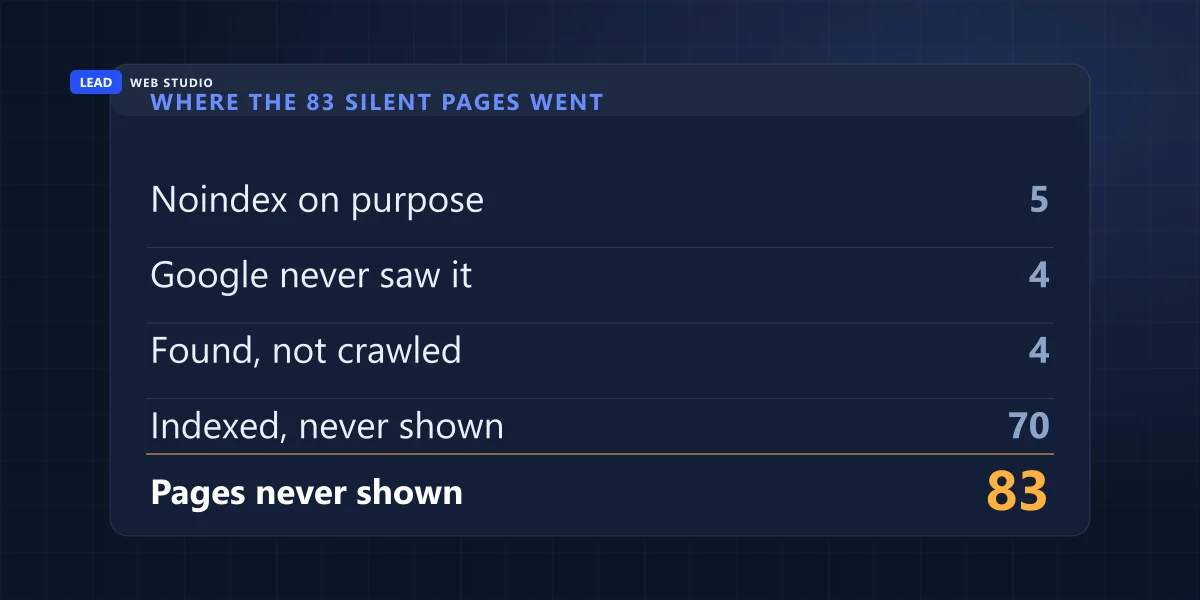
- 83 of my 359 pages earned zero impressions in six months. Five of those are meant to be invisible, so the real number is 78.
- 70 of those 78 come back "Submitted and indexed". Only 8 have any indexing problem at all.
- My silent pages are longer than my successful ones — median 1,791 words against 1,127. Thin content does not explain a single one of them.
- 87 city pages earned 24,909 impressions. 123 trade pages, same site, same templates, built two weeks later, earned 2,571.
- 81% of every impression I get comes from a query that names a place. The phrase decides, not the page.
What does zero impressions in Search Console mean?
It means that during the dates you selected, Google never displayed a link to that page on a results page somebody actually looked at. That is the whole definition. It is not a penalty, not a manual action, and not a warning. It is the absence of an event, and the event can be missing for reasons that have nothing to do with your page.
Everything below is one measurement of one website: leadlls.com, 359 pages, Search Console data for 15 March to 11 September 2026, pulled read-only on 14 September 2026. Index statuses come from the URL Inspection API, which reads a status and cannot submit anything. Where I quote Google, the exact page is linked at the bottom.
Zero impressions and zero clicks are not one problem
Before you change anything, find out which row you are actually looking at. A page with 900 impressions and no clicks has been offered to 900 people who read your title and kept scrolling — that is a writing and position problem. A page with no impressions has never been offered to anybody, so the title cannot be blamed for anything.
| What the row says | What actually happened | What is worth doing | What is a waste of time |
|---|---|---|---|
| Impressions, no clicks | Google showed it; people chose someone else | Rewrite the title and description; find out what position it sits at | Rebuilding the page |
| No impressions at all | Google never showed it to anyone | Check the index status, then check whether the phrase has any searchers | Rewriting the title of a page nobody has seen |
| Impressions falling, clicks steady | You lost broad queries, kept the specific ones | Read the query list before panicking | Treating it as a penalty |
If it is the first row you are in, the useful reading is what "average position" is actually an average of, because that number is what decides whether anyone ever sees the title you are about to rewrite. The rest of this is about the second row.
Step one: subtract the pages that are supposed to be invisible
Five of my 83 were never meant to be found. The thank-you page someone lands on after sending a form, the cancelled-payment page, the invoice payment page, and two archived versions of legal documents kept for the record. All five carry a noindex tag that I put there on purpose. They are not failures; they are correctly behaving pages sitting in a report that does not know what they are for.
Do this first, because it is free and it changes the shape of the list. Sort your zero-impression URLs and cross off everything that exists to be arrived at rather than found: confirmations, receipts, internal tools, archived terms, print versions. Whatever is left is the actual question.
Step two: ask Google whether it even has the page
This is the ten-second check almost nobody runs before they start rewriting. Paste the URL into the search bar at the top of Search Console and read the status it gives back. There are only three answers that matter, and they send you in three completely different directions.
| Status the inspection returned | My pages | What it actually means | What fixes it |
|---|---|---|---|
| Submitted and indexed | 70 | Google has the page and chose not to show it | Nothing technical. The problem is the phrase. |
| Discovered — currently not indexed | 4 | Google knows the URL, has not fetched it yet | Waiting. It is a crawl-scheduling queue. |
| URL is unknown to Google | 4 | Google has never heard of this address | One link or one sitemap entry |
| Anything else | 0 | — | — |
Ninety per cent of my supposedly broken pages are not broken. And here is the part that finished the argument for me: I ran the same inspection on 40 pages that Google does show, spread evenly across the site. All 40 came back "Submitted and indexed" too. The status is identical on both sides. It cannot be the explanation for either.
Indexed means Google kept a copy. It has never meant Google intends to use it.
The two pages that embarrass me most are both in the 70. My guide on getting found on Google is 1,434 words, was last crawled on 10 August, is fully indexed — and has been shown to nobody in six months. Same for my website maintenance checklist. If a technical fault were causing this, those two would have it, and they do not.
It is not thin content, and I can prove it on my own site
The standard answer at this point is "the page is too thin". On my site the opposite is true, and it is not close. The median zero-impression page runs 1,791 words. The median page Google actually shows runs 1,127. My silent pages are 664 words longer than my successful ones.
| Words in the body | Pages | Zero impressions | Share silent |
|---|---|---|---|
| Under 800 | 55 | 9 | 16% |
| 800 – 1,600 | 172 | 28 | 16% |
| 1,600 – 2,400 | 49 | 14 | 29% |
| 2,400 – 3,600 | 39 | 12 | 31% |
| Over 3,600 | 39 | 15 | 38% |
I am not going to claim that length hurts, because that table has an obvious confound and I can see it: my newest pages are also my longest ones, and new pages have had less time to be shown. What the table does kill is the reverse claim. There is no reading of this data in which the silent pages are the short ones. My longest page on the entire site — 5,882 words, on pest control web design — has zero impressions. My shortest real page, a 235-word link preview checker, gets shown.
Internal links do not explain it either. I counted every internal link on this site last week — 24,250 of them — and 71 of the 83 silent pages already had one pointing at them from inside a sentence. I am not going to re-run that argument here.
What it actually is: the phrase, not the page
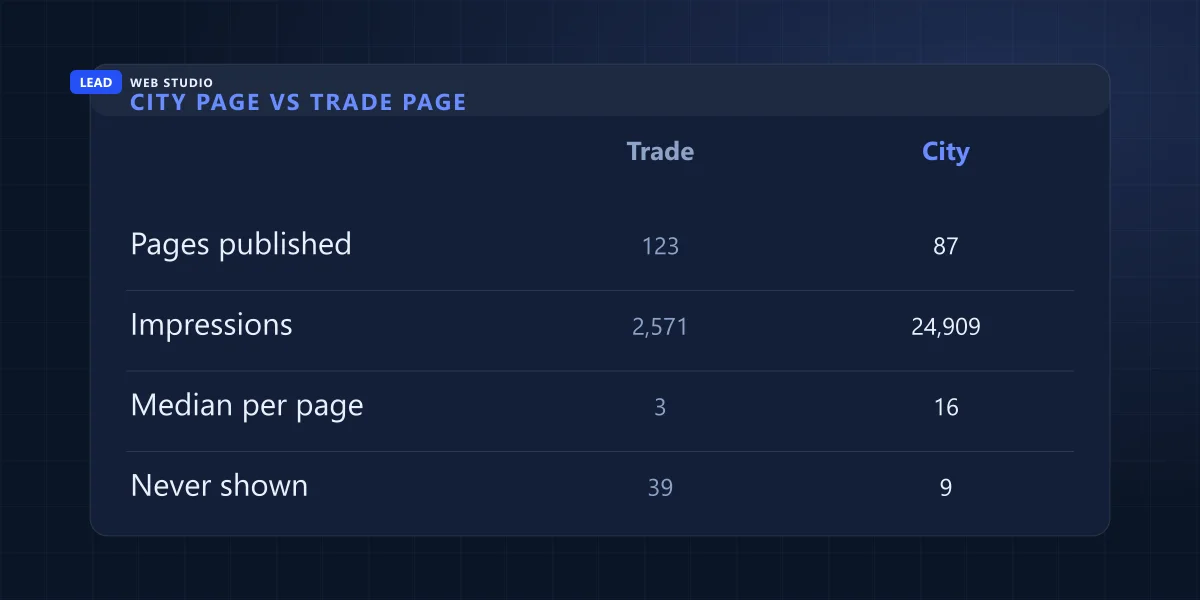
My site has two large sets of pages built by scripts from fixed templates. One set targets a city — "web design Mississauga". The other targets a trade — "web design for funeral homes". Same code, same author, same design, and the median number of inbound links written into a sentence is three in both sets. The city pages first appeared in Search Console in the first half of July; the trade pages in the second half. Two weeks apart, and that is the only age difference between them.
| Six months, same site | City pages | Trade pages |
|---|---|---|
| Pages published | 87 | 123 |
| Impressions earned | 24,909 | 2,571 |
| Median impressions per page | 16 | 3 |
| Never shown once | 9 (10%) | 39 (32%) |
Forty per cent more trade pages, earning one tenth as many impressions. And the query list says why. Across the six months Google reported 1,630 distinct queries for my property. 808 of them name a place, and those carry 81% of every impression I received. Queries shaped like "web design for something" — the exact shape 123 of my pages were written for — account for 91 queries and 547 impressions in total, which is 1.6%.
Then there is the blunt version. Fourteen words never appear in a single one of those 1,630 queries, in any spelling: dealership, funeral, travel, veterinary, retirement, masonry, soccer, catering, deck, fence, pest control, mortgage, appliance, pool. I have 29 pages built around those words. Between them, in six months, they collected 15 impressions — and since no query contains any of the words, not one of those fifteen came from somebody looking for that trade.
I built 123 of those pages around one phrase shape — “web design for X” — which turns out to carry 1.6% of my search demand. The city pages use the shape that carries 81% of it. Nothing else about the two sets differs, and one earns ten times the other. Publishing more pages does not create the demand; it only spreads the same demand thinner.
The honest limit: Search Console cannot tell you which of the two it is
Here is where I have to be careful, because the test I just ran is weaker than it looks. "No query containing the word funeral" does not prove nobody searches for it. It proves that Google never placed my site anywhere a person looking for that word actually looked. Search Console only reports queries that produced an impression, so a phrase you rank 40th for looks exactly like a phrase nobody types.
And the numbers refuse to separate cleanly. Thirty of my 39 silent trade pages have no query carrying their trade word — but so do 42 of the 84 trade pages that are getting shown. The test leans. It does not decide.
Google's own rule is what makes the two indistinguishable. An impression is counted, in their words, "whenever an item appears in the current page of results, whether or not the item is scrolled into view, as long as the user need not click to see more results". And on position: "A link must get an impression for its position to be recorded. If a result does not get an impression — for example, if the result is on page 3 of search results, but the user only views page 1 — then its position is not recorded for that query."
Read that twice. If you sit on page three of a busy phrase and nobody clicks through to page three, Search Console reports zero impressions and no position — the same two zeros you get for a phrase nobody searches at all. The report is not hiding anything from you. In both cases there is genuinely nothing to record.
The ten-minute check that does separate them
Since the dashboard cannot answer it, answer it from outside. This takes about ten minutes for five pages and it costs nothing.
- Paste the URL into Search Console's top search bar and read the status. If it is not "Submitted and indexed", stop here — you have an indexing question, not a demand question, and it is a different job.
- Open a private browser window and type the exact phrase the page targets into Google. Not your brand name. The phrase in your H1.
- Look at what came back on page one. Ten strong, on-topic pages from real competitors means the demand is there and you are below where anyone looks. Google returning loosely related pages, forum threads and dictionary definitions means almost nobody is searching this and the page will never be shown regardless of what you do to it.
- Check whether one of your own pages is already ranking for it. Add
site:yourdomain.comto the same search. If a different page of yours comes back, you have two pages fighting over one phrase, and the older one is usually winning. - Decide in one line. Demand exists and you are buried: the page needs to be genuinely better than what is on page one, or it needs a narrower phrase. No demand: leave the page alone and stop spending on it.
One thing that is not on this list: pressing "Request indexing". It does not create searchers and it does not move you up a results page. If the page is already indexed — and on my site 90% of them are — you would be asking Google to re-read something it has already read and already decided about. Every one of my 70 indexed-and-silent pages has a recorded crawl date, and 24 of them were crawled in the last seven days — including trade pages that have been live for eight weeks and still have no impressions. Google is already reading them. Here is what the actual wait looks like.
Two things that will confuse you while you look
Your query numbers will not add up to your total. My page report says 48,997 impressions for the six months. My query report says 34,303. That is a 30% gap and it is not a bug: Google withholds rare queries, describing them as omitted "to protect user privacy". You cannot get those back, and you should not build a theory on the difference.
Pages you deleted are still earning. Twenty-nine URLs that no longer exist on my site collected 1,939 impressions in the same window — twenty-two retired project pages and seven old service URLs. If you compare your sitemap against your Pages report, those will show up as strangers, and they are real data rather than a mistake in your spreadsheet.
What this measurement does not show. One website, one six-month window, one industry. The two large script-built sets here — 87 city pages and 123 trade pages — only began appearing in Search Console in July, so most of what I measured is under ten weeks old. That is why I judge whether Google showed a page at all rather than how well it ranked. The word-count table is confounded with age and I have said so rather than dressing it up. And the trade-word test leans one way without deciding. If you run this on an older, flatter site and get a different answer, I would like to see it.
If your Search Console is full of zeros and you want somebody to tell you which of the three statuses you are actually in, send me the domain — that is a twenty-minute answer, not a project. If the pages are indexed and the problem is that they sit below where anyone looks, that is SEO work and it starts with the phrases, not the pages. If the site itself is the reason nobody stays, that is a rebuild. What I charge is on the pricing page, and the trades I actually work in are on the industries page — including several I have now proven nobody searches for.
Common questions
What does zero impressions in Search Console mean?+
It means Google never displayed a link to that page on a page of results anybody actually viewed, during the dates you selected. It is not a penalty and it is not a warning. On my own site, 70 of the 78 pages with zero impressions are recorded by Google as "Submitted and indexed" — Google has them, reads them, and simply never puts them in front of anyone.
Is zero impressions the same as zero clicks?+
No, and they need opposite fixes. Zero clicks with impressions means Google showed your page and people scrolled past it, which is a title, description and position problem. Zero impressions means Google never showed it at all, so nothing on the page can be blamed for the click that did not happen.
Does zero impressions mean my page is not indexed?+
Usually not. I inspected all 78 of my zero-impression pages that are meant to be findable: 70 came back "Submitted and indexed", 4 as "Discovered - currently not indexed" and 4 as "URL is unknown to Google". So 90% of them are fully indexed. Check the status yourself before you touch anything technical.
Can a page get zero impressions if it ranks, just badly?+
Yes, and this is the trap. Google counts an impression "whenever an item appears in the current page of results, whether or not the item is scrolled into view, as long as the user need not click to see more results". If you sit on page three and nobody clicks through to page three, you get no impression and no position recorded at all.
How do I tell whether nobody searches for it or I am just buried?+
Search Console cannot tell you, because it only reports queries that already produced an impression. Type the exact phrase into Google yourself in a private window. If the first page is full of strong, on-topic pages, demand exists and you are below where anyone looks. If Google returns loosely related pages instead, almost nobody is searching that phrase.
Should I delete a page that has zero impressions?+
Not on the impression count alone. Several of my zero-impression pages exist to be sent to a person in an email or linked from a proposal, and they do that job perfectly. Delete a page when it duplicates another page of yours, or merge the two. Otherwise leave it and stop spending money on it.
Why do my query numbers not add up to my total impressions?+
Because rare queries are withheld. Google's documentation says plainly: "Some queries are omitted from the report to protect user privacy. These are called anonymized queries." On my property the page report shows 48,997 impressions for six months and the query report shows 34,303 — a 30% gap that is not a bug and cannot be recovered.
Sources, read in full on 14 September 2026: Google — Search Console performance data for the verbatim definitions of an impression and of position, including the page-three example; Google — Performance report dimensions and data groupings for anonymized queries. Everything numeric here is my own measurement rather than an industry study: page and query figures are Search Console data for leadlls.com from 15 March to 11 September 2026, joined to the 359 index.html files on disk by URL path; word counts were parsed from the same files on 14 September 2026; coverage states come from the Search Console URL Inspection API, which is a read — no URL was submitted for indexing, and every failed read was recorded as unknown rather than counted as "not indexed".

10+ years building websites for GTA trades, clinics and service businesses. I write the scripts that publish and audit them, which is how I end up publishing the measurements that make my own pages look bad. Read my full bio · Get in touch