Sooner or later somebody answers how many pages a website needs by sending you a proposal with a number in it. Two hundred pages. Three hundred. One for every city within an hour's drive, one for every service, one for every combination of the two. I know that pitch from the inside, because I have built that matrix — my own site is sitting at 347 published pages as I write this.
So this month I did the thing nobody quoting a page count ever does. I pulled six months of Google Search Console data for nine websites I have access to — mine, a roofing and restoration contractor in Illinois, a stucco company in the GTA, a notary, a paralegal, an art gallery, a public adjuster, a renovation crew and a claims software product — and asked the same two questions of every single published page. Did Google ever show you to anybody? Did anybody click?
The answers were worse than I expected, including for my own site.
The short version
- 1,072 published pages. 254 of them were never shown in Google once in six months.
- Of the 1,083 addresses Google did show, 813 — 75% — got zero clicks.
- Nine pages produced half of all 3,837 clicks. Twenty-eight produced 80% of them.
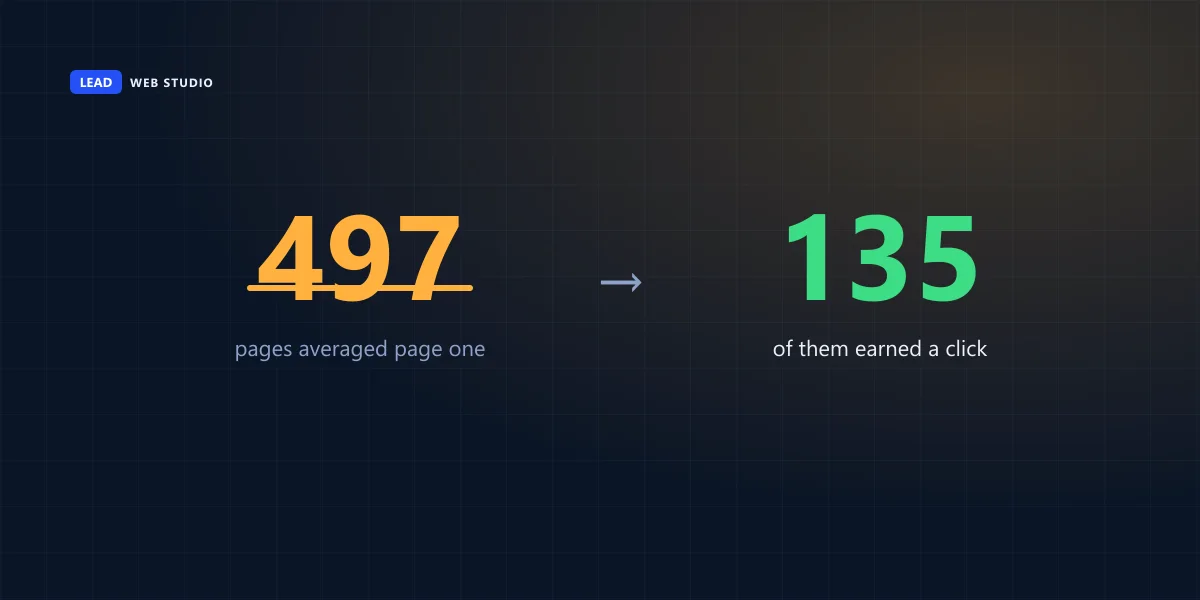
- 497 pages averaged page one and only 27% of them earned a click, because the median one was shown twelve times in six months.
- The site with 34 pages got 359 clicks. The site with 347 pages got 85. That one is mine.
How many pages does a website need?
Far fewer than you are being sold. Across nine real sites, half of every click came from nine pages. Build one page for each thing a customer actually searches for and that you can answer better than whatever is on page one today — then stop. Nothing in six months of this data rewards volume on its own.
That is the short answer, and the rest of this article is the evidence, including the part where my own page matrix comes out badly. Every number below is my own measurement of nine Search Console properties between 14 March and 10 September 2026, pulled read-only on 12 September 2026. Nothing here is quoted from an industry study.
What happened to 1,072 published pages in six months
The nine sitemaps list 1,072 pages between them. Google showed 1,083 addresses from those sites at least once in the window, and 813 of those addresses did not receive a single click in half a year. Two hundred and seventy pages got one or more, and 161 of those got exactly one or two.
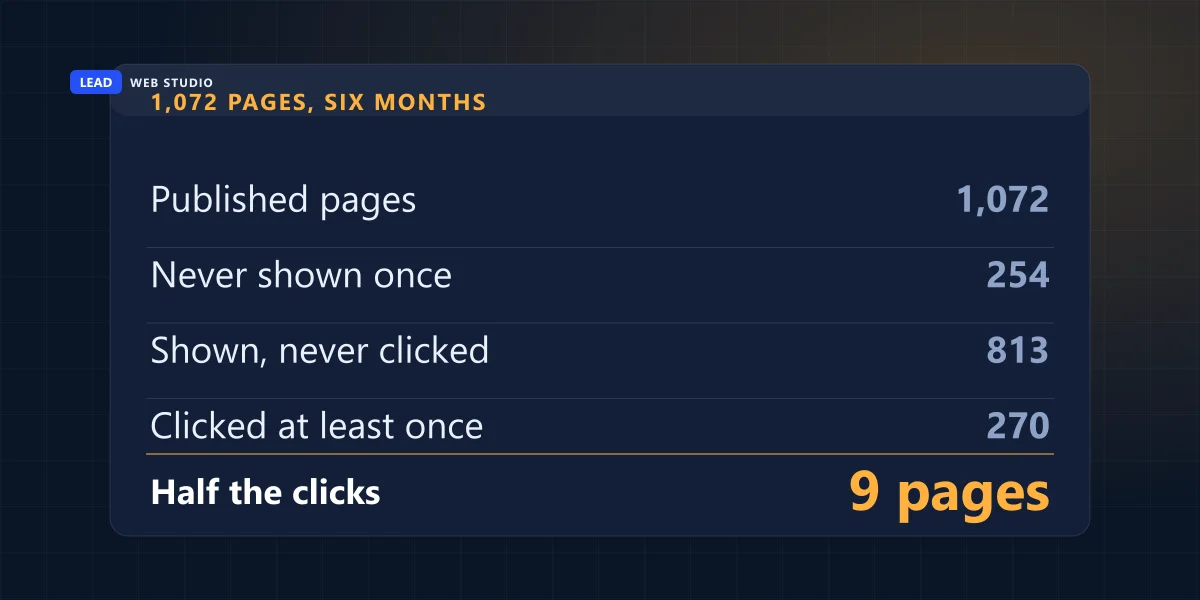
| Stage | Pages | Share |
|---|---|---|
| Listed in the nine sitemaps | 1,072 | — |
| Never shown in Google once | 254 | 23.7% of published |
| Addresses Google showed at least once | 1,083 | — |
| Shown, but never clicked | 813 | 75.1% of those shown |
| Clicked at least once | 270 | 24.9% of those shown |
| Clicked more than twice | 109 | 10.1% of those shown |
Two honest notes about that table. Google showed more addresses than the sitemaps list because it also shows things nobody put in a sitemap — the roofing site's Russian translations, an app subdomain on the software product, gallery pages that live in a query string. And some of the 254 never-shown pages are days old, including three of my own from this month, so they have not had a chance yet.
The concentration is the part that changed how I think about page counts. Nine pages carried half of all 3,837 clicks. Twenty-eight carried 80%. Sixty-one carried 90%. That is 5.6% of the addresses Google showed doing nine tenths of the work.
On every one of the nine sites — big, small, new, established — half of the clicks came from between one and seven pages.
That per-site version matters more than the combined one, because the combined number leans heavily on a single busy site. Counted site by site, the number of pages needed to account for 80% of that site's clicks ran from one to sixteen. Nobody in the group is earning from their two hundredth page.
Does building more pages bring more traffic?
Not on these nine sites. The smallest one — 34 published pages — earned 359 clicks in six months. The largest, mine at 347 pages, earned 85. Page count and clicks moved completely independently of each other. What did move with clicks was whether the pages answered a question people were already typing.
| Website | Pages published | Clicks in 180 days | Clicks per page | Median position |
|---|---|---|---|---|
| Roofing & restoration (Illinois) | 183 | 2,773 | 15.2 | 9.0 |
| Notary (Scarborough) | 34 | 359 | 10.6 | 39.2 |
| Stucco contractor (GTA) | 120 | 309 | 2.6 | 14.0 |
| Paralegal (Toronto) | 127 | 226 | 1.8 | 24.6 |
| Mine (leadlls.com) | 347 | 85 | 0.24 | 22.8 |
| Public adjuster | 67 | 43 | 0.64 | 8.8 |
| Art gallery | 114 | 23 | 0.20 | 8.2 |
| Claims software | 57 | 16 | 0.28 | 9.3 |
| Renovation company | 23 | 3 | 0.13 | 38.7 |
Read that table as "page count tells you nothing", not as "fewer pages is better". These are nine different industries in two countries with different competition and different ages: the art gallery, the public adjuster and the renovation company only started reporting Search Console data in late July and early August, so their pages have had weeks rather than months. A comparison between whole websites cannot separate any of that. What it can do is kill the idea that the number of pages is the lever.
Google's own guidance asks the question I have to answer about my own site: "Are you producing lots of content on many different topics in hopes that some of it might perform well in search results?" If the honest answer is yes, the page count is the symptom rather than the strategy. Google's spam policy is blunter about the extreme version — scaled content abuse is "when many pages are generated for the primary purpose of manipulating search rankings and not helping users".
Why does a page rank on page one and still get no traffic?
Because a ranking is only worth the demand behind it. In this data 497 pages averaged a position on the first page of Google. Only 135 of them — 27% — got a single click in six months. The median page-one page was shown twelve times in half a year, and 237 of them were shown fewer than ten times.
Google defines an impression as a user having "seen (or potentially seen) a link to your site in Search". Twelve impressions in six months means twelve chances, total. No title rewrite fixes that, and no amount of internal linking does either.
| Average position | Pages | Median impressions in 180 days | Share that earned a click |
|---|---|---|---|
| Page 1 (1–10) | 497 | 12 | 27.2% |
| Page 2 (11–20) | 191 | 32 | 26.7% |
| Pages 3–5 (21–50) | 300 | 46 | 22.3% |
| Past position 50 | 95 | 38 | 17.9% |
The median impression count goes up as the position gets worse, which looks wrong until you see what kind of page sits in each row. A page averaging position 1–10 is usually winning one narrow phrase that almost nobody types. A page averaging 21–50 is being shown for lots of broad phrases and losing all of them. Both are common. The second is the one that costs you, because those broad phrases have real demand behind them and the page is nowhere near winning any of them.
Page one is still where the money is — those 497 pages took 2,774 of the 3,837 clicks, 72% of everything. The point is narrower than "rank higher". A first-page ranking on a phrase with no volume is worth exactly nothing, and you can own dozens of them without noticing.
What my own 205 location and industry pages actually did
I am not going to write this article and skip my own numbers. Of my 347 pages, 86 are city service pages and 119 are industry pages. Together, in six months, they collected 26,436 impressions and 13 clicks.
| Page type on leadlls.com | Published | Impressions | Clicks | Median position |
|---|---|---|---|---|
| City service pages | 86 | 24,021 | 4 | 24.7 |
| Industry pages | 119 | 2,415 | 9 | 27.0 |
| Guides (this blog) | 68 | 5,702 | 1 | 24.4 |
| Core service pages | 73 | 7,235 | 30 | 17.5 |
| Homepage | 1 | 8,308 | 41 | 20.5 |
The homepage alone earned 41 clicks. The 273 city, industry and guide pages earned 14 between them. And the median position on the city pages is 24.7, which is the third page of results — 24,021 impressions there produced four clicks, so almost nobody is scrolling that far.
Here is the part that keeps me from calling the whole thing a waste. Those city pages had zero impressions in March. By early July, 37 of them were being shown, for 337 impressions between them. In the last 30 days, 67 of them were shown for 18,816 impressions. They are climbing hard and they are climbing from nothing. My own rule is that a page under eight weeks old cannot be judged, because Google moves a new address around before its position settles, and most of these are inside that window.
So the honest reading is not "location pages do not work". It is that after five months they have bought impressions and almost no clicks, that impressions are not money, and that the page count itself shortened nothing. If you are being sold a matrix, budget for the year it takes before you find out — and ask what each page is going to say that the last one did not.
So how many pages should you actually build?
Start with the pages a customer needs in order to hire you, not the ones a keyword tool suggests. For the service businesses I build for, that list usually comes to somewhere between eight and twenty-five pages. After that, add one at a time, and only when there is a real question behind it.
- One homepage that says what you do, where you do it, and how to reach you.
- One page per service you would actually write a quote for. Not one per keyword variant of the same service.
- One page per place you physically travel to — and only if you can write something true and specific about working there.
- Contact or booking. One page, one obvious action.
- Proof: projects, reviews, an about page with a real person on it.
- Then, one page per question a customer has asked you twice. That is where the roofing site's traffic comes from — its top five pages are all plain answers to plain questions, and they carry 1,180 clicks between them.
Before you build page number twenty-six, three questions. Is anybody searching for this — can you point at impressions, a customer email, a phone call? Can this page be better than what is on page one for that search today? Would you send this page to a customer without apologising for it? Three yeses and it is worth building. Two is a maybe. One is a page that joins the 813.
How do I check my own pages in ten minutes?
Open Search Console, go to Performance → Search results, set the date range to the last six months and switch to the Pages tab. Sort by clicks. Now count how many rows have a zero in the clicks column, and compare the number of rows with the number of pages you think you have.
| What you see | What it usually means | What to do |
|---|---|---|
| Impressions, no clicks, position past 15 | It ranks, on page two or three | Improve or merge this one before building anything new |
| Under 10 impressions in six months | Nobody searches for this | Leave it if it has a job; stop making more like it |
| The page is not listed at all | Google has never shown it | Check it is indexed, in the sitemap and linked from a real page |
| Three pages hold nearly all the clicks | Completely normal | Make those three better; that is where your next hour pays |
If your Pages tab lists far fewer rows than you have pages, that gap is the interesting number. On my site it was 76 pages Google had not shown once. I wrote about how long Google takes to index a new page after measuring exactly that, and about reading the rest of Search Console if this is the first time you have opened it.
What this data does not show. Nine small-business sites in Canada and the US, and the roofing site supplies 2,773 of the 3,837 clicks — 72% of the total — so the combined "nine pages carry half the clicks" figure leans on it. The per-site version does not: one to seven pages on every one of the nine. Five of those sites only began reporting data in the last few months. And Search Console counts only clicks that land on the website, so a call or a direction request from the map pack is a real customer who appears nowhere in these numbers.
If a proposal in front of you is priced by the page, I am happy to read it — send it over and I will tell you which of those pages would have earned anything. My own rates are on the pricing page, what a build includes is on the web design page, and if the problem is that the pages you have are stuck on page two, that is SEO work rather than more pages. The industry pages in this measurement are the ones I keep building anyway, because each of them is about work I actually do.
Common questions
How many pages should a small business website have?+
Fewer than most proposals suggest. Start with a homepage, one page for each service you would actually quote on, one page for each place you physically travel to, a contact page and your proof pages. After that, add a page only when a customer has asked you the same question twice. On the nine sites I measured, half of all clicks came from nine pages.
Do more pages help SEO?+
Not by themselves. Across nine sites over six months, the site with 34 published pages earned 359 clicks and the site with 347 pages earned 85. Google's own spam policy names scaled content abuse as many pages generated to manipulate rankings rather than help users, so volume with nothing behind it is a documented risk rather than a shortcut.
Why does my page rank on page one but get no traffic?+
Because a ranking is only worth as much as the demand behind it. In my data 497 pages averaged a position on page one, and the median one of those was shown twelve times in six months. Two hundred and thirty-seven of them were shown fewer than ten times in half a year. The page ranks; nobody is searching for it.
Is it bad to have pages that get no traffic?+
Not automatically. A privacy policy, a terms page and a booking page all earn their place without ever ranking. Across the nine sites, 813 of the 1,083 addresses Google showed got zero clicks in six months, and plenty of those pages are doing a job for visitors who arrived somewhere else. The problem is a page built only to rank that then does not rank.
Should I delete pages that get no clicks?+
Only if the page has no job. Check Search Console first: a page shown often but never clicked is usually stuck on page two or three and is a candidate for improving or merging. A page shown fewer than ten times in six months has no search demand behind it, which is a different problem and deleting it changes nothing on its own.
How many location pages should I build?+
One for each place you genuinely serve and can write something true and specific about. I built 86 of them on my own site. In six months they collected 24,021 impressions and four clicks, at a median position of 24.7, which is page three. They are climbing, not finished, but the page count itself bought nothing.
How long before a new page earns clicks?+
Longer than most people wait. My own city pages had no impressions at all in March, 337 across 37 pages by early July and 18,816 across 67 pages in the last 30 days, with three clicks so far. I do not judge a page under eight weeks old, because Google moves a new address around before its position settles.
Sources, read in full on 12 September 2026: Google — Spam policies for Google web search for the definition of scaled content abuse; Google — Creating helpful, reliable, people-first content for the self-assessment question about producing lots of content on many topics; Google — Search Console performance report for the definitions of an impression, a click and average position. Everything numeric is my own measurement rather than an industry study: Search Console data for nine verified properties covering 14 March to 10 September 2026, pulled read-only on 12 September 2026. "Published" is the count of URLs in each site's own live sitemap; published and shown pages were matched by path with the host normalised, because one site's sitemap uses the www host while Search Console reports both. Google reported 1,083 page rows, which collapse to 1,067 distinct pages once www duplicates and anchor links are merged; the click and position figures use the 1,083 rows as Search Console reports them. Sitemap lastmod was deliberately not used as a publish date — these sitemaps are rebuilt on every deploy, so it is not one.

10+ years building websites for GTA trades, clinics and service businesses. I have Search Console access to nine of them, which is how I could count what every published page earned — including the 205 pages on my own site that earned thirteen clicks. Read my full bio · Get in touch