Every few weeks somebody forwards me a spreadsheet from an SEO agency. Four hundred rows, sorted by search volume, colour-coded, and somewhere near the bottom a tab called long-tail opportunities. The pitch attached to it is always the same: the short phrases are too competitive, so we will build pages for the longer, more specific ones, because long-tail keywords bring visitors who are ready to buy. I have repeated that sentence myself. I had never once checked it against my own data.
So I checked it. Ten Google Search Console properties I have read access to — my own site, a notary, a paralegal, a roofing and restoration company, a stucco contractor, an art gallery, a couple of others — over the 180 days from 11 March to 7 September 2026. After stripping out brand searches and site: audit queries, that is 12,841 distinct searches and 281,485 impressions.
The rule held for about twenty minutes. Then I tried to break it, the way you are supposed to, and it fell apart in two different directions.
The short version
- At first it looked true. Inside the top three positions, phrases of five words or more were clicked at 1.47% and phrases of three words or fewer at 0.74%. Twice as good, at the same ranking.
- Then I removed one phrase family. Sixteen variations of one insurance question carried 53.5% of all the long-phrase clicks. Without them the gap shrank to 1.1×.
- Then I removed the biggest site. On the other nine, short phrases beat long ones — 2.00% against 1.60%. The rule reversed.
- Below the top three, wording did nothing at all. At positions 4–10: 0.31% short, 0.29% long. From position 11 down, 156,244 impressions produced 96 clicks.
- What did hold was rank — and even that guarantees nothing. Thirty-two phrases sat at an average position of 1.7, collected 8,826 impressions between them, and earned zero clicks.
What is a long-tail keyword?
A longer, more specific search that fewer people type. "Roofing company" is a short head term. "What does net claim if depreciation is recovered mean" is long-tail. The standard argument is that the long one is less competitive and attracts people closer to buying, so a small business should aim its pages there instead of at the big obvious phrase.
It is a genuinely sensible-sounding idea, and it is the backbone of most SEO packages sold to small businesses. It is also, as far as I can tell, almost never tested by the person selling it. So: does the long phrase actually get clicked more often than the short one?
Do long-tail keywords get more clicks than short ones?
Not reliably. In my data the long phrases won by 2× — but only inside the top three positions, only before I checked the result properly, and only because of one topic on one website. Once I removed that topic the advantage nearly vanished, and once I removed that website it pointed the other way.
Here is the comparison that started it. Click rate by how many words the searcher typed, grouped by where the page was actually ranking, so a phrase at position 2 is never being compared against a phrase at position 30.
| Where the page ranked | 3 words or fewer | 4 words | 5 words or more |
|---|---|---|---|
| Top 3 | 0.74% | 0.36% | 1.47% |
| Positions 4–10 | 0.31% | 0.39% | 0.29% |
| Positions 11–20 | 0.17% | 0.09% | 0.09% |
| Position 21 or worse | 0.03% | 0.03% | 0.02% |
Two things in that table were already awkward before I went digging. The four-word column is worse than both of its neighbours in the top row, which no theory about specificity explains. And in the bottom three rows the columns are identical to each other. If phrasing were doing the work, it would keep doing some of it at position 7. It does not.
Why that first number was wrong
A single group producing a big effect is the oldest trap in this kind of measurement, and the fix is boring: take something out and see whether the result survives. I took out two things, and it survived neither.
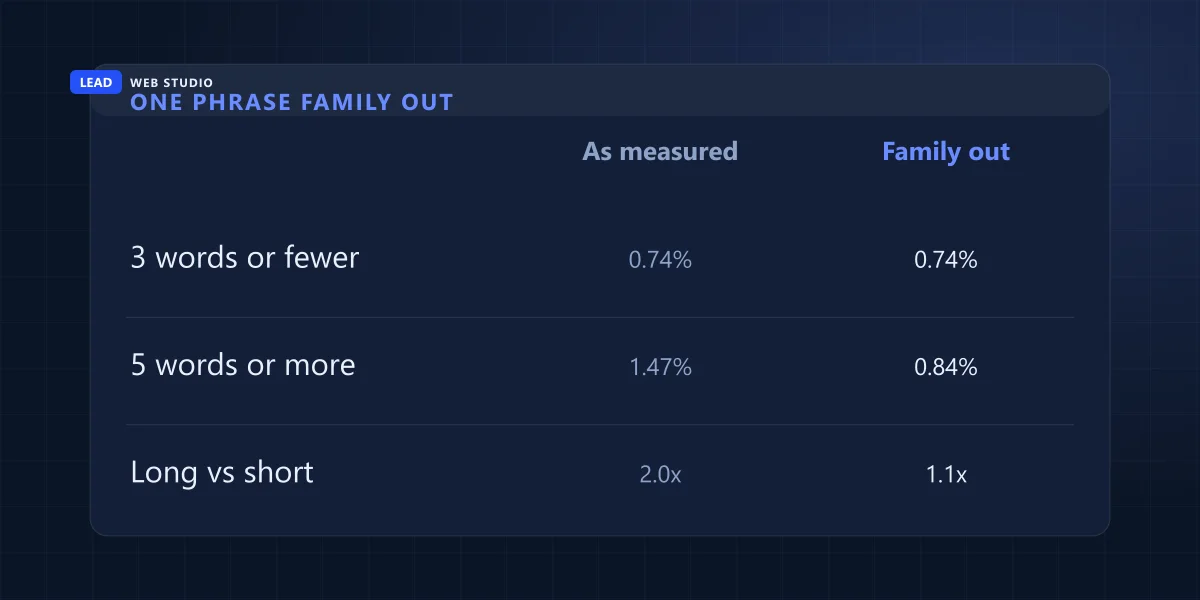
First, the phrase family. Sixteen wordings of one question about insurance depreciation, all on the restoration company's site, carried 2,100 impressions and 91 clicks — 53.5% of every long-phrase click in the top three. That is not a pattern about phrase length. That is one article that happens to answer one question extremely well, and it was carrying the entire finding on its back.
Second, the site. That one property is 202,877 of the 281,485 impressions, so when it moves, everything moves. I ran the same top-three comparison on the other nine.
| The same top-3 comparison | Short phrases | Long phrases | Long ÷ short |
|---|---|---|---|
| As I first measured it | 0.74% | 1.47% | 2.0× |
| One phrase family removed | 0.74% | 0.84% | 1.1× |
| Biggest site removed | 2.00% | 1.60% | 0.8× |
A result that reverses when you drop one website out of ten cannot be used to plan anything.
One honest caveat, because it matters. The studies that report long-tail keywords converting several times better are measuring conversion — what people do once they land on your page. I measured clicks — whether anyone came at all. Both can be true at once. But a phrase nobody clicks cannot convert anybody, so this is the earlier step, and it is the cheaper one to check.
So what did predict a click?
Position, and nothing else I could find. Being in the top three was worth roughly thirty times a position of 21 or worse. That single variable survived every cut I made to the data, on every property, whether the phrase was two words or nine.
| Average position | Impressions | Clicks | Click rate |
|---|---|---|---|
| Top 3 | 34,664 | 315 | 0.91% |
| 4–10 | 90,577 | 280 | 0.31% |
| 11–20 | 47,721 | 63 | 0.13% |
| 21 or worse | 108,523 | 33 | 0.03% |
Look at the bottom two rows together. 156,244 impressions from position 11 downward produced 96 clicks. More than half of all the visibility these ten sites earned in six months was spent in a region of the results page where essentially nobody arrives. It is also the largest single reason 97.6% of the searches in this dataset never produced a click: most of them were never near the top of the page in the first place.
And that is not the tidy "so just rank higher" conclusion it looks like, because nobody chooses to rank higher. It does mean that if you are choosing between rewriting a page's title to be more specific and doing the harder work that might move it from position 14 to position 3, the second one is where the clicks live.
Thirty-two phrases that ranked in the top three and earned nothing
This is the part that changed how I read a Search Console export. Thirty-two searches in this window had at least 150 impressions, sat at an average position of 1.7, and produced zero clicks between them across 8,826 impressions. Not a low click rate. Zero.
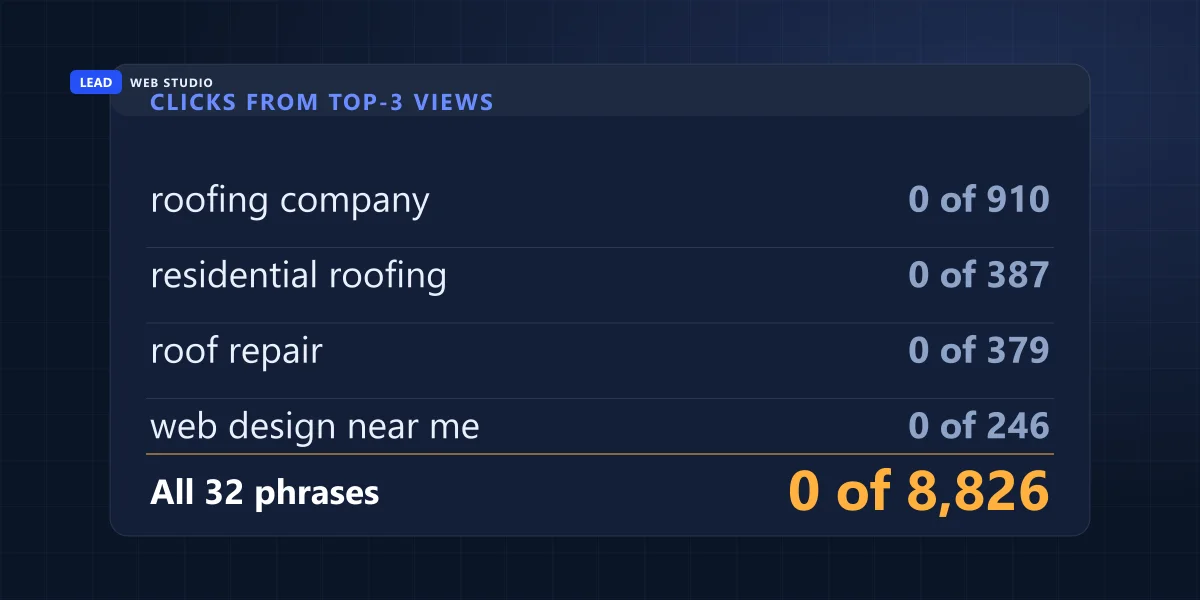
Three of them are mine. This website ranks at position 1.0 for "web design near me", 1.0 for "web design agency near me" and 1.3 for "web design". Those three phrases gave me 730 impressions in six months and not one visitor. I sell web design for a living, I am apparently at the top of Google for the exact words, and the number in the clicks column is a zero.
Here is the awkward part for the long-tail theory. Put the dead phrases next to the ones that earned, and word count does not separate them at all.
| Search phrase | Words | Position | Impressions | Clicks |
|---|---|---|---|---|
| roofing company | 2 | 1.2 | 910 | 0 |
| roof repair | 2 | 1.0 | 379 | 0 |
| web design near me | 4 | 1.0 | 246 | 0 |
| limited replacement cost | 3 | 1.8 | 557 | 17 |
| notary near me | 3 | 3.3 | 777 | 36 |
| net claim if depreciation is recovered | 6 | 2.1 | 1,000 | 52 |
"Notary near me" is three words, sits at position 3.3, and returned 36 clicks. "Roofing company" is two words, sits two places higher at 1.2, and returned none. The shorter phrase at the better position is the one that earned nothing. Whatever is separating these rows, it is not word count.
Why would a number-one result get no clicks?
Google's own documentation gives three separate mechanisms, and Search Console will not tell you which one you are looking at. An impression does not mean anyone looked. A click only counts if the visitor leaves Google. And "position 1" is not a promise that your blue link was first.
Taking those one at a time, in Google's words. An impression is counted "whenever an item appears in the current page of results, whether or not the item is scrolled into view". So a result sitting eleventh on a long page counts as seen by someone who never scrolled past the third.
On clicks: "Any click that sends the user to a page outside of Google Search, Discover, or News is counted as a click; clicking a link that stays inside the Google platform is not counted as a click." Somebody who taps your business listing, gets your phone number and calls you has not clicked, as far as this report is concerned. If you also run a Google Business Profile, some of what looks like failure here is being counted in a different dashboard entirely. I measured that separately: across five businesses over 241 days, the listings sent 415 visits to those websites and Google web search sent 258.
On position: "The position value shown in the Performance report is the topmost position occupied by a link to your property or page in search results, averaged across all queries in which your property appeared." The topmost link to your property. Not necessarily the ordinary result you are picturing.
I want to be careful about the obvious guess. It is tempting to say the map pack ate them, and for "roofing company" or "web design near me" that is plausible. But I went looking for it in Google's documentation on how these metrics are counted, and that page does not describe local results at all. So I do not know, and neither does anybody selling you a report built on this same export.
What I do instead of buying a keyword list
Nothing here says stop caring about words. It says the words are a smaller lever than they are sold as, and that the useful information arrives after publishing rather than before. My working method now, in order:
- Publish for a real question first, not for a volume number. The best-earning phrase in this whole dataset is a question about insurance paperwork sitting on a roofing company's website. It has never once appeared on a roofing keyword list anybody has sent me.
- Read the clicks column, not the impressions column. Sort your Search Console query report by clicks and look at what is actually there. It is usually not what anyone predicted. Here is how to read that report if you have never opened it.
- Find the pages sitting at positions 4 to 10 and work on those. That is where a real gain is available: moving into the top three was worth roughly three times the click rate of positions 4–10 and thirty times position 21 or worse.
- Ignore anything sitting past position 20 unless the topic matters to you commercially. On this evidence it is not close to earning, and rewriting its title will not change that.
- Check the map listing separately. If a customer can tap a phone number without leaving Google, your website report is not the whole picture and never will be.
If you want a second opinion on which of your pages are close enough to the top to be worth the work, that is a free call rather than a package — tell me the domain and I will look at the export with you. And if you are choosing an agency or a specialist for your trade, the useful question to ask them is not which keywords they are targeting. It is which of your pages currently rank between 4 and 15, and what they intend to do about those specifically.
Common questions
What is a long-tail keyword?+
A longer, more specific search phrase that fewer people type. "Roofing company" is a short head term. "What does net claim if depreciation is recovered mean" is long-tail. The usual sales pitch is that the long one is less competitive and brings better visitors, so you should write pages aimed at it.
Do long-tail keywords get more clicks than short ones?+
Not reliably. Across 281,485 impressions on ten sites over 180 days, long phrases out-clicked short ones 1.47% to 0.74% inside the top three positions. Remove one phrase family and the gap fell to 1.1×. Remove the largest site and short phrases won instead, 2.00% to 1.60%.
Does phrase length matter if my page ranks on page two?+
No. At positions 4 to 10 the click rates were 0.31% for short phrases and 0.29% for long ones, which is no difference at all. Everything from position 11 downward produced 96 clicks from 156,244 impressions. Below the top few results, how the search is worded stops mattering.
Why does my page rank number one and get no clicks?+
There are several possible reasons and Search Console cannot tell you which one applies. Google counts an impression whenever the result appears on the page whether or not it was scrolled into view, counts a click only when the visitor leaves Google, and reports position as the topmost place any link to your site appeared — which may not be the blue link.
Does this mean keyword research is pointless?+
No, it means the ranking is worth more than the wording. Getting into the top three multiplied the click rate roughly thirtyfold in this data, from 0.03% at position 21 or worse to 0.91% in the top three. No amount of clever phrasing did anything comparable.
Do these numbers contradict the studies that say long-tail converts better?+
They measure a different step. Those studies compare conversion rate, meaning what visitors do after they arrive. I measured click-through rate, meaning whether anyone arrived at all. Both can be true. The point is that a phrase you never get clicked on cannot convert anybody, so the earlier step is the one to check first.
Source, read in full on 9 September 2026: Google — Search Console performance report metrics, for the definitions of impression, click and position quoted above. Everything numeric here is my own measurement rather than an industry study: Search Console query data for ten verified properties covering 11 March to 7 September 2026, pulled read-only on 9 September 2026. Brand searches were identified per property from that property's own name and excluded, as were site: and inurl: operator queries, which are somebody auditing a site rather than a customer. Click rates are impression-weighted across each group, never an average of per-search rates.

10+ years building websites for GTA trades, clinics and service businesses. I have access to the Search Console for ten of them, which is the only reason I could test a piece of SEO advice I had been repeating for years — and find out it does not hold. Read my full bio · Get in touch