
People send me their SEO reports. Not to be nosy — because they've been paying a monthly retainer for most of a year and they genuinely cannot tell whether anything is happening. The report is pages of graphs going gently up and to the right, and not one line of it says we changed this page, on this date, for this reason. So the honest answer to "is my SEO working?" starts by splitting that question in half, because there are two questions in there and only one of them takes months to answer. Did anyone do any work? You can settle that today, yourself, for free. Did the work move anything? That one needs a quarter. Most people ask the slow question and never ask the fast one.
The short version
- "Was work done" and "did it work" are separate questions. The first is verifiable this afternoon. Only the second needs patience.
- Ask for URLs and dates. Real SEO changes specific pages on specific days. If nobody can name one, nothing happened.
- Search Console is the referee — it's free, it's yours, and it doesn't care whose invoice is being defended.
- Rank-tracker screenshots aren't evidence. Positions move on their own, and a report full of them can be produced by someone who touched nothing.
- Google says out loud that nobody can guarantee a #1 ranking. A guarantee tells you what kind of company you're dealing with.
- An audit full of red warnings proves nothing. I ran my own checker on this site while writing this and it found 16 problems on 9 pages.
Is my SEO working?
Split it in two. Whether the work is being done shows up in days — changed pages, new pages, rewritten titles, more of your site indexed. Whether it's paying off shows up in Search Console over a quarter, as impressions first, then positions, then clicks. Judge the work weekly, the results quarterly, and never the reverse.
That order matters more than any individual check below, because the two failure modes look identical from the outside. An agency doing careful work on a competitive market can show you nothing much for four months and still be worth every dollar. An agency doing absolutely nothing can also show you nothing much for four months. Rankings alone can't tell those apart. A list of URLs and dates can, immediately.
What can I check myself, and what do I have to ask for?
More than you'd think is on your side of the fence. Your own website is public, Google's index is public, and Search Console belongs to you rather than to your agency. What you genuinely can't see without asking is the reasoning — why these pages, why this order, what's planned next.
| The question | Where the answer lives | How long it takes |
|---|---|---|
| Did my page titles change? | Google, searching site:yourdomain.com | Two minutes |
| How much of my site is indexed? | Search Console → Pages | Two minutes |
| Is anything trending up? | Search Console → Performance, compared to the previous period | Five minutes |
| Which pages were touched, and when? | Only your agency has this — you have to ask | One email |
| What's planned for next month? | Same — and the answer is very revealing | One email |
Notice which rows are grey. Two out of five. Everything else you can verify without anyone's permission, which is a much stronger position than most owners realise they're in.
The seven checks, in the order I'd run them
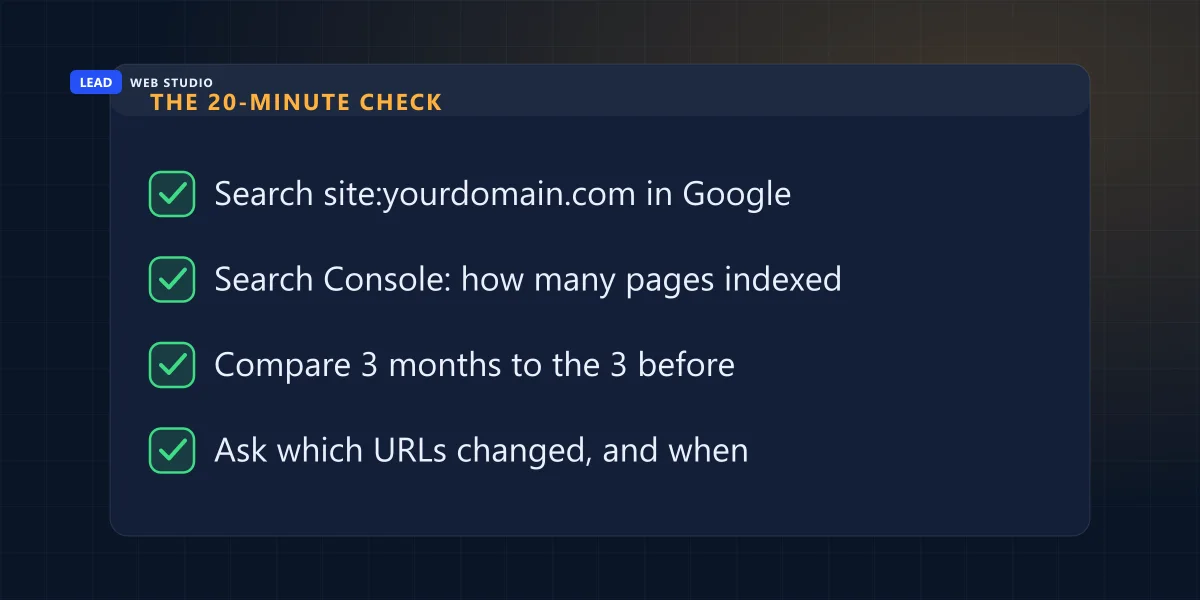
This takes about twenty minutes and needs no technical skill beyond typing into Google and clicking around a free dashboard. Do them in order — the early ones are the fastest and catch the most obvious cases.
- Search site:yourdomain.com in Google and read the blue lines. Those are your page titles as Google shows them. If eight pages in a row read "Home | Your Company" or "Untitled", nobody has been near the most basic thing SEO does. If they read like specific offers in specific places, someone has.
- Count the results. Google's count is a rough estimate, but the shape tells you something: a 40-page site showing 6 results has a problem somebody should already have flagged to you.
- Open Search Console → Pages. This is the real count. Google's documentation describes the report as showing "how many URLs on your site have been crawled and indexed by Google", split into "indexed and non-indexed (but requested) pages", with a "Why pages aren't indexed" table underneath. If the indexed number is flat over six paid months, ask why — that table names the reason.
- Go to Performance and compare the last three months to the three before. There's a date picker with a "Compare" tab; it takes one click. You want the four numbers side by side: clicks, impressions, average CTR, average position. Impressions usually move first.
- Look at the actual queries, not just the totals. Sort by impressions and read the top thirty. Are they things a customer would type before buying something, or are they your own business name and a drift of irrelevance? Ranking first for your own business name proves nothing — you'd be there anyway, whether anybody was working on it or not.
- Ask for the list of URLs changed this month, with dates. One sentence in an email. The answer, or the absence of one, is the whole audit.
- Check who owns the accounts. Open Search Console → Settings → Users and permissions and confirm you're the owner, not a guest in someone else's property.
Check six is the one people flinch at, because it feels like an accusation. It isn't. An agency that's actually working answers it in five minutes from its own project notes, and in my experience the ones doing the work are glad to be asked — it's the first sign in months that the client is paying attention. The uncomfortable silence happens when there's nothing to list.
Rankings can't tell the difference between careful work in a hard market and no work at all. A list of URLs and dates can, in about five minutes.
What should a monthly SEO report actually say?
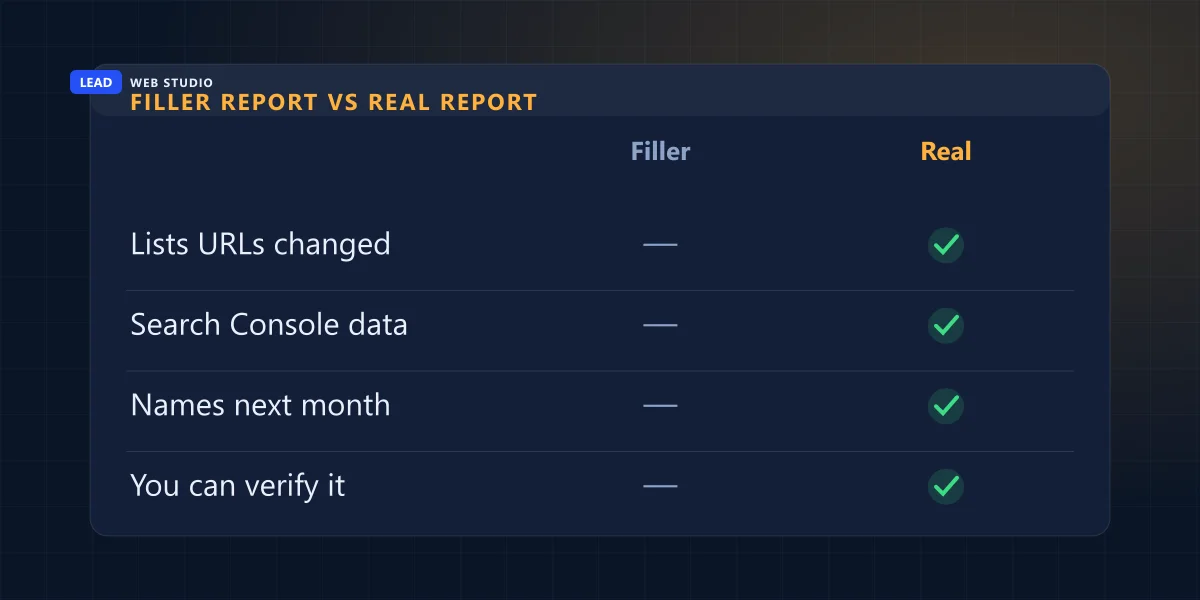
Three sections: what changed, what the numbers did, what happens next. Changes named by URL and date. Numbers pulled from Search Console, which is yours and can be checked. Next month's plan in plain sentences. The rank widgets, the traffic curves and the coloured gauges are decoration wrapped around those three sections, and a report can be full of them while containing none of the three.
Here's the split I'd apply to whatever landed in your inbox this month.
| What's in the report | A report that shows activity | A report that shows work |
|---|---|---|
| The changes | "Optimized on-page elements" | Seven URLs, dates, what changed on each |
| The numbers | A rank tracker's own screenshots | Search Console exports you can reproduce |
| The comparison | This month, standing alone | This period against the same period before |
| Next month | "Continue ongoing optimization" | Named pages and a reason for each |
| Bad news | Never appears | Appears — because it happens to everyone |
That last row is the one I'd watch. Twelve consecutive months of unbroken good news usually means the report has stopped being written for you and started being written about you. Real months contain a page that dropped, a competitor who published something better, an experiment that did nothing — and saying so is what makes the rest of the document worth reading. If the report names competitors you have never checked yourself, it is worth spending half an hour finding your real website competitors from your own query list before you accept the list you were handed.
How long before SEO is supposed to show results?
Longer than a month, shorter than forever, and it depends on how competitive your market is. Google's own guidance is refreshingly unglamorous about it: some changes land in hours, others take months, and you should wait weeks before deciding whether anything helped. Which is exactly why you check the work in the meantime.
Google's SEO starter guide puts it in writing: "Every change you make will take some time to be reflected on Google's end. Some changes might take effect in a few hours, others could take several months." And on judging it: "In general, you likely want to wait a few weeks to assess whether your work had beneficial effects in Google Search results." The same page also disposes of the entire genre of secret-sauce pitching in one bracket — "There are no secrets here that'll automatically rank your site first in Google (sorry!)" — and adds the line I'd frame if I ran an agency: "Not all changes you make to your website will result in noticeable impact in search results."
So here's the rough shape I give clients when they ask, and I'm labelling it as mine rather than dressing it up as data: it's what I expect to see, not a promise, and a plumber in a small town moves faster than a personal injury lawyer competing in downtown Toronto.
| When | What should be visible | Where you'd see it |
|---|---|---|
| Weeks 1–2 | Work you can point at: rewritten titles, new or merged pages, technical fixes | Your own site, and site: search |
| Month 1–2 | More pages indexed; impressions start moving before clicks do | Search Console → Pages, Performance |
| Month 3–6 | Average position improving on real commercial queries | Performance, compared to the prior period |
| Month 6–12 | Clicks and enquiries — the part you actually care about | Your phone, inbox and booking system |
If month one has produced no visible work, don't wait for month six to find out why. The clock only starts when something is done. And if the whole timeline sounds slow to you, that's worth taking seriously rather than pushing through — it's the honest case for paid search, which I've laid out beside the case for SEO in SEO vs Google Ads: where a small business should start.
What are the red flags that I'm paying for nothing?
Three big ones: a guaranteed ranking, secrecy about what's being done, and links appearing from places you'd never advertise. Google publishes all three as warning signs itself, which makes them easy to raise without it turning into an argument about opinion.
Google's own guidance on hiring an SEO is the most useful page in this entire subject and almost nobody reads it. It says flatly: "No one can guarantee a #1 ranking on Google." It tells you to "be wary of SEO firms and web consultants or agencies that email you out of the blue" and to "be careful if a company is secretive or won't clearly explain what they intend to do." It even scripts your questions for you, including the two I'd lead with: "How do you measure your success?" and "Will you share with me all the changes you make to my site?"
Then there's the link question, which is where money gets burned most quietly. If your report mentions "link building" and the links are directory entries in countries you don't serve, that's the practice Google's spam policies define as "creating links to or from a site primarily for the purpose of manipulating search rankings", with "buying or selling links for ranking purposes" and "low-quality directory or bookmark site links" listed among the examples. You're not just wasting the money; you're paying someone to build a liability on your domain.
- A guarantee of position, ever. Especially "page one in 30 days".
- No URLs in any report. Twelve months of "ongoing optimization" is twelve months of nothing you can inspect.
- The accounts are in their name. Search Console, Analytics and the Google Business Profile should all be yours, with them added as users.
- Traffic that never turns into a phone call. Worth checking the traffic is even from your city before anyone celebrates it.
- An audit PDF as the deliverable. A generated list of faults is the beginning of the job, not the job.
- Nobody has asked you a single business question. Which services you make money on, which you'd rather stop doing — SEO that skips this optimises for the wrong pages very efficiently.
That last one is the difference between a checklist and a strategy, and it's why the vetting conversation matters before the contract, not after. I wrote the reference-call version of this — the questions to ask a designer's or agency's previous clients — in how to vet a web designer before you hand over money.
Doesn't a scary audit prove my site is neglected?
No. Every site fails something. Automated checkers grade against an ideal that no real website meets, so a report full of red rows proves a tool was run and nothing else. The number that matters isn't how many faults exist — it's how many were fixed, on which URLs, on which date.
I'll put my own numbers where my mouth is. This site is hand-coded, I run a checker of my own across every page before anything ships, and I did exactly that on the morning I wrote this. It scanned 278 pages and reported 16 issues across 9 of them: six page titles longer than I'd like, five images loading lazily that shouldn't be, two images missing width and height attributes, and one page — the "payment cancelled" page nobody ever links to — missing its description, its canonical tag and its font preloads.
None of that is going to change anyone's rankings this quarter. If I handed you that list as an audit, styled it red, and quoted you $900 to "resolve critical issues", it would look alarming and mean almost nothing. The honest use of a list like that is as a work queue, worked through in priority order, with the dates written down. If you want to see what your own site's version looks like without paying anyone, my free website audit tool runs the same class of checks in your browser and hands you the output rather than a sales call.
What do I do if the checks come back empty?
Ask once, in writing, and be specific: the URLs changed in the last 90 days with dates, and the plan for the next 90. Give it a week. If the answer is vague or doesn't arrive, you have your result — and before you cancel anything, take ownership of the accounts, because that's the part that's genuinely hard to recover later.
The order to do this in matters, and it's not the order anger suggests.
- Secure the accounts first. Search Console, Google Analytics and your Google Business Profile, all owned by an email address you control. Years of history live there, and it's simply gone if the property was theirs.
- Get your website and domain in your own name too. Same principle, bigger stakes — the full argument is in who really owns your website, and it's the single most common way small businesses end up hostage.
- Then send the email. Two questions, a deadline, polite.
- Read the reply for specifics, not tone. A defensive reply with seven URLs in it is a working relationship. A warm reply with no URLs is not.
- If you leave, leave with the data. Export the last 16 months of Search Console performance before access changes hands. Google only keeps that window, and it's the baseline the next person needs.
And if the checks come back full — pages changing, impressions climbing, sensible answers to direct questions — the right move is to stop poking it. Search work compounds, and the surest way to waste a year is to switch providers every six months so nobody's work is ever old enough to pay off. What that costs and what fair pricing looks like is in what SEO actually costs in Toronto; my own monthly SEO work starts at $300 a month, and everything in this article is the standard I'd want held against it, because I'd be asking these questions from the other side of the table too.
Do this one thing today: open Search Console, go to Settings → Users and permissions, and check that you are the owner. If the owner is your agency's email address, that's the first thing to fix — everything else in this article depends on being able to see your own numbers. Not sure what you're looking at? Send me your domain and I'll tell you what's indexed and what's ranking, free, no retainer.
Frequently asked questions
How do I know if my SEO company is doing anything?+
Ask for the list of URLs they changed and the dates, then look at those pages yourself. Work leaves marks you can see: rewritten titles in Google's results, new pages, faster loading, more indexed pages in Search Console. If nobody can name a single URL that changed this month, nothing changed this month.
How long should SEO take before I see results?+
Months for results, days for evidence of work. Google's own starter guide says some changes might take effect in a few hours while others could take several months, and suggests waiting a few weeks before assessing whether a change helped. So judge the work weekly and the rankings quarterly, never the other way round.
Can an SEO guarantee me the number one spot on Google?+
No. Google states plainly in its own hiring guidance that no one can guarantee a #1 ranking on Google, and warns about companies claiming a special relationship with Google or advertising priority submission services. Treat a guarantee as a warning sign: it's a promise about something the person selling it doesn't control.
What should a monthly SEO report actually contain?+
Three things: what changed, with URLs and dates; what the numbers did, taken from Search Console rather than a third-party tool; and what happens next month. Rank-tracker screenshots and traffic graphs only describe what happened, not what anyone did. You're paying for work, so the report should list the work.
Who should own my Google Search Console and Analytics accounts?+
You should. Your agency should be added as a user on your property, not the other way round. If the data lives in their account you can't verify a single claim they make, and you lose the entire history the day you leave. Getting that fixed takes about five minutes and is worth doing today.
Is it a bad sign if an SEO audit finds problems on my site?+
No — every site has problems. I ran my own checker across this site while writing this article and it flagged 16 issues on 9 of 278 pages. A list of faults proves a tool was run, nothing more. What matters is which faults got fixed, on which URLs, and on what date.
Want a second opinion on what you're paying for?
I'll look at your Search Console and tell you honestly whether the work is being done — no contract, no pitch deck. If it turns out you'd rather move, monthly SEO and Google Maps management are both month to month here, and every rate is published on the pricing page.
Get My Free Quote
10+ years building websites and local SEO for GTA trades, clinics and service businesses — and reading a lot of other people's SEO reports out loud to their owners. Read my full bio · Get in touch