The SEO vs Google Ads argument almost always gets settled on the wrong grounds. Somebody asks which channel is better, gets an answer from whoever sells that channel, and spends a year finding out. The version I get asked most weeks is much more specific and much more useful: "I've got about $800 a month. Do I put it into SEO or into Google Ads?" That question does have a right answer — it just isn't the same answer for everyone, and it depends on three numbers most owners haven't worked out yet. So here's the whole thing: what each channel really costs in 2026 with published figures rather than vibes, the three numbers that settle it, and the belief that quietly costs people the most money — that running ads lifts your organic rankings. It doesn't, and Google puts that in writing.
The short version
- Need work inside 30 days? Ads. Nothing else in marketing turns on that fast.
- Can you fund 6–9 months with no return? SEO. It's the cheaper lead once it lands, and it keeps arriving.
- The 2026 average cost per lead on search ads was USD $66.69 across all industries — $90.92 in home improvement, $131.63 in legal.
- Ads do not help your organic rankings. Google's own policy page says Search gives no ranking boost for advertising relationships.
- If your site doesn't convert, both channels burn money at exactly the same rate. Fix the page first.
- Most established GTA businesses should run both — ads to cover the gap, SEO to close it.
SEO vs Google Ads — which should I start with?
Start with Google Ads if you need leads inside 30 days and can afford roughly $70–130 per lead. Start with SEO if you can fund six to nine months with no return and want your cost per lead falling instead of flat. If your website doesn't convert, neither one works — both send traffic to the same page.
That's the answer, and everything below is me showing my working. The reason the question feels hard is that it's usually framed as a preference — do you believe in ads or in organic? — when it's actually a cash-flow decision with a fixed shape. Once you know what a customer is worth to you and how long you can go without one, the choice mostly makes itself.
The one difference that decides everything
You rent Google Ads clicks and you own SEO rankings. Switch the ads off on a Tuesday morning and the traffic is gone by Tuesday afternoon. Stop paying for SEO and the pages carry on ranking for months before they slowly slide. That one mechanical difference explains nearly every other trade-off between the two.
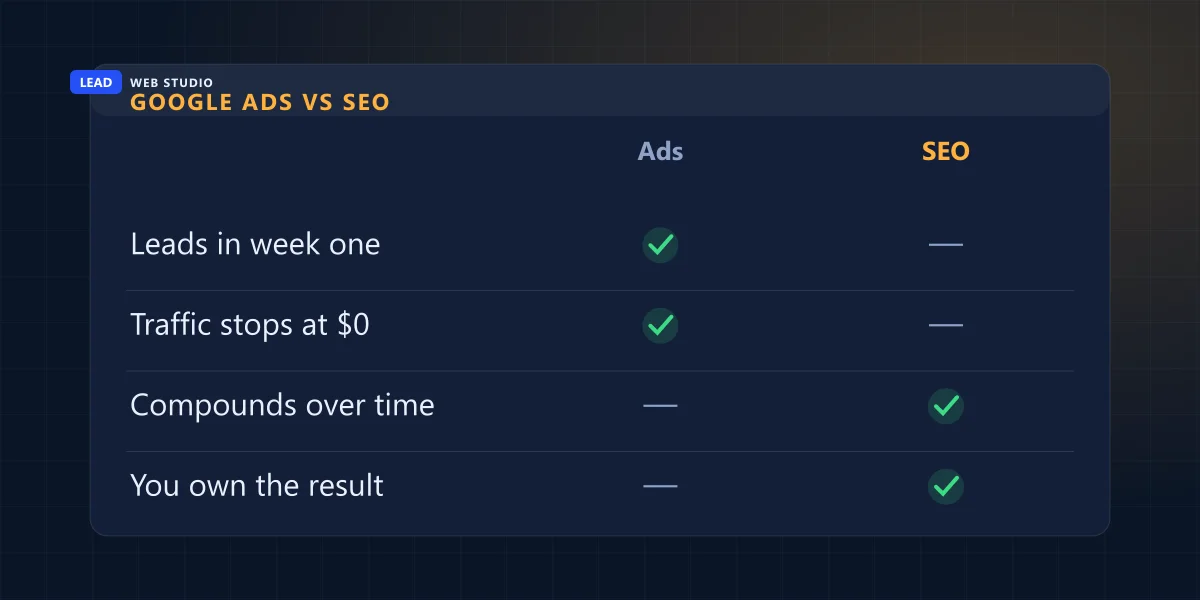
| Google Ads | SEO | |
|---|---|---|
| When the first lead can realistically arrive | Same week | Month 4–9 |
| What happens the day you stop paying | Traffic ends immediately | Declines over months |
| What the money actually buys | One visit | A page that keeps earning visits |
| Cost per lead over three years | Flat, or rising with competition | Falls as the pages mature |
| Position you can buy tomorrow | Top of the page | None — it has to be earned |
There's a practical consequence people miss. Ads are a tap: you can open it wider for a busy month and close it for January, and the response is immediate. SEO is a slow-building asset: you can't turn it up in a hurry, and you can't turn it off to save money in a bad quarter without giving back ground you paid for. Which of those two behaviours suits your business is often a better guide than any ranking argument.
Three numbers you need before this question has an answer
You cannot answer "SEO or ads" in the abstract, and anyone who does is guessing on your behalf. Three figures decide it, and all three are things you already know or can find in twenty minutes. Write them down before you spend anything.
- What one customer is worth to you in a year. Not the value of one job — the value of the relationship. A roofer's customer is usually one job and a referral. A dental practice's is a decade of cleanings. That number sets the ceiling on what a lead may cost. If a customer is worth $4,000, a $100 lead is cheap even at a 25% close rate. If your average sale is $180, a $100 lead is a business that loses money on every sale.
- How many months you can fund with nothing coming back. This is the one that actually decides it. SEO is money spent now for leads that begin arriving in month four to nine. If the honest answer is "two months", SEO is not a strategy for you yet, no matter how well it would suit you in principle. That's not a failure — it's a sequencing problem, and ads exist for exactly this.
- What a click costs in your trade. Google's Keyword Planner shows this for free inside any Google Ads account, before you spend a dollar. It's the single fastest reality check available: a plumber's emergency keywords and a bookkeeper's keywords are not remotely the same market, and the averages in the next section will tell you which end of the scale you're on.
What does Google Ads actually cost in 2026?
Across every industry LocaliQ tracks, the 2026 average was USD $5.42 per click, a 6.64% click-through rate, an 8.18% conversion rate on the landing page, and $66.69 per lead. Service trades sit well above that average. Those are US-dollar figures, so read them as an order of magnitude for a Toronto account, not a quote.
| Industry | Average cost per click | Average cost per lead |
|---|---|---|
| All industries | $5.42 | $66.69 |
| Home & home improvement | $8.33 | $90.92 |
| Attorneys & legal services | $9.87 | $131.63 |
| Dentists & dental services | $8.00 | $72.97 |
| Business services | $5.87 | $93.69 |
Source: LocaliQ's 2026 search advertising benchmarks, last updated June 2026. Worth knowing what a "lead" means in that dataset: it's a form fill or a call, not a signed job. Whatever your close rate is, divide by it.
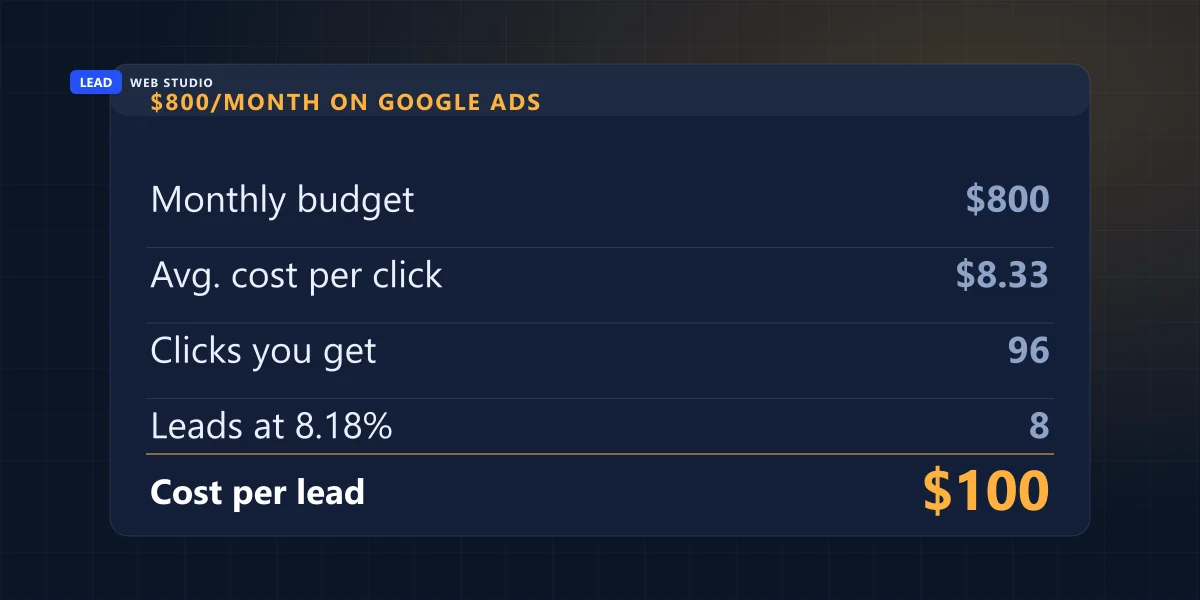
Put the $800 through it. At the home-improvement average of $8.33 a click, $800 buys about 96 clicks. At the all-industry conversion rate of 8.18%, those 96 clicks produce roughly 8 enquiries — around $100 each, which lines up with the $90.92 that LocaliQ reports for that industry directly. Eight enquiries a month. If you close three of them and each job is worth $2,500, that is an excellent month. If you close three and each job is worth $300, you have just paid $800 to earn $900 and done the work for free.
Run that arithmetic before you open the account, not after the first invoice. It takes four minutes and it is the entire decision.
What does SEO cost, and when does it actually start?
Real local SEO in Toronto starts around $300 a month and runs to $1,500+ depending on how competitive your terms are and how much of the site needs rebuilding first. The Google Business Profile side usually moves within one to three months. Organic pages become a dependable lead source somewhere between month four and month nine.
That gap between "money starts" and "leads start" is the whole risk, and it's the part cheap SEO sellers are vaguest about. I've written the honest breakdown of what SEO costs in Toronto — including what the $99-a-month version actually buys — so I won't repeat it here. What matters for this decision is the shape of the curve: you pay flat, and the return starts at zero, stays at zero for a while, and then keeps climbing after you've stopped increasing the spend.
One important split inside "SEO": for a local service business, the map pack is a separate and much faster job than organic rankings. A properly set up and actively managed Google Business Profile can produce calls in weeks, not months, and it costs a fraction of a competitive ads budget. If you're weighing SEO against ads and you don't yet have that profile working, you're comparing the wrong two things — the Google 3-pack is usually the cheapest lead source a GTA service business has access to.
So which one should you start with? A straight answer by situation
Below is what I actually tell people, sorted by the situation they're in rather than by what I'd like to sell them. Find the row that matches you. If two rows match, take the more urgent one — cash flow decides first, and the other channel can start next quarter.
| Your situation | Start with | Why |
|---|---|---|
| You need booked work in the next 30 days | Google Ads | It's the only channel that turns on that fast |
| Emergency service — leaks, lockouts, towing | Google Ads + Maps | Nobody scrolls or compares at 2am; they tap the first result |
| Seasonal peak six weeks out | Google Ads | SEO can't be timed to a season; a budget can |
| Steady demand and 6+ months of runway | SEO + Maps | Cheapest long-run lead, and you keep it |
| You have a Google profile but almost no site traffic | Maps first, then SEO | Fastest and cheapest gap to close |
| Average job under about $200 | Neither yet | A $90 lead can't work at that margin — fix pricing or offer first |
| Your site gets visits but no enquiries | Neither yet | More traffic multiplies a conversion problem |
Does running Google Ads improve my organic rankings?
No. Ads and organic results are produced by separate systems, and Google states the policy plainly on its own How Search Works page: Search gives no "special treatment such as ranking boosts" on the basis of advertising or other financial relationships. Spending more on ads does not move you up the organic list, and pausing them does not push you down.
I bring this up because it's sold both ways, and both are wrong. One version: "run ads for a few months and your rankings will pick up." The other, usually from a nervous business owner: "if I stop the ads, will Google punish my rankings?" No, to both. If your organic traffic drops after you pause ads, what dropped is the paid traffic that was sitting on top of it — check which report you're reading before drawing a conclusion.
The two systems don't talk to each other. The only thing they share is your landing page — and that page is the cheapest thing on this list to improve.
There is one genuine overlap, and it's worth money. Google Ads scores landing page experience as part of Quality Score, so a fast, relevant, honestly-labelled page lowers what you pay per click. The same page speed and relevance also help you organically. That means the money you spend on the page itself is the only spend on this entire page that works for both channels at once — which is why I keep pushing people toward it before they pick a channel at all.
When the honest answer is "neither, yet"
If your website doesn't convert the traffic it already gets, buying more traffic makes the problem more expensive, not smaller. This is the most common version of the question I see, and it usually arrives disguised as a channel question when it's really a page question.
The case I still use as a teaching example: a small-batch maple syrup producer who called me convinced Facebook Ads was broken, with a cost per lead past $40 on a $30 product. The ads were fine. Every click was landing on a homepage that opened with a slider about his grandfather's farm, and the "Order Now" button was buried in a mobile nav nobody taps. He didn't need a different channel. He needed a page with one job — the full version of that story is in website vs landing page, and it's why a proper landing page is usually the first thing I build for anyone about to run paid traffic.
Three checks before you spend on either channel: does a stranger know what you do and where you do it within five seconds of landing; is there a phone number or form visible without scrolling on a phone; and does the form actually deliver to an inbox you read? That last one is not a joke — I've found silently broken contact forms on live sites more than once, and every ad dollar spent while one is broken is simply gone. Our free website audit checks the technical half of this in a couple of minutes.
What I'd do with $500, $1,500 or $3,000 a month
Concrete versions, assuming a GTA service business with a website that works. These are starting allocations, not permanent ones — the point of the first ninety days is to learn your real cost per lead, then move money toward whichever channel is producing it cheaper.
- $500 a month — pick one, don't split. Split three ways this becomes a rounding error in every direction. Put it into the Google Business Profile and local SEO if you can wait; put all of it into a tightly targeted ads campaign on your two or three highest-intent keywords if you can't. Broad keywords at this budget just buy expensive browsing.
- $1,500 a month — run both, weighted to the urgent one. Roughly $500 on SEO and Maps to build the asset, $1,000 on ads to keep the phone busy while it builds. Revisit the split at month six; by then organic should be taking some of the load and the ad budget can narrow to the terms you won't rank for soon.
- $3,000 a month — split it and add the third leg. SEO and content, an ads budget with real room for testing, and a proper conversion pass over the site itself. At this level the biggest wins usually come from the third one, because a page converting at 4% instead of 2% halves your cost per lead on both channels simultaneously.
If you want the wider version of this conversation — what the whole website-and-marketing line should look like against your revenue — that's covered in how much a small business should budget for a website and marketing. And if you'd rather see what the SEO side costs before deciding, the SEO plans and the pricing page both list real numbers rather than "contact us for a quote".
If you take one thing from this page: work out what one customer is worth to you over a year, then compare it to the $66–132 that a search-ad lead costs in your industry. That single comparison tells you whether ads are a growth tool or an expensive way to stay busy — and it takes less time than reading this paragraph twice. Not sure which side you land on? Send me your numbers and I'll tell you straight, even if the answer is "don't spend anything yet".
Frequently asked questions
Should I start with SEO or Google Ads?+
Start with Google Ads if you need work inside 30 days and can afford roughly $70–130 per lead. Start with SEO if you can fund six to nine months with no return and want the cost per lead to fall over time. If your website doesn't convert, fix that before you spend on either.
Does running Google Ads improve my organic rankings?+
No. Google's own How Search Works policy page states that Search gives no ranking boost based on advertising or other financial relationships. Ads and organic results are ranked by separate systems. The only honest overlap is that a fast, relevant landing page helps your Quality Score and your organic rankings at the same time.
How much does a Google Ads lead cost in 2026?+
LocaliQ's 2026 search advertising benchmarks put the average cost per lead at USD $66.69 across all industries, with an average cost per click of $5.42. Service trades run higher: home and home improvement averages $90.92 per lead, dentists $72.97, and legal services $131.63.
How long does SEO take before it brings leads?+
For a local service business in the GTA, expect the Google Business Profile and map pack to move within one to three months, and organic pages to become a steady lead source somewhere between month four and month nine. A brand-new domain with no reviews and no links sits at the slow end of that range.
Can I run SEO and Google Ads at the same time?+
Yes, and for most established businesses that's the right answer. Ads cover the gap while the organic pages mature, then the ad budget gets cut back or pointed at the terms you'll never rank for. Below about $800 a month combined, though, splitting usually means neither channel gets enough to work.
Not sure which one your business should be spending on?
Tell me your average job value and how long you can wait, and I'll tell you where the money should go — including when the answer is "neither, fix the site first".
Get My Free Quote
10+ years building websites and local SEO for GTA trades, clinics and service businesses — including the ones who came to me after a year of paid clicks landing on the wrong page. Read my full bio · Get in touch