A client called me last month in a small panic: her competitor was showing up on the map when she searched her own business's name, and she wasn't. "Do I need SEO or local SEO?" she asked, like they were two separate departments and she had to pick one. They're not the same thing, but I get why she was confused — half the "SEO gurus" cold-emailing small businesses can't actually explain the difference themselves, they just know "local" sells better in a subject line. So let's define it properly, before you pay anyone a cent for it.
The short version
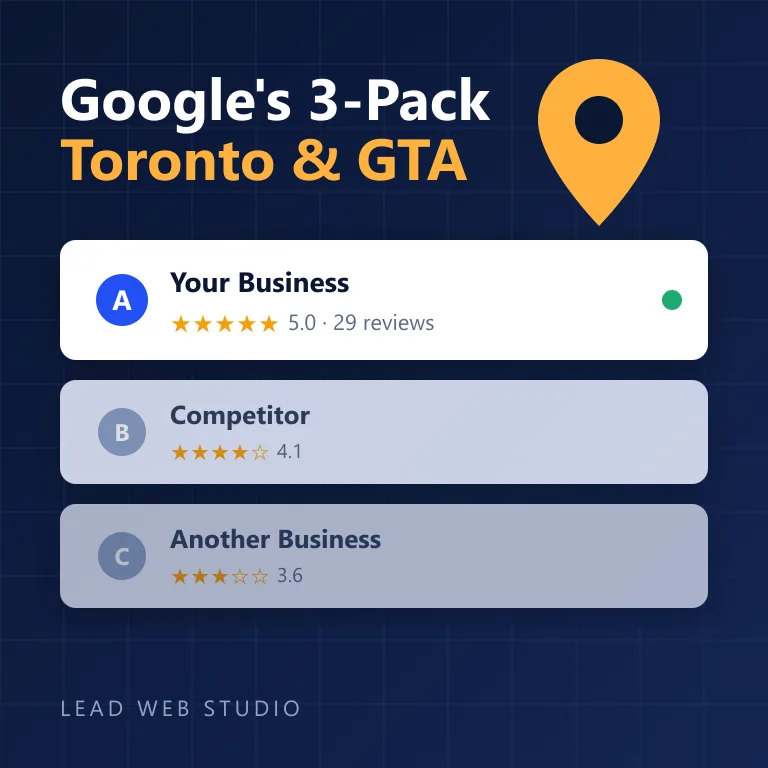
- Local SEO isn't a separate service. It's ordinary SEO, tuned specifically for the Google Maps 3-pack and "near me" searches.
- It only matters if location matters to your customers — a driving radius, a service area, a physical door they walk through.
- The three real levers are your Google Business Profile, a steady flow of reviews, and consistent business details everywhere — not just your website.
- If you can't remember the last time you got a new Google review, that's more likely your actual local SEO problem than anything on your site.
What is local SEO, in one sentence?
Local SEO is the set of things that get your business found by people searching with a location attached — either they typed "in Etobicoke," or their phone already knows where it is. It covers your Google Business Profile, your reviews, consistent business information across the web, and location-aware content on your own site.
That's the same definition I give on my SEO optimization page, because it doesn't change depending on who's asking: local SEO helps your business appear in searches from nearby customers, including the Maps 3-pack and "near me" queries. It's essential if you serve a specific area, and close to irrelevant if you don't.
How is local SEO actually different from regular SEO?
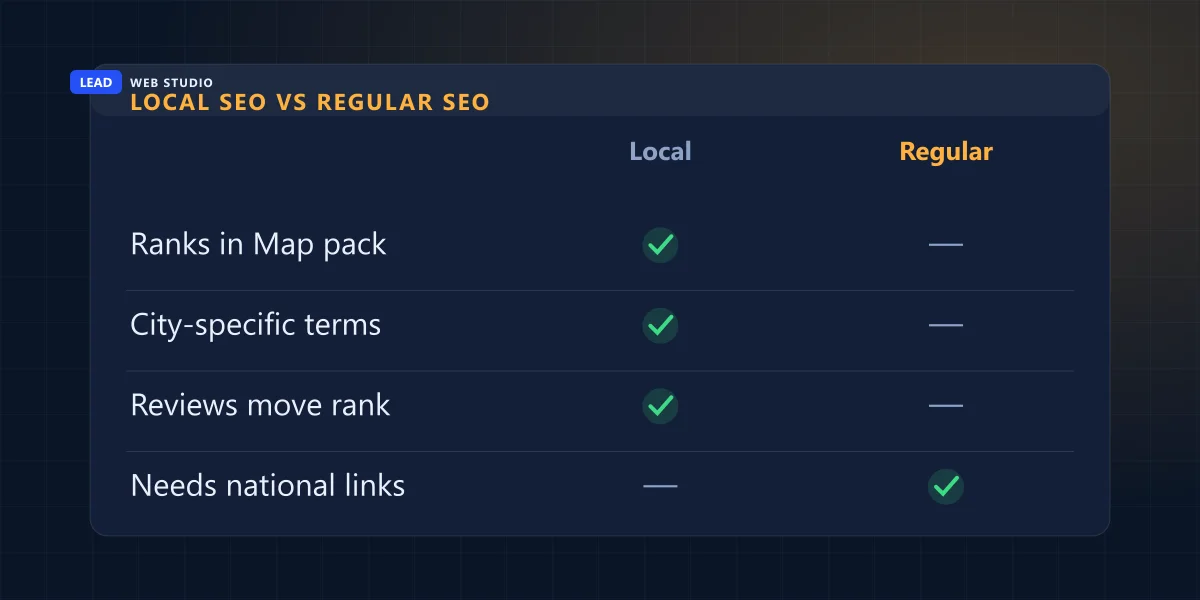
Regular SEO competes for a keyword against every business that ranks for it, anywhere. Local SEO only competes against businesses near the searcher, and it adds a whole second results block — the Map pack — that ordinary organic rankings never touch. Same search engine, genuinely different game.
| What's different | Regular SEO | Local SEO |
|---|---|---|
| Target keywords | "roofing contractor" | "roofing contractor in Etobicoke" |
| Where you can rank | Organic results only | Organic results + the Map pack |
| Reviews as a ranking signal | Minor factor | One of the biggest levers you control |
| Who it's built for | National brands, ecommerce, SaaS | Service-area & storefront businesses |
Google publishes exactly three factors it uses to rank local results — relevance, distance, and prominence — in its own Business Profile documentation. I've walked through what each one means in practice, and the full step-by-step playbook for winning the Map pack specifically, in how to rank in Google's 3-pack — this post is the "what and why," that one's the "how."
Does your service business actually need local SEO?
If a real location or service radius matters to your customers — you drive to them, they drive to you, or you're only licensed to operate in certain areas — yes, unambiguously. If you sell a digital product or ship the same box to every province with no physical service area, location adds little, and your budget is usually better spent on regular content SEO or ads.
A quick gut-check: would a customer ever type your city, or a nearby one, into the same search as your service? If yes, you're a local SEO candidate. If your customers genuinely don't care where you're based, local signals won't move much for you — and I'd rather tell you that honestly than sell you a Google Business Profile you don't need. (If eligibility itself is the question — whether Google will even let you have a listing — I covered that separately in do you need a Google Business Profile.)
What are the actual building blocks of local SEO?
Three pillars, and none of them work well alone. Skipping one caps what the other two can do for you.
- On-site local signals. Your city and service area named in your title tags, headings and body copy — real dedicated pages if you cover more than one city, not one page trying to rank everywhere at once.
- Google Business Profile & Maps. A complete, correctly categorized listing is the single biggest lever most businesses leave half-finished. I go deep on setup and category choice in Google Maps setup.
- Off-site trust — citations & reviews. Your name, address and phone matching everywhere they appear online, plus a steady, honest flow of Google reviews. This is the pillar almost nobody maintains, and it's usually the cheapest one to fix — starting with the Apple Maps and Bing listings that already exist under your name and cost nothing to claim.
Nobody ranks in the Map pack because their website is pretty. They rank because Google trusts they're a real, established business in that neighbourhood — and trust is built with reviews and consistency, not a font choice.
How do you know if your local SEO is actually broken?
Run this six-point check yourself, right now, before you hire anyone to "fix" it. Most of what's broken takes ten minutes to diagnose and costs nothing to confirm.
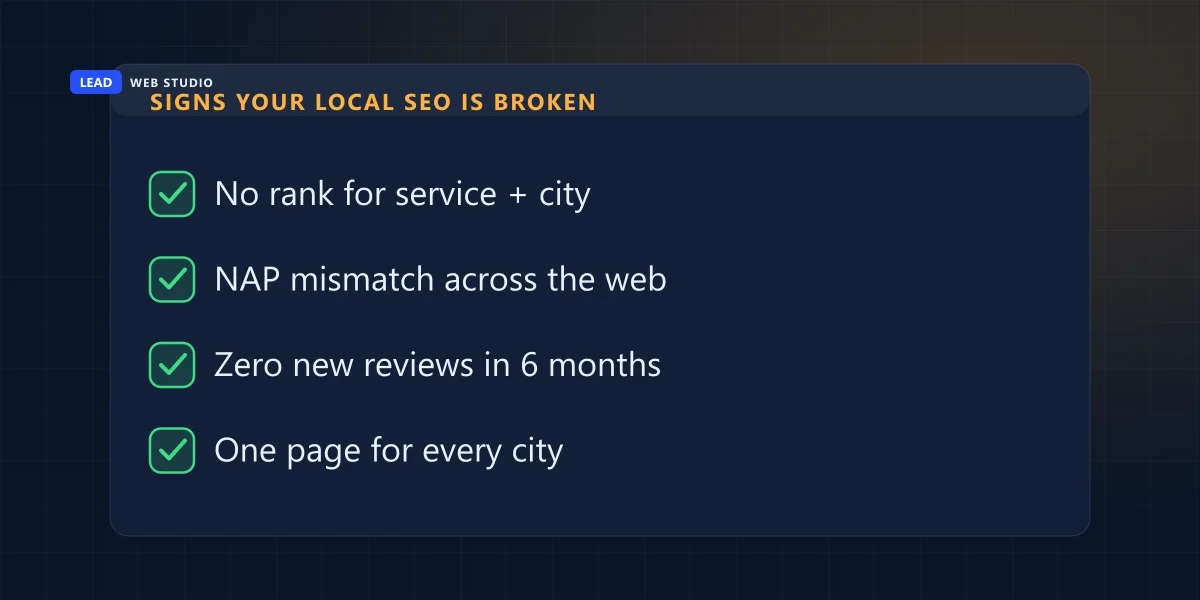
- Search "your service + your city" in an incognito window. If you don't see yourself on page one, that's the actual problem — not your logo.
- Check your NAP (name, address, phone) matches across your Google Business Profile, your website footer, and any directory listing you can find. Mismatches quietly erode trust.
- Count your Google reviews from the last six months. Zero recent reviews reads to Google as a business that's gone quiet, even if you're busier than ever.
- Read your own homepage. Does it mention your city or service area anywhere in actual sentences, not just the footer address?
- Check if one page is trying to rank for every city you serve. That's usually a sign you need dedicated, distinct pages instead of one generic one.
- Ask who on your team last logged into your Google Business Profile. If nobody remembers, it's been neglected — and neglected profiles rank worse than actively managed ones.
What does local SEO cost, and how fast does it actually work?
My own local SEO plans start at $300/month for up to 5 pages, $500 for 10, and $1,000 for 30 — every tier includes Google Business Profile work, Google posts, and review replies, with no lock-in contract. For a full breakdown of pricing across providers and project types, see how much SEO costs in Toronto.
Timeline-wise: expect movement in months, not weeks. Google needs time to trust a profile's completeness and your review pattern before it moves you up. Realistically, early signs show around 6-12 weeks in, with real ranking gains building over 3-6 months of consistent work — anyone promising a page-one ranking in two weeks is selling you the SEO equivalent of a lottery ticket.
If you only do one thing this week: search your own main service plus your city, incognito, on your phone. Whatever you see — or don't — tells you more about your local SEO than any audit tool will.
Frequently asked questions
What is local SEO in simple terms?+
Local SEO is the work that gets your business found by people searching with a location attached, whether they type it or their phone already knows it. It covers your Google Business Profile, reviews, consistent business details across the web, and location-aware content on your site.
Is local SEO different from regular SEO?+
Yes. Regular SEO competes for a keyword against every business that ranks for it anywhere. Local SEO only competes against businesses near the searcher, and it also targets the Google Maps 3-pack, a results block regular organic SEO never touches.
Do all service businesses need local SEO?+
Only if your customers care where you are. If you serve a city or a driving radius, yes. If you ship the same product to all of Canada with no physical service area, location adds little and regular SEO or ads are usually the better spend.
How long does local SEO take to work?+
Realistically, months rather than weeks. Google needs time to trust a profile's completeness, review pattern and citation consistency. Expect early movement around 6-12 weeks and real ranking gains over 3-6 months of consistent work.
What's the single biggest lever in local SEO?+
A steady, honest flow of Google reviews. It's the fastest signal to move because it's entirely within your control every time you finish a job, and Google states directly that review quantity and quality feed local ranking.
Not sure where your local SEO actually stands?
I'll run the same six checks above on your business myself and tell you honestly what's broken — no obligation.
Get My Free Quote
10+ years building websites and local SEO plans for GTA service businesses. Read my full bio · Get in touch