A client emailed me in a mild panic last month. She'd read that businesses should "spend 7-8% of revenue on marketing," ran the math on her $190,000 nail salon, landed on roughly $15,000 a year, and wanted to cancel her SEO plan because it suddenly felt reckless. I get some version of this question constantly — and the honest answer is that the percentage rule she read wasn't written for her at all. It was written for companies with a finance department. So let's throw the percentage out and build you a real budget in actual dollars, sized for a business your size.
The short version
- Skip "% of revenue" advice — it comes from surveys of billion-dollar firms and doesn't translate to a $200K local business.
- Budget in two buckets: a one-time website cost (typically $899 to $2,999) and an ongoing monthly spend ($100 maintenance minimum, $300+ if you're adding SEO).
- A realistic first year for a small business running a starter package lands around $5,700 all-in — not $15,000, not $500.
- If money's tight, fund your website and Google Business Profile first — they keep working after you stop paying. Ads don't.
- Never cut maintenance to save $100/month — that's the plan that keeps your site from quietly breaking.
How much should a small business actually budget for a website and marketing?
Budget it in two separate buckets, not one percentage. A one-time website build typically runs $899 to $2,999 depending on size, and ongoing monthly marketing runs anywhere from $100 (maintenance only) to $1,000+ once you add SEO and Google Business Profile management. Forget the generic revenue-percentage rule — it wasn't built for a business your size, and it produces a number that's either meaningless or needlessly scary.
Why "spend 7-8% of revenue on marketing" is bad advice for you
That percentage is real — it's just aimed at the wrong audience. Gartner runs an annual CMO Spend Survey, and its 2026 edition polled 401 senior marketing leaders and found budgets sitting flat at around 7.7-7.8% of company revenue. The catch: that survey draws heavily from companies with over $1 billion in annual revenue. Those companies have a CMO, a martech stack, and a finance team translating a percentage into a real number. A Toronto plumbing company with $300K in revenue has none of that — and 7.8% of $300K is $23,400, a number that tells you nothing useful about what to actually buy.
| What it tells you | The revenue % rule | A dollar budget |
|---|---|---|
| Built from data on | Mostly $1B+ firms | Real small-biz pricing |
| Needs your revenue figures first | Yes | No |
| Tells you what to actually buy | No | Yes |
| Usable the day you read it | No | Yes |
None of that means marketing spend doesn't matter — it means a percentage borrowed from enterprise data is the wrong tool for a business writing its own cheques. What you actually need is two real numbers: what a website costs once, and what keeping it working costs every month.
My client didn't need a smaller percentage. She needed to stop thinking in percentages entirely and look at the actual invoice — $899 once, $400 a month. That's a number she could hold in her head and say yes or no to.
The two real buckets: one-time website cost + ongoing monthly spend
Every dollar you spend on getting found online falls into one of two buckets, and mixing them up is where the confusion starts. The one-time bucket is your website — you pay once and own it. The ongoing bucket is everything that keeps working for you month after month: hosting and upkeep, local SEO, and your Google Business Profile.
| Bucket | What's in it | Real cost |
|---|---|---|
| One-time (pay once) | Website build — Startup / Growth / Enterprise | $899 / $1,499 / $2,999 |
| One-time | Landing page (single focused page, not a full site) | $899 flat |
| Ongoing (monthly) | Maintenance & support — hosting, updates, small fixes | $100/mo |
| Ongoing | Local SEO — Starter / Growth / Pro | $300 / $500 / $1,000 mo |
| Ongoing | Google Maps management — Starter / Growth / Pro | $149 / $249 / $449 mo |
Put those together for a typical brand-new small business — a Startup website, the entry-level SEO plan, and maintenance running the whole first year — and here's what the real invoice looks like, not a percentage:
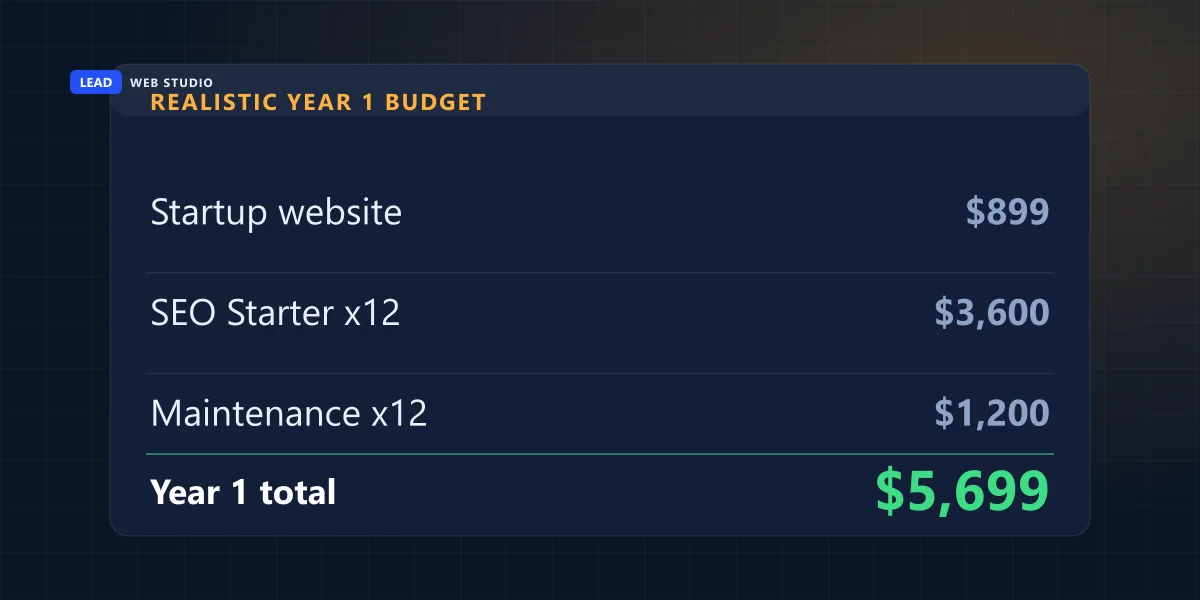
$5,699 for a full first year — website built, ranked, and maintained — is a number you can actually plan around. Compare that to the $15,000-plus a revenue percentage rule was scaring my client into thinking she owed, and it's obvious which one is more useful sitting at your kitchen table doing your own books.
What to fund first when the budget is tight
If you can't afford everything at once — and most small businesses can't in year one — fund things in the order they keep paying you back. Website and Google Business Profile first, because they keep working after you stop paying for them. Ads last, because the moment you stop, you disappear. I go through why in how to get your business found on Google — the short version is that ads rent visibility, while a website and local SEO own it.

- Your website first. Everything else — the profile, the SEO, the ads — points traffic at this. A slow or DIY site caps the return on every dollar you spend after it.
- Your Google Business Profile second. Setup and optimization is a one-time $149-299, and it's the fastest, cheapest visibility a local business can buy.
- Local SEO third. Once the foundation exists, a $300/month starter plan compounds — it keeps ranking whether or not you touch it that week.
- Ads last, and only once the first three are working. Sending paid traffic to a homepage that doesn't convert is how you burn a budget fast — see the honest guide to a site that ranks and converts.
A realistic budget by business stage
The right number changes with where your business actually is, not with your revenue percentage. Here's how I'd size it for three real stages:
| Stage | One-time website | Monthly ongoing |
|---|---|---|
| Brand new, not launched yet | $899 (Startup) | $100 (maintenance only) |
| Established, but invisible online | $899-$1,499 | $400-$600 (SEO Starter + Maps mgmt) |
| Ready to scale | $1,499-$2,999 | $750-$1,450+ (SEO Growth/Pro + Maps mgmt, ads budgeted separately) |
If your business is somewhere between the second and third row, start at the lower number and move up once the site is actually generating enough leads to justify it — never the reverse. I'd rather see a client under-spend for three months and prove the math than overcommit to a $1,000/month plan on week one and resent it by March.
What not to cut first when money's tight
Three mistakes I see constantly when a budget gets squeezed, in order of how often I see them:
- Cutting the $100/month maintenance plan to "save money" — this is how a site quietly breaks, falls out of date, or becomes a security risk with nobody watching it. It's the cheapest line item on the whole list; it's rarely the right one to cut.
- Chasing a cheap hosting deal instead — the checkout at most budget hosts pre-checks $300-500/year in add-ons you don't need. I broke down the real trap in web hosting's hidden fees; fair pricing for domain plus solid hosting is $100-200/year, not $400-500.
- Running ads to a site that isn't ready to convert — this is the fastest way to burn a marketing budget with nothing to show for it. Fix the site first; the ad spend works harder for the same dollars once it does.
If you only take one number from this page: a realistic starter budget is roughly $900 once and $400/month ongoing. That buys a real website, a Google Business Profile that's actually optimized, and local SEO working in the background — no revenue math required.
Frequently asked questions
How much should a small business budget for a website?+
Most small businesses in Toronto spend $899 to $2,999 one-time for a professional website, depending on page count and features. A flat-price landing page runs $899. Budget the low end if you're brand new, the higher end if you need more pages or online ordering.
Is the "spend 7-8% of revenue on marketing" rule actually true?+
It's real data, but it comes from Gartner's CMO Spend Survey, which draws mostly from companies with over $1 billion in revenue. Applying a big-company percentage to a $200K local business produces a number that's either meaningless or needlessly scary. A dollar-based budget works better at small-business scale.
How much should I budget for SEO every month?+
Realistic local SEO plans start around $300 a month and scale to $500 or $1,000 depending on how many pages and posts you need covered. See how much SEO costs in Toronto for the full breakdown. Give any plan three to six months before judging results.
What should I cut first if my budget is tight?+
Cut ads before you cut your website or local SEO. Ads stop working the second you stop paying for them; a good website and an optimized Google Business Profile keep earning you visibility for free, long after the invoice is paid.
Do I need to budget for ongoing maintenance too?+
Yes — plan on roughly $100 a month for hosting, updates and small fixes, separate from your one-time build cost. Skipping it to save money is how a site quietly goes stale, breaks, or gets hacked with nobody watching it.
Want a real number for your business, not a percentage?
Tell me where you're at and I'll give you an honest one-time and monthly figure — no revenue math required.
Get My Free Quote
10+ years pricing real websites and marketing plans for GTA businesses, not billion-dollar ones. Read my full bio · Get in touch