A guy selling small-batch maple syrup called me convinced Facebook Ads was broken. His cost per lead had crept past $40 on a $30 product, and he wanted me to "fix the pixel." The pixel was fine. Every click on his ad landed on his homepage — the one that opens with a slider about his grandfather's farm, three scrolls of family history, and the actual "Order Now" button buried inside a nav menu nobody taps on mobile. He didn't have a landing page problem. He'd never built a landing page at all. He just assumed his website already was one.
The short version
- A website browses. A landing page converts. Different jobs, built in completely different shapes.
- Landing page: one page, one goal, live in 2–3 days, flat $899.
- Full website: multiple pages doing many jobs, 5–7 days to build, also starts at $899 — same number, wildly different scope.
- Sending paid traffic to your homepage is one of the most common, and most expensive, mismatches I see.
What's the actual difference between a website and a landing page?
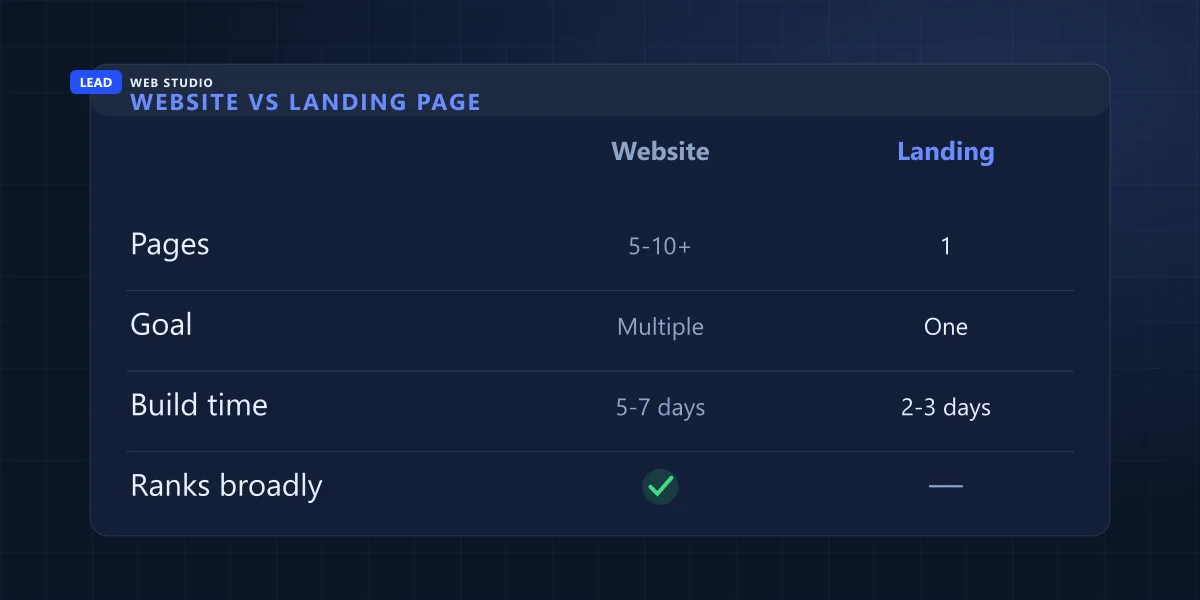
A website is a multi-page hub built for browsing — home, services, about, contact, maybe a blog — with a dozen possible next steps for a visitor to wander down. A landing page is one page with one goal: get a click to do a single thing, usually leaving their name and number. Everything on it either pushes toward that one action or gets deleted.
| What's different | Website | Landing page |
|---|---|---|
| Pages | 5–10+ | 1 |
| Job | Many (browse, learn, buy, apply) | One clear action |
| Navigation | Full menu, many exits | Minimal or none — no exits |
| Build time | 5–7 days | 2–3 days |
| Starting price | $899 · up to 10 pages | $899 · flat, 1 page |
Yes, you read that price row right — I'll get to why the same number buys two completely different things in a minute.
When a landing page is the right call
Reach for a landing page when you already know exactly what you want a visitor to do next, and you're paying to send them there.
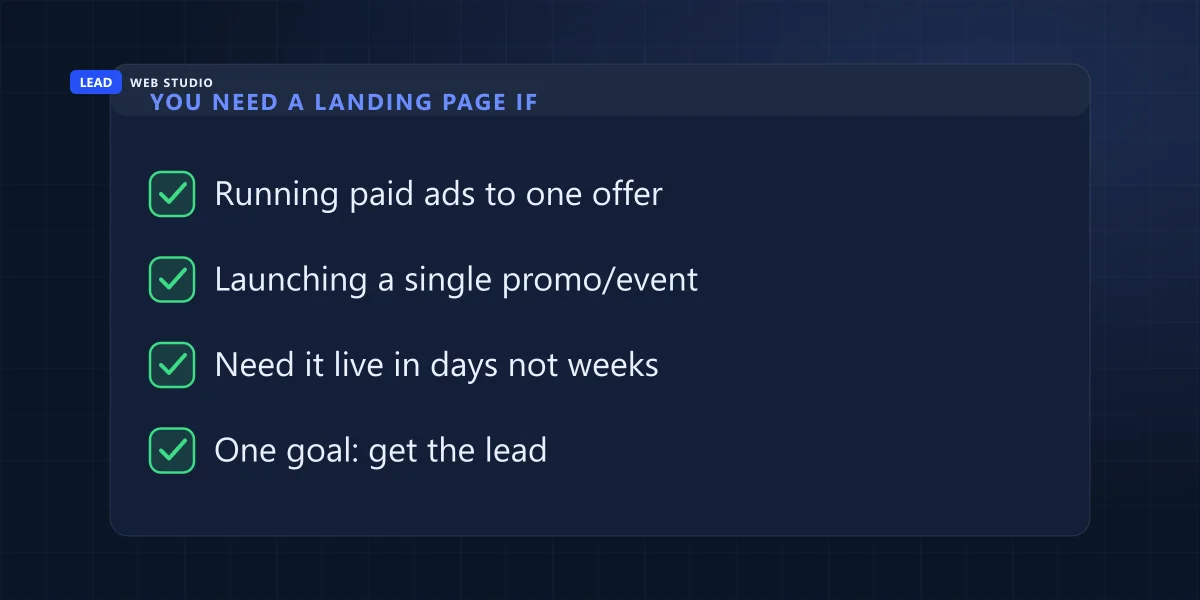
- You're running paid traffic — Google, Facebook, TikTok — to one specific offer.
- You're launching a single product, promo, or event with a start and an end date.
- You need it live fast — days, not weeks, because a campaign is already booked.
- You already have a website and just need a focused page to plug a specific campaign into.
- There's exactly one goal — book a call, claim the offer, get the quote — nothing else competing for the click.
When you actually need a full website
Reach for a real website when your business has more than one story to tell, and you want that story to keep working long after any single campaign ends.
- You sell or explain more than one thing — several services, several products, several audiences.
- You want to rank organically for many different searches, not just one campaign's keyword.
- You want pages that keep earning traffic for free, long after you've stopped paying for clicks — the whole point of organic search is that it doesn't switch off.
- You need a real home for reviews, a portfolio, an about page, and a blog people can actually find later.
A landing page and a website aren't cheaper or pricier versions of each other — they're not even the same species. Pricing them against each other is like comparing a scalpel to a toolbox because they're both made of metal.
The $899 coincidence that trips people up
My Startup Website package is $899 for up to 10 pages. My landing page is also $899, flat, for exactly one page. Clients notice that and ask the obvious question: why would I pay the same money for ten pages' worth of website, or one page's worth of landing page — isn't one of those a rip-off?
Neither is. The $899 buys a different shape of work each time. A ten-page website spreads a normal amount of effort per page across ten pages, because most of those pages are simpler — an about page, a contact page, a services list. A one-page landing page concentrates deep conversion copywriting, offer testing, and a single relentless focus on one action into that single page. You're not buying pages. You're buying either breadth or depth, and both happen to land at the same number.
Does a dedicated page really convert better than a homepage?
Yes, and by a wide margin, because it's built for exactly one job while your homepage is built for a dozen. According to Unbounce's 2024 Conversion Benchmark Report — 41,000+ landing pages and 57 million+ conversions analyzed — the median landing page conversion rate across industries is 6.6%, ranging from 3.8% to 12.3% depending on industry. Your homepage, competing against a nav bar, a blog link, and three other things a visitor could click instead, is almost never in that range.
That's not a landing page being "better" than a website in some general sense — it's a focused page beating an unfocused one at the single job it was built for. It's the same principle I covered in building a website that ranks and converts: a page optimized for one outcome will always out-convert a page trying to do five things at once.
Does a landing page hurt your SEO?
Not the rest of your site — but don't expect it to carry your organic rankings either, because that was never its job. A landing page is usually thin on purpose: one message, one form, minimal navigation. Google can index it, and it can even rank for your brand name, but it isn't built to rank for the dozens of different searches a real website's page structure earns over time. If organic growth is the goal, that investment belongs on your website's actual pages, not on a campaign page designed to disappear when the campaign ends.
Can one page do both jobs?
I get asked this the other way around almost as often. A client once hired me for "just a landing page," then asked to add an about section, three service blurbs, a testimonials carousel, and a map — one addition at a time, each one reasonable on its own. By the end it wasn't a landing page anymore. It was a badly organized homepage wearing a landing page's clothes, and the one clear action I'd built it around was now buried under everything else, exactly like the maple syrup homepage from the top of this article.
If you keep adding sections to "the landing page," you're describing a website. That's fine — just call it what it is, so it gets scoped and priced for what it's actually going to do, instead of quietly outgrowing a format that was never built to hold it.
The 60-second test: which one do you need?
Answer these honestly and the right answer usually falls out on its own.
- Can you name ONE single action you want every visitor to take? If you can't narrow it to one, you're describing a website.
- Is the traffic paid or campaign-driven, or organic and long-term? Paid traffic to one offer points to a landing page.
- Do you need it live this week, or is a longer build fine for more pages? Urgency points to a landing page too.
- Will you want to rank for many different searches over the next year? That's a website's job, not a landing page's.
- Do you already have a website this page just needs to plug into, or is this your only web presence? A standalone presence needs to be a real website.
If you only do one thing this week: check exactly where your current ad traffic lands. If it's your homepage, that's very likely costing you leads right now — and it's usually a 2–3 day fix, not a redesign.
Frequently asked questions
What's the difference between a website and a landing page?+
A website is a multi-page hub for browsing — home, services, about, contact, maybe a blog. A landing page is one page with one goal: get a visitor to take a single action, usually leaving their name and number. Everything on it either supports that goal or gets cut.
Can a landing page replace my whole website?+
No. A landing page can't hold your services, about page, blog, reviews, or the dozens of pages that carry your organic search rankings over time. It's built for one campaign, not to be your entire web presence.
Does a landing page hurt my SEO?+
Not the rest of your site. A landing page usually isn't built to rank broadly on its own — that was never its job — but it doesn't damage your website's organic rankings, which live on your actual site pages.
Why does a landing page cost about the same as a small website?+
Because the price buys different kinds of work. A landing page concentrates conversion copywriting and testing onto one page. A small website spreads simpler, broader work across up to ten pages. Same number, different scope entirely.
How fast can I get a landing page live?+
My own landing pages are designed, written and live in about 2–3 days — faster than a full website because there's only one page to build and one message to get right. See landing page design.
Not sure which one your business needs?
Tell me what you're trying to do — I'll tell you honestly whether it's a landing page, a website, or both, before you spend a dollar.
Get My Free Quote
10+ years building both websites and landing pages for GTA businesses. Read my full bio · Get in touch