Web Hosting Company Website Design in Toronto
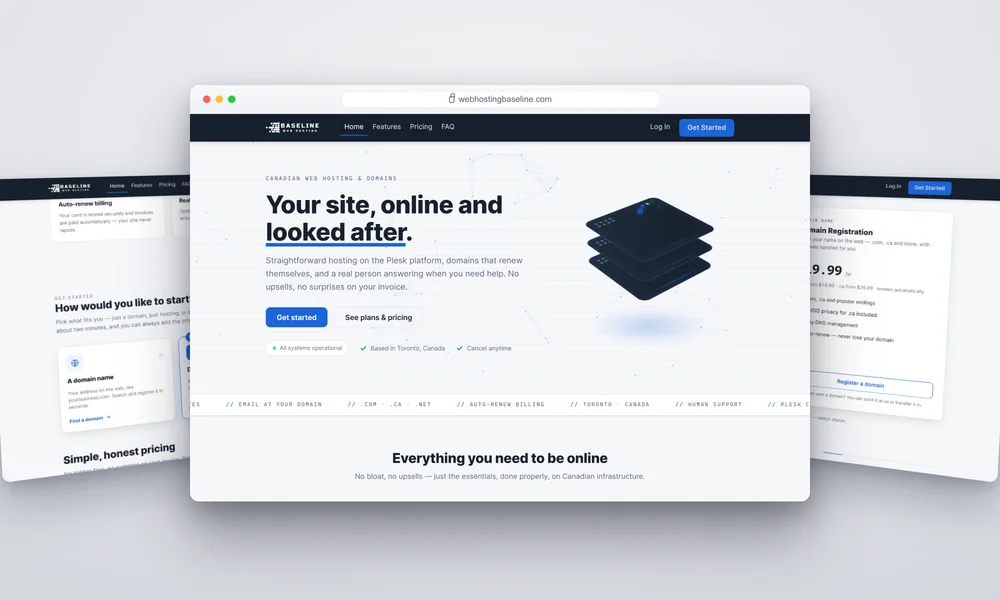
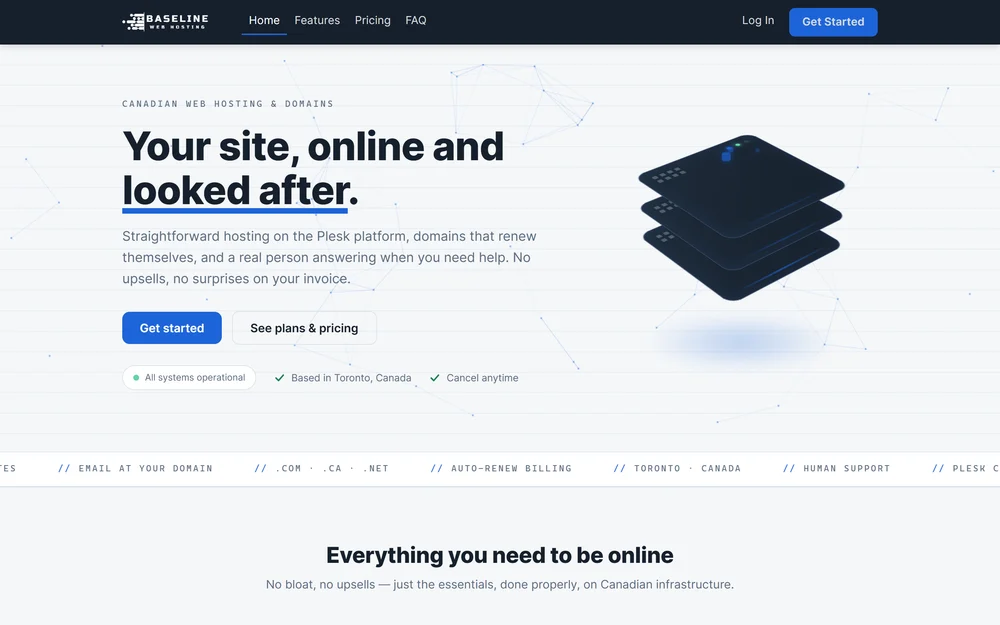
I build websites for web hosting and domain companies in Toronto — the one industry where the buyer is technical enough to check your claims and burned enough to expect the price to change at renewal. The reference build is a Toronto hosting company's site I designed and hand-coded: plans explained in plain English, honest pricing in Canadian dollars, three obvious ways to start, and a checkout that does not fight anyone.
The page a hosting customer opens before they email you. An illustration of the element, not anyone's real numbers. A status page with a visible history — including the bad days — is worth more than any adjective on the homepage, because it is the one claim a visitor can verify without asking.
Short answer
Lead Web Studio builds websites for web hosting and domain companies in Toronto — hand-coded, mobile-first, with plain-English plans, the renewal price shown next to the sign-up price, a status page and a sign-up that finishes in about two minutes. A build is $899–$2,999 one-time and goes live in 5–7 days once content is ready. The reference project for this trade is a Toronto hosting company, live at webhostingbaseline.com.
What does a web hosting company's website have to answer before someone signs up?
Four things, in this order: what the plan actually includes in words a non-specialist understands, what it costs at renewal and not only on day one, who moves an existing site across and whether it goes down while that happens, and what happens at 11 at night when something breaks. Everything else on the page is decoration.
Hosting is unusual among the industries I build for because the buyer can check you. A contractor's customer cannot verify a claim about workmanship until the job is done; a hosting customer can look up your nameservers, read your status page, time your reply and search your brand name plus the word "renewal" before they have spent a dollar. That changes what the site has to do. It cannot win on adjectives, because every competitor has the same ones — fast, reliable, secure, 24/7 — and the words have stopped meaning anything through repetition.
What it can win on is specificity. A number instead of an adjective. A named control panel instead of "easy management". A renewal price instead of an asterisk. Support hours in a timezone instead of "always here for you". Each one is a small, checkable commitment, and a page made of checkable commitments reads as a company that expects to be checked.
What an Uptime Promise Actually Costs You in Minutes
Uptime percentages are the most quoted and least examined figures in this industry. Here is the arithmetic behind each one, on a 30-day month, so you can decide which number belongs on your own plan page before a customer does the sum for you.
| The promise | Downtime allowed per month | Per year | What it means for the page |
|---|---|---|---|
| 99% | 7 hours 12 minutes | About 3 days 15 hours | Do not publish this one. A full working day offline in a year is a number a careful buyer will hold against you |
| 99.9% | 43 minutes | About 8 hours 46 minutes | The realistic figure for shared hosting, and the one most buyers expect to see. Publish it with the maintenance-window exclusion written out |
| 99.99% | 4 minutes 19 seconds | About 53 minutes | Only if the infrastructure genuinely supports it. Claim it and one bad afternoon puts you in breach of your own page |
| 99.999% | 26 seconds | About 5 minutes | An enterprise figure. On a small hosting site it reads as marketing, and it invites the exact scrutiny you do not want |
Calculated from a 30-day month (43,200 minutes) and a 365-day year. The point is not which row you pick — it is that the number on your site should be one you would be comfortable defending in an email.
Built for a Toronto Hosting Company, Not a Template
Baseline Web Hosting sells hosting and domains out of Toronto, and wanted the opposite of the usual industry site: no spec dump, no buried renewal rate, no upsell wall between a visitor and a working website. I designed and hand-coded it around one promise — one plan, one price — with a feature grid that explains SSL, email, the Plesk control panel and .ca domains in words a first-time site owner can follow, honest pricing tables in Canadian dollars, and trust signals that are specific rather than decorative: Toronto-run hosting and support, real human replies, automatic backups, cancel any time.
What a Support Page Has to Prove Before Anyone Trusts It
Nobody buys hosting for the hardware. They buy it for the night the site is down and somebody has to answer. Two things make that believable on a page: a stated reply time you can keep, and evidence that a person — not a macro — is on the other end.
My site is showing a security warning and I have no idea what changed. I did not touch anything today.
Your SSL certificate did not auto-renew last night — I have reissued it and the warning is gone on my end. Clear your browser cache and check again. I have also set a reminder to watch the next renewal so this does not repeat.
An illustration of the exchange a support page promises — not a real ticket. What matters is that the page states which hours are covered, roughly how long a first reply takes, and which channel actually reaches a human. Vague reassurance costs you the customers who read carefully, and they are the ones who stay. The same discipline applies after launch on website maintenance and support.
Who's Actually on a Hosting Site, and What Each One Checks
Six very different people land on the same homepage, and only one of them is a beginner. A single "Features" page cannot answer six questions this far apart.
| Who's on the page | What they're really checking | Page I'd build |
|---|---|---|
| First-time site owner | Whether they can do this at all without hiring someone | A getting-started page that names the three steps and says plainly what you do for them and what they do themselves |
| Someone whose site is down right now | Whether you are up, and whether anyone will answer | A status page reachable from every header, plus a support page with hours and a first-reply time |
| Moving off a big host | Whether the move breaks their email and how long the site is offline | A migration page that answers who does the transfer, what happens to mailboxes, and what the DNS cutover looks like |
| Buying a .ca domain | Whether they qualify to hold one, and what it renews at | A domain page that explains the Canadian Presence Requirements in plain words and shows registration and renewal prices side by side |
| Agency or freelancer | Whether they can hold several client sites and get billed sensibly | A page for multi-site accounts covering client billing, access separation and who your registrar is |
| Comparison shopper on tab three | The renewal price, the refund window and the exit path | A plan page with both prices on the card, a refund line that is not in the footer, and an honest answer on leaving |
Three Ways to Start, One Checkout
Most hosting sign-ups fail before the payment page, because the visitor cannot tell which product they need. Some already own a domain and want space to put a site on. Some own nothing and want both. Some only want to park a name they just thought of. On the Toronto build I made that the first decision on the page — just a domain, just hosting, or both together in one checkout — instead of leaving the visitor to work it out from a specifications table. It removes the most common reason a hosting page is abandoned: not price, but not being sure what you are buying.
The same idea drives the plan layout: one plan at one price, billed monthly or yearly in Canadian dollars, with what is included written as sentences rather than a matrix of ticks.
Say What It Means Before You Say What It Is
Every term below is on almost every hosting site in the country, and most of them are printed without translation. The specification can stay — it just belongs underneath the sentence that tells a human why they should care.
The padlock, and no browser warning
It encrypts the connection and stops the browser telling visitors your site is not secure.
What they're really asking: is it included, and does it renew by itself?
The screen where you actually do things
Add a mailbox, restore a backup, install a site. Name the panel — Plesk, cPanel or your own — because people search for it by name.
What they're really asking: will I be able to find anything in it?
The signpost that points a domain at a server
Change them and the domain starts loading from you instead of the old host. It is the moment people are most afraid of.
What they're really asking: will my site or email go down while it changes?
How far back you can undo a bad day
Frequency and retention are the whole answer. "Automatic backups" without a number is not an answer.
What they're really asking: how many days can I go back, and who restores it?
What it costs in year two
Put it on the plan card beside the sign-up price. This is the single most-searched thing about any hosting brand.
What they're really asking: is the first year the real price or the hook?
Moving a site that already exists
Say who does it, what it costs, how long it takes and what happens to the mailboxes.
What they're really asking: is this going to be my weekend or yours?
"Every hosting site I have looked at has the same five adjectives on it. The only ones that convert have a number where the adjective should be." — Liubomyr Lukaniuk, on building the Baseline Web Hosting website
Why a Toronto Address Is Worth Putting on a Hosting Site
Hosting is sold everywhere, so "Canadian" is one of the few things a Toronto company can say that a competitor in another country cannot copy. It is also the claim most often left implied. If your servers, your support desk or both are here, the site should say which — because a customer who wants Canadian data residency is not going to guess, and a customer who does not care will not be put off by the sentence.
There is a physical reason the claim is credible from this city. TorIX, the Toronto Internet Exchange, describes itself as Canada's largest internet exchange point and the third largest in North America, carrying traffic for hundreds of connected networks. A large share of the country's domestic traffic is handed between networks here rather than routed south and back. That is worth one honest sentence on a hosting page and no more — the customer does not need a network diagram, only the reassurance that "Toronto" refers to something real.
The buyers are here too, and they are not who most hosting sites are written for. They are the accountant on Eglinton with a five-page brochure site, the trades business north of Steeles whose nephew built the site and moved away, the design studio holding fifteen client domains it never wanted to hold, and the shop that has been paying a US host in US dollars for six years and just noticed the exchange rate. None of them are looking for NVMe benchmarks. They are looking for someone in the same timezone who will answer, and for a bill they can predict — which is why the plan page and the support page matter far more here than the specifications page.
One local specific worth building a page around: .ca domains. Every .ca registrant has to meet CIRA's Canadian Presence Requirements by selecting a category that shows their connection to Canada. Most hosting sites either ignore this or bury it in the registration agreement. Explaining it clearly on the domain page is free, genuinely useful, and it earns the kind of search traffic a features page never will.
A Hosting Website Built to Earn Trust and Close the Sign-Up
Both halves matter. The first gets a technical visitor to believe you; the second gets a nervous one to the payment page.
Design & credibility
A clean, technical design that reads as reliable rather than loud.
- Plans explained in sentences, with the specification underneath
- Renewal price on the plan card, not in the terms
- A status page linked from the header, not hidden in the footer
- Support hours, channels and a first-reply time you can keep
- Mobile-first layouts that load in about a second
Growth & functionality
Built to turn a comparison shopper into a renewing customer.
- Three entry paths — domain only, hosting only, or both in one checkout
- Honest pricing tables in Canadian dollars
- A migration page that answers downtime, email and DNS
- Connected to your billing system and control panel
- SEO structure and schema from the first line of code
If you already sell domains through an ICANN-accredited registrar as a reseller, say so on the domain page. It answers a question careful buyers ask and most hosting sites leave silent.
Which Package Fits a Hosting Company
| Package | Best for | What's included |
|---|---|---|
| Starter — $899 | Up to 10 pages | Home, plans, domains, features, support, status and contact, with a protected form and local SEO |
| Full Site — $1,499 | A fuller site | Use-case and documentation pages, a migration page, a knowledge-base structure and deeper SEO |
| Advanced — $2,999 | Custom functionality | Portals, integrations with your billing or control panel, sign-up flows, unlimited pages and priority support |
One payment, fixed in writing before I start, and about 5 to 7 days once content is ready. Technical products usually need an extra round on the messaging — see full pricing.
Hosting Website FAQ, Toronto
What should a web hosting company's website include?+
A plan page that states the renewal price next to the sign-up price, a plain-English explanation of what is actually included, three obvious entry paths for a domain only, hosting only or both, a live status page, a migration page saying who moves the site and whether there is downtime, real support hours, and a checkout that finishes in about two minutes.
Should a hosting website publish its renewal price?+
Yes, on the plan card itself rather than in the terms. Renewal pricing is normal in this industry and buyers know to look for it, so the page that hides it is the page that gets closed. Stating both numbers up front costs a few sign-ups and saves a great many refund requests and chargebacks later.
Do I need to be Canadian to register a .ca domain?+
You need to meet CIRA's Canadian Presence Requirements, and every .ca registrant picks one of the categories that shows their connection to Canada — Canadian citizen, permanent resident, a corporation incorporated in Canada, and so on. If you sell .ca domains, that check belongs on the domain page in plain words, not buried in the registration agreement.
Does a hosting company need its own status page?+
Yes, and it needs to be reachable when the main site is having a bad day. It is the first URL an existing customer opens before they write to support, and the first thing a careful buyer checks before they sign up. A status page with a real history reads as confidence; no status page at all reads as something to hide.
What does a hosting company website cost in Toronto?+
$899 one-time for up to 10 pages, $1,499 for a fuller site with use-case and documentation pages, $2,999 where custom functionality, portals or integrations are involved. One payment, fixed in writing before I start, and about 5 to 7 days once the content is ready. See my website design packages.

10+ years designing SEO-ready websites for local businesses, including technical and B2B companies across the GTA. About the studio · Get in touch
Selling hosting from a site that reads like everyone else's?
I'll build the plan page, the status page and the sign-up flow that make a technical buyer stop comparing. Packages from $899.