Appliance Installation Website Design in Toronto
I build websites for appliance installation and hookup companies in Toronto — sites organised around what actually decides a booking: which appliance, which utility connection, and whether you can get there this week. My anchor project is Prime Appliance, an installation company here in Toronto, so I have already solved this exact brief once.
An installation site is a control panel, not a brochure. Appliance, address, date — three settings, and every page should make one of them easier to choose.
Short answer
Lead Web Studio builds websites for appliance installation companies in Toronto — custom-coded, mobile-first and structured around one page per appliance type rather than a single "services" list. A build like this costs $899–$2,999 one-time and goes live in 5–7 days once your service list and pricing are ready. The real anchor client is primeapplianceinstallation.com, based here in Toronto.
What does an appliance installation website have to answer before someone books?
Three things, in this order: can you install this appliance, can you get to this address, and can you come before the delivery truck arrives. Most installer sites answer none of them on the page a visitor lands on — they open with a company story. The booking goes to whoever states the appliance, the area and the availability first.
That is why I do not build these sites around a single "Services" page. Someone searching for a gas range hookup and someone searching for a stacked laundry install have different worries, different price expectations and different reasons to hesitate. One page each lets you answer both properly, and gives Google two distinct pages to rank instead of one generic one. See how I handle the same problem for HVAC companies and for handyman businesses.
The Five Measurements That Decide the Job
Almost every install that goes wrong went wrong before anyone arrived. These are the five things a good site asks about while the visitor is still reading — not on the doorstep.
Put these five in the quote form and you pre-qualify the lead. Leave them out and you pay for the second trip.
Built for a real Toronto installation company
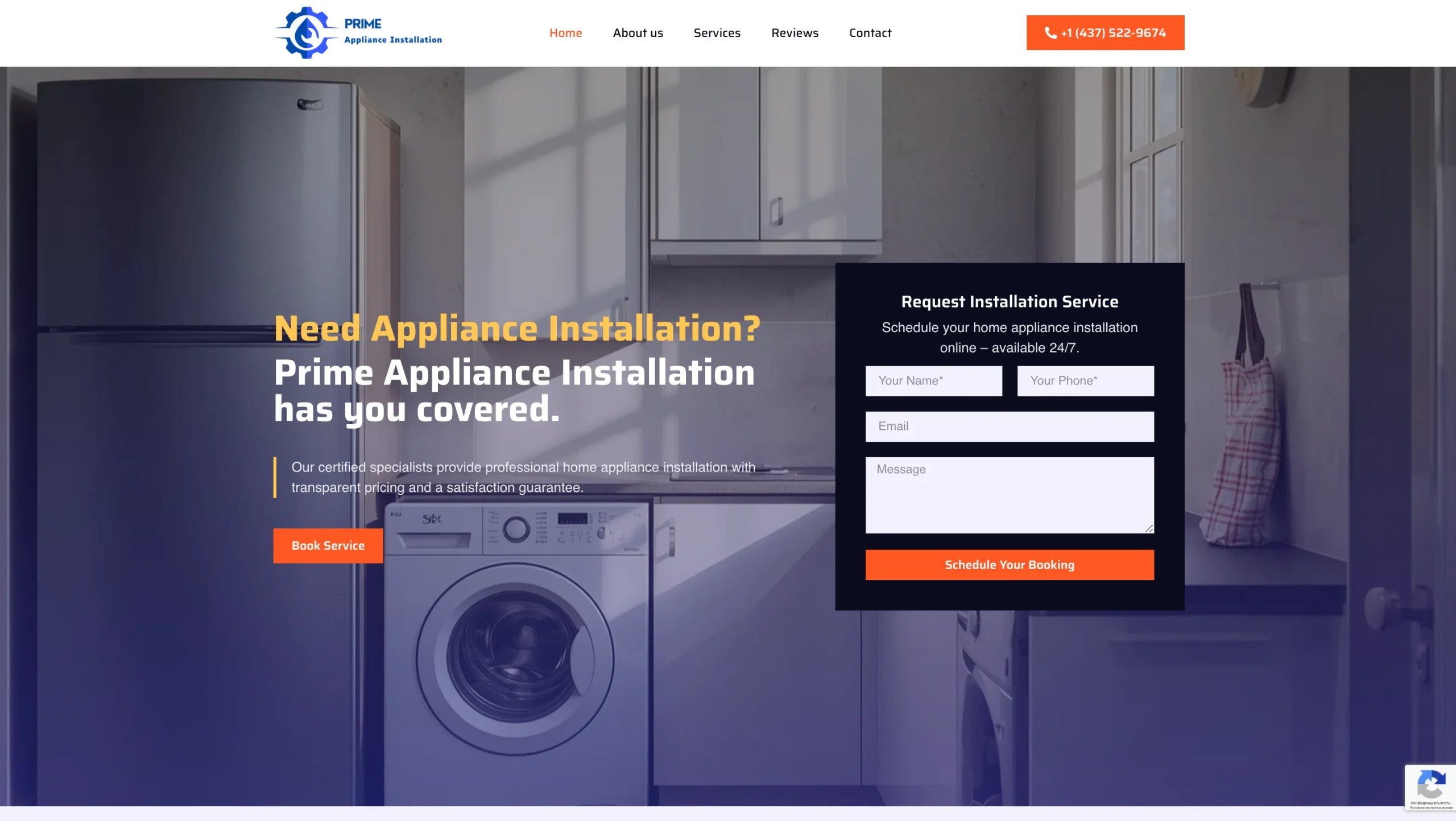
Prime Appliance needed a website that works as a sales tool, not an online brochure. I built dedicated service pages for refrigerators, dishwashers, ovens and washers so each one answers its own questions and sets expectations before the phone rings, presented pricing up front so the calls that come in are ready to book, and added same-day booking paths with click-to-call on mobile. Local SEO and local business markup went in from the first line of code.
A Kitchen Is Not One Service — It Is Five
Read a kitchen the way a searcher does: each unit on the wall is its own search, its own price question and its own page.
RefrigeratorDoorway, hinge clearance and cabinet depth — the measure-first page.
Range & cooktopSplit the page in two: gas connection versus electric, they are different jobs.
DishwasherSupply line, drain and shut-off valve — what exists, what you supply.
Over-range microwaveDucted outside or recirculating, and what each one needs above the cabinet.
Washer & dryerStacking kits, vent length and whether the old set gets hauled away.
Every Appliance Comes With a Different Worry
| Appliance | What the Homeowner Is Actually Worried About | Page I'd Build |
|---|---|---|
| Counter-depth or built-in fridge | "Will it fit through the door and sit flush with the cabinets?" | A measure-first page with doorway, hinge and depth guidance |
| Gas range or gas dryer | "Is the person who shows up actually allowed to touch the gas line?" | A gas-connection page that names the certification the work requires |
| Dishwasher | "Is there already a water line and a drain under there?" | A hookup page covering supply, drain and the shut-off valve |
| Over-the-range microwave | "Does it vent outside, or just blow back into the kitchen?" | A venting page that explains ducted and recirculating side by side |
| Stacked washer & dryer | "Will a stack fit that closet, and will you take the old set?" | A laundry page with stacking-kit and haul-away details |
| Wall oven or cooktop | "Will the new unit match the cabinet cutout that's already there?" | A cutout page listing the measurements to send ahead |
Three Connections, Three Trust Questions
An appliance install is really a connection to a utility. Each one raises a question a website can settle in a sentence — or leave hanging until the visitor calls someone else.
Dishwashers, ice makers, washers. The visitor wants to know who provides the supply line and whether a seized shut-off valve is your problem or theirs. Say it plainly on the page and the quote conversation starts one step further along.
Ranges, cooktops, gas dryers. In Ontario, work on fuel-gas appliances and lines is regulated, and the Technical Standards and Safety Authority certifies the technicians permitted to carry it out. A page that states clearly whether gas connection is in scope, or whether you install and a certified technician connects, removes the single biggest hesitation on this kind of job.
Electric ranges, dryers, wall ovens. Connecting to an existing 240-volt receptacle and adding a new dedicated circuit are not the same job — the second is licensed electrical work. Most sites blur the two, then lose the afternoon arguing about it in a driveway.
These are general Ontario requirements for the trade, not a statement about any one company's certifications — what your own site says about scope should come from you.
Toronto's Housing Stock Decides the Install
Along the Danforth and through East York — Pape, Donlands, Coxwell — the housing is largely semi-detached and dates from the 1920s and 30s. Laundry sits in an unfinished basement at the bottom of a narrow, turning staircase, and the rear door is often the only realistic route in. Here the deciding factor is access, not the appliance: an installer who asks for the stair measurement before quoting looks like the only professional in the search results.
Out in Scarborough, Agincourt and Milliken are postwar bungalow country with decades of infill on top. Households are frequently multigenerational and cook heavily, which means gas ranges, second refrigerators and chest freezers in garages and basements — jobs where the appliance goes somewhere the builder never planned for, and where a page about running a new water line or a dedicated circuit earns its place.
Downtown, Corktown, Regent Park and the Canary District are almost entirely new build, and the constraint moves from the house to the building: service-elevator booking windows, a certificate of insurance the property manager wants before you arrive, loading-dock times, and panel-ready appliances that have to be integrated into cabinetry. A site that says "we handle condo building requirements" and lists what the concierge will ask for converts a whole category of job that most installers quietly avoid. It is the same discipline I apply on Toronto web design projects generally: name the constraint the customer is already worrying about.
They Type the Brand, Not Your Company Name
Nobody searches "appliance installation services". They search the thing they just bought, and often paste the model number straight off the delivery email.
That is one query out of hundreds of the same shape — brand, appliance, city. A single "Services" page can only match a handful of them. Separate appliance pages that name the brands you install, with a short section on what each type of hookup involves, match far more of that long tail, and they read as expertise rather than as keyword padding. This is ordinary SEO work, done at write time instead of bolted on later.
A Complete Website Built to Perform
Design & Experience
A clear, task-focused design for a busy installation company.
- Appliance-specific service pages
- Upfront pricing presentation
- Simple, scannable layouts
- Mobile-first responsive design
- Fast loading on every device
Growth & Functionality
Built to convert local searches into scheduled jobs.
- Booking & quote forms
- Click-to-call on mobile
- Local SEO for installer searches
- Google Maps integration
- SEO-optimized structure from day one
"Most of what stops an appliance booking is physical — a doorway width, a shut-off valve that won't turn, a 240-volt outlet that isn't there. A site that raises those before the call is the site that gets the call." — Liubomyr Lukaniuk, on building appliance installation websites
Which Package Fits an Installation Business
| Package | Best for | What's included |
|---|---|---|
| Starter — $899 | Up to 10 pages | Core appliance pages, coverage area, quote form, basic local SEO |
| Full Site — $1,499 | Separate service and area pages | A page per appliance type, city pages, deeper local SEO |
| Advanced — $2,999 | Booking or maintenance-plan signup involved | Scheduled booking with time slots, unlimited pages, priority support |
One-time pricing, quoted before I start. Google Business Profile setup or optimisation is separate, from $149 — see full pricing.
Appliance Installation Website FAQ, Toronto
Have you built an appliance installation website before?+
Yes. I designed and built the website for Prime Appliance, an appliance installation company here in Toronto — service pages for every appliance type, pricing presented up front, same-day booking paths and local SEO for installation searches.
How long does an appliance installation website take to build?+
Usually 5 to 7 days once your service list, coverage area and pricing are ready. The part that slows a build down is not the design — it is deciding what you will quote a flat price for and what has to stay a site-visit estimate.
Can the site take same-day booking requests?+
Yes — anything from a simple request form to scheduled booking with time slots, depending on how you actually dispatch. For emergency work the phone still converts best, so it stays prominent either way.
What does an appliance installation website cost?+
$899 one-time for up to 10 pages, $1,499 for a fuller site with separate service and area pages, $2,999 where booking or maintenance-plan signup is involved. See my website design packages.
Will it help with "near me" and installation searches in Toronto?+
That is what the structure is for: named service areas, local business schema and pages built around the words people actually type. Pair it with a properly optimised Google Business Profile, from $149, or neither half works.

10+ years designing SEO-ready websites for home-service and trade businesses, including Prime Appliance in Toronto. About the studio · Get in touch
Need a website for your appliance installation business?
I'll build a fast site that answers the appliance, the area and the availability before the phone rings. Packages from $899.