Bakery Website Design in Vaughan
A bakery website in Vaughan often does two jobs at once: it takes orders from people who want a dozen pastries on Saturday, and it answers grocery and café buyers who want a standing weekly delivery. My bakery website design for Vaughan starts with the part nobody sees until it goes wrong: the checkout has to know that one muffin, two muffins and six muffins are taxed three different ways.
Three receipts, one muffin priceIllustrative $3.50 muffin, not packaged, sold at the counter or online
Sources: Excise Tax Act, Schedule VI, Part III, s. 1 (m); CRA GST/HST Info Sheet GI-064; Statistics Canada table 33-10-1176-01. The $3.50 price is an example. This is how the rules read, not tax advice; the bakery’s accountant confirms the settings.
When is a baked good taxable in Ontario, and why does the website care?
Cakes, muffins, pies, pastries, tarts, cookies, doughnuts, brownies and sweet-filled croissants are taxable when sold as single servings in quantities of fewer than six, and zero-rated at six or more. Bread, bagels and plain croissants are zero-rated at any quantity. An online order form applies that rule on every cart, with no cashier to catch a mistake.
The wording comes from paragraph 1 (m) of Part III of Schedule VI to the Excise Tax Act, the list of basic groceries that carry no GST/HST. It names the products, then excludes them from zero-rating where they are “sold as single servings in quantities of less than six”, and it carves bread products back out: “bagels, English muffins, croissants or bread rolls, without sweetened filling or coating”. At the counter a trained cashier and a point-of-sale system handle this. On a website the same logic has to live in the product data, because the customer builds the cart alone.
Ontario adds a second layer. The CRA’s info sheet GI-064 describes a point-of-sale rebate of the provincial 8% on qualifying prepared food and beverages when the total price for them, before tax, is not more than $4. That is why Order A above is charged 5% and Order B 13%. A cart that holds one croissant and a loaf of bread is a small puzzle of its own: the loaf is zero-rated and, per GI-064, goods that do not qualify are ignored when the $4 limit is counted.
| Product, as sold | GST/HST | Rule | What the product record stores |
|---|---|---|---|
| Loaf, baguette, bagels, plain rolls | Zero-rated | 1 (m) bread exclusion | Tax class “bread”; quantity does not matter |
| 1 to 5 muffins, cookies or pastries, loose | Taxable | 1 (m)(ii) | Tax class “single-serve sweet”, counted across the cart |
| 6 or more of the same, loose or boxed | Zero-rated | Outside 1 (m) | The count that flips the class, tested at 5, 6 and 7 |
| A box of 4 packaged at the bakery | Taxable | 1 (m)(i) | “Pack of 4” is one product with four servings, not one item |
| A whole cake or whole pie | Zero-rated | Not a single serving | Tax class “whole”; slices are a separate product |
| Anything heated, sandwiches, platters | Taxable | 1 (o), (o.2), (o.3) | Tax class “prepared”, regardless of quantity |
| Food sold with catering service | Taxable | 1 (o.5) | Event orders with setup or service are their own product type |
Paragraph (q) adds one more case: at an establishment where “all or substantially all” food sales are taxable, such as a café, even zero-rated items are taxed unless sold in a form not suitable for immediate consumption, or as six or more of a paragraph (m) product not eaten on site. A bakery-café with seating asks its accountant which side it is on before the checkout is configured.
How many bakeries does Vaughan have, compared with the rest of Ontario?
Statistics Canada counted 84 bakery businesses with employees in Vaughan in January 2026, second in Ontario after Toronto’s 278. Against 2021 Census population that is 26.0 per 100,000 residents, 2.6 times Toronto’s 9.9 and almost twice Richmond Hill’s 13.4. Mississauga, with 2.2 times Vaughan’s population, has 78.
Bakery businesses with employees per 100,000 residents · the 16 Ontario municipalities with the most
- Vaughan26.0
- Richmond Hill13.4
- Mississauga10.9
- Cambridge10.8
- Markham10.3
- Toronto9.9
- Waterloo9.1
- St. Catharines8.8
- Oakville7.5
- Burlington7.5
- Windsor7.4
- London6.2
- Kitchener6.2
- Brampton5.8
- Ottawa5.7
- Hamilton4.7
Counts: Statistics Canada, table 33-10-1176-01, Canadian Business Counts with employees, reference period January 2026, NAICS 3118 “Bakeries and tortilla manufacturing”, census subdivisions, matched by geographic code. Population: 2021 Census, Focus on Geography pages for each municipality. The two sources are five years apart, so the rates are a comparison, not a census of bakeries per person today.
The same 84 are two different industries
The size bands matter more for a website than the total. In Vaughan 18 of the 84 bakery businesses employ 50 people or more at the location, 21.4%, against 11.3% across all Ontario municipalities that report any. Fourteen employ 100 or more, which is 18.2% of Ontario’s 77 bakery businesses of that size in one city. Those are production bakeries whose customers are grocery chains, restaurants and distributors. The other end is 34 businesses with fewer than ten employees: the counter, the display case and the Saturday line.
- Built for neighbours checking hours, today’s trays and holiday cut-off dates
- The money page is the custom cake and tray order
- The Google Business Profile has to show the same hours as the site
- Built for category buyers and foodservice purchasers
- The money page is the product catalogue with pack sizes and a wholesale inquiry
- Licence status, pack sizes and delivery area sit on the page, not in a sales call
| Employees at the location | Vaughan | Toronto | Ontario, all reporting municipalities |
|---|---|---|---|
| 1 to 4 | 16 | 63 | 269 |
| 5 to 9 | 18 | 73 | 285 |
| 10 to 19 | 16 | 61 | 216 |
| 20 to 49 | 16 | 45 | 144 |
| 50 to 99 | 4 | 9 | 39 |
| 100 to 199 | 7 | 15 | 40 |
| 200 to 499 | 7 | 10 | 32 |
| 500 or more | 0 | 2 | 5 |
| Total | 84 | 278 | 1,030 in 139 municipalities |
Four things to read with these numbers. The table counts businesses with employees, so an owner baking alone is not in it and every figure is a floor. NAICS 3118 includes retail bakeries and also commercial bakeries, frozen bakery products, cookies, crackers, flour mixes and tortillas. Counts are by business location on the Business Register. The Ontario column adds up the 139 census subdivisions that report at least one; it is not a separate provincial figure.
What should a custom cake order form on a bakery website ask?
The pickup date first, because it decides whether the order is possible, then the number of servings, the design, the message and any allergy the bakery must know about. Each question should map to something the kitchen does. Anything the form does not ask, the bakery has to phone the customer about.
Every field arrives in the same order on every order, by email and, where the bakery uses one, into its order system. The customer gets the same ticket as a confirmation.
Lead times, sizes and deposit terms are the bakery’s decisions. The form only enforces them.
Health Canada lists the priority food allergens. What a bakery can promise about cross-contact is a statement only the owner can make, so the site shows the owner’s wording and no more.
Does a Vaughan bakery that sells wholesale need a CFIA licence on its website?
Only if it sells across a provincial border. The CFIA says no Safe Food for Canadians licence is needed to make food sold directly to consumers or to make food sold and consumed within Ontario. It is needed to make, package or label food for retail locations in another province. The wholesale page states which case applies.
For a production bakery the practical result is one line on the wholesale page: the delivery area, and, where it reaches beyond Ontario, the licence number with a link to the Safe Food for Canadians licence registry, where the CFIA lists licence holders in good standing. A buyer can confirm it in one search. For a counter bakery the same page would be noise, so it is not built.
Your inspection record is already public
York Region Public Health publishes food premises inspection results through YorkSafe, its inspection disclosure program, and every Vaughan bakery with a storefront is in it. A customer who searches the bakery’s name can land on that record next to the website. I do not put inspection results on a bakery’s own site, because they change with each visit and are the Region’s to publish. What the site controls is everything around them: the address and legal name written the same way the Region lists the premises, so the two records are recognisably the same business.
Have you built a website for a bakery before?
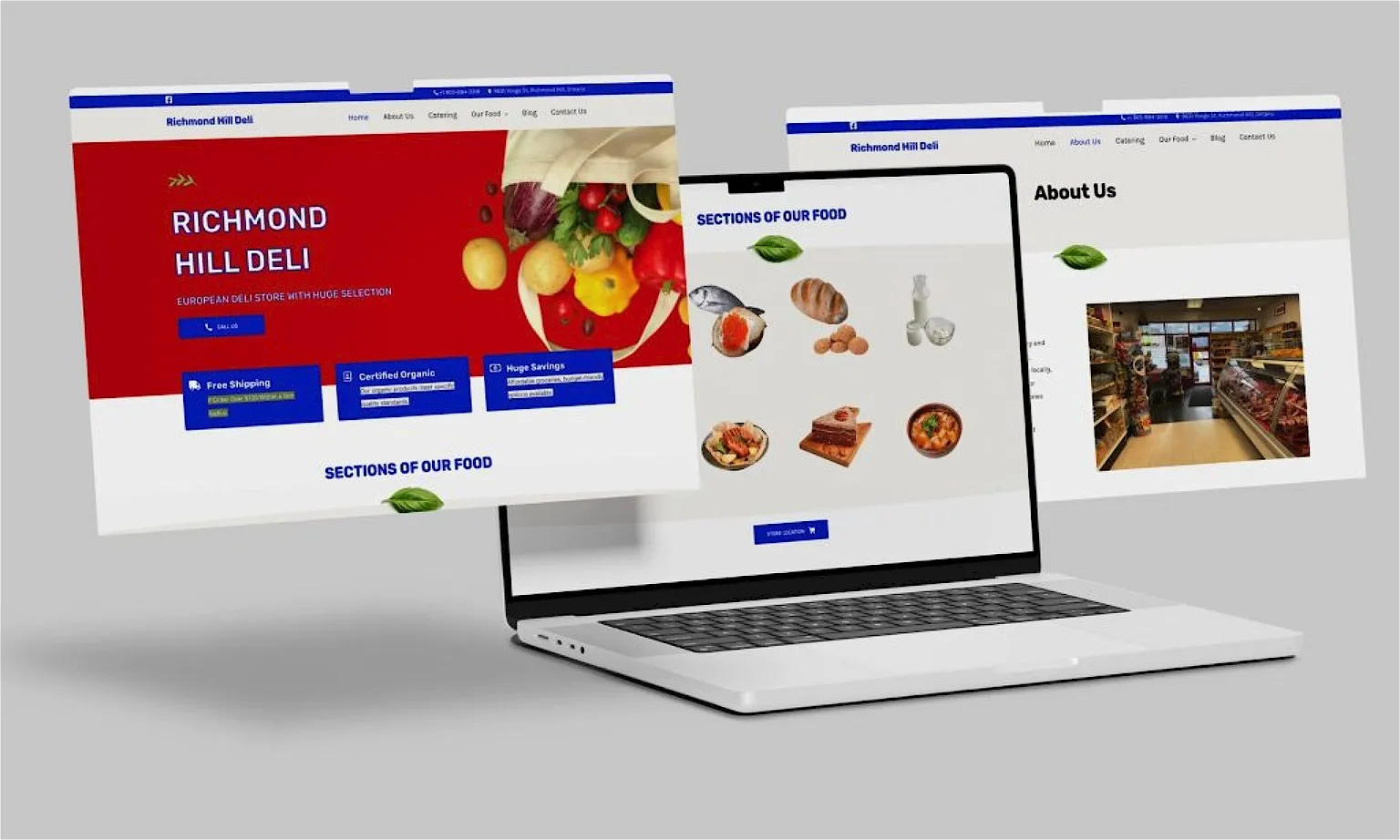
Not for a standalone bakery. The closest is a European deli in Richmond Hill, next door to Vaughan, where I designed and hand-coded a site with its own Bread & Bakery department page, a Dessert page, and a delivery rule written on the home page. The tax logic, the cake ticket and the wholesale path above are new work for this niche.
Richmond Hill Deli: a bakery counter inside a food store
The client sells cold cuts, cheese, prepared food and baked goods. On richmondhilldeli.com each counter has its own department page, bakery included, so a search for bread or cakes lands on that shelf instead of the home page. The home page states the store’s own delivery rule in one line: free shipping on orders over $120 within a 5 km radius. That is the same kind of rule a bakery needs for trays and cakes, stated before the customer asks.
What I would carry to a Vaughan bakery is the structure: a page per counter, photography sized to load fast on a phone, and hours and location one tap from anywhere. The full story is on the deli website case study, and the local build is on the Richmond Hill deli page.
What carries over from the deli
- Department pages: bread, pastry, cakes, seasonal
- A delivery rule stated on the home page
- Fast food photography in modern formats with fixed dimensions
- Hours, map and phone one tap from every page
What is new for a bakery
- Tax classes per product and a cart-wide count to six
- The custom cake ticket with lead times the kitchen sets
- A wholesale catalogue with pack sizes and licence status
- Holiday pre-order pages that close on the bakery’s cut-off date
Which pages does a Vaughan bakery website need, and for whom?
A counter bakery needs a home page, a menu by counter, a custom-order page and a location page. A production bakery needs a catalogue, a wholesale inquiry and a page on capacity and delivery area. A bakery that does both keeps the two paths separate from the first menu, so neither visitor wades through the other’s pages.
| Page | Who arrives | What shapes it |
|---|---|---|
| Home | Someone nearby deciding whether to come in today | Hours, today’s status, address and the order button above the fold |
| Menu by counter | Customers comparing what the bakery makes | A page per counter with photos; tax class set per item |
| Custom cakes and trays | A parent, an office manager, a couple planning an event | The order ticket, the lead time and real examples by occasion |
| Holiday pre-order | Regulars ordering ahead for a date the bakery names | Opens and closes on the bakery’s dates; pickup slots cap themselves |
| Wholesale catalogue | Café, restaurant and grocery buyers | Pack sizes, shelf life as the bakery states it, delivery area, licence status |
| Location and contact | People already on their way | Map, parking notes the owner supplies, phone, the same address as on Google |
Where in Vaughan the customers come from
Vaughan is several communities under one city name: Woodbridge, Maple, Concord, Kleinburg, Vellore and the Vaughan side of Thornhill. A customer may know the bakery by its community rather than by the city, so a bakery in Woodbridge names both Woodbridge and Vaughan on its location page. The production bakeries that make Vaughan’s size profile unusual sell to buyers who are not local at all, and their pages are written for someone ordering by the case or the pallet. Both pages can belong to the same company. They should not share a first screen.
How do you build a bakery website, step by step?
I start with the product list and its tax classes, because every later page depends on it, then the order ticket, then photography and pages. The site goes live in 5 to 7 days once the product list, prices, lead times and photos are ready, and the same build range applies as on every other project here.
- Product list and tax classesEvery item with its price, pack size and one of the tax classes from the table above, confirmed with the bakery’s accountant before anything is built.
- Order rulesLead times, closed dates, pickup windows, slot caps and deposit terms, written down by the owner and enforced by the form.
- The custom order ticketBuilt and test-ordered at the edge cases: five items and six, $4.00 and $4.01, a date one day inside the lead time.
- Photography and counter pagesThe bakery’s own photos, compressed to WebP with fixed dimensions so the page does not jump while it loads.
- Wholesale path, if there is oneCatalogue, pack sizes, delivery area and licence status, with an inquiry form that asks what a buyer actually specifies.
- Local searchThe Google Business Profile and the site saying the same name, address, hours and holiday closures.
Packages are listed on the pricing page, from $899 one time. How I build and hand over a site is on web design, and ongoing changes such as new seasonal products are covered by maintenance and support.
Common questions
Do bakeries charge HST on muffins and cookies in Ontario?+
On fewer than six single servings, yes. Paragraph 1 (m) of Part III of Schedule VI to the Excise Tax Act makes cakes, muffins, pies, pastries, tarts, cookies, doughnuts, brownies and sweet-filled croissants taxable in quantities of less than six, and zero-rated at six or more. Plain bread, bagels and rolls are zero-rated at any quantity.
What is the Ontario $4 rebate on bakery items?+
A point-of-sale rebate of the provincial 8% part of the HST on qualifying prepared food and beverages when their total price before tax is not more than $4, as described in CRA info sheet GI-064. A single muffin at $3.50 is therefore charged 5% GST only. Above $4 the full 13% applies.
Can an online bakery order form handle the six-item tax rule automatically?+
Yes, if each product carries a tax class and the cart counts single servings of the same class. I set the classes with the bakery’s accountant, then test the edge cases before launch: five items and six, $4.00 and $4.01, and a cart that mixes bread with a pastry.
How many bakeries are there in Vaughan?+
Statistics Canada counted 84 bakery businesses with employees in Vaughan in January 2026, second in Ontario after Toronto. That is 26.0 per 100,000 residents on 2021 Census population. Eighteen employ 50 or more people, so a large share are production bakeries selling to other businesses.
Does my bakery need a CFIA licence to sell online?+
Not to sell directly to consumers, according to the CFIA, and not for food made and sold within Ontario. A Safe Food for Canadians licence is needed to make, package or label food for retail locations in another province. The wholesale page states which case applies and links the licence registry when it does.
Have you built a website for a bakery before?+
Not for a standalone bakery. The closest is Richmond Hill Deli, a European deli in Richmond Hill where I designed and hand-coded a site with separate Bakery and Dessert department pages and a delivery rule on the home page. The tax classes, the cake order ticket and the wholesale path are new work.
Should a bakery website show its York Region inspection results?+
I do not copy them onto the bakery’s site, because York Region publishes them through YorkSafe and they change after every inspection. The website keeps the legal name and address written the way the Region lists the premises, so a customer who finds both records sees they belong to the same business.
What does a bakery website cost and how long does it take?+
A build of this scope is $899 to $2,999 one time and goes live in 5 to 7 days once content is ready, the same range and timeline as every other build on this site. The main variables are the number of products that need photos and whether there is a wholesale catalogue.

10+ years designing SEO-ready websites for Ontario businesses, including food stores, restaurants and markets in York Region and Toronto. My studio is in North York, a short drive from Vaughan. About the studio · Get in touch · Packages and pricing
Vaughan is the first city page for this niche — start at the bakery website design hub. Closest related work: delis · catering companies · restaurants · farmers’ markets. Nearby: Vaughan web design · restaurants in Vaughan · delis in Richmond Hill. Or browse all industries.
Send me your product list, even a rough one
With your current URL and whether you sell wholesale, I can tell you how the tax classes and the order form would work for your bakery and send a fixed quote within a business day. How I build websites · packages from $899.