Web Design for Catering Companies and Event Caterers in Ontario
Every catering enquiry in Ontario contains a legal question the customer does not know they are asking: who is allowed to pour the drink at the venue they have just named. There are exactly three answers, they are decided by the venue and by whether the caterer holds a liquor sales licence, and a website that answers them on one page settles the question before the phone rings.
The endorsement lets the licensee sell, serve and permit open liquor at premises other than its own. The event must run no more than ten consecutive days, must be sponsored by someone other than you, and must not be held in a residence.
O. Reg. 746/21 ss. 16, 17 (4), 60The host applies to the AGCO — at least 10 days ahead for a private event for invited guests, at least 30 days for anything else — and the permit holder, or a person they designate, has to attend the event.
O. Reg. 747/21 ss. 2, 4, 10 (1), 20A premises used as a dwelling cannot be used for the sale, service or consumption of liquor under a permit, and the caterer's endorsement cannot be used at a residence. Consumption in a residence is lawful in itself, so the host supplies their own bottles.
O. Reg. 747/21 s. 13 (2); O. Reg. 746/21 s. 60 (1) (b)Read from the consolidated regulations under the Liquor Licence and Control Act, 2019 on 12 September 2026: O. Reg. 746/21 (Licensing) and O. Reg. 747/21 (Permits). The three-branch shape is mine; the regulations are written as separate provisions and never side by side. I build to the published regulations and cite them — I am not a licensing consultant, and the application is always the licensee's or the host's.
Short answer
A catering website has two jobs a restaurant website never has: proving the kitchen the food is legally allowed to come from, and settling who serves the alcohol at a venue the caterer does not own. I hand-code Ontario catering sites that answer both on their own pages, cite the regulation they come from, and then sell the food through packages banded by guest count and a quote form built on guest count, venue and date.
Builds are $899 to $2,999 one time and go live in 5 to 7 days once content is ready. The nearest project I have is a family restaurant in North York — named, with the parts that transfer and the parts that do not, further down this page.
Which food safety rules end up on a catering website?
The ones a client asks about in writing. A caterer's kitchen is a "food service premise" under Ontario Regulation 493/17 — meals prepared for immediate consumption "on the premises or elsewhere" — so the rules follow the food to the venue. Seven of them answer questions that otherwise arrive by phone, which makes each of them a paragraph on a page.
| The rule | What it says | The page it feeds |
|---|---|---|
| s. 5 — notice before opening | Notice of an intention to start operating a food premise goes to the medical officer of health with your name, contact information and the location of the premise | The kitchen page: it names a location that is already on file somewhere public |
| s. 6 — inspection results | The operator ensures the results of any inspection by a public health inspector are posted in accordance with the inspector's request | The kitchen page again — if it is posted on the wall, linking it from the site costs nothing |
| s. 32 — food handler training | At least one food handler or supervisor who has completed food handler training is on the premise during every hour it is operating | The team page. A named, trained person beats the phrase "fully certified staff" |
| s. 27 — temperature | Potentially hazardous food stays at 4°C or lower, or 60°C or higher, while stored, transported, displayed, sold or served, except for periods "not to exceed two hours" needed for preparation | The process page, and the honest limit on how far you will travel with hot food |
| s. 30 — holding equipment | Refrigeration and hot-holding equipment must be big enough for the food and carry accurate, easily read thermometers | The equipment line on the process page — it answers a hot-holding question without a phone call |
| s. 29 (2) — purchase records | Records of food purchases are kept on the premise until the first anniversary of the purchase date | The sourcing page. "Where is the beef from" gets a document, not an adjective |
| s. 4 — mobile premises | A trailer, cart or vehicle-mounted premise needs separate potable and waste-water tanks, each with a readable gauge | The festival page, if you work events out of a unit rather than a kitchen |
Quoted and summarised from O. Reg. 493/17 (Food Premises), read 12 September 2026. The "page it feeds" column is mine. One exemption worth knowing if you work with churches and service clubs: under s. 2 (2) (b) and s. 2 (3) a religious organisation, service club or fraternal organisation serving a special-event meal is outside the regulation, but only if patrons are told in writing whether the premise was inspected and a list of everyone who donated potentially hazardous food is kept for the inspector.
What are the five Special Occasion Permit classes, and which ones will you actually meet?
Ontario Regulation 747/21 establishes five classes of permit. A caterer realistically meets two of them — the no-sale permit at a hosted-bar wedding and the sale permit at a cash bar — and the other three belong to public events, auctions and a designated bring-your-own event. Knowing which one your client has changes what your staff may legally do.
Keep for sale, offer for sale and sell liquor at a special occasion; serve it; permit open liquor on the premises.
Cash bar — commonServe and offer to serve liquor; permit open liquor on the permitted premises. No selling of any kind.
Hosted bar — commonSell and serve liquor purchased under the permit at a bring-your-own event, and allow what attendees brought.
Public outdoor events onlyPermit attendees to possess and consume liquor they brought to the event themselves. Nothing else.
Public outdoor events onlySell liquor through an auction, and deliver it for a fee. Charities, estates and law enforcement.
Almost never a catererFrom O. Reg. 747/21 ss. 4 to 9, read 12 September 2026. A bring-your-own event is defined narrowly: a public event at an outdoor premises at ground level, either tied to a professional, semi-professional or post-secondary sporting event, or designated by a municipal council as a cultural or community event. The "common" and "almost never" labels are my own reading of what a caterer meets, not part of the regulation.
What does the site have to answer, page by page?
A catering website is a sequence of answers, and the order is fixed by which question blocks the booking. Below is the mapping I build to: the question on the left is what the customer is actually thinking, and the page on the right is where it gets settled. Nothing on the list is decorative and nothing is there for length.
| What the client is thinking | The page that answers it | What happens without it |
|---|---|---|
| "Where is this food actually made?" | The kitchen page, naming the inspected premises and linking the public inspection record | A buyer who needs that address for a checklist has to email you for it |
| "Can they even serve alcohol at my venue?" | One alcohol page: the endorsement, the permit, the home-event case, with the filing deadlines | The same question by phone on every enquiry, answered live instead of once in writing |
| "What does 80 people cost?" | Packages banded by guest count, each with inclusions, staffing and the minimum | Every enquiry starts from zero, and neither side knows yet whether the budget fits |
| "Have they done a wedding like mine?" | One page per event type — weddings, corporate, funerals, festivals, drop-off | One generic page tries to speak to five buyers with different lead times |
| "Will they come out this far?" | A service-area page with the travel charge and the outside limit as numbers | A shaded map that says yes everywhere, and a travel conversation at quoting |
| "Does the food look like this in real life?" | Plated photography of your own service, in modern formats with dimensions set | Stock photography, showing food nobody at your events has eaten |
| "How do I start?" | A quote form on guest count, venue and date, with the deadline warning shown against the date | A contact form that produces enquiries nobody can price |
The alcohol page is also the one page with rules about how it may be written. Section 29 (1) of the Liquor Licence and Control Act, 2019 says nobody may advertise liquor except in accordance with the Registrar's guidelines, and section 29 (2) lets the Registrar order an advertisement withdrawn, effective immediately. The guidelines require that advertising "does not associate consumption of liquor with driving a motorized vehicle, or with any activity that requires care and skill or has elements of danger", does not imply drinking is needed for social, professional or personal success, and does not appeal to people under the legal drinking age — with an exception that matters for a caterer's family and school work: advertising of a licensed establishment that makes no reference to the availability of liquor may be aimed at people under drinking age.
The nearest project I have built, named
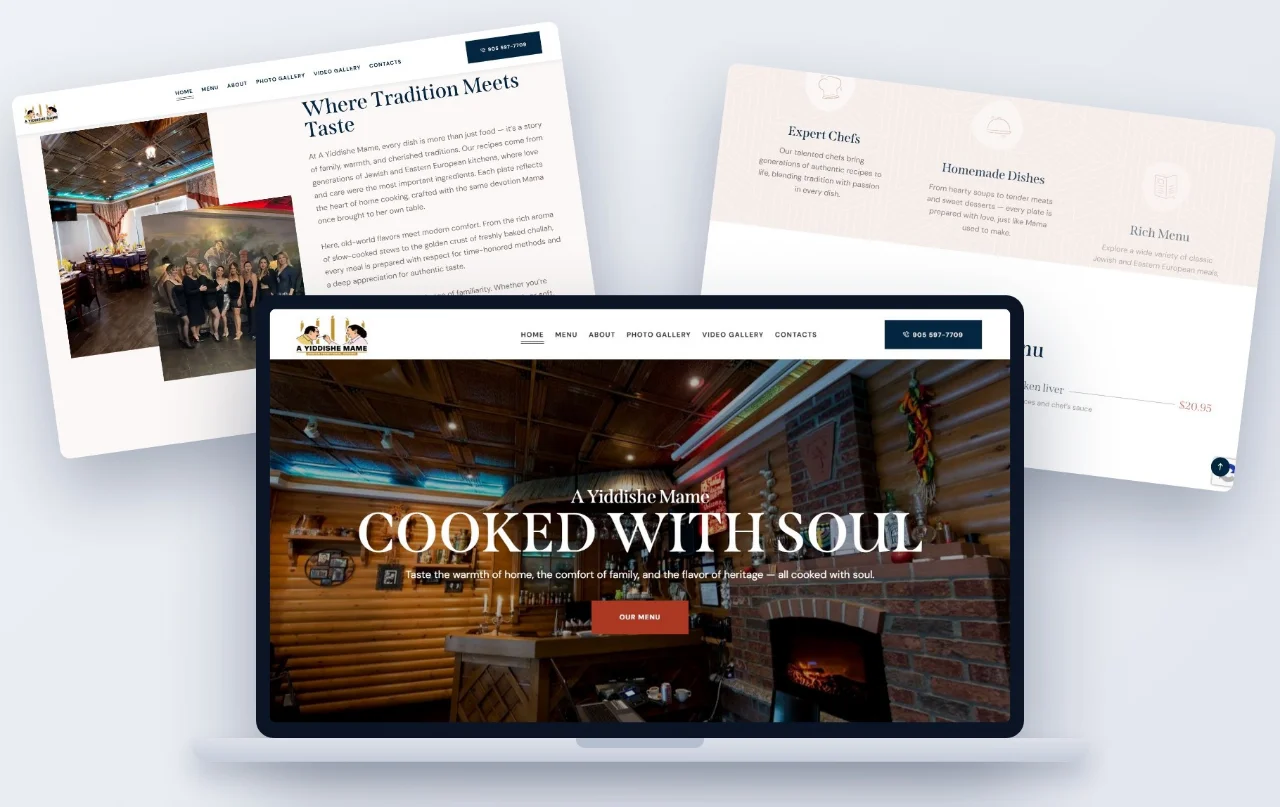
A family restaurant in North York
A family restaurant serves traditional Jewish and Eastern European home cooking, and I designed and hand-coded its website — linked here. The whole build came down to photography that makes food look like food, a menu readable on a phone in one hand, and hours, location and reservations within one tap. It is written up on the family restaurant case study.
I have not built a catering website. The appetite half of one I have built repeatedly — the same is true of the deli and farmers' market projects. The kitchen page, the alcohol page, the event-type pages and the guest-count quote form are new work, and I quote them as new rather than as something already solved. That is the whole disclosure: no invented catering client, no borrowed result.
Catering website design by city
City pages carry the local layer the province does not: the regional public health deadlines, the local inspection disclosure, and who the competition actually is in that market. One city so far, written from its own measured data rather than from a template.
Working outside Niagara? I build across Ontario — Toronto, Mississauga, Vaughan and eighteen other service areas. The food-safety and liquor rules above are provincial; only the public health filing calendar and the disclosure portal change with the region.
What you get, and what it costs
| Item | Included | Notes |
|---|---|---|
| Hand-coded pages, no page builder | Yes | The seven pages mapped above, plus about and contact |
| Kitchen page linked to your public inspection record | Yes | Where your health unit publishes one; you confirm the entry is yours before it goes live |
| Alcohol page cited to the regulations | Yes | Written from O. Reg. 746/21 and 747/21 and reviewed by you before publishing |
| Quote form on guest count, venue and date | Yes | With the deadline warning driven by the date the client types |
| On-page SEO, event-type and service-area pages | Yes | Titles, descriptions, schema and the local pages chosen with you |
| Card deposits or online ordering | Quoted | Depends on how you take deposits today |
| Google Business Profile management | From $149/mo | Priced separately — see Google Maps management |
| Food photography | No | I do not shoot on site. Plated photography is worth hiring for |
| Licensing or legal advice | No | I cite the published regulations. The AGCO application and the public health filings are yours |
A build of this scope is $899 to $2,999 one time and goes live in 5 to 7 days once content is ready — the same range and timeline as every other build on this site. Full numbers are on the pricing page.
Common questions
What is a caterer's endorsement in Ontario?+
It is an endorsement on a liquor sales licence. Ontario Regulation 746/21 prescribes it as one of seven endorsements available on that licence, and section 17 (4) says it authorises the licensee to keep for sale, offer for sale, sell, serve and permit open liquor at premises other than the licensed premises. A caterer with no liquor sales licence has nothing to attach it to.
What conditions come with a caterer's endorsement?+
Sections 60 to 63 of O. Reg. 746/21 set them. The event may not exceed ten consecutive days, must be sponsored by someone other than the licensee, and must not be held in a residence. The premises has to meet the requirements that apply to licensed premises. Unsold liquor goes back into the licensee's inventory, and the transport exemption for open liquor applies only between the licensed premises and the catered event.
Does a Special Occasion Permit holder have to be at the event?+
Yes, or a designated person in their place. Section 20 of O. Reg. 747/21 requires the permit holder to attend the event or activity the permit applies to, or to designate someone to attend instead, and it bars designating a person who was refused a permit within the previous two years. Worth stating on a caterer's site, since the permit and the catering are often assumed to come from the same supplier.
How far in advance is a Special Occasion Permit applied for?+
At least 10 days before a private event for invited guests, and at least 30 days for any other event or activity. If the event is outdoors, written notice also goes to the municipal clerk, the police service, the fire department and the local board of health — 30 days ahead if fewer than 5,000 people are expected, and 60 days if 5,000 or more are.
Does a caterer need a certified food handler on site?+
On the premise, yes. Section 32 of O. Reg. 493/17 requires at least one food handler or supervisor who has completed food handler training to be on a food service premise during every hour it is operating. At special events, health units commonly require certification at the booth itself — Niagara Region, for example, requires a certified food handler on site with the certificate and photo identification at the booth.
Have you built a catering website before?+
No, and I would rather say so here than imply otherwise. The closest projects are food businesses: a family restaurant in North York, a European deli and a farmers' market. Photography, phone-readable menus and local search structure transfer directly. The kitchen page, the alcohol page and the guest-count quote form are new work and I price them as new.
How much does a catering website cost?+
$899 to $2,999 one time, live in 5 to 7 days once content is ready — the same range as every other build on this site. What moves the number is how many event-type pages you want, whether card deposits are in scope, and how many service-area pages. Google Business Profile management is separate, from $149 per month.

10+ years designing SEO-ready websites for Ontario businesses, including food businesses and regulated trades where a statute decides what a page may offer. About the studio · Get in touch · Packages and pricing
Related niches on this site: restaurants · delis and specialty food shops · farmers' markets · funeral homes. Or browse all industries.
Send me the last three enquiries you had to answer by phone and I will show you which pages would have answered them
Three real enquiries tell me more than any brief. Packages from $899.