Website Design for Catering Companies in Niagara Falls
Before a Niagara Falls customer asks a caterer about food, two questions have already been decided by law: where the food is allowed to be cooked, and who is allowed to pour the wine. Both have exact answers in Ontario's regulations, and a wedding or corporate client who has been through one booking already knows to ask. So that is where I start a catering website.
Sources read on 12 September 2026: O. Reg. 493/17 (Food Premises), O. Reg. 746/21 (Licensing), O. Reg. 747/21 (Permits) and Niagara Region's food safety page for special events and farmers' markets. The "what the site has to carry" lines are mine, not theirs.
Short answer
A catering website in Niagara Falls has to do three jobs in order: prove the kitchen, settle the alcohol question, and then sell the food. I hand-code a site that names your inspected kitchen and links to your public inspection record, carries one plain page on the licence-or-permit route for alcohol, states the real filing deadlines for events in Niagara, and only then opens into menus, galleries and a quote form built around guest count, venue and date.
I have not built a catering website. The closest project I have is a traditional family restaurant in North York, where the whole build turned on menu, photography and one-tap location. What carries over to catering and what does not is set out in the section on that project.
Where does Ontario allow a caterer to cook the food?
In an inspected food premises, or on site at the event itself. A caterer's kitchen is a food service premise under O. Reg. 493/17 — meals prepared for immediate consumption "on the premises or elsewhere" — so the regulation's rules follow the food out of the door, and Niagara Region will not accept a home kitchen unless that kitchen is itself routinely inspected.
Four of the regulation's requirements land directly on a catering website, because each one is a question a corporate or wedding client asks in writing. Section 32 puts at least one person with food handler training on the premise during every hour it operates. Section 27 fixes the temperature band the food has to stay inside, in transit as well as in storage. Section 30 requires the hot-holding and refrigeration equipment to be big enough for the job and to carry accurate, easily read thermometers. Section 29 keeps purchase records on the premise until the first anniversary of the purchase date — which is how you answer "where does the beef come from" with a document rather than a sentence.
My schematic of the words of section 27 (1) and (2) (a); the regulation contains no such diagram. The two-hour allowance is for preparation, not for a drive across the region.
Why this belongs on a website rather than in a binder: the two-hour allowance is written for preparation, processing and manufacturing, and it is easy to read as though it also covered the drive to the venue. Saying so on your process page, in the regulation's own numbers, settles a question a corporate client would otherwise put in an email, and sets an honest limit on how far you will travel with hot food.
Who is allowed to serve alcohol at a catered event in Ontario?
One of three people, and which one depends on the venue. A caterer holding a liquor sales licence with a caterer's endorsement may sell and serve at premises other than its own. Otherwise the host applies to the AGCO for a Special Occasion Permit. In a private home, neither route exists — the permit regulation excludes dwellings and the caterer's endorsement excludes residences outright.
| The venue | Who may serve the alcohol | The rule that decides it | What your site should say |
|---|---|---|---|
| A banquet hall, winery, hotel or other licensed room | The room's own licensee, in most cases — or you, if you hold a liquor sales licence with a caterer's endorsement | O. Reg. 746/21 s. 17 (4): the endorsement authorises selling, serving and permitting open liquor "at premises other than the licensed premises" | Whether the bar is yours or the room's — the detail two suppliers can each assume the other is covering |
| A hall, community centre, park or tent with no liquor licence | The host, under a Special Occasion Permit — or you, under your endorsement, if the event is sponsored by someone other than you | O. Reg. 747/21 ss. 2, 4–6 (sale and no-sale permits); O. Reg. 746/21 s. 60 (1) (a): no more than ten consecutive days, sponsored by a person other than the licensee | Which permit class the host needs — a no-sale permit for a hosted bar, a sale permit for a cash bar |
| A private home, cottage or backyard | The host, from their own bottles. Nobody sells, and nobody needs a permit | O. Reg. 747/21 s. 13 (2) 1 bars a dwelling from use under a permit; O. Reg. 746/21 s. 60 (1) (b) bars the endorsement from a residence; the Act s. 41 (1) (a) allows consumption in a residence | That you can staff and pour at a home event but cannot sell the drink — say it before the quote, not after |
| An outdoor public event | Whoever holds the permit, once four separate notices have gone out | O. Reg. 747/21 s. 10 (2)–(3): written notice to the municipal clerk, the police service, the fire department and the local board of health, 30 days ahead under 5,000 expected attendees and 60 days at 5,000 or more | The deadline, in days, on the same page as the enquiry form |
Read from the consolidated regulations on 12 September 2026. Two details worth keeping straight on your own pages: unsold liquor has to go back into the licensee's inventory at the end of a catered event (O. Reg. 746/21 s. 62), and the licensee and its employees are exempt from the open-liquor-in-a-vehicle rule only when carrying liquor between the licensed premises and the catered event (s. 63, exempting them from s. 42 (1) of the Act). I build to the published regulations and cite them; I am not your licensing consultant.
How early does a Niagara Falls event have to be booked?
Up to 60 days ahead. Five separate filings sit between a Niagara enquiry and a legal event, the longest 60 days out and the shortest 10, and four of the five are filed by your client or the event's coordinator rather than by you. A website that states all five in plain numbers stops the enquiry that arrives three days before a festival and cannot be served.
Written notice to the clerk, police, fire and the board of health for an outdoor event expecting 5,000 or more people.
Permit applicantNiagara Region event registration for a farmers' market, filed before the market begins.
Market coordinatorNiagara Region event registration for a special event, with the vendor list attached to avoid delays. The same 30 days is the outdoor notice deadline under 5,000 people, and the AGCO deadline for any permit other than a private event.
Event coordinatorThe Niagara food vendor application, once per calendar year before your first event or market. The Region's wording is blunt: vendors who do not submit this form will not be allowed to participate.
You, the catererSpecial Occasion Permit application for a private event for invited guests, filed with the AGCO by the person responsible.
Your clientRegional deadlines from Niagara Region Public Health; permit deadlines from O. Reg. 747/21 s. 10. Read 12 September 2026. Only one of the five is filed by you — which is exactly why it belongs on your website: four of these are your client's homework and they will not know about them.
There is a second reason to publish the vendor-application date. It is annual rather than per event, so a caterer who files in March is clear for the rest of the Niagara season, and the Region tells coordinators that an inspector "will also advise you about food vendors that have not completed application forms" — so the organiser learns who has filed either way. One sentence on a page is enough to say you have. Niagara also requires a certified food handler on site at every special event booth where food handling is taking place, with the food handler certificate and photo identification at the booth.
What can a Niagara customer already look up about your kitchen?
Every inspection the Region has done at your premises for the past two years. Niagara Region publishes food premises inspection results online, one page per premises with its own permanent web address, showing each date, the type of inspection and whether infractions were found. A client comparing three caterers can read all three records before replying to any of them.
Premises in Niagara Region's public inspection list when I counted it on 12 September 2026.
Of those in Niagara Falls, 991 of them in food-handling classes — the largest single line being 446 restaurants and 40 banquet halls.
Premises filed in Niagara Falls under the service class Caterer. Region-wide there are 69, so Niagara Falls is second only to St. Catharines, which has 21.
Posted inspection records across those 14, every one of them a routine inspection. Twenty-three say no infractions were found; one of the fourteen has no posted record at all.
And here is the finding that decides where the link goes. Across the whole region, 51 premises have "cater" in the name — but only 26 of them are filed under the Caterer class. The rest are spread over nine other service categories, so a customer who filters the Region's list by category will not find most of the catering businesses in it. Your own website is the only reliable route to your own record.
- 26 Caterer
- 8 Production Kitchen
- 5 Mobile Food Premise
- 3 Take Out
- 3 Banquet Hall
- 2 Bakery
- 1 Centralized Food Premise
- 1 Child Care Centre
- 1 Secure Water Source
- 1 Enclosed Workplaces
Counted by reading the full public list at niagararegion.ca/health/inspect on 12 September 2026, then opening the disclosure page of every premises Niagara Falls files under Caterer. The record card above is my schematic of the page layout with the fields relabelled; it is not a screenshot and it is not any real business's record. The list also shows that 228 of the 1,693 Niagara Falls entries carry no last-inspection date at all, and the Region states that inspection results are disclosed for at least two years. I did not attempt to explain any individual result — the list does not say why an item was recorded, and I do not guess.
Which rooms in Niagara Falls actually take a catered event?
Community halls, not hotels — which is the opposite of what the city looks like from the Falls. I sorted all 1,693 Niagara Falls premises by address and by name. Of the 446 restaurants, 159 sit at tourist-core addresses — Fallsview Boulevard, Victoria Avenue, Stanley Avenue, Clifton Hill, Falls Avenue and the Niagara Parkway — and another 66 line Lundy's Lane. Of the 40 premises the Region files as banquet halls, six are in that core.
Reading the 40 names one by one is the part that changes the brief. Nineteen are churches or a temple, six are service or cultural clubs, four are fire halls, two are veterans' halls. Five entries belong to hotels and the convention centre, and four are commercial event venues. So 31 of the 40 premises this city files as banquet halls are community rooms, spread along Dorchester Road, Montrose Road, Portage Road, Drummond Road, Main Street and Thorold Stone Road, out to Willoughby Drive and Sodom Road — Stamford, Chippawa and the streets behind the strip.
A catering site written for the Fallsview wedding is therefore aimed at the handful of rooms that already have a banquet department. The pages that earn work here are the ones that name those roads, say what you bring to a hall you have never cooked in, and price a funeral reception for eighty as readily as a wedding for two hundred.
Counted from the same public list, on 12 September 2026. The street groupings are string matches on the addresses as the Region prints them, and the nineteen/six/four/two split is my own reading of the business names — the list carries no such column, and it does not say which of these rooms rent to the public or on what terms. Treat it as where to look, not as a booking guide.
Then there is the rest of the region. The counts above put 69 caterer-class premises across Niagara, concentrated in St. Catharines (21) and Niagara Falls (14), with five each in Niagara-on-the-Lake, Welland and Fort Erie, and four each in Port Colborne and Lincoln. Niagara is twelve municipalities, and the honest way to cover them on a website is a service-area page that states the travel charge and the outside limit as numbers, not a map with the whole peninsula shaded in.
The closest project I have, and what it does not cover
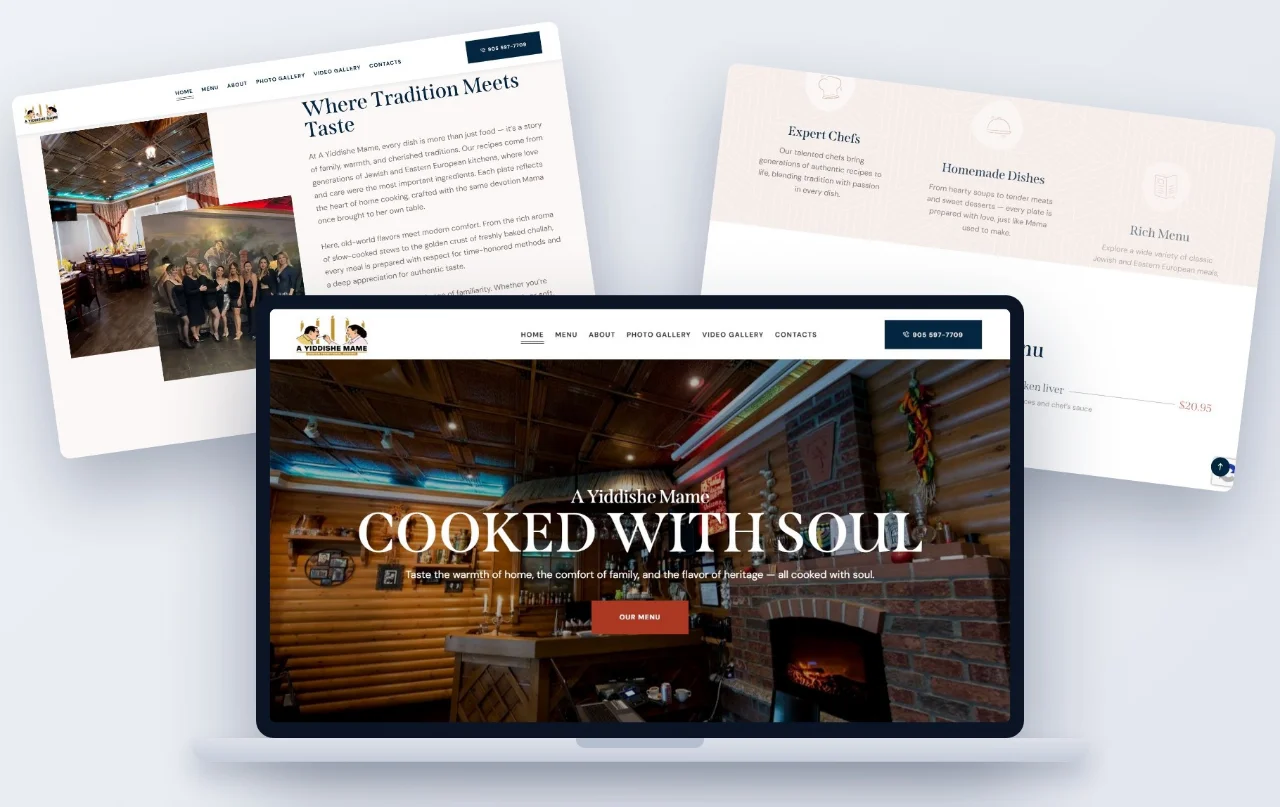
A traditional family restaurant in North York
A family restaurant serves Jewish and Eastern European home cooking in North York, and I designed and hand-coded its website — linked here. The build came down to three things: photography that makes the food look like the food, a menu that can be read on a phone while someone is already walking, and hours, location and reservations inside one tap. The full write-up is on the family restaurant case study.
That is genuinely half of a catering site — the appetite half. The other half is the two gates at the top of this page, and it is new work, which is how I price it.
| Part of the build | Transfers | Why |
|---|---|---|
| Food photography and gallery handling | Yes | Same problem: large images that have to stay fast on a phone, in modern formats with dimensions set |
| Menu structure readable on a phone | Yes | A catering package list is a menu with a guest count attached |
| Local search structure and matching Google Business Profile | Yes | Identical discipline — the site and the profile must not contradict each other |
| One-tap contact, hours and directions | Yes | A restaurant is found on the way there; a caterer is found weeks ahead, so the same components serve a slower funnel |
| Quote form built on guest count, venue and date | New | A restaurant has no equivalent. The three fields decide the whole answer, and the date drives the deadline warnings |
| The alcohol page | New | A licensed restaurant serves in its own room. A caterer has to explain a licence-or-permit choice it may not control |
| Inspection record link and kitchen page | New | Nobody asks a restaurant where its kitchen is. A corporate catering client routinely does |
| Event and festival page against the Niagara deadlines | New | Written against a filing calendar rather than an opening-hours calendar |
What pages does a catering website actually need?
Seven, and the order matters more than the count. Each one below answers a question that arrives before the menu question, which is why the quote form sits last rather than first — by the time a client reaches it they should already know whether you can legally do the job they are describing.
Where you cook, the service class you are filed under, and a direct link to your own entry in the Region's inspection results.
The licence-or-permit choice in plain words, the ten-day and thirty-day filing deadlines, and what happens at a home event.
Bands rather than one price, each with what is included, what the staffing looks like and what the minimum is.
Weddings, corporate, funerals, festivals and drop-off. Separate pages because the buyer, the lead time and the objection are different in each.
The municipalities you work in and the point at which travel is charged or declined, stated as a number.
Your own food, your own service, in modern formats with dimensions set so the gallery does not stall on a phone.
Three fields that decide everything else, with the deadline warning shown against the date the client types.
A note on what goes on the alcohol page, because it is regulated too. Under section 29 (1) of the Liquor Licence and Control Act, 2019 nobody may advertise liquor except in accordance with the Registrar's guidelines, and the Registrar may order an advertisement withdrawn. The guidelines do not mention websites by name — they bind advertising "carrying their business or brand name", which a website plainly does — and they require, among other things, that advertising "does not associate consumption of liquor with driving a motorized vehicle", does not imply that drinking is needed for social or professional success, and does not appeal to people under the legal drinking age. There is also a useful exception written into them: advertising of a licensed establishment that makes no reference to the availability of liquor may be aimed at people under drinking age, which is exactly how a school or children's-party page should be written.
What you get, and what it costs
| Item | Included | Notes |
|---|---|---|
| Hand-coded pages, no page builder | Yes | The seven pages above, plus contact and about |
| Kitchen page with the inspection-record link | Yes | I find your entry in the Region's list and link it; you confirm it is yours before it goes live |
| Alcohol page written against the regulations | Yes | Cited to O. Reg. 746/21 and 747/21, and reviewed by you before publishing |
| Quote form on guest count, venue and date | Yes | With the deadline warning driven by the date field |
| On-page SEO and event-type pages | Yes | Titles, descriptions, schema and the local pages chosen with you |
| Online ordering or deposits by card | Quoted | Depends on whether you take deposits now and through what |
| Google Business Profile management | From $149/mo | Priced separately — see Google Maps management |
| Food photography | No | I do not shoot on site. Good plated photography is worth hiring for |
| Licensing or legal advice | No | I build to the published regulations and cite them. I am not your lawyer, and the AGCO application is yours |
A build of this scope is $899 to $2,999 one time and goes live in 5 to 7 days once content is ready — the same range and timeline as every other build on this site. Full numbers are on the pricing page.
Common questions
Can a caterer in Niagara Falls cook from a home kitchen?+
Not for a special event. Niagara Region Public Health states that food at a special event must be prepared in an inspected food premises before the event or on site at the event, and that food cannot be prepared at a vendor's home unless the home kitchen is routinely inspected by a public health inspector. That is why the kitchen page names a real inspected address.
Does my caterer need a liquor licence, or do I need a Special Occasion Permit?+
One or the other, depending on the caterer. A caterer's endorsement only exists as an endorsement on a liquor sales licence, and it lets that licensee sell and serve at premises other than its own. If your caterer does not hold that licence, the alcohol runs on your Special Occasion Permit from the AGCO instead, which is applied for at least 10 days ahead for a private event and 30 days for anything else.
Can a caterer serve alcohol at a backyard wedding in Ontario?+
They can staff the event, but nobody sells the drink. O. Reg. 747/21 bars a premises used as a dwelling from the sale, service or consumption of liquor under a permit, and O. Reg. 746/21 says events under a caterer's endorsement must not be held in a residence. Consumption in a residence is allowed by section 41 of the Act, so the host supplies their own bottles.
How far in advance does a Niagara festival vendor have to register?+
Three weeks before your first event or market of the calendar year, through Niagara Region's online vendor application. The Region says vendors who do not submit the form will not be allowed to participate. The event's coordinator registers separately, one month before a special event or six weeks before a farmers' market, and attaches the vendor list.
Are food premises inspection results public in Niagara?+
Yes, and each premises has its own page. Niagara Region publishes inspection results online and keeps them posted for two years, showing the date, the type of inspection and whether infractions were found. When I counted the list on 12 September 2026 it held 6,933 premises, 1,693 of them in Niagara Falls, including 14 filed under the service class Caterer.
Why should my catering site link to my own inspection record?+
Because the Region's category filter will not find you. Of the 51 Niagara premises with "cater" in the name, only 26 are filed under the Caterer class; the others sit under Production Kitchen, Mobile Food Premise, Take Out, Banquet Hall, Bakery and four more classes. A customer who searches by category misses most caterers, so the link from your own page is the shortest honest route to your record.
What temperatures does the regulation require for catered food?+
Potentially hazardous food has to be kept at an internal temperature of 4°C or lower, or 60°C or higher, while it is stored, transported, displayed, sold or served. The only allowance is for periods "not to exceed two hours" necessary for preparation, processing and manufacturing. Hot-holding and refrigeration equipment must also carry accurate, easily read thermometers.
Have you built a catering website before?+
No. The closest is a family restaurant in North York, which I designed and hand-coded around photography, a phone-readable menu and one-tap location. The appetite half of a catering site is the same work. The kitchen page, the alcohol page, the event pages and the guest-count quote form are new, and I quote them as new rather than as something already solved.
How much does a catering website cost and how long does it take?+
A build of this scope is $899 to $2,999 one time and goes live in 5 to 7 days once content is ready, the same range and timeline as every other build on this site. The variables are how many event-type pages you want, whether card deposits are in scope, and how many service-area pages. Google Business Profile management is priced separately from $149 per month.

10+ years designing SEO-ready websites for Ontario businesses, including food businesses and licensed trades where a regulation decides what a page may offer. About the studio · Get in touch · Packages and pricing
Niagara Falls is the first city page for this niche — start at the catering web design hub. Closest related work: restaurants · delis and specialty food shops · farmers' markets · St. Catharines, the other Niagara page on this site. Or browse all industries.
Tell me the venue of your next booking and I will tell you which of the two gates your website is failing
One venue, one guest count, one date is enough for me to show you what your current site does not answer. Packages from $899.