Landscaping & Lawn Care Website Design in Oakville
I build websites for landscaping, lawn care and seasonal property maintenance companies in Oakville. This trade sells several different products a year off one domain, and most of its revenue comes from customers who book again rather than once. A website built for one service, or torn down and rebuilt every season, cannot do either job. My reference project here is an Oakville home services company with seven service lines. Another team designed and built that site; my role on it is ongoing development, and the first thing I found was a menu that Google could not follow.
An illustration of the thing this website is really selling. A landscaping company is paid per visit and pays for the drive between visits, so a customer on a street you already serve is worth more than a customer twice the size across town. That is why neighbourhood pages matter more in this trade than in almost any other one I build for.
Short answer
Lead Web Studio builds websites for landscaping, lawn care, garden and seasonal property maintenance companies in Oakville — hand-coded, mobile-first, with a separate page per service so mowing and snow clearing can each rank, neighbourhood pages that keep the routes tight, and seasonal content published before the season rather than during it. A build is $899–$2,999 one-time and goes live in 5–7 days once content is ready. The reference project for this trade is an Oakville home services company, live at everyseason.pro.
What Does a Landscaping Website Have to Do That Other Trade Sites Don't?
It has to sell a different service every few weeks without rebuilding itself, and it has to attract customers who live near the customers you already have. A roofer can run one page for one product all year. A landscaping company sells mowing in June, gutters in October, snow clearing in December and window cleaning in April, on the same domain, to the same neighbourhoods.
Most sites in this trade are built as if the business sells one thing. Everything is folded into a single "Services" page, so there is one URL trying to rank for mowing, garden design, gutter cleaning and snow removal at once — four different searches, at four different times of year, from people in four different states of mind. Google gets one weak signal instead of four strong ones, and the visitor gets a bulleted list where they wanted a price and a schedule.
The second habit is worse and more common: taking the snow removal page down in April and putting it back in November. A page that disappears for seven months starts from nothing every autumn. Leaving it published costs nothing, and a snow page that has been indexed since last year is already ranking when the first forecast lands — which is exactly when the contracts get signed.
One Company, Six Products a Year
This is the structural problem of the trade, written out. The right-hand column is the point: each of these pages has to be live and indexed before the season it sells, not published in the week the phone starts ringing.
| Time of year | What you are actually selling | What has to already be on the site |
|---|---|---|
| Late winter | Next season's mowing contracts, and spring clean-ups | A contract page with the visit frequency and what a season includes, plus a form that asks for the address, not just a name |
| Spring | Clean-ups, mulch and bed work, first cuts, window cleaning | A dedicated lawn care page and a separate garden and bed page, because those are two different customers with two different budgets |
| Summer | Weekly and biweekly maintenance, hedge and shrub work | Neighbourhood pages for the streets you already route, so the new customer is a five-minute detour and not a lost morning |
| Early autumn | Gutter cleaning, leaf clearing, and next winter's snow contracts | The snow removal page — published months early, because the contract is signed before the first storm, not after it |
| Late autumn | Final cuts, yard waste hauling, gutter repair | A page that answers what the town collects and what you have to haul away yourself |
| Winter | Snow and ice clearing, salting, windrow work | A service-level page: what triggers a visit, how quickly, and what happens on a storm day when everyone calls at once |
Six products, one site, no rebuilds. The homepage changes which one it leads with; the pages themselves stay published all year and keep whatever rankings they have earned.
What I Found on an Oakville Home Services Site
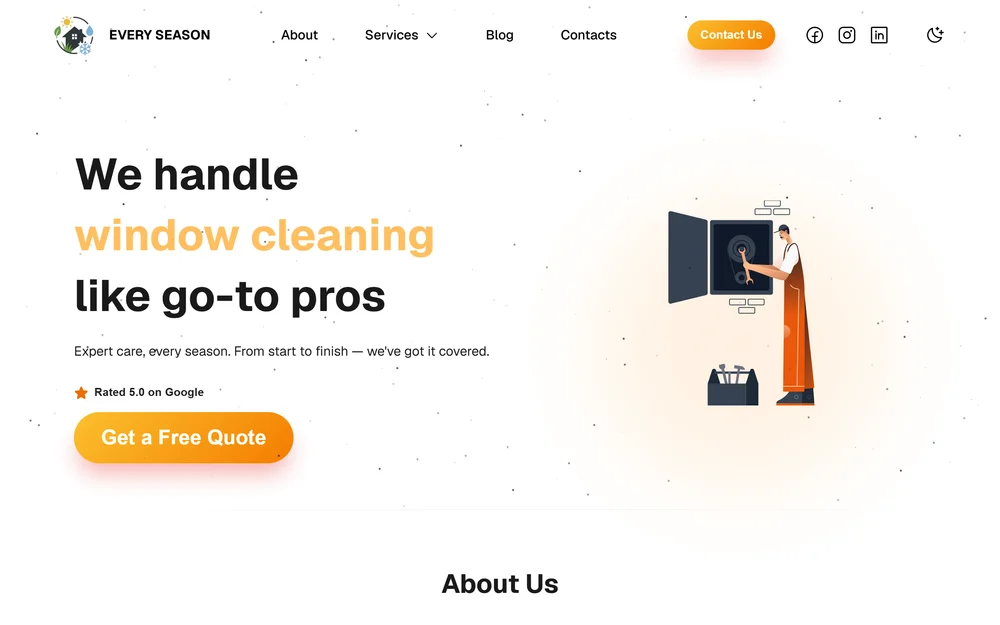
Every Season runs seven service lines out of Oakville — window cleaning, lawn mowing, landscaping, gutter cleaning and repairs, commercial and residential cleaning, moving, and snow removal. The site is a statically exported Next.js application on Cloudflare Pages. An earlier team designed and built it. I did not. My work is what came after: making the navigation crawlable, adding the blog, and shipping changes to the live codebase without touching the original design.

The Menu a Person Could Use and a Crawler Could Not
Nothing about this looked broken. The site loaded fast, the menu opened, every service was one click away, and the owner had clicked through it hundreds of times. There was no error to find — only an absence.
✗ <button onClick={router.push('/services/lawn-mowing')}>
✓ <a href="/services/lawn-mowing">
The menu was built from <button> elements calling router.push() instead of links. That navigates perfectly for a person and is invisible to a crawler, because there is no anchor tag with an href to follow. Nine of the navigation's destinations were reachable only that way, so Google could see the homepage and had almost no signposted route to the service pages that were supposed to earn the rankings. The fix was the correct element in place of the convenient one, plus a real footer nav — no redesign, no rebuild, no new framework. If your own site might be in this position, the free website audit is the fastest way to find out.
Seasonal Content Is What Keeps a Service Site Alive Between Busy Periods
A seven-service company has quiet months on every individual product and no quiet months overall, which is exactly what a blog is good at. I built the blog section and its publishing pipeline, plus automated seasonal article drafts that go to the owner for review before anything is published. The guides are written for houses and condos in Oakville, Mississauga, Milton, Burlington and Etobicoke — gutter guards in August, why windows streak after cleaning, what to do before the first frost.
That is the same discipline I sell as website maintenance and support. If you are moving off someone else's platform first, see website migration, and what a seasonal business should do online in the off-season covers the Google Business Profile side of the same problem.
What Each Service Line Actually Has to Answer
These are seven different purchases. Two of them are contracts signed months ahead, three are one-off jobs decided in an afternoon, and the rest sit in between. A single Services page cannot hold seven decisions this far apart.
| Service | What the customer is actually deciding | Page I'd build |
|---|---|---|
| Lawn mowing | Whether to hand over the whole season or try one cut first | A page that prices by frequency and lot size band, with a plain answer on what happens if it rains on your day |
| Landscaping & garden work | Whether your taste matches theirs — this is bought with the eyes | A gallery organised by job type and by season, because a bed planted in May and the same bed in August are two different photographs |
| Gutter cleaning & repairs | Whether you go up the ladder so they do not have to | A page separating cleaning from repair, saying what height you work to and what you do about the downspout |
| Window cleaning | Whether interior access is included and who moves the furniture | A page stating interior, exterior or both, screen and track cleaning, and what you need from them on the day |
| Snow removal | Whether you will actually arrive at 5 a.m. after a 20 cm night | A contract page with the trigger depth, the response window and what happens on a storm day when every client calls at once |
| Property cleaning | Whether it is a one-off or a recurring booking, and whether it is insured | Separate residential and commercial pages, because a property manager and a homeowner ask nothing in common |
| Moving | Whether the quote will change on the day | A page that says what the hourly or flat rate covers, the crew size, and what is not carried |
The Oakville Rules a Landscaping Site Should Answer
Four local rules decide how the work is actually done here: when your crews can start, what the town will collect, what a homeowner has to do before a tree comes down, and who is left clearing their own windrow. Each one is checkable against the town's own documents, and each one is a page worth having.
A permit is needed for a private tree 15 cm or larger
Under Oakville's Private Tree Protection By-law, a permit is required to remove a private tree with a diameter equal to or greater than 15 centimetres at chest height. Woodlands and greenlands fall under Halton Region's tree by-law instead. If you take trees down, that paragraph belongs on your page — homeowners search for it before they search for you.
Yard maintenance tools are prohibited between 9 p.m. and 7 a.m.
Oakville's Noise By-law restricts yard maintenance tools during those hours. It decides how early your crews can start, and it is the honest answer to the customer who wants their lawn done before they leave for work. Put your actual working hours on the page instead of "flexible scheduling".
Yard waste is collected April to December, in paper bags
Halton Region collects yard waste from the first week of April to the second week of December, on the regular garbage day, in paper yard waste bags or open labelled rigid containers with no lid. Brush must be tied in bundles no larger than 2 m by 1 m, with branches to a maximum of 7.5 cm in diameter. Anything outside that, you are hauling — and that is a line item worth stating before the quote, not after.
The town's windrow program is capped, and misses sidewalk plows
Oakville runs a paid driveway windrow snow clearing program with a limited number of places, and it does not remove windrows created by sidewalk plows. That is a real gap in the market and it belongs on your snow page in plain words, because the people it leaves out are the people looking for a contractor in November.
Where the Work Is in Oakville, and Why It Changes the Site
Oakville is not one market. The properties south of the QEW around Bronte, Kerr Village, Falgarwood and College Park were built through the 1950s to 1970s on generous lots with a canopy that is now fifty or sixty years old. That is tree work, leaf volume that fills a truck, gutters that clog every autumn, and beds that need shaping rather than planting — more hours per visit and more to haul away. It is also the work that needs the tree by-law paragraph on your page.
North of that, River Oaks, Iroquois Ridge North, Joshua Creek and the Uptown Core are the 1980s-to-2000s subdivisions: smaller lots, younger trees, and owners who are more likely to buy a straightforward weekly cut than a design consultation. Newer again are Palermo and the streets filling in along the Dundas Street corridor north of Highway 407, where the lots are small, the landscaping is often still builder-grade, and the first purchase a homeowner makes is usually a full front-yard redo rather than maintenance.
Those are three genuinely different offers, and one homepage cannot lead with all three. Neighbourhood pages let each one speak to the people it is for, and they keep the routing tight — which is the whole economics of this trade. Oakville also runs up against three boundaries a customer never thinks about and your route planning always does: Burloak Drive to Burlington in the west, Winston Churchill Boulevard to Mississauga in the east, and the ravine systems of Sixteen Mile Creek and Bronte Creek cutting the town north to south, so two addresses a kilometre apart on a map are not a kilometre apart in a truck. Say on the page which side of those lines you actually cross.
Beyond Oakville I build the same structure for companies in Mississauga, Burlington and Milton. Locally, see Oakville web design, Oakville SEO and Google Maps setup in Oakville.
What an Oakville Landscaping Site Gets From Me
Design & experience
Built for a homeowner comparing three quotes on a phone in their own driveway.
- A page per service, each one published all year
- A gallery split by job type and by the season it was shot in
- Local pages for the Oakville areas you actually route
- Real crawlable links in the navigation and the footer
- Fast, mobile-first pages that load on a weak signal
Growth & functionality
The half that turns a February search into a season signed in March.
- A quote form asking address, frequency and access, not just a name
- A contract page for recurring mowing and snow work
- Seasonal articles scheduled ahead of each season
- Google Business Profile and Maps wired to the right pages
- SEO structure and schema from the first line of code
"The snow removal page that goes live in November is competing with one that has been indexed since last August. Leaving a page up costs nothing. Taking it down costs you the season." — Liubomyr Lukaniuk, on building landscaping websites
Which Package Fits a Landscaping Company
| Package | Best for | What's included |
|---|---|---|
| Starter — $899 | Up to 10 pages | Home, a page per core service, gallery, about and contact, with a protected quote form and local SEO |
| Full Site — $1,499 | A larger structure | Individual service and neighbourhood pages, a contract page, a blog for seasonal content and deeper SEO |
| Advanced — $2,999 | Custom functionality | Online booking, payments or a client portal, route-area logic, unlimited pages and priority support |
One payment, fixed in writing before I start, and about 5 to 7 days once content is ready. See full pricing.
Landscaping Website FAQ, Oakville
What should a landscaping company's website include?+
A page per service rather than one combined list, so mowing, garden work, gutters, window cleaning and snow clearing can each rank and each answer its own questions. Add neighbourhood pages for the areas you actually route, a form that asks for the address and the frequency instead of only a name, seasonal content published before the season starts, and a contract page for the recurring work.
How do you build a website for a business that sells different services each season?+
All the services stay published all year, and the homepage promotes whichever one is in season. That way the snow removal page keeps its rankings through July instead of being taken down and rebuilt every autumn, and the seasonal push is a change of emphasis on one page rather than a rebuild of the site four times a year.
Should a landscaping website answer Oakville's by-laws?+
Yes, because customers search for them and almost no competing site answers them. Oakville requires a permit to remove a private tree measuring 15 centimetres or more in diameter at chest height, yard maintenance tools are prohibited between 9 p.m. and 7 a.m., and Halton Region collects yard waste from the first week of April to the second week of December.
Can you take over a landscaping website another developer built?+
Yes, that is a normal part of what I do. I need repository access, the hosting account and the domain registrar login. If the stack is one I work with I can usually start shipping within a few days. If there is no repository at all, that is a rebuild conversation and I will say so rather than patch around it. See website maintenance and support.
What does a landscaping company website cost in Oakville?+
$899 one-time for up to 10 pages, $1,499 for a larger structure with individual service and neighbourhood pages, $2,999 where booking, payments or portals are involved. One payment, fixed in writing before I start, and about 5 to 7 days once the content is ready. See my website design packages.

10+ years designing SEO-ready websites for local businesses, including home service and seasonal trades across the GTA. About the studio · Get in touch
Selling six services from one page that ranks for none of them?
I'll split them out, wire the neighbourhoods and get the snow page live before the first forecast. Packages from $899.