Every year around the second week of November my phone does the same thing. A landscaper asks whether he should "pause" his website until spring, because the grass stopped growing and he doesn't like paying for something nobody's looking at. Two weeks later a pool company asks me the same question in slightly different words. Then somebody with a farm stand. Running a seasonal business means half the year you're flat out and the other half you're staring at a quiet inbox doing arithmetic on your overheads. So here's the straight answer — including the sentence Google publishes in its own help documentation that almost nobody in my industry quotes to you, because it's inconvenient.
The short version
- Never take the website down. Offline pages fall out of Google's index, and buying them back in spring costs far more than the hosting you saved.
- First decide which kind of seasonal you are: genuinely closed, or just quiet. The two get opposite playbooks.
- Google's rule, in its own words: closed more than 7 days or for the off-season → "Temporarily closed". Closed 6 days or fewer → Special hours.
- Google also admits, on the same page, that temporarily-closed businesses can rank after open ones. That's the real cost of being honest — and it's still the right call.
- Most "seasonal" businesses aren't closed at all. They have a second service they never put on the website.
- The off-season is the only window where SEO work has time to mature before you need it.
Should a seasonal business shut down its website in the off-season?
No — never take the site down. A website that disappears for four months loses its indexed pages, its rankings and the trickle of enquiries that would have booked your spring. You then pay, in time and money, to win all of it back. Change what the site says in the off-season. Don't switch it off.
The money argument doesn't hold up either. A domain plus solid hosting should run you roughly $100 to $200 a year — I broke down where the rest of the bill comes from in web hosting's hidden fees. Cancelling that to save eight dollars a month, then rebuilding your search visibility in March, is the single worst trade in this entire article.
Are you actually closed, or just quiet?
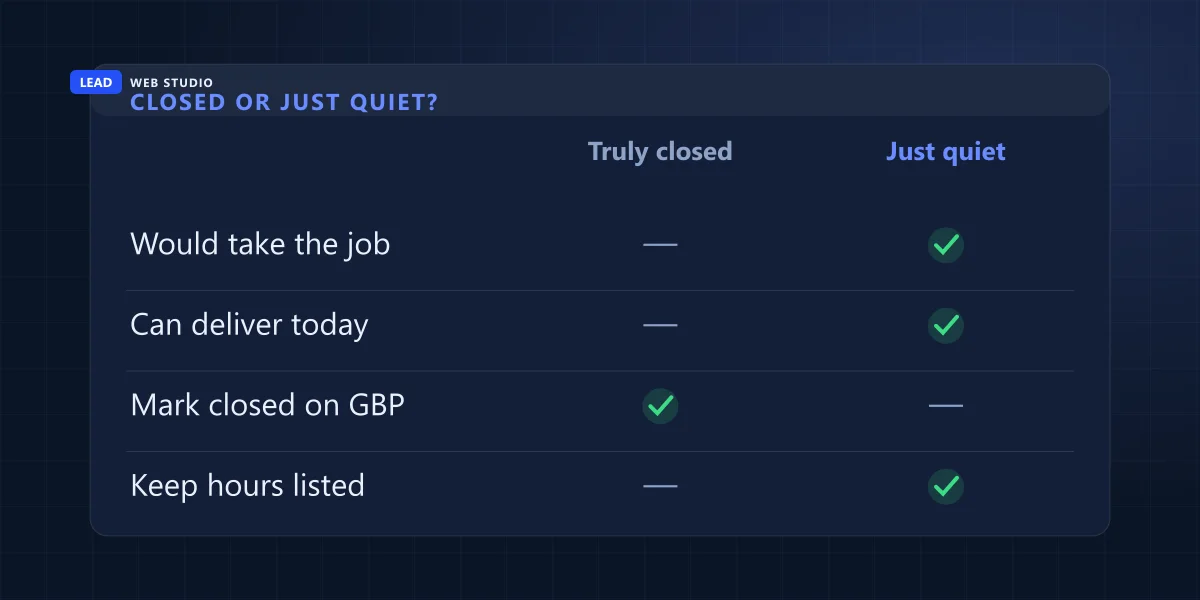
This is the question everything else hangs on, and almost nobody asks it. "Closed" means a customer phones you in January and there is genuinely nothing you can sell them. "Quiet" means the phone rings less but you'd absolutely take the job. Those are different businesses, and Google treats them differently.
| Ask yourself | Genuinely closed | Just quiet |
|---|---|---|
| Would you take the booking if someone called today? | No | Yes |
| Can you deliver anything at all right now? | No | Yes |
| Mark the profile "Temporarily closed"? | Yes | No |
| Keep normal opening hours listed? | No | Yes |
A marina that pulls every boat out of the water in October is genuinely closed. A Christmas tree lot is genuinely closed for eleven months. A landscaper who owns a plough is not closed — he's quiet, and he's about to make a very expensive mistake if he tells Google otherwise.
What Google actually tells seasonal businesses to do
Google publishes a specific instruction for this, and it names the off-season directly. From Google Business Profile Help: "If your business is closed for more than 7 days, closed for the off-season, or closed indefinitely, use the option 'Temporarily closed.'" Shorter breaks get a different tool — Special hours apply when a business "temporarily adjusts its hours of operation or remains closed for up to 6 days in a row."
| How long you're shut | What Google says to use | Typical case |
|---|---|---|
| Up to 6 days in a row | Special hours | Holiday week, family trip, renovation |
| More than 7 days, or the whole off-season | Temporarily closed | Marina, farm stand, seasonal patio |
| Not coming back | Permanently closed | You've sold or wound up the business |
Yes, there's a one-day gap in that guidance — exactly seven days belongs to neither bucket. Round it to whatever is actually true on the ground: if you'd answer the phone on day six, use Special hours; if the doors are genuinely bolted for a stretch, use Temporarily closed. Nobody at Google is grading you on the technicality, and both settings are reversible in about thirty seconds.
Google tells you to mark yourself closed, then tells you what that costs, on the same help page. The honest move and the profitable move point in opposite directions here — and I still think you take the honest one.
The cost Google admits to in the same breath
Here's the sentence that changes the decision. On that same help page Google states that for broad queries, temporarily-closed businesses can rank after open businesses — with the size of the effect depending on your category, the type of query, and how many matching businesses nearby are also closed. In plain English: flip that switch and you can slide down the local results while you're away.
That is a genuine cost and I'm not going to pretend it isn't. But weigh it against the alternative. If you leave the profile open while the doors are locked, somebody drives across the city on a Saturday, finds nothing, and writes the review that follows you for the next three years. Reviews are one of the loudest signals a local business has — I went through the mechanics in how to get more Google reviews — and one avoidable one-star will outlast one quiet winter every time.
There's a softer landing, too. In your category, if most of your competitors are seasonal, most of them are closed alongside you, which is precisely the condition Google names as reducing the effect. The marina down the road is not open in February either.
Most "seasonal" businesses have a second season they never sell
This is where the real money is, and it has nothing to do with settings. In the GTA, the overwhelming majority of businesses that call themselves seasonal already do work in the other half of the year — they just never put it on the website, so Google has no idea it exists and neither does the customer searching for it at 11pm in January.
- HVAC. Cooling in summer, heating in winter. The same company, two entirely different search terms, and often only one of them on the site. If your HVAC website only talks about air conditioning, you're invisible for six months a year by choice.
- Landscaping and lawn care. Snow clearing, salting, winter property checks. If you own the equipment and you'd take the call, that's a service page, not a footnote.
- Roofing and exteriors. Emergency leak and ice-related repairs don't wait for spring. Nobody shops around at 6am with water coming through a ceiling — they call whoever appears.
- Painting. Interiors in winter, exteriors in summer. Two pages, two seasons, one crew.
- Producers and makers. Even a genuinely seasonal harvest has a shoulder season. When I built the site for a honey farm in Erin, the layout had to handle seasonal stock and "sold out" states gracefully — because "we're out until August" and "we don't exist until August" look identical to a first-time visitor, and only one of them is true.
The rule I'd give anyone in that list: if you would take the money today, there must be a page on your website that says so, with its own heading and its own URL. A sentence buried in a paragraph on your homepage is not a page, and it will not rank.
Why the off-season is the only time you can afford to fix the site
Local SEO is measured in months rather than weeks — usually three to six months for meaningful gains. Do that arithmetic against a season and the conclusion is uncomfortable: anything you publish in your peak month arrives, at best, as the season ends. Work started in February is what ranks in June. Work started in June ranks for next year.
Which means the quiet months aren't the punishment. They're the only stretch of the year when you have both the time to answer a designer's questions and enough runway for the work to mature before it matters. Every seasonal client who has ever been happy with me started in their off-season. Every stressed one started three weeks before opening.
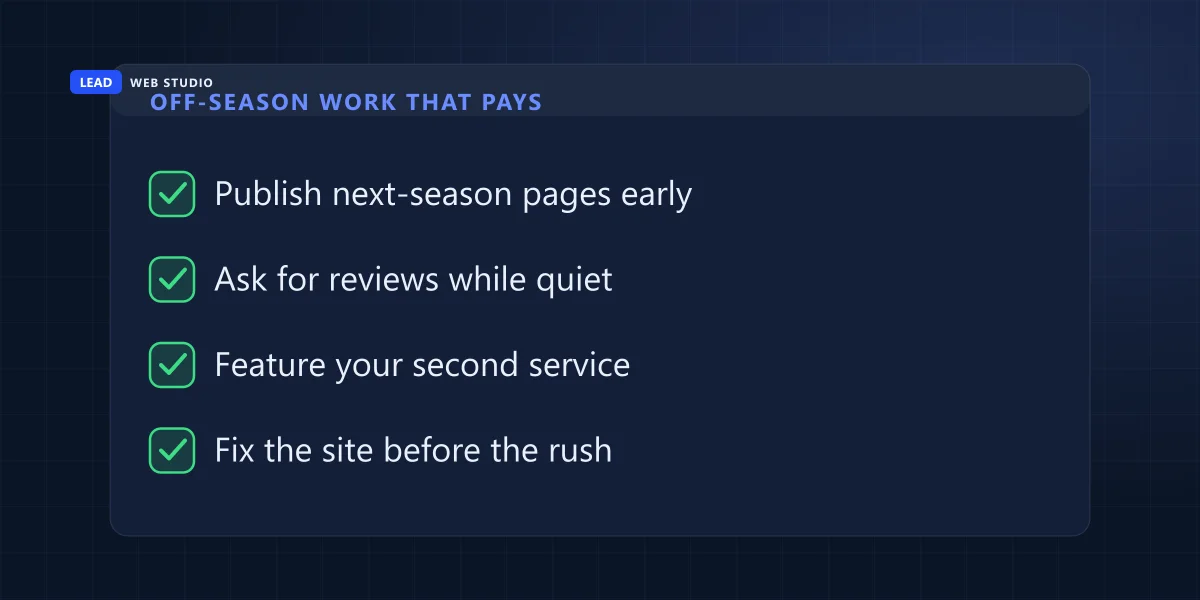
- Publish next season's pages now. One page per service, written properly, while you have time to actually check the copy. See what to gather before a build if you're starting from nothing.
- Ask last season's customers for reviews. You have time to follow up properly, and they still remember the job. This is the single highest-return hour of your off-season.
- Put your second service on the homepage. Swap the hero headline to whatever you're actually selling this month. It takes minutes and it's the change most people never make.
- Fix what broke last season. Slow pages, a form that eats enquiries, photos from 2019. Nobody has time for this in July.
- Update the profile honestly. Hours, description, a photo from the season that just ended. If you're genuinely shut, mark it — and set a reminder to reopen.
- Book the work for the season after. If you want to rank next spring, the pages need to exist this winter, not next March.
What to do in the last month before your season opens
The month before opening is the one people always get wrong — they start the marketing there instead of finishing it there. Here's the order that actually works:
| How far out | What you do | Why then |
|---|---|---|
| 4–6 months | Publish the service pages for next season | Needs months to rank, not weeks |
| 2–3 months | Reviews, photos, fix the site's speed and forms | Still quiet enough to do it properly |
| 1 month | Reopen the profile, update hours, swap the homepage headline | Live before the first searches land |
| Opening week | Nothing structural. Answer the phone. | Anything started now lands after the peak |
If you're reading this row by row and realising you're in the "opening week" column with nothing behind it, that's fine — it just means this year is the year you fix it for next year. Do the pages now anyway. The season after is the one that pays for them.
If you only take one thing from this page: don't mark yourself closed unless you truly are, and don't wait until your season opens to be findable. If keeping the profile accurate all year is the part you'll forget, that's exactly what Google Maps management covers — hours, posts and reviews handled month to month, from $149.
Frequently asked questions
Should I mark my seasonal business as temporarily closed on Google?+
Only if you genuinely cannot serve a customer who calls. Google's own guidance says to use Temporarily closed if your business is closed for more than 7 days, closed for the off-season, or closed indefinitely. If you still answer the phone and still book work, you are not closed — leave the profile open.
Does marking my business temporarily closed hurt my Google rankings?+
Google states that for broad queries, temporarily-closed businesses can rank after open businesses, and that the effect depends on your category, the query and how many nearby businesses are also closed. So yes, it can cost you position — but the alternative is customers turning up to a locked door and leaving one-star reviews.
What is the difference between Special hours and Temporarily closed?+
Special hours cover a short break: Google allows them when your business adjusts hours or stays closed for up to 6 days in a row. Anything longer than 7 days, or a full off-season, is what Temporarily closed is for. A one-week shutdown falls right in the gap, so round it to whichever is true on the ground.
Should I take my website down in the off-season to save money?+
No. Taking a site offline drops its pages out of Google's index, and getting them back is slow and unpredictable. Hosting and a domain should cost roughly $100 to $200 a year — far less than rebuilding rankings every spring. Change what the site says instead of switching it off.
When should I start marketing for next season?+
Start in the off-season, not the month your season opens. Local SEO is measured in months rather than weeks — usually three to six months for meaningful gains — so a page published in your peak month arrives after the peak has passed. Publish while it is quiet and let it mature.
Want your quiet months to build next season?
Tell me what you sell and when, and I'll tell you honestly what's worth doing now and what can wait.
Get My Free Quote
10+ years building websites for GTA trades, producers and service businesses that live and die by the calendar. Read my full bio · Get in touch