Two calls, same week. First one: a client got a one-star review from an account with no photo and a name like a keyboard mash, accusing him of "scamming" a job he never did. He wanted to write Google Support an essay. Second one: a client who's done maybe 40 jobs in three years and has exactly two Google reviews — because in three years, nobody on his team ever actually asked. Neither of those is a Google problem. Both are a process problem, and the fix for each is boring, mechanical, and works if you actually do it.
The short version
- Ask within 24–48 hours of a job going well, with the direct review link — not "check us out on Google."
- Google's own policy bans review-gating — asking only customers you think will say something nice — and bans offering anything in exchange for a review.
- 89% of customers expect a reply to reviews, and 80% say they're more likely to use a business that replies to all of them (BrightLocal, 2026).
- But 50% say a copy-pasted, generic reply is enough to make them go elsewhere. The reply has to sound like a human wrote it, because one did.
- A fake review is a 3-step flagging process through your Business Profile, not a public argument.
How do you get more Google reviews?
You ask happy customers directly, right after the job goes well, using your business's actual Google review link — never a vague "check us out on Google." Send it by text or email within a day or two while the experience is fresh. Never offer anything in return, and never ask only the customers you think will say something nice; Google's own guidelines ban both of those.
The ask system that actually works
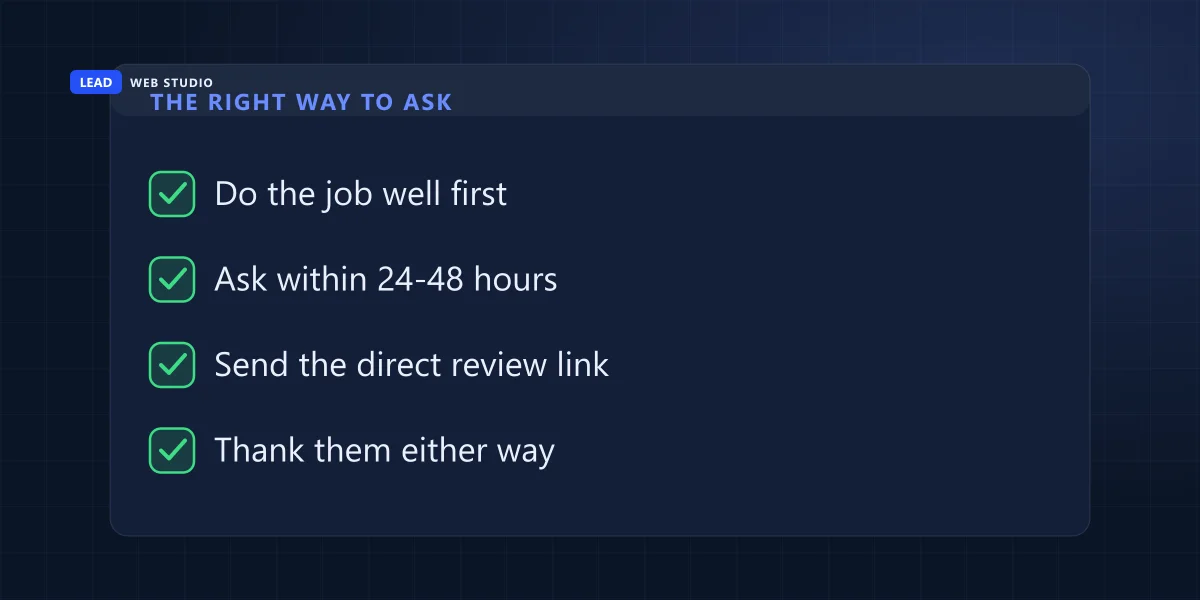
Most business owners treat asking for a review like it's awkward or pushy. It isn't — customers who had a good experience are usually happy to spend fifteen seconds tapping five stars, they just need to be handed the door instead of told a building exists somewhere. Here's the exact system I tell clients to run:
- Do the job well first. A review ask is a receipt for good work, not a substitute for it. Asking after a mediocre job just invites an honest mediocre review.
- Ask within 24–48 hours of the job finishing, while the relief and gratitude are still fresh — not three weeks later in a batch email nobody remembers opening.
- Send the direct link, not a general pointer to "Google us." Every Google Business Profile has a shareable review link under Ask for reviews in the profile dashboard, or you can generate a QR code from it for a van decal, invoice footer, or thank-you card.
- Say thank you either way. If they don't leave one, don't chase them a second time — one polite ask, then move on. Nagging turns a five-star customer into a silent one.
Google doesn't grade you on how many reviews you have. It grades you on whether they're real. Game that, and you're one flag away from losing all of them at once.
What Google explicitly bans (and does enforce)
This is the part most "review growth hacks" you'll find online quietly skip. Google's own review policy is direct about what's off-limits: merchants may not "offer incentives — such as payment, discounts, free goods and/or services" for reviews, may not "discourage or prohibit negative reviews, or selectively solicit positive reviews," and may not "require or pressure users to leave ratings or write reviews while on the premises." That last one covers those in-store tablets that only pop up a review prompt after a customer taps a happy-face button — that's textbook review-gating, and Google can wipe the reviews it produced.
| What you do | Fine to do | Against Google's rules |
|---|---|---|
| Ask every customer the same way | Yes | |
| Send the direct link by text/email after the job | Yes | |
| Only ask customers who seemed happy | No — review gating | |
| Offer a discount or gift for a review | No — incentivized review | |
| Pressure a customer on the premises to review now | No — coerced review |
The honest reason this rule exists isn't Google being precious — it's that a review system where only happy customers get asked isn't measuring your quality, it's measuring your filtering. Ask everyone the same way, every time, and let the stars fall where they fall. If you're genuinely doing good work, that system produces a 5.0 anyway; if it doesn't, that's information you needed, not a reason to game the ask.
How to respond to reviews (most businesses get this backwards)
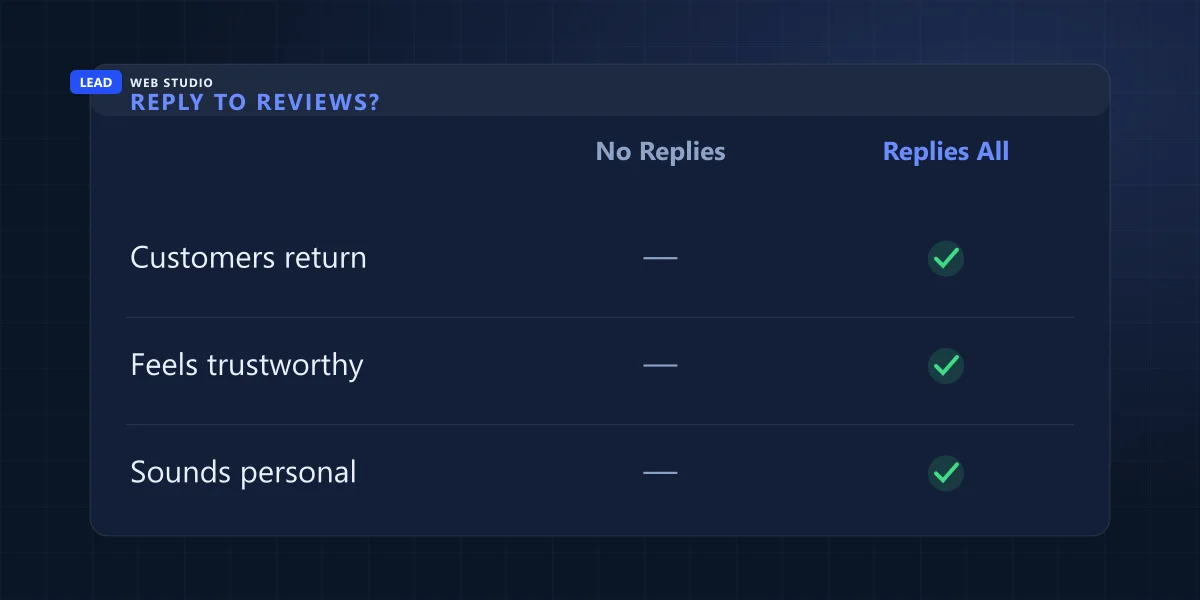
Reply to every review, good or bad, within a few days. 89% of customers expect a business to respond, and 80% say they're more likely to use a business that replies to all of its reviews (BrightLocal, 2026). But don't just copy-paste "Thanks for the kind words!" under everything — 50% of customers say a templated, generic reply is itself a reason to skip a business.
Here's what that looks like in practice — three real situations and how I'd handle each one:
- A genuine 5-star review: thank them by name, and mention one specific detail from the job (the actual service, not "your business"). It proves a human read it, and it's free marketing copy for the next reader scanning your reviews.
- A real complaint (3-star or lower): acknowledge the specific issue without getting defensive, apologize where you actually owe one, and move the resolution off the public thread — "please call/email me directly so I can make this right." Never argue in the reply box; every future customer reads that exchange.
- A fake or malicious review: don't respond emotionally in public. Flag it (next section), and only post a short, calm public note if you must — something like "we have no record of this transaction and have reported it to Google" — while the flag works its way through.
The reviews that shouldn't be there
Fake reviews happen — a competitor, a disgruntled ex-employee, or just someone who mixed up two businesses with similar names. Google's policy requires that content "reflect a genuine experience at a place or business," which gives you real ground to stand on. To flag one: open the review on your Business Profile, click the three-dot menu, choose "Flag as inappropriate," and pick the reason. Google reviews the flag and decides — there's no guarantee, and it typically takes days, not hours, so don't panic-refresh the page every ten minutes. What you shouldn't do is fight it out in the replies; a public shouting match reads worse to the next visitor than the fake review ever did on its own. And before you assume a review was removed at all, check whether it is simply not being counted — I measured that gap across nineteen profiles in why your Google reviews are not showing.
What review count actually buys you
Reviews aren't just social proof for humans — they're one of the three ranking factors Google confirms it uses for the local map pack, alongside relevance and distance, which I cover in full in how to rank in Google's 3-pack. A steady monthly trickle of genuine reviews beats a pile of old ones sitting untouched since 2022. I run this exact ask-and-reply system for my own business — it's how Lead Web Studio sits at a 5.0 rating across 46 Google reviews today, not a vague "great reputation" claim but the actual, checkable number on our reviews page.
Do you even need a Google Business Profile first?
Reviews live on your Google Business Profile, so if you haven't set one up yet, that's the actual first step — and not every business type qualifies for one. I wrote the full eligibility breakdown in do you need a Google Business Profile, including the setup mistakes that get listings suspended before they ever collect a single review.
If you only do one thing this week: pull up your Business Profile's review link right now, and text it to your last three happy customers. That's the entire system. Want it set up properly with a reply cadence built in? See Google Maps setup — I build the ask link, the QR code, and the review-monitoring habit into the same $149–$299 setup.
Frequently asked questions
Can I offer a discount for a Google review?+
No. Google's guidelines explicitly ban offering incentives — payment, discounts, or free goods and services — for reviews, and also ban selectively asking only happy customers. Both can get reviews removed or a profile suspended.
How many Google reviews do I need to rank in the map pack?+
There's no magic number. Google weighs review count, rating and recency together under "prominence," one of three ranking factors alongside relevance and distance. A steady monthly flow of genuine reviews outranks a pile of old ones.
Should I reply to negative reviews?+
Yes, always, and calmly. 89% of customers expect a reply, and 80% are more likely to use a business that replies to all its reviews. Acknowledge the issue, take specifics offline, and never argue in public.
Can I get a fake Google review removed?+
You can flag it through your Business Profile for violating Google's rule that reviews must reflect a genuine experience. Google reviews the flag and decides — there's no guarantee, and it usually takes days, not hours.
Is it OK to ask employees or friends to leave a review?+
No. Reviews must come from people with a genuine experience with your business. Google can detect patterns tied to a shared IP, device, or account cluster, which risks your entire profile's credibility, not just one review.
Want your review system running on autopilot?
I set up the Business Profile, the direct review link, and a simple reply cadence — so the asking and answering actually happens. Setup from $149.
Get My Free Profile Review
10+ years setting up Google Business Profiles and review systems for GTA businesses. Read my full bio · Get in touch