Real Estate Agent Website Design in Milton
I build websites for real estate agents, teams and brokerages in Milton — sites registered in your name, on your own domain, so that changing brokerages costs you a footer edit instead of your entire web presence. I'll be exact about my proof in this field: the property site I work on week to week was designed and built by another team, and my role there is ongoing development. The design-and-build work is what the rest of my portfolio is, and it is what a Milton agent would be buying.
FOR SALE
Your name, as registered
Your brokerage's registered name, clearly and prominently
yourname.ca
A lawn sign already gets the order right. It carries your name, the brokerage exactly as it is registered, and one address a person can type. Plenty of agent websites bury two of those three and rent the third from a platform.
Short answer
Lead Web Studio builds websites for real estate agents and brokerages in Milton — hand-coded, mobile-first, and owned by you rather than rented from a platform that ends when your brokerage does. A build costs $899–$2,999 one-time and goes live in 5–7 days once the content is settled. Ontario's advertising rules and CREA's listing-feed rules decide parts of the layout, so I build those in from the first template instead of bolting them on afterwards.
What does a real estate agent's website need that a brokerage profile page doesn't?
Three things: an address that stays yours when you move brokerages, content about specific Milton neighbourhoods that a national portal will never write, and a path for sellers — who are not searching listings at all. A profile page inside a brokerage site gives you none of those, because it was never yours to begin with.
That is the whole argument, and it is worth being blunt about the cost of ignoring it. An agent who spends four years answering questions on a brokerage-supplied page has built four years of value into someone else's domain. The pages rank, the reviews sit there, the enquiry form fills a CRM you don't control — and on the day the sign changes, the URL either dies or keeps working for the person who replaces you. Nothing about that is unusual or dishonest; it is simply how a supplied site is structured. It is also why the first decision I ask an agent to make is not about design at all, but about who the domain is registered to.
The Website You Keep When the Sign Changes
The practical difference between a site you own and a site you are given shows up on one specific day. Here is what moves with you and what does not.
| Asset | On a brokerage-supplied site | On a site in your own name |
|---|---|---|
| The web address | A folder or subdomain of the brokerage's domain | Your own domain, registered to you, portable to any host |
| Search rankings | Earned by the brokerage's domain, kept by it | Earned by your domain and still there next year |
| Neighbourhood pages you wrote | Usually removed or reassigned when you leave | Yours, and the reason the phone rings for local searches |
| Sold and just-listed history | Drops off with the feed | An archive you keep, with your own write-up of each sale |
| Reviews and testimonials | Sit in a template you cannot restructure | On a page you control, marked up so search engines can read it |
| Enquiries from the form | Into a system chosen for you | Straight to your inbox and your own CRM |
None of this is an argument against your brokerage's site. Keep the profile page — it is free reach. The point is that it should not be the only address you have.
What Ontario's Rules Decide Before the Design Starts
A real estate website is advertising, and in Ontario advertising is regulated. Four requirements shape the template itself, which is why they belong in the first wireframe rather than in a review at the end.
1Jane Doe, Salesperson — the name you are registered under, not a nickname or a short form.
2Milton Example Realty Inc., Brokerage — the employing brokerage, clearly and prominently identified on the page.
3MLS®, REALTOR® and the associated logos are trademarks owned by CREA and used under licence — the trademark statement each page carrying feed data needs.
4▣ Powered by REALTOR.ca · min 90px wide
I build the requirements into the template; I am a web designer, not a lawyer, so your broker of record confirms the final wording before the site goes live.
Ongoing Development on a Bilingual Property Site
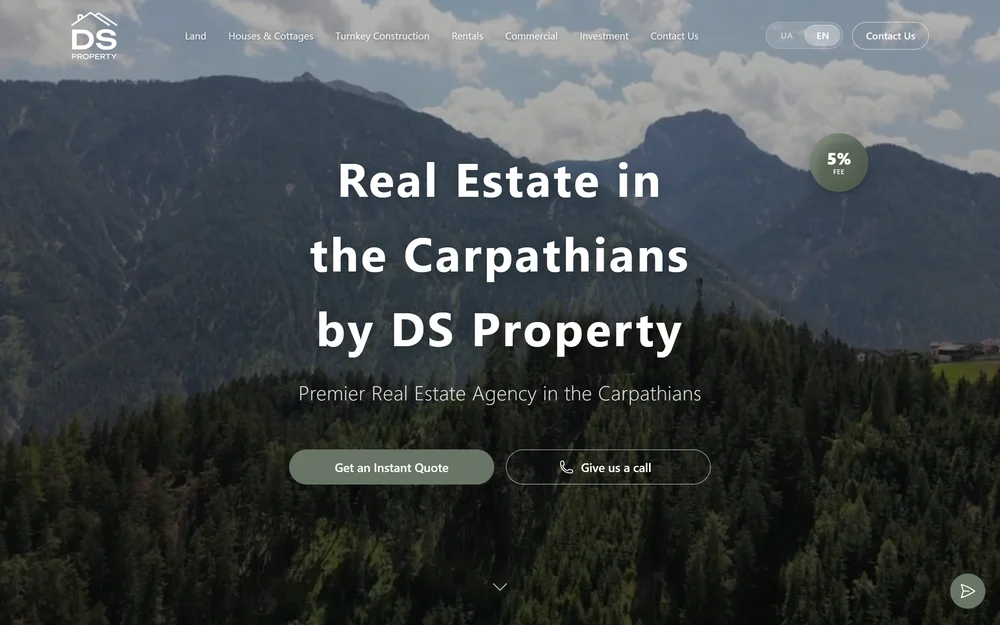
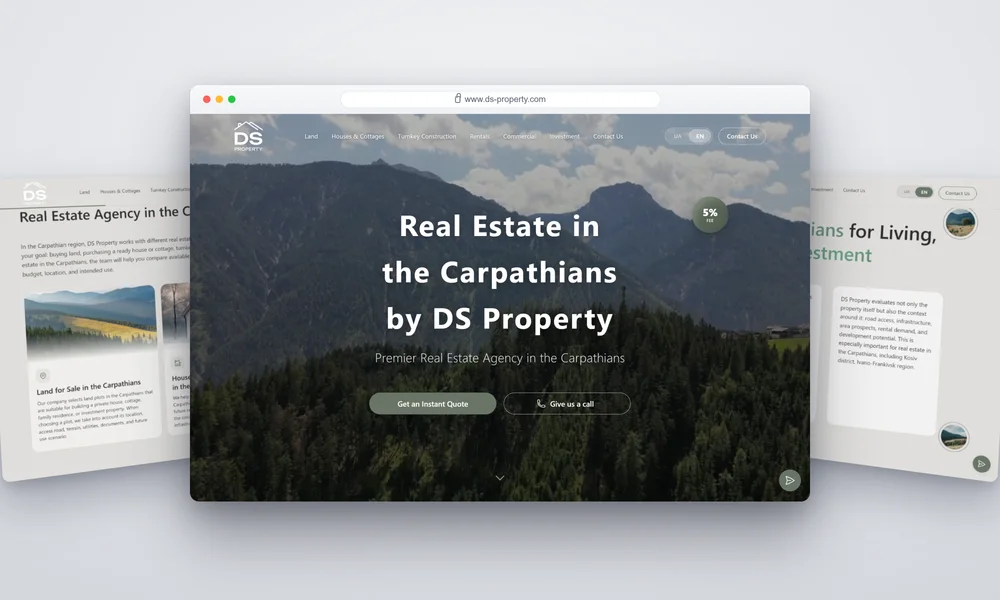
My hands-on real estate work is a property site selling land, houses, turnkey builds, rentals and commercial space — a bilingual application running English and Ukrainian off one shared routing layer. Another team designed and built it. I hold repository and deployment access and handle what comes after launch: new sections, translated content, structured data, sitemap and search work. Two languages is a real constraint on how anything gets added — every new section ships as a matched pair, same structure, same metadata, same schema, translated strings — and it is a good discipline to bring to a bilingual Milton listing page.
The client is DS Property, a real estate agency in the Ukrainian Carpathians. Read the full case study →
Five Things Your Own Site Does That a Listing Portal Never Will
A portal is very good at one job: showing every listing to every searcher. Everything below is a job it is not trying to do, which is exactly why it is worth owning.
A page about the 1970s streets of Dorset Park — lot sizes, mature trees, what a buyer is signing up for with a house of that vintage — answers a question no listing feed answers. It also keeps earning after the listing sells, which a listing page does not.
Someone deciding whether to sell searches for what their street is worth and who they should call. That is a separate path with its own pages and its own form, and on most agent sites it does not exist — the whole site is built for buyers.
Feed data disappears when the listing closes. A short write-up of what the property was, what it needed and how the sale went is proof of work, and it is the material a buyer reads before deciding whether to call you rather than the agent on the sign.
If you serve buyers in a second language, a portal gives you a checkbox on a profile. Your own site can carry whole pages in that language, indexed separately — which is the same matched-pair discipline the bilingual property site above is built on.
A portal enquiry can be routed by rules you don't set. A form on your own domain sends to your inbox, records nothing to a third party, and can ask the two or three questions that tell you whether this is a Tuesday showing or a spring listing.
Every Search Is a Different Person at a Different Stage
| What they search | What they are actually doing | Page I'd build |
|---|---|---|
| "homes for sale in Milton" | Browsing, months out, comparing towns | A town overview that explains the market segments before it shows a single listing |
| "Milton new build vs resale" | Weighing a builder purchase against an existing home | A comparison page on closing timelines, deposit structure and what "as built" means |
| "[neighbourhood] Milton homes" | Already narrowed to one area, wants detail | One page per neighbourhood, written by someone who has walked it |
| "sell my house in Milton" | A seller, not a buyer — a completely different visit | A seller path: evaluation request, preparation checklist, what your commission covers |
| "Milton real estate agent reviews" | Checking you specifically, usually after a referral | A reviews page with marked-up testimonials and the name they were referred to |
| "moving to Milton from Toronto" | Comparing commute, schools and price per square foot | A relocation guide covering the 401, the GO line and what the drive really costs |
Six searches, six pages. A single "Listings" page tries to be the answer to all of them and is the best answer to none.
Milton Is Four Housing Markets, Not One
A town that grew 20.7% between 2016 and 2021 does not have one kind of buyer. Four distinct types of property sit inside the same postal code, and each one deserves its own page.
Mature stock, big lots
Dorset Park, bounded by Main Street, Steeles Avenue, Ontario Street and Thompson Road, and Timberlea just south of it: 1970s and early-80s houses on generous lots with grown trees. The buyer here is usually pricing a renovation into the offer.
Page it needs: what to expect from a house of that vintage, and what it costs to update.
Old Milton and Bronte Meadows
The streets around Main Street East and Bronte Street, walking distance to the downtown shops and the mill pond. Character homes, tighter inventory, and buyers who are choosing the street before the floor plan.
Page it needs: a downtown-living page that sells the walk, not just the square footage.
The family subdivisions
Hawthorne Village, Beaty, Clarke and Dempsey — master-planned neighbourhoods built out from the late 1990s onward, full of freehold towns and detached homes bought by families who came for the schools and the price.
Page it needs: schools, parks and the difference between the phases, by name.
South of Derry, toward Britannia
Willmott, Ford and Scott: the newest construction, and often the landing spot for buyers priced out of Oakville and Mississauga. The questions here are new-build questions — deposit structure, closing dates, what the builder's contract does and doesn't cover.
Page it needs: new-build buying explained — deposits, closings, and what a builder contract does not include.
Beyond the subdivisions there is a fifth market that hardly anyone writes for: the rural edge. Campbellville and Brookville, the escarpment around Kelso and Rattlesnake Point, acreage and hobby-farm listings that behave nothing like a freehold town. If you sell out there, that is a page of its own — well and septic, road frontage, conservation-authority land — and it faces very little competition in search, because the big portals do not publish that kind of page.
The town's own geography is a content plan if you read it that way. Highway 401 crosses the north end and the 407 runs along the south, which decides who commutes where; Ontario Street and Bronte Street decide which side of town a buyer is really shopping; the GO station and Milton District Hospital are landmarks a relocation page should name outright. Between 2016 and 2021 the population grew from 110,128 to 132,979 — Statistics Canada put that 20.7% among the highest growth rates in the country — and many of those arrivals were house-hunting from outside Halton with no idea which of the four markets above they were looking at. Answering that in writing is ordinary Milton SEO work, and it is the same approach behind every Milton web design project I take on.
The Part That Comes After Launch
Most working websites outlive whoever made them, and a real estate site is a bad candidate for standing still: listings change, neighbourhoods get built out, and a page written for last year's market reads as neglect. On the property site above, the ongoing work is exactly that — new sections inside the existing design system, content kept current in both languages, structured data and sitemap entries as the site grows.
If your site already exists and the person who built it has moved on, that is website maintenance & support, and moving a site off a platform you don't control is website migration. Both are ordinary work, and I will tell you honestly when a rebuild is the cheaper answer.
What's Included in a Real Estate Website
Hand-coded, no theme and no page builder — so there is nothing to license, update or patch later.
The buyer path
Everything a buyer needs before they will call an agent they have never met.
- A page per Milton neighbourhood you actually work
- Listing cards with room for the required brokerage and trademark lines
- A sold archive that stays yours after the feed drops the listing
- Photo galleries that load fast on a phone at an open house
- A short enquiry form that reaches your inbox directly
The seller path
The half of the market most agent sites forget to build at all.
- A home evaluation request with its own page and form
- A plain explanation of what your commission covers
- A preparation checklist sellers can work through before listing
- Reviews marked up so search engines can read them
- Your registered name and your brokerage's, on every page
"A brokerage-supplied website works perfectly right up to the day you change brokerages. Then it keeps working — for whoever takes your desk." — Liubomyr Lukaniuk, on building real estate websites
Which Package Fits a Real Estate Agent
| Package | Best for | What's included |
|---|---|---|
| Starter — $899 | Up to 10 pages | Home, about, current listings, two or three neighbourhood pages, reviews and contact, with a protected enquiry form and basic local SEO |
| Full Site — $1,499 | A larger structure | A page per neighbourhood you work, a separate seller path with its own evaluation form, a sold archive and deeper local SEO |
| Advanced — $2,999 | Booking, payments or a listing feed | DDF® listing integration built to CREA's display rules, showing appointments, online payment, unlimited pages, priority support |
One-time pricing, fixed in writing before I start, with the domain and hosting registered in your name. Google Business Profile setup or optimisation is separate, from $149 — see full pricing.
Real Estate Website FAQ, Milton
Have you worked on a real estate website before?+
Yes, and I will describe it exactly. I hold repository and deployment access on a bilingual property site — English and Ukrainian, built in Next.js and hosted on Netlify — where my role is ongoing development: new sections, translated content, structured data and sitemap work. Another team designed and built that site. For a Milton agent I would be designing and building from an empty folder, which is what the rest of my portfolio is.
Do I need MLS® listings on my own website?+
Not automatically. CREA's REALTOR.ca Data Distribution Facility is a permission-based feed, and if you use it every page showing that data has to carry a trademark statement, a "Powered by REALTOR.ca" badge at least 90 pixels wide linking to the matching listing, and the listing brokerage's name in readable text. Many agents do better with their own listings plus real neighbourhood content. Decide before the build, because it changes the templates.
What does RECO require on a real estate agent's website?+
RECO's bulletin on online advertising says the employing brokerage's name must be clearly and prominently identified, that you advertise under the name you are registered with rather than a nickname, that information is current and accurate, and that you have consent before posting someone's photo or name. The brokerage and the agent are both responsible. I build those requirements into the template; your broker of record signs off on the wording.
What happens to my website if I change brokerages?+
If the domain, the hosting and the code are in your name, you update the brokerage identification and everything else keeps working — the URL, the neighbourhood pages, the search history and the leads. If the site was supplied by the brokerage, you usually lose all of it on the day you leave, including the rankings those pages had earned.
What does a real estate website cost in Milton?+
$899 one-time for up to 10 pages, $1,499 for a larger structure with neighbourhood pages and a separate seller path, $2,999 where booking, payments or a listing feed are involved. Fixed price agreed in writing before work starts, and the domain and hosting stay in your name. See my website design packages.

10+ years designing SEO-ready websites for local businesses, plus ongoing development on a bilingual property site. About the studio · Get in touch
Still working off a brokerage profile page?
I'll build you a site on your own domain — neighbourhood pages, a seller path and the compliance lines already in the template. Packages from $899.