Website Design for Security Guard Companies in Sudbury
This is the fifty-second industry I have written a page for on this site, and the first where a regulation specifies the clothing in the photographs. Ontario Regulation 362/07 sets the security guard uniform down to the height of the lettering. Ontario Regulation 364/07 sets the marked vehicle. Section 40 of the Act prohibits four terms from the words printed beside them. So on this kind of site the photo brief and the wording list come before the layout, and that is where I would start.
Every element below is required by name. This is what a photograph on the site has to show if it shows a uniformed guard at all.
LOGO OR CREST ↕ 2–3 cm below the crest SECURITY NAME OR LICENCE NUMBER
- Licensee name, logo or crest, affixed to the chest of the outermost pieces. 2 (1)
- “SECURITY”, “SÉCURITÉ”, “SECURITY GUARD” or “AGENT DE SÉCURITÉ” on the chest, upper case, at least 1.5 cm high, in a contrasting colours. 2 (2)
- Placed two to three centimetres below the crest where the crest also appears elsewhere on the uniforms. 2 (2) (b)
- “SECURITY” or “SÉCURITÉ” on the back, at least 10 cm high — unless the outermost piece is a collared shirt, sweater, blazer, sports jacket or suit jackets. 2 (3)
- Identification tag on the chest carrying the guard’s name or licence numbers. 3
If a photograph shows any of these, it shows a uniform Ontario does not permit. Checking an image against this list takes about a minute.
- A collared shirt that is black or navy blues. 5
- A police-style forage caps. 7
- Rank chevronss. 4 (1)
- Trouser stripes down the side, other than reflective safety stripess. 6
- No “SECURITY” lettering on the chest, or none on the back where the outer layer is a jacket that is not a blazer or sports jackets. 2 (2), s. 2 (3)
Source: O. Reg. 362/07, Uniforms, ss. 2–7, read 9 September 2026. The exemption in s. 35 (3) of the Act — bodyguards, and loss-prevention work in an industrial, commercial, residential or retail environment — decides whether a uniform is worn at all, not what it looks like when it is.
Short answer
A security agency website in Ontario is regulated material. The uniform and the marked vehicle in your photographs have written specifications, four terms are prohibited from the copy, and the Registrar can order a correction of equal prominence to the original publication. I build the site so those are components rendered from one source, rather than sentences retyped page by page.
I have not built a website for a security guard agency, and I would rather say that at the top than have you find out later. The closest work I have is a fire protection engineering site in Markham, sold to the same kind of buyer. What carries over and what does not is set out further down, in its own table. Everything about the regulation on this page comes from the primary text, linked at each point, and I am a web designer rather than your licensing counsel — how any section applies to your agency is a question for them or for the Ministry of the Solicitor General.
Which words can an Ontario security company not use on its website?
Four: detective or private detective, law enforcement, police, and officer — “or variations of them”, in the words of section 40 of the Act. The prohibition is written against the licensee and the licensed individual rather than against a medium, so it reaches the website, the careers page and the vehicle alike.
The vehicle regulation spells the same list out again and adds the French forms, which is the version I would work from on a bilingual Sudbury site. Below is what that means as an edit: the phrase to look for, the reason, and a replacement that says the same thing.
Sources: Private Security and Investigative Services Act, 2005, ss. 39–40, and O. Reg. 364/07, Vehicles, s. 4. Both read 9 September 2026. A find-and-replace across a site is ten minutes of work; it is worth doing deliberately because these words also sit outside the page copy — in image alt text, in a PDF capability statement, in an old job posting.
Why the photographs are the part I would check first
Because it is the province’s own first-listed finding. In its 2024–25 annual report the Ministry of the Solicitor General sets out Ontario’s top three compliance issues, and the first is failure to wear a compliant uniform. The uniform and the vehicle are also the two things this kind of site photographs.
Source: 2024–2025 Annual Report on the Private Security and Investigative Services Branch, published 6 October 2025, read 9 September 2026. The same report records 452 inspections completed, up 38% on the previous year, and 892 compliance checks in total.
The practical consequence for a website is small and specific. A photograph is either shot to the specification above or it is not, and the difference is visible in the frame: the lettering on the chest, the colour of the collared shirt, the shape of the hat, the stripe on the trouser leg. It takes a minute to check an image and it cannot be fixed later by editing text.
I do not photograph on site, on any project. The photographs come from you or from a photographer you hire, and what I supply is the brief. On a security agency site that brief is unusually easy to write, because the regulation has already written most of it: front of the outer layer, back of the outer layer, identification tag, the vehicle from the side, the vehicle from the front or back.
The vehicle has its own specification and it is shorter. “SECURITY” or “SÉCURITÉ” in upper case, in a contrasting colour, at least 10 cm high on both sides and at least 8 cm high on the front and the back. No red, blue, gold or yellow stripes, or any combination of them, except as part of the licensee’s crest or logo. The word may also appear inside the crest itself. That last clause matters to a designer, because it is the one place the regulation makes room for the crest to carry both the word and the colours.
Two of the five prohibited terms are worth re-reading here as well: they apply to the vehicle as an object, so a wrap carrying one of them has to be corrected on the vehicle as well as in the photograph of it.
Source for the vehicle specification: O. Reg. 364/07, Vehicles, ss. 3–4, read 9 September 2026.
What a rebrand changes for a licensed agency that it does not change for anyone else
A filing. The Ministry of the Solicitor General lists six items an agency has to update through ServiceOntario immediately when they change, and two of them are the uniform design and the marked vehicle design. Those are exactly the two things a rebrand redraws and a website publishes, which puts a design decision inside a regulatory process.
The public registry searches agency licences by legal business name, so the name in your header is checkable by anyone who wants to check it.
Section 32 of the Act gives five business days to inform the Registrar in writing of a change of address for service.
Not a website field, but it is the reason an “our team” page and the filing can quietly diverge.
The one that touches a coverage page: a second office is a filing, an unstaffed service area is not.
The clothing in every photograph on the site. A new crest, a new colour, a new outer layer — all of it is a design change to a filed design.Your website publishes this
The wrap. Same point, and the specification in O. Reg. 364/07 constrains the artwork before the brand does.Your website publishes this
Source: Requirements for licensed agencies, Ministry of the Solicitor General, read 9 September 2026, and PSISA, 2005, s. 32.
Section 33 of the Act adds the other half of the name question: a licensee may not carry on business in a name other than the name in which it is licensed. Set that beside ServiceOntario’s public registry, which searches agency licences by licence number or by legal business name, and the header of the website becomes something a procurement officer can verify in one search before replying to a proposal.
This is why I ask for the licence document at the start rather than at the end. The exact legal name, the licence number and the class decide the wording of the header, the footer, the schema, the contact page and the proposal template — and they are the fields most likely to be typed from memory into a design file and then repeated across every page that carries them.
New agencies get one more date worth designing around. A compliance inspector contacts every newly licensed agency within thirty days, and a compliance inspection follows within six months, covering uniform requirements, vehicle signage, insurance and recordkeeping. A site launched in that window is describing things an inspector is about to look at directly.
What happens if the Registrar disagrees with something the site says?
Section 42 of the Act: where the Registrar believes on reasonable grounds that a licensee is making a false, misleading or deceptive representation in material published or transmitted by any means, the Registrar may order the licensee to cease making it, and to retract it, publish a correction of equal prominence to the original publication, or both.
On paper “equal prominence” is a size of advertisement. On a website it points at a slot. A claim made in the hero implies a correction in the hero, which makes it a design decision as well as a legal one.
Two build consequences follow, and both are cheap at the start and expensive later. Every claim that could be the subject of an order lives in editable text rather than inside an image, so it can be replaced without a designer. And the same claim appears once, in one component, rather than being retyped on each service page — otherwise a correction is a hunt.
The penalties sit in section 45: an individual convicted of an offence under the Act is liable to a fine of up to $25,000, imprisonment of up to one year, or both, and a business entity to a fine of up to $250,000. Section 44 extends the offence to a director, officer or partner who authorizes, permits or acquiesces in it. I am quoting the maximums the statute sets, not predicting what any case would attract. Source: PSISA, 2005, ss. 42, 44 and 45, read 9 September 2026.
The page set I would build for a Sudbury security agency
Seven pages plus a French set where French is in scope, and the reason each one exists is either a rule above or a question the buyer asks before signing. The row I would defend hardest is the third, because it answers the question a property manager has to ask before a shift starts: what will arrive, and what will be written on it.
| Page | What it carries | What it answers |
|---|---|---|
| Home | The legal business name exactly as licensed, the agency licence number, one sentence on what you sell, and the coverage statement | Can a stranger match this business to the public registry in one search? |
| Services | One page per service you hold licensed guards for — static site, mobile patrol, concierge and front desk, construction site, event, alarm response, loss prevention | Do you do the specific thing I need, and is it a post or a patrol? |
| Uniform and vehicles | The filed uniform photographed front and back, the marked vehicle, and the words that appear on both | What will arrive at my site, and will my staff and my tenants recognise it? |
| Compliance and insurance | Licence number and class, confirmation that the agency is insured as section 30 requires, and a plain description of your use-of-force reporting and recordkeeping practice | Can I put this vendor through procurement without a second round of questions? |
| Coverage | Named communities, and a plain statement of what is a scheduled patrol, what is a call-out, and what the response window is in each case | Do you actually cover my site, or is it inside a circle drawn on a map? |
| Careers | “Security guard” as the job title, the licence requirement stated, and a link to the ministry’s own licensing page | Do I need a licence before I apply, and where do I get one? |
| Request a quote | Six fields: site type, hours, number of posts, armed or unarmed, start date, duration | Can I ask for a price without a phone call I do not have time for? |
| French | A parallel set, not a widget — including the uniform and vehicle wording, which the regulation already provides in French | Can I read the contract terms in the language I work in? |
The careers page earns its place twice. It is the page most likely to still carry a prohibited term, and it is the page that has to explain the licence: the ministry’s report records 60,520 licensing tests conducted in 2024–25, with 87% of test takers passing.
What is different about selling security in Greater Sudbury
Distance, first. The City of Greater Sudbury covers 3,186 square kilometres of land and 3,627 square kilometres including water, which makes it the largest municipality in Ontario by area — around five times the size of Toronto, on the City’s own comparison. It contains 330 lakes and 601 square kilometres of water. A coverage page that says “Sudbury and surrounding area” is describing 3,627 square kilometres, and a mobile patrol route inside it is a schedule rather than a radius.
The city is also the regional centre for northeastern Ontario, a market the City puts at 555,000 people reaching from the Quebec border west to the eastern shore of Lake Superior and north to the James and Hudson’s Bay coasts. It sits 390 kilometres north of Toronto, 290 kilometres east of Sault Ste. Marie and 483 kilometres west of Ottawa, where Highway 69 South meets Highway 17. For an agency, that means a real distinction on the site between what is covered on a schedule and what is quoted as a mobilisation.
Greater Sudbury was formed on 1 January 2001 from seven former municipalities — Sudbury, Capreol, Nickel Centre, Onaping Falls, Rayside-Balfour, Valley East and Walden — plus nine unincorporated townships. Those names are still how the areas are described locally, which makes them the content a coverage page has to contain.
Then the work itself. The City reports that mining companies here employ about 6,000 people and support a cluster of some 300 mining supply and service companies employing a further 10,000. Fenced industrial sites and controlled access are a different services page from a downtown retail post, which is the reason to write both rather than one — alongside the ordinary retail, healthcare, education and construction demand of a city the City put at approximately 166,000 people in 2018.
- Sudbury
- Capreol
- Nickel Centre
- Onaping Falls
- Rayside-Balfour
- Valley East
- Walden
- Highway 17
- Highway 69 South
Sources: City of Greater Sudbury, About Greater Sudbury, Location and History, all read 9 September 2026. The ministry’s 2024–25 annual report, citing federal Job Bank data, records that 53% of the industry workforce is based in Toronto while most job postings are concentrated in southwestern and northern Ontario — which is the sourced reason this page exists for a northern city rather than another GTA one.
The closest project I have actually built, and what it does not cover
This client is a fire protection engineering firm in Markham. I designed and built the site so that developers, general contractors and property managers could establish credibility from the page rather than from a phone call — capability pages, compliance and credential displays, and a structure that survives being forwarded around a buying committee. It is live at this link, and the full write-up is in the fire protection case study.
I have put it here rather than a closer-sounding project because the buyer is genuinely the same person: someone responsible for a building, choosing a life-safety vendor, checking credentials before replying. That part transfers. The trade does not, and the table below says exactly where the line falls.
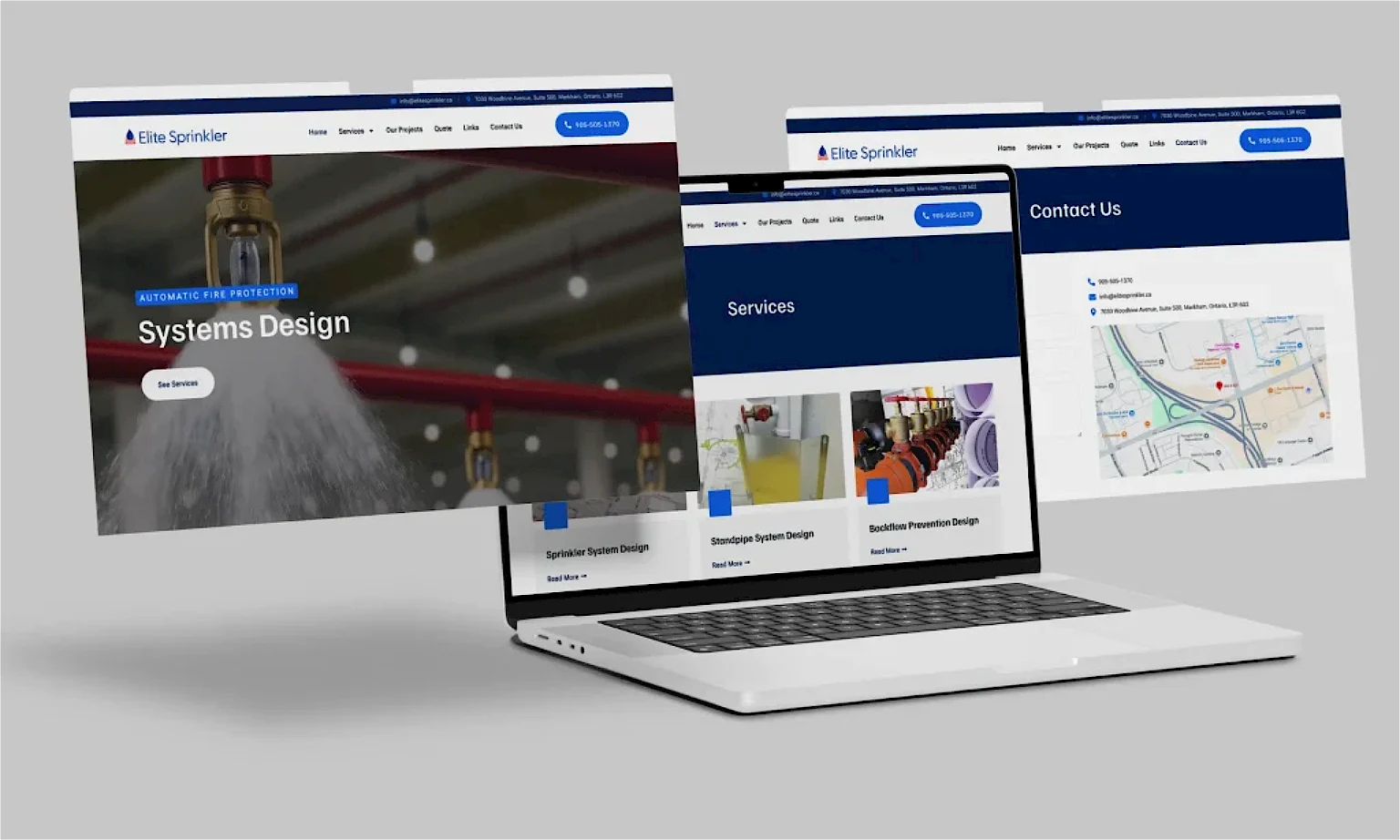
| Area | Carries over | Does not — new work, priced as new work |
|---|---|---|
| The buyer | A property manager or general contractor comparing vendors, and a page written so credentials can be checked rather than claimed | The procurement questions specific to guarding: post orders, supervision ratios, coverage of an after-hours call-out |
| Credentials on the page | Licence and certification blocks presented as verifiable facts with a number a reader can look up | The PSISA layer itself — the licence class wording, the prohibited terms, the photograph specification |
| Service-area structure | Coverage pages that survive a long list of municipalities without turning into duplicates | The scheduled-patrol versus mobilisation distinction, which has no equivalent in fire protection |
| Software | Forms, quote requests, analytics, accessible tables and print behaviour | Guard scheduling, incident reporting portals, guard tour and patrol-verification systems, and anything that reads from your workforce system |
| Photography | Direction and a written brief | Shooting it — I do not photograph on site, on any project |
| Legal wording | Building the components that hold it, and keeping each claim in one editable place | Drafting anything that touches sections 39 and 40. That comes from your counsel |
Two other builds are relevant for different reasons. The fire protection city page is the closest sibling in this portfolio for a compliance-first B2B site, and the notaries work is where I learned the wording discipline a regulated title forces: say what is held, link where it is checked, and stop.
Six things I would get wrong if I built this page from a template
Written as my own list rather than as a claim about anybody else’s site. Each one is a decision I would have made by default before reading the two regulations this week.
- 01Writing “officer” into the headline
It is the natural word in English and it is on the prohibited list. It would have gone into the H1, the alt text and the careers page before anybody read section 40.
- 02Choosing a dark navy for the uniform in a mockup
A collared shirt cannot be black or navy blue under section 5. A brand palette built around navy runs into section 5 while the mockup is still being approved.
- 03Treating a vehicle wrap as pure branding
Ten centimetres on the sides, eight on the front and back, and no red, blue, gold or yellow stripes except inside the crest. That is a constraint on the artwork, and it is worth knowing before the design is approved.
- 04Baking the main claim into a hero image
Section 42 lets the Registrar order a correction of equal prominence. Text inside a JPEG cannot be corrected without a designer.
- 05Using a trading name because it looks better
Section 33 says the business is carried on in the licensed name, and the public registry searches by legal business name. A prettier name in the header is a mismatch a buyer can find.
- 06Adding French with a translate widget
In a city where roughly 38% of people know both official languages, and where the regulation itself supplies the French terms, a machine-translated page can produce the exact words section 40 prohibits, because they are the ordinary French renderings of the English ones.
What you get, and what it costs
| Item | Included | Notes |
|---|---|---|
| Hand-coded pages | Yes | No template and no page builder. The shape above is the starting point; the count moves with your service list |
| Licence and identity components | Yes | Legal name, licence number and class written once and rendered everywhere they belong |
| Photo brief against the regulation | Yes | A written shot list keyed to O. Reg. 362/07 and 364/07, for you or your photographer |
| Wording sweep for prohibited terms | Yes | Across pages, headings, alt text and any document you publish on the site |
| Local SEO structure | Yes | Schema, coverage pages and the Greater Sudbury community names above |
| Accessibility | Yes | WCAG 2.1 AA target — see accessibility compliance |
| Photography | No | I do not shoot on site. The brief is included; the shoot is yours |
| Legal drafting | No | Anything touching sections 39 and 40 comes from your counsel |
| Scheduling or incident software | No | Integration can be scoped separately once you name the system |
| Google Business Profile management | Separate | From $149 per month — Google Maps management |
A build of this scope is $899–$2,999 one-time and goes live in 5–7 days once content is ready. Full breakdown on the pricing page. A bilingual set is quoted on top of that, because it is a second site’s worth of content and maintenance.
Common questions
Can an Ontario security company call its guards “officers” on its website?+
No. Section 40 of the Private Security and Investigative Services Act, 2005 prohibits a security guard, a private investigator, or a person who engages in the business of selling their services from using four terms or variations of them: detective or private detective, law enforcement, police, and officer. The prohibition is written against the person rather than against a medium, so it reaches website copy, headings, image alt text and job postings. The vehicle regulation, O. Reg. 364/07, repeats the list for anything displayed on a marked vehicle and adds the French forms.
Does the uniform regulation really affect a website?+
Indirectly but concretely, because a photograph of a guard shows a uniform. O. Reg. 362/07 requires the licensee’s name, logo or crest on the chest of the outermost piece, the word SECURITY, SÉCURITÉ, SECURITY GUARD or AGENT DE SÉCURITÉ in upper case at least 1.5 cm high on the chest, the word SECURITY or SÉCURITÉ at least 10 cm high on the back unless the outer piece is a collared shirt, sweater, blazer, sports jacket or suit jacket, and an identification tag with the guard’s name or licence number. It also forbids rank chevrons, a police-style forage cap, black or navy collared shirts and trouser stripes other than reflective safety stripes.
What has to be on a marked security vehicle, and does that change the wrap design?+
Yes, it constrains it. Under O. Reg. 364/07 the word SECURITY or SÉCURITÉ must be prominently displayed in upper case in a contrasting colour, at least 10 centimetres high on both sides and at least 8 centimetres high on the front and the back. The vehicle must not carry red, blue, gold or yellow stripes, or any combination of them, except as part of the licensee’s crest or logo. The word may also appear inside the crest. Those measurements decide the artwork before a brand guideline does.
Why does a rebrand involve the regulator at all?+
Because the uniform design and the marked vehicle design are among the six items the Ministry of the Solicitor General requires an agency to update through ServiceOntario immediately when they change. The other four are the business name, the business address and contact information, the sole proprietors, officers, directors and partners, and branch offices. A rebrand normally touches the first, the fifth and the sixth at once, which is why I ask about it during scoping rather than at launch.
Can the Registrar order us to change something on the website?+
Section 42 says that where the Registrar believes on reasonable grounds that a licensee is making a false, misleading or deceptive representation in an advertisement, circular, pamphlet or material published or transmitted by any means, the Registrar may order the licensee to cease making it and to retract it, publish a correction of equal prominence to the original publication, or both. On a website, equal prominence points at the slot the claim occupies, which is why the main claim should be editable text in one component rather than a sentence baked into a hero image.
Should a Sudbury security agency website be in French as well as English?+
It is a scoping decision with a real cost, and here it has a real basis. The City of Greater Sudbury describes itself as a truly bilingual community and home to Canada’s third-largest French population outside Quebec, with roughly 38% of people identifying as knowing both official languages. The regulations already supply the French terms for the uniform and the vehicle and name the prohibited French forms, so the wording exists. What has to be budgeted is a parallel content set and its ongoing maintenance, not a translation widget.
Have you built a security guard company website before?+
No. The closest project I have is a fire protection engineering site in Markham for a fire sprinkler company, where the buyer is also a property manager or general contractor choosing a life-safety vendor and checking credentials before replying. What transfers is the credibility structure, the coverage pages and the forms. What does not is the PSISA layer, guard scheduling and incident-reporting software, and the photograph specification — and I price those as new work rather than as something I have already solved.
How much does a security agency website cost and how long does it take?+
A build of this scope is $899 to $2,999 one time and goes live in 5 to 7 days once content is ready, which is the same range and the same timeline as every other build on this site. The variables here are the number of services you hold licensed guards for, whether a French set is in scope, and whether you already have photographs that match the uniform regulation. Google Business Profile management is priced separately from $149 per month. Photography is not included, because I do not shoot on site.

10+ years designing SEO-ready websites for Ontario businesses, including regulated trades where a statute decides which components a page must carry. About the studio · Get in touch · Packages and pricing
Sudbury is the first city page for this niche — start at the security guard company web design hub. Closest related work: fire protection · notaries · trucking · public adjusters · restoration. Or browse all industries.
Send me your agency licence and a photograph of the uniform, and I will map the pages before I quote
Those two decide most of the structure — the legal name, the licence block, and whether the photographs you already own can be used. Packages from $899.