Tree Service Website Design in Scarborough
Before anyone in Scarborough can buy a tree removal there is a question they usually cannot answer: am I allowed to cut this down? Toronto answers it with a measurement. Under Municipal Code Chapter 813, a private tree that is 30 centimetres or more across at 1.4 metres above the ground cannot be injured, destroyed or removed without a permit — and the application needs a survey, an arborist report, a protection plan and a replanting plan before the City will look at it. That question decides whether the job exists at all, so a site that settles it in the first screen has done the useful part of the sale before the phone rings. There is no tree service company in my portfolio yet, and I would rather write that here than imply otherwise.
2027 report
today · §813-12
from 1 Sep 2026
from 1 Sep 2026
Thresholds read straight from the by-law and the City's own by-law review page. 30 cm is the live line; 61 cm and 40 cm arrive on 1 September 2026; 20 cm is a reduction the City has only asked staff to report back on in 2027, and is not in force. A multi-stem tree counts if a single stem reaches the line.
Short answer
Lead Web Studio designs and hand-codes websites for tree services, arborists and stump-removal crews in Scarborough and across Toronto — mobile-first, structured for local search, no template and no page builder. Every site is built around the permit question first: a page that explains the 30 cm rule in plain English, a ravine check before anyone quotes, a quote form that asks for the trunk measurement and a photo instead of "tell us about your tree", and an emergency route that says what you can legally do the same day. A build is $899–$2,999 one-time and goes live in 5–7 days once content is ready. There is no tree service company in my portfolio yet; this page says so.
Do You Need a Permit to Remove a Tree in Scarborough?
Yes, once the trunk reaches 30 centimetres across at 1.4 metres above the ground. Scarborough is part of the City of Toronto, so Chapter 813, Article III applies here exactly as it does downtown. Below that size the by-law's size test does not bite; at or above it, cutting without a permit is an offence — and the by-law counts a multi-stem tree if even one stem reaches the line.
What the by-law says
"No person shall injure, destroy or remove or permit the injury, destruction or removal of any tree, including a multi-stem tree having at least one stem that has a diameter measurement of 30 centimetres or more measured at 1.4 metres above ground level."
Taken at 1.4 m above ground for straight upright stems; 1.4 m along the centre of the stem axis for trees growing on an angle or on slopes; and at 1.4 m for each stem of a double or multi-stemmed tree.
Destruction "shall only be carried out by or under the supervision of an Arborist", and the permit "shall be posted in a conspicuous location visible from the street" from one day before the work until it is finished.
On conviction: "a minimum fine of $500.00 and a maximum fine of $100,000.00 per tree", plus "a special fine of $100,000.00" under the City of Toronto Act, 2006.
What that forces onto the website
Diameter at 1.4 m is not something a homeowner guesses. Give them the one sentence that works — measure the circumference with a tape at chest height and divide by 3.14 — and you have qualified the lead before it reaches you.
Split-trunk maples and clump birches are the shape people measure wrong. One stem at 30 cm brings the whole tree inside the by-law, so a single-trunk measurement can produce a confident, incorrect "no permit needed".
The by-law requires permitted destruction to be carried out by or under the supervision of an arborist. Name the qualification you hold and who issued it, because that condition is the reason a customer can lawfully hire you for the job at all.
$500 minimum and up to $100,000 per tree is the strongest argument on your site for doing this properly. Publish it as a fact with a link to the by-law and let it work; do not build a scare page around it.
Source: Toronto Municipal Code, Chapter 813, Trees (Article III, Private Tree Protection), City of Toronto. Quotations are from the consolidated text dated May 12, 2022.
What Does the City Ask For Before It Will Issue a Permit?
Seven things, listed in section 813-14, plus photographs and a scaled site plan the City asks for on its own application page. Six of the seven have to be produced by somebody — a surveyor, an arborist, a designer — before the form can even be submitted. Which is why a quote on a protected tree involves paperwork before it involves a price.
Name, address and telephone number of the owner making the application.
Non-refundable, set out in Chapter 441, Fees and Charges, Appendix E, Schedule 1. The City states the current amount on the form itself.
Why the permit is required — construction, decline, safety, a driveway. It shapes which route the application takes.
Showing the location of trees on the property. Not a photograph, and not a sketch.
Location, species, size and condition of the trees, with maintenance strategies and protection measures.
The extent of injury where applicable, plus protection details including where the barriers go.
Location, species and size of the trees proposed for planting, with planting details.
Clear colour photographs of the trees, a site plan with scale drawings, elevations for construction projects, and a ravine-line delineation where one applies.
Items 01–07 are section 813-14 of the by-law. The last tile is from the City's page on how to apply for a tree or ravine permit. Four of these are billable work a tree company either does, subcontracts or explains, and that deserves a service page of its own.
How Long Before the Work Can Legally Start?
It depends which of four routes the tree falls into, and the by-law sets floors rather than estimates. A healthy protected tree needs notice posted on the property for not less than 14 days before the permit is issued. A boundary tree adds two written notices to the neighbour. A certified hazard has no waiting period at all. Those are four different sales conversations, and one page cannot carry all of them.
| The tree | Which rule applies | What has to exist first | The statutory clock | What the website has to do |
|---|---|---|---|---|
| Dead, terminally diseased or imminently hazardous | Exempt from the permit under § 813-13 A — but only once certified as such by the General Manager | The City's certification. Nothing else on the 813-14 list. | No posted-notice period. The wait is however long certification takes; the by-law sets none. | Say plainly that "dead tree" is a City determination, not the crew's. This is the one route where a fast answer is honest. |
| Healthy tree, 30 cm or more, in the yard | Permit required, § 813-12 | Survey, arborist report, tree protection plan, landscaping and replanting plans, fee, photographs, scaled site plan. | Notice posted on the property not less than 14 days (§ 813-19), and it must be posted before the permit issues (§ 813-18.2). | Set the expectation in weeks on the service page, so the quote call is not the first time anyone says it. |
| Boundary tree or a neighbour's tree | Permit required, plus the notice duties in § 813-19.1 | Everything above — and the City tells the applicant that all of it will be handed to the other owner. | The City writes to the other owner within 15 business days of receiving the application, and again at least 15 days before a permit is issued. | A page of its own. The neighbour will read your customer's arborist report, and customers want to know that before they apply. |
| Anything inside a protected ravine or natural feature | Chapter 813 does not apply (§ 813-13 F). Chapter 658, Ravine and Natural Feature Protection, does. | A different application: tree inventory, tree protection plan, tree removal plan, grading plan, drainage plan and a geotechnical report. | Set by the ravine permit process, not by § 813-19. Non-refundable application fees are being introduced from 1 September 2026. | A ravine check before you quote. Getting this wrong quotes the wrong job under the wrong by-law. |
| A refused application | § 813-22, Appeals | A written request to the General Manager asking that community council hear it. | 14 days from the date of refusal. The Clerk then notifies the ward councillor and abutting owners of the hearing date. | Worth one FAQ answer. It is what a customer asks after a refusal, and the deadline is short enough to miss. |
Compiled from Chapter 813 sections 813-13, 813-14, 813-18.2, 813-19, 813-19.1 and 813-22, and from the City's own apply for a tree or ravine permit page for the 15-business-day and 15-day neighbour notifications. These are the minimums written into the rules, not a service standard for how quickly the City actually decides.
What Changes in the Toronto Tree By-laws on 1 September 2026
Five things, and one that people will wrongly assume. This page was published on 28 August 2026, four days before the City's amendments to both the Private Tree Bylaw and the Ravine and Natural Feature Protection Bylaw take effect. None of them moves the 30 cm line. All of them change what a tree company has to explain, and people will start asking about them on 1 September.
A new Distinctive Tree category for healthy private trees over 61 cm in diameter at breast height, considered during permit review. On the website: a second gate on your measuring page, above the 30 cm one.
A stump diameter of 40 cm or greater may be used as a secondary measurement tool. On the website: the plain answer to "what if it is already down" — the evidence does not disappear with the trunk.
Trees planted through enforcement actions or development approvals will need a permit for injury or destruction regardless of size. On the website: the reason a two-year-old replacement tree on a job site is not yours to touch.
Replacement planting shifts to a diameter-based system starting at 5:1 and increasing for larger trees. On the website: the number that changes a removal budget, so it belongs on the pricing page rather than in a phone call.
Non-refundable permit application fees are introduced for regulated ravine activities including tree injury, removal and grade alteration. On the website: one more reason the ravine check happens before the quote, not after.
Reducing the minimum protected tree size on private property from 30 cm to 20 cm is described as needing further analysis and an implementation strategy in a 2027 report. It has not been approved. A site that states it as current is wrong today.
Source: Tree Bylaw Review, City of Toronto, read on 28 August 2026. I have quoted the City's own wording for each item and marked the one that is not in force, because that distinction is exactly where a tree-service website loses trust.
What Makes Scarborough Different From the Rest of Toronto
Two things: the ravine systems, and the age of the tree canopy in the subdivisions. Both change which by-law applies and how long a job takes, and neither shows up on a website that was written for "Toronto" as one flat market.
Scarborough is cut through by two river systems — Highland Creek, which drains much of the district before it reaches Lake Ontario in the east end, and the Rouge, which forms the eastern edge and runs through Rouge National Urban Park. Add the Bluffs along the shoreline and the tributary valleys that reach north of Ellesmere, and a large amount of Scarborough's residential land sits close to something the City protects as a ravine or natural feature.
That matters commercially, not just ecologically. Section 813-13 F takes ravine-area trees out of the private tree by-law entirely and puts them under Chapter 658, which asks for a different application with a grading plan, a drainage plan and a geotechnical report. Quoting one of those properties under Chapter 813 prices the wrong process: the extra reports change both the cost and the timeline. So a Scarborough tree-service site needs a ravine question in the intake, before anyone drives out.
The second difference is the age of the canopy. Much of Scarborough's housing stock went up in the post-war decades, in Wexford, Bendale, Dorset Park, Cliffside, Guildwood and Woburn, and a tree that has been standing in one of those yards since then has had fifty to seventy years to grow. It only has to reach 30 centimetres across at chest height to be protected — a threshold a great many mature back-yard trees are well past. That is why the permit question belongs at the top of a Scarborough tree-service page rather than three clicks into an FAQ.
See how I approach the rest of the city on Scarborough web design, and the adjacent trade on landscaping and lawn care web design.
What a Scarborough intake form should ask
- Is the property near Highland Creek, the Rouge, or a valley slope? If yes, the ravine by-law may apply instead of Chapter 813, and the paperwork is different.
- What is the circumference of the trunk at chest height? One tape measurement decides whether a permit is in play at all.
- Is it a single trunk or several from one base? A multi-stem tree counts if one stem reaches 30 cm.
- Does the trunk touch or cross the property line? Boundary and neighbour trees add two written notices from the City.
- Is anything being built, dug or paved nearby? Injury includes construction damage, and a tree protection plan is part of the application.
- Photograph of the whole tree, and one of the base. A quote given without either is a site visit that could have been an email.
The Nearest Real Work, and What It Taught Me
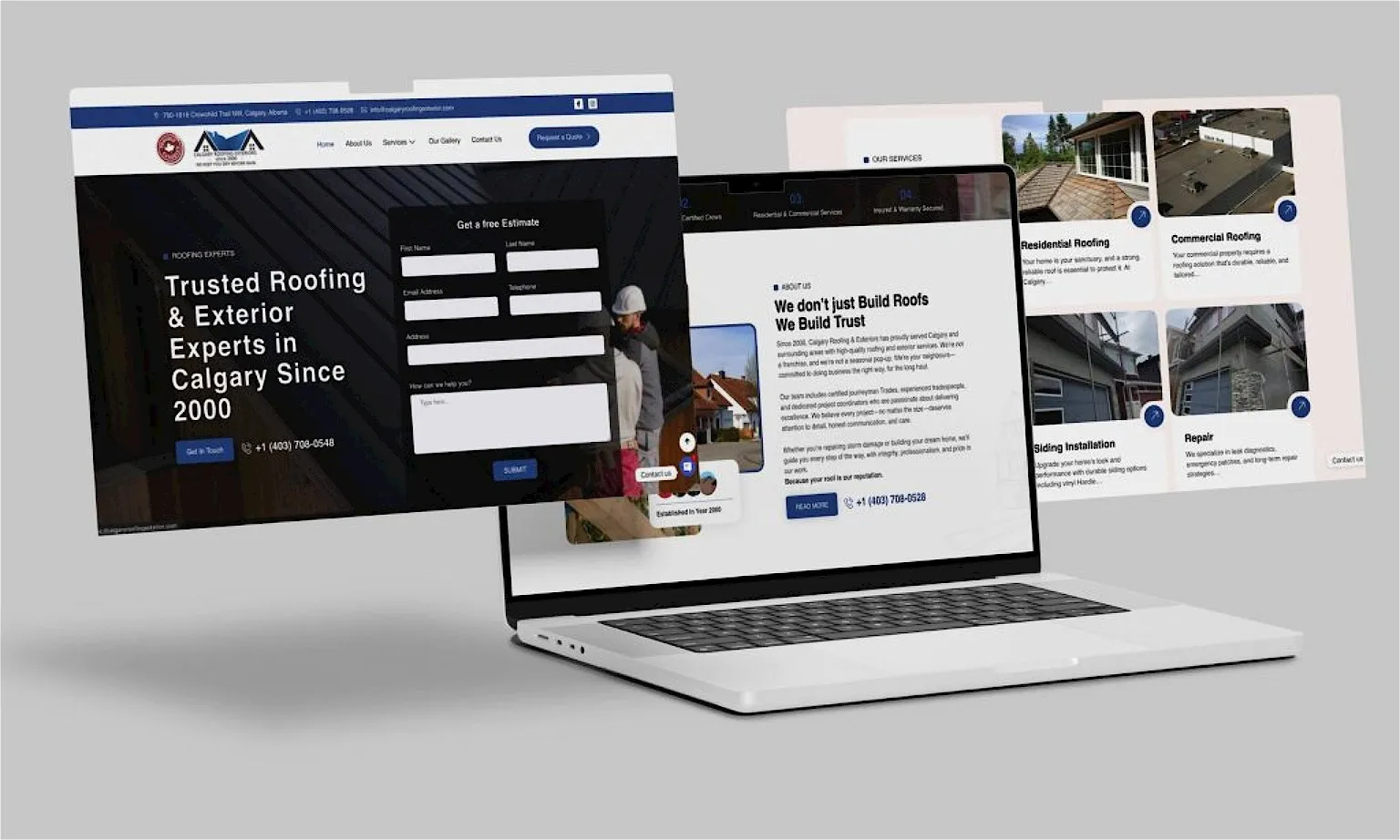
A roofing company is live at this link. I designed and hand-coded it — an exterior trade where the weather decides when the phone rings, the crew works at height, and the customer is choosing from photographs and a quote form rather than a showroom.
Tree work runs on the same three facts. A wind event fills the inbox in an afternoon; the job is dangerous enough that credentials count for more than price; and the whole decision is made on a phone, from a photograph the customer took at the back door. What the roofing build taught me is what to ask for on that form — a photo and a measurement, and nothing else, so the lead arrives ready to price.
The nearest local reference is Home Services in Oakville, a seasonal property-services company covering lawn care, gutters and snow removal. I did not design or build that site — an earlier team did, and I ship ongoing development on it. It is on this page because it is the closest thing I work on to a year-round property crew, not because I can claim it.
What Goes on a Scarborough Tree Service Website
One page per question a property owner needs answered before they will let a crew onto the driveway — not one page per piece of equipment.
| Page | Who lands on it | What it has to answer |
|---|---|---|
| Home | Someone who has just looked at a tree and does not know if they are allowed to touch it. | The 30 cm rule in one sentence, how to measure, your arborist credential, and one button that starts a quote. |
| Do I need a permit? | Anyone who has decided a tree has to go and does not know whether they may. | The measurement, the multi-stem catch, the four exemptions, the 14-day notice, and a link to the City's own by-law so the page can be checked. |
| Tree removal | Owners with a declining, leaning or overgrown tree. | What is included — felling, sectional dismantling, brush and debris, stump — and what the permit adds to the timeline before any of it starts. |
| Emergency and storm work | People calling at 6am with a limb on a roof. | What emergency work the by-law lets you do, that emergency work is certified by the General Manager, and a phone number that a person answers. |
| Pruning and cabling | Owners told their tree can be saved rather than removed. | That pruning to good arboricultural practice is exempt from the permit, which turns "no" into a smaller job you can still sell. |
| Ravine properties | Anyone backing onto Highland Creek, the Rouge or a valley slope. | That Chapter 658 replaces Chapter 813 there, what the extra reports are, and how they should confirm which side of the line they are on. |
| Permit help | Owners who have read the application list and stopped. | Which of the seven documents you produce, which you subcontract, and what you charge for handling the application. |
| Stump grinding | Buyers of a smaller, faster, self-contained job. | Depth, what happens to the grindings, access width the machine needs, and a flat price where one is honest. |
| Neighbourhood pages | Search from Guildwood, West Hill, Agincourt, Malvern, Birch Cliff, Wexford, Woburn. | Real places by name rather than a radius, so local search has something concrete to match. |
Everything a Tree Service Site Needs
Built for someone standing in their back yard with a phone in one hand, and for the search engine reading it afterwards.
Answered before anyone calls
The facts that decide whether you are the right company to phone.
- The 30 cm rule and how to measure a trunk, in the first screen
- Your arborist qualification named, with who issued it
- Proof of liability insurance and WSIB coverage stated plainly
- Your own job photographs — the same tree before and after, not stock
- The service area by neighbourhood, not by a circle on a map
- What an emergency call gets you today, and what it does not
Built into the code
The parts nobody sees, which decide whether the rest gets found.
- A quote form that asks for a photo and a trunk measurement first
- A ravine question in the intake, before a site visit is booked
- Click-to-call that works with one thumb during a storm
- Fast on a weak signal — no hero video, no chat bubble over the call button
- Service and local business schema with a consistent name, address and phone
- A Google Business Profile carrying exactly the same details
Where Tree Service Websites in Toronto Go Wrong
Each of these is a claim or an omission I would fix first on an existing site. None of them needs a redesign; they need a sentence.
For a healthy protected tree it is not deliverable: section 813-19 requires notice posted for not less than 14 days before the permit is issued. Same-day is honest for a small tree, a certified hazard or a pruning job.
Fix: keep the same-day promise, and put the three cases it applies to right underneath it.
It is one of the first things a customer searches once they have decided a tree has to go, and it is the one question that can cancel the job. A site that never raises it reads as either uninformed or evasive.
Fix: one page called "Do I need a permit to remove a tree in Toronto?", linking the by-law so it can be verified.
"Tell us about your project" produces a paragraph you cannot price. The by-law already told you what to ask: the diameter at 1.4 m, whether it is multi-stem, and whether the trunk crosses a property line.
Fix: three fields and a photo upload, and most quotes can be given without driving anywhere.
The by-law makes an arborist mandatory for permitted destruction work, so the qualification is the reason a customer can lawfully hire you for that job at all. Leaving it off the page throws away the one thing on your site a competing crew cannot copy.
Fix: name the certification and the issuing body on the home page and on every service page.
The reduction of the protected size from 30 cm to 20 cm is a report-back for 2027, not law. A site stating it as current is wrong, and a competitor or a customer will find that out.
Fix: publish what takes effect on 1 September 2026, and label anything proposed as proposed with its date.
What a Tree Service Website Costs in Scarborough
One payment, fixed in writing before I start, and about 5 to 7 days once the content is ready.
| Package | Best for | What's included |
|---|---|---|
| Starter — $899 | Up to 10 pages | Home, the permit page, removal, pruning, stump grinding, emergency work, about, pricing, FAQ and contact, with a protected quote form and local SEO from day one |
| Full Site — $1,499 | A page per service and neighbourhood | Everything above plus a ravine-properties page, a permit-help page, a before-and-after gallery, and separate pages for Guildwood, West Hill, Agincourt, Malvern, Birch Cliff, Wexford and Woburn |
| Advanced — $2,999 | Quote intake and scheduling | Photo-upload quote intake with the measurement fields, emergency routing to a phone that is on call, online deposits, a job-status page for booked work, unlimited pages and priority support |
Google Business Profile work is separate and starts at $149. See full pricing and Google Maps management.
Tree Service Website FAQ — Scarborough
Do you need a permit to remove a tree on private property in Scarborough?+
Yes, once the tree measures 30 centimetres or more in diameter at 1.4 metres above ground level. Section 813-12 of Toronto Municipal Code Chapter 813 says no person shall injure, destroy or remove any tree at or above that size without a permit, and it counts a multi-stem tree if even one stem reaches 30 centimetres. Scarborough is part of the City of Toronto, so the same article applies here as everywhere else in the city.
What documents does the City of Toronto want with a private tree permit application?+
Section 813-14 lists the applicant's name, address and telephone number, the non-refundable application fee set out in Chapter 441, the purpose of the permit, a tree survey showing the location of trees on the property, an arborist report, a tree protection plan, and landscaping and replanting plans. The City's application page also asks for clear colour photographs of the trees, a site plan with scale drawings, and elevations on construction projects.
How long does a Toronto tree removal permit take before work can start?+
For a healthy tree the by-law sets a floor rather than an estimate. Section 813-19 requires notice of the application to be posted on the property for a period of not less than 14 days, and section 813-18.2 says that notice must be posted before the permit is issued. For a boundary or neighbour tree the City writes to the other owner within 15 business days of receiving the application and again at least 15 days before a permit is issued. None of those clocks starts until the arborist report, the survey and the plans exist.
When does a tree removal in Toronto not need a permit?+
Section 813-13 exempts removal of a terminally diseased, dead or imminently hazardous tree certified as such by the General Manager; pruning carried out in accordance with good arboricultural practice; pruning of branches interfering with utility conductors as certified by the General Manager; emergency work as certified by the General Manager; trees on rooftop gardens and courtyards with less than 1.5 metres of soil; and trees in ravine protection areas, which fall under Chapter 658 instead. Note how many of those say "certified by the General Manager" — the City decides, not the crew.
What changes for Toronto tree work on September 1, 2026?+
The City's tree by-law review page states that amendments to both the Private Tree Bylaw and the Ravine and Natural Feature Protection Bylaw take effect on September 1, 2026: a Distinctive Tree category for healthy private trees over 61 cm in diameter at breast height, a stump diameter of 40 cm or greater usable as a secondary measurement tool, a permit requirement for trees planted through enforcement actions or development approvals regardless of size, replacement planting on a diameter-based ratio starting at 5:1, and non-refundable ravine permit application fees. The reduction from 30 cm to 20 cm is not among them — it is a 2027 report-back.
What is the fine for removing a protected tree in Toronto?+
Section 813-29 sets a minimum fine of $500.00 and a maximum fine of $100,000.00 per tree on conviction, plus a special fine of $100,000.00 under the City of Toronto Act, 2006. Section 813-28 also makes every director or officer of a corporation who knowingly concurs in a contravention guilty of an offence. That is the plainest argument on your website for why the permit conversation happens before the truck is booked.
Does the ravine by-law change what a Scarborough tree company can quote?+
Yes. Section 813-13 F takes trees in designated ravine protection areas out of the private tree by-law entirely; Chapter 658 governs them instead, with its own application asking for a tree inventory, a tree protection plan, a tree removal plan, a grading plan, a drainage plan and a geotechnical report. Scarborough has a lot of this land along Highland Creek, the Rouge and the valley slopes, which is why a ravine question belongs in the intake form rather than in the site visit.
Have you built a website for a tree service company before?+
Not yet, and this page says so rather than implying otherwise. The closest build is a roofing and exteriors company at this link, which I designed and hand-coded around storm-driven demand and quote requests. The nearest local reference is a seasonal property-services company in Oakville whose site I develop rather than built — an earlier team designed it. Tree work shares the same shape: weather makes the phone ring, the crew works at height, and the customer decides from a photograph.
What does a tree service website cost in Scarborough?+
$899 one-time for up to 10 pages, $1,499 for a larger site with a page per service and neighbourhood, and $2,999 where photo-upload quote intake, emergency routing or online deposits are involved. One payment, fixed in writing before work starts, and about 5 to 7 days once the content is ready. Google Business Profile work is priced separately from $149. See my website design packages.

10+ years designing SEO-ready websites for local businesses across Ontario, including outdoor trades where the weather decides the week. About the studio · Get in touch
Scarborough is the first city page for this niche — more follow as I take on work in each area. Related trades I already build for: landscaping & lawn care · roofing companies · siding & exteriors · handyman & home repair. Also see all industries, all service areas and web design in Scarborough.
Answer the permit question before your competitors do
The by-law changes on 1 September 2026. I'll write the measuring page, the ravine check and the quote intake first, then design around them. Packages from $899.