A client told me last month, dead serious, "I don't need a website — I've got twelve thousand followers on Instagram." I hear some version of that sentence at least once a month, usually from someone who built a genuinely good audience the hard way, one Reel at a time, and doesn't want homework on top of it. Fair enough. But I've also watched a business lose that entire audience overnight, from one automated email, with an appeal process that went precisely nowhere for weeks. So let's actually settle this properly — including the part that changed this year — instead of me just saying "trust me, I build websites."
The short version
- Yes, you still need a website. Instagram is a channel you rent; a website is infrastructure you own.
- Google can now find Instagram content too — public posts have been indexed since July 2025, and Search Console started tracking them in July 2026. Real progress, but it's not the same thing as owning your own page.
- The real risk was never ranking — it's ownership. Meta can suspend or lock an account with no warning, and businesses with tens of thousands of followers have lost everything overnight.
- The right setup is both: Instagram to reach people where they already scroll, a website as the one piece of your business online that's actually yours.
Do I need a website if I already have Instagram?
Yes. Instagram is a genuinely good, free marketing channel — but you don't own the platform, the algorithm, or even your own account; Meta does, and it can suspend or delete it with no warning through a support process that frequently doesn't work. A website is the one piece of your business online that's actually yours: no landlord, no algorithm, and nobody's automated system can take it away from you by mistake.
What actually changed in 2026 — Google can find your Instagram now
Here's the part that makes this question harder than it used to be, and I'd be lying if I pretended otherwise. Since July 2025, Google has been indexing public Instagram posts from Business and Creator accounts — captions, Reels, carousels, alt text, even geo-tags can now surface in a regular Google search, no click into the app required. Then on July 7, 2026, Google went further and added Instagram, TikTok, X and YouTube as trackable "platform properties" inside Search Console, so creators can see exactly which searches send people to their posts — a feature Google itself says is "available even to creators who don't have their own websites."
That's a real shift. For years my honest answer to "does Google even see my Instagram" was basically no. Today it's a qualified yes, for public Business or Creator accounts. Which is exactly why more people are asking me this question this year than any year before — and exactly why I want to walk through it properly instead of pretending nothing changed.
Google can finally read a caption on Instagram. That's real. It still can't stop Meta from deleting the account that caption lives on — and neither can you.
So why not just skip the website, then?
Because indexing isn't ownership. Even with Google reading your captions, you're still building on land you don't own, under rules you didn't write, that can change or vanish without a phone call. Here's the honest breakdown, side by side.
| What you need | Instagram only | Instagram + a website |
|---|---|---|
| You own the platform | No — Meta does | Yes |
| Survives suspension | No | Yes |
| Checkout or booking | DMs & guesswork | Yes, on your terms |
| Google can find your content | Yes, since 2025 | Yes |
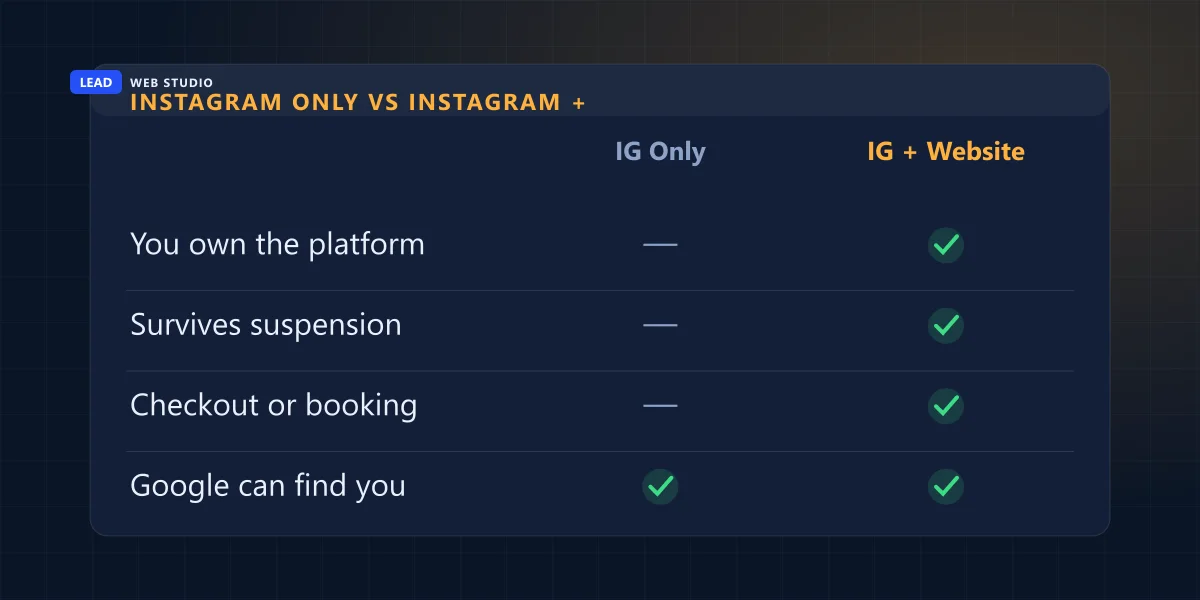
Notice that last row isn't a clean win for the website anymore — and I said as much above. That's the honest, current state of things. But three out of four rows still go to the website, and the one row that flipped is about being found, not about what happens once someone actually wants to book you or buy from you. A caption that ranks on Google still dumps that person into your DMs to figure out pricing, availability and checkout by hand. A real website does that automatically, at 2am, without you typing a single reply.
The part nobody plans for: losing the account
This is the risk that actually matters, and it's not hypothetical. Two sisters running a matcha cafe pop-up in Miami — nearly 30,000 followers, roughly 500 customers a day relying on Instagram as their main line to those customers — had their business account wrongfully suspended by Meta over a false violation. They eventually got it back, with an apology, but only after real public pressure — and they were far from an isolated case; a public petition over similar wrongful suspensions has gathered more than 40,000 signatures from businesses in the exact same spot.
If your account isn't verified or tied to a Meta Business Manager, the appeal process for a permanent suspension is, in practice, close to a black hole — automated review, automated rejection, and a genuine phone number to a human being that most business owners never manage to find. None of that is a Google indexing problem. It's an ownership problem, and no amount of search visibility fixes it.
Instagram didn't do anything wrong by growing your audience for you. It did something risky by quietly becoming your entire infrastructure.
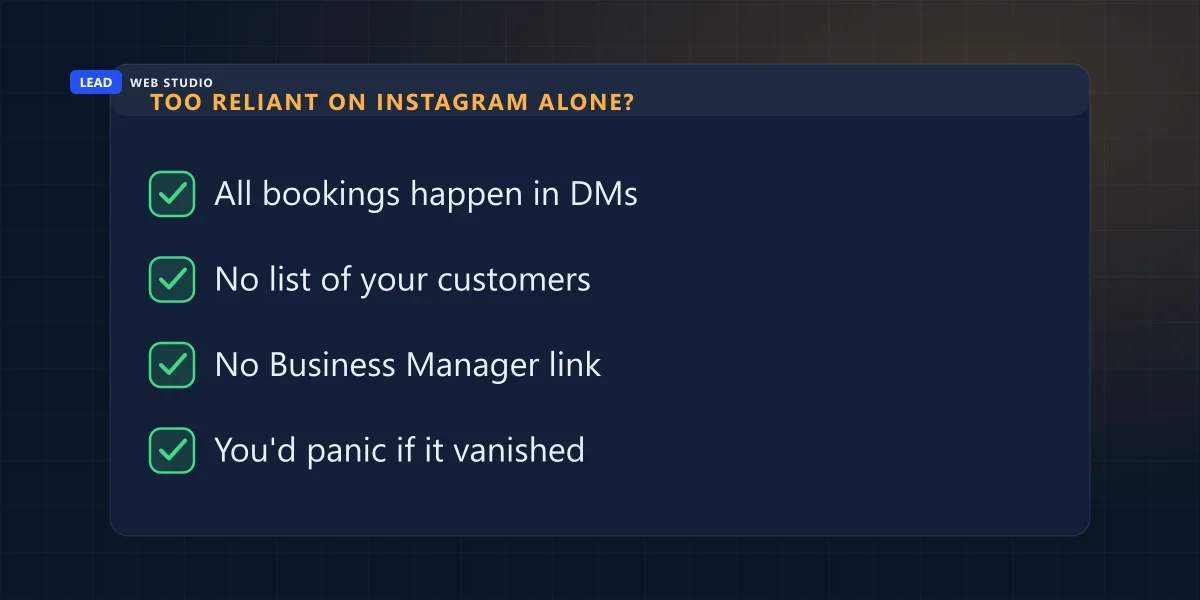
Signs you're too reliant on Instagram alone
- All your bookings happen in DMs. No confirmation trail, no calendar, no record if the thread disappears.
- Your "customer list" is just your followers. You can't export it, email it, or reach it anywhere else.
- The account isn't linked to a Meta Business Manager. That link is often the difference between a real appeal and a dead end.
- You've never downloaded your data. Meta lets you export it in Settings — most business owners have simply never clicked it.
- You'd genuinely panic if it vanished tonight. If the honest answer is yes, that's the tell.
What actually works: Instagram as a channel, not as your whole business
I'm not telling anyone to quit Instagram — that would be terrible advice. It's still one of the best free discovery tools a small business has, and now it even earns you a sliver of Google traffic on top. The fix isn't choosing one or the other; it's putting them in the right order. Instagram brings people in. A website is where they actually become a customer, and where you keep a record of them that doesn't depend on an app staying online.
In practice that means: your own domain with a fast, SEO-ready website as the home base; a real contact form or booking flow instead of "DM us for pricing"; your Instagram bio linking to that site instead of a generic link-in-bio tool; and an email list you actually own, built from people who've already bought from you once. If you just need one focused page to point that Instagram traffic at quickly, that's exactly what a landing page is for — you don't need a 10-page site to get started, you need one page you actually control.
And if you're weighing how much of this costs to set up properly, I've broken that down honestly in what a website actually costs — it's usually a lot less than a single bad month of lost DMs during an account lockout.
If you only do one thing this week: open Instagram Settings and download your data — followers, posts, contact info, all of it — so a copy exists somewhere Meta doesn't control. Then put a real link in your bio instead of "DM me," even if that link only goes to one simple page for now.
Frequently asked questions
Do I need a website if I already have Instagram?+
Yes. Instagram is a free marketing channel, but Meta owns the platform, the algorithm, and ultimately your account access. A website is the one part of your business online that's actually yours, with no landlord and no risk of losing it to an automated suspension you can't appeal.
Does Google actually index Instagram posts now?+
Yes, since July 2025 Google indexes public posts, Reels and captions from Business and Creator accounts, and since July 2026 Search Console shows which searches send traffic to them. That's real progress for reach, but it still doesn't give you ownership, a real checkout, or a backup of your customer list.
What happens if my Instagram account gets banned or hacked?+
It can happen with no warning and a support process many businesses describe as a black hole. A Miami cafe lost access to an account with nearly 30,000 followers over a false violation; some owners never get their account back at all. A website has no algorithm that can suspend it.
Can I just use a link-in-bio tool instead of a real website?+
A link-in-bio page is better than nothing, but it's still a rented page on someone else's platform, with no real SEO, no booking or checkout you control, and the same account-dependency risk as Instagram itself. It's a patch, not infrastructure.
Want a website that actually backs up your Instagram?
I'll build the home base — fast, SEO-ready, and entirely yours — while you keep doing what you're already doing on Instagram.
Get My Free Quote
10+ years building websites for GTA businesses that back up what they've already built on social. Read my full bio · Get in touch