A domain name is the one thing you buy at the start of a project that you can't quietly swap later. Hosting, designer, logo, the entire website — all replaceable in an afternoon. The name in the address bar ends up on your van, your invoices, your Google listing and four hundred business cards in a drawer. And most people choose it in about eleven minutes, somewhere between "that one was available" and "my nephew says .com is better". So here is the version I give clients before they buy anything: how to pick one, what it honestly costs over five years rather than on day one, and the three boring ways people lose a name they've been paying for since 2018.
The short version
- Use your business name, not keywords. The name has to survive you adding a second service and a second city.
- Canadian customers? Buy the .ca. Only someone with a Canadian connection can hold one, which quietly keeps squatters out.
- Budget $20–35 CAD a year. That's the whole product. Registrars pay roughly USD $15–19 wholesale on a renewal.
- The $1 price is year one only. Five years of one .com is around $129 CAD, not $5.
- Check auto-renew with your own eyes. Two of my seven domains came back from an API with it switched off, and nothing warned me.
- The registrant must be you. Access is not ownership, and fixing that later can lock the domain for 60 days.
How do I choose a domain name for my business?
Pick the shortest name a stranger can spell after hearing it once on the phone. Use your business name rather than keywords. Skip hyphens and numbers. Check it isn't already someone's registered trademark. Then buy both the .ca and the .com so nobody parks a lookalike beside you.
That's the whole method, and the reason it's so short is that almost every domain regret I've watched play out came from breaking one of those five rules, not from missing some clever trick. The name doesn't have to be brilliant. It has to be sayable, spellable and still correct in five years.
The keyword thing deserves burying properly, because someone will try to sell it to you. In ten years of building sites I have never once seen a keyword-stuffed address outrank a better page because of what it was called. What I have seen is toronto-best-plumbing-services24.com being read aloud down a phone line three times and still typed wrong, and a landscaper stuck with gtalawnmowing.ca the year he started doing snow removal.
.ca or .com — which one should a Canadian business buy?
If your customers are Canadian, use the .ca. It reads as local before anyone has read a word of your site, and the short names are still genuinely available. Buy the matching .com too if you can and point it at the same site — that's roughly another $30 CAD a year and it ends the argument permanently.
There's a structural advantage to .ca that nobody mentions: you can't just buy one. CIRA, the organisation that runs the .ca registry, enforces Canadian Presence Requirements — the holder has to be a Canadian citizen or permanent resident, a company incorporated in Canada, or fit one of a short list of similar categories. That single rule is why the .ca space is calmer than .com. An overseas domain investor can't casually sweep up every plausible Ontario trade name, because they aren't allowed to hold them.
| .ca | .com | |
|---|---|---|
| Who is allowed to register it | Canadians and Canadian companies only | Anyone, anywhere |
| What it signals to a local customer | Canadian business | Neutral — could be anywhere |
| Chance the short name is still free | Good | Poor |
| Typical Canadian retail, per year | $22–30 CAD | $28–35 CAD |
| Best use | Your main address | Buy it, redirect it to the .ca |
If you sell to Americans or ship worldwide, flip it: lead with the .com and keep the .ca pointing at it. The rule is one address that everything uses, and the other one redirecting. Never run the same site live on two addresses — that's two versions of every page competing with each other, which is a mess I've had to untangle more than once.
The four-check name test
Before you buy anything, run the shortlist through these four. Each one takes under two minutes and each one has saved somebody real money.
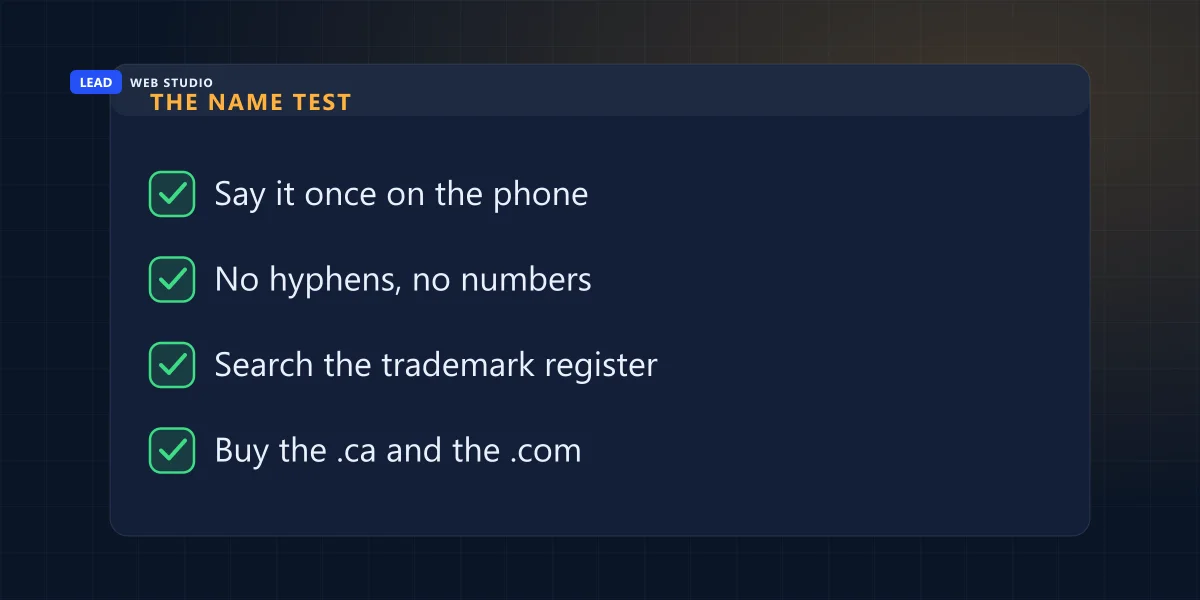
- Say it once on the phone. Read the name aloud to somebody who has never seen it written down and ask them to type what they hear. If they ask "is that with a hyphen?" or "one word or two?", the name has already failed. This is the single best test there is, and it costs one phone call.
- No hyphens, no numbers. Both are unspeakable. "Four" or "4"? Hyphen or space? You will spend the next decade clarifying it on every call, and the version without the hyphen belongs to someone else who now gets your traffic.
- Search the trademark register. Run the name through the Canadian trademark database before you buy, not after you've printed signage. A domain registration gives you no rights over somebody else's registered mark, and this is the one mistake on the list that can arrive as a lawyer's letter.
- Buy the .ca and the .com together. Two registrations is about $55 CAD a year. Discovering that a competitor bought the other extension is worse than that, every time.
An honest confession about my own: leadlls.com fails check one. Nobody spells "lls" right on the first attempt, and I spell it out on every single call. I keep it because moving now would cost more than the annoyance does — which is exactly the trap I'm trying to keep you out of. The eleven minutes you spend on this decision are the cheapest eleven minutes in the whole project.
What should a domain name actually cost?
Budget about $20–35 CAD a year for a .ca or a .com, and treat that as the entire product. There is no premium version of a domain. Anything above that range is either a different service bundled in, or a markup that someone is hoping you won't compare.
I can show you the wholesale side because I resell domains through a separate hosting company of mine, so I see the registrar invoices as well as the customer ones. These are the real numbers from August 2026:
| What you're buying | Registrar's own cost (USD) | Fair Canadian retail |
|---|---|---|
| .com — first year | $11.28 + $0.20 ICANN fee | $18–25 CAD |
| .com — every renewal after | $18.48 | $28–35 CAD |
| .ca — first year | $11.98 | $18–27 CAD |
| .ca — every renewal after | $14.97 | $22–30 CAD |
| WHOIS privacy | $0 at many registrars | $0 |
There is nothing scandalous in that table. A registrar has to cover support, billing and a payment processor, and a 20–30% margin on a $15 product is not where anybody gets rich. I'm showing it so you can tell the difference between a normal markup and a $75-a-year "domain management" line on an invoice, which is a markup with a costume on. Privacy is the other one to watch: it hides your personal details from the public registration record, it's genuinely worth having, and many good registrars now include it at no charge. That whole checkout genre gets a full treatment in the hosting cart trap, and the mailed version of it — a "renewal notice" from a registrar you have never paid — is covered in how to check a scam email about your website.
Why year one is $1 and year two is $32
The first-year price is an advertising budget, not a price. Registrars run rotating promotions to win the registration, because they know how rarely anyone moves a domain afterwards. The number that decides what you actually pay is the renewal, and it's typically two to three times the intro.
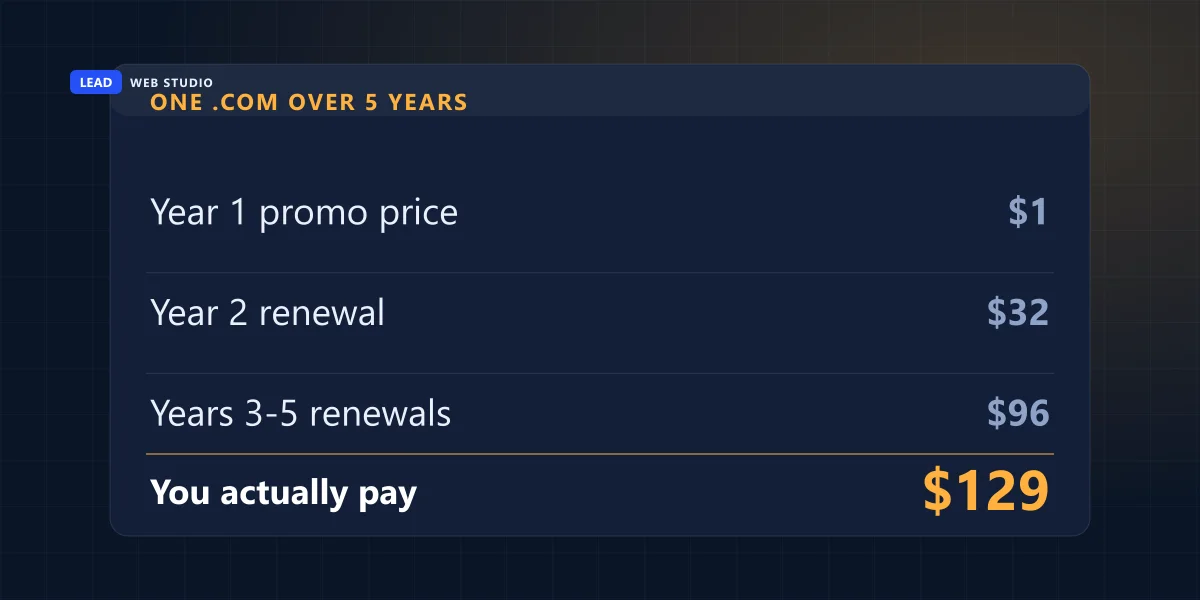
One .com, five years, at Canadian retail: a dollar to get in the door, then four renewals at about $32. Roughly $129 CAD for the five years — around $26 a year, which is completely reasonable. It's only a trap if you budgeted from the dollar. So when you compare registrars, compare the renewal column and ignore the big number on the front page.
Multi-year registration is worth doing for a name you're committed to, but buy the years for peace of mind rather than for SEO — I've never seen registration length move a ranking. What it does is remove four future chances to forget, which is the actual risk, as the next section explains.
How do people lose a domain they've paid for since 2018?
Three ways, all boring. The card on file expired and the reminder went to an inbox nobody reads. The domain was registered in somebody else's name. Or auto-renew was never switched on at all. The name then walks down a fixed ladder, and catching it late costs many times what the renewal would have.
| After the expiry date | What's happening | What it costs to fix |
|---|---|---|
| Day 0 | Website and email stop working, same morning | The renewal |
| Roughly days 1–30 | Registrar grace period — still yours | The renewal |
| Roughly days 31–60 | Redemption period — off the market, recoverable | Renewal + restore fee, usually USD $80–200 |
| The few days after that | Pending delete — nothing anyone can do | — |
| Then | Back on the open market | Whatever a broker decides to ask |
Those windows are the typical shape for .com and .net; the exact dates come from your registrar, and ICANN's Expired Registration Recovery Policy sets out the notices they must send you. A .ca runs on CIRA's own rules instead, so confirm the dates rather than assuming they match. The important part isn't the calendar anyway — it's that everything stops on day zero. Email included. A client of mine once discovered a lapse because quotes stopped arriving, not because anyone looked at the website.
Nobody loses a domain dramatically. They lose it because a Visa expired and the warning went to an accountant who left in 2021.
Now the part I found the hard way, one evening in August, going through all seven domains I'm responsible for. Two of them had auto-renew switched off — both the ones that had been registered through a registrar's API rather than by a human clicking through a checkout. Nothing had flagged it. If a system registered a domain on your behalf, assume auto-renew is off until you have personally seen the toggle in the registrar's own control panel.
The same evening turned up a second one. My billing system had the wrong expiry date on four of the seven, each about a year early, because transferring a domain in adds a year and nothing had gone back to re-read it. Harmless in that direction — it would have renewed early — but it makes the point: the invoice is not the source of truth. The registrar's own domain list is. Open it once a year and check three columns: the expiry date, the auto-renew toggle, and whose name is on it.
Register it in your own name — this is the part people regret
The registrant on the domain should be you or your company, with your email address on the account and, ideally, your card. Your designer can have access without being the owner. Those two things get blurred constantly, and the difference only becomes visible on the day you want to leave.
I've written the full version of this in who really owns your website, so I'll just add the timing detail that catches people: changing the registrant's details on a domain can lock it against transferring for 60 days. So the moment to fix ownership is now, while everyone is still on good terms — not the week you've decided to move on. If you're currently choosing who builds the site, the questions to ask a designer's old clients covers what to ask about this before money changes hands.
For what it's worth, my own arrangement is deliberately dull: the client registers the domain in their own name, or I register it and transfer it to them, and either way they can lock me out of it any afternoon they like. That's how it should read on any website project, and it's a fair question to ask before you sign anything — the answer takes ten seconds and tells you a lot.
What if I already have a bad domain name?
Usually, keep it. Changing a domain isn't a rename, it's a move: every link, listing, citation and QR code pointing at the old address has to be redirected, and Google needs weeks to re-attribute everything. Worth doing for a real rebrand. Rarely worth doing because you'd prefer something shorter.
If you do have to move, it's a defined job rather than a gamble — Google documents the process for a site move with URL changes, and the honest expectation is that positions wobble for a few weeks while the old address is re-pointed. Redirect every old URL to its real match, keep the old domain registered for years afterwards, and update your Google profile and directory listings the same week. That's the whole of what a website migration is; the failure mode is always the same, which is somebody redirecting all forty old pages to the new homepage and wondering where the traffic went.
One thing genuinely not worth agonising over: whether the name describes what you do. Your Google Business Profile, your page titles and your service pages do that job far better than an address ever could. If you want to see how the descriptive work is actually distributed across a site, the industry pages here are the same business under twenty different search intents, all on one unremarkable domain.
If you take one thing from this page: spend the eleven minutes on the name, then spend two more checking that the account is in your name with auto-renew on. That second step is the one that costs people a business email address at 8am on a Tuesday. If you're pricing a whole site rather than just the address, the pricing page has the real ranges, and you can send me the name you're considering before you buy it.
Frequently asked questions
Should a Canadian business use .ca or .com?+
If your customers are Canadian, use the .ca. It reads as local before anyone has read a word of your site, and the short names are still available. Buy the matching .com as well if you can and point it at the same site, so nobody parks a lookalike beside you.
How much should a domain name cost per year?+
Budget about $20–35 CAD a year for a .ca or a .com, and treat that as the whole product. Registrars pay roughly USD $15–19 wholesale for a renewal, so a normal retail price sits a little above that. A $75-a-year "domain management" line is not a domain.
Do keywords in a domain name help SEO?+
Not enough to buy an ugly name for. In ten years of building sites I have never seen a keyword-stuffed domain outrank a better page because of its address. Your business name is easier to say, easier to trust, and easier to keep once you add a second service.
What happens if my domain expires?+
Your site and your email stop working the same day. For a typical .com there is then a short registrar grace period where a normal renewal still fixes it, followed by a redemption period where restoring the name costs a fee that is usually USD $80–200, and finally a few days after which anyone can register it.
Can my web designer own my domain?+
They can, and that's exactly the problem. The registrant on the domain should be you or your company, with your email address and your card on the account. A designer can have access without being the owner. If the name is in someone else's account, fix it while everyone is still friendly.
Not sure whether the name you've picked will hold up?
Send me the two or three you're weighing and I'll tell you straight which one you'll still be happy with in five years — and what it should cost you to register.
Get My Free Quote
10+ years building websites for GTA trades, clinics and service businesses — and registering, transferring and rescuing the domains that sit under them. Read my full bio · Get in touch