Every summer I get some version of the same call: a small producer — honey, jam, soap, maple syrup, whatever they make with their own hands — has been told by someone that they need "a proper online store." Usually that means Shopify, sometimes it means a $2,999 custom build with a full cart, and it's usually total overkill for someone selling fifteen jars a week out of a farm stand. So let's actually do the math, because the honest answer depends entirely on how many orders you're taking and how they get to the customer — not on what sounds professional.
The short version
- Most small producers don't need a shopping cart at all — a product page plus "order by text or e-transfer" genuinely works under about 15-20 orders a week, especially for local pickup.
- Real 2026 numbers: Etsy costs about $5.56 CAD in combined fees on a $53 sale. Your own site with Stripe costs about $1.84 on that same sale, at any volume.
- Shopify's cheapest plan runs $37-49/month before you sell a single jar. A one-time custom site ($899-$2,999) has no monthly software rent — only fees on sales you actually make.
- The one thing that should never live only on a rented platform: your customer list and your domain. See who owns your website.
Do small producers need an online store to sell online?
No — and this is the part every "you need e-commerce" pitch skips. There are three real ways to take a payment online, and which one fits you depends on your volume and how customers get the product, not on what looks impressive. Skipping a shopping cart entirely is a completely legitimate choice for a lot of producers, not a temporary workaround until you can afford the real thing.
The three ways small producers actually get paid
Strip away the sales pitches and every option for taking money online falls into one of three buckets. Here's what each one actually costs and who it fits:
| Method | Setup cost | Who owns the customer | Best for |
|---|---|---|---|
| No checkout (order by text/e-transfer) | $0 add-on to a simple site | You, fully | Low volume, mostly local pickup |
| Checkout on your own site | $1,499-$2,999 one-time | You, fully | Steady volume, want to stop paying rent |
| Marketplace (Etsy, Shopify) | $0-$49+/month | Mostly the platform | Need discovery, no site yet |
Nobody's grandmother took Interac e-transfer for her jam at the farmers' market and lost the sale over it. Don't let a website checklist convince you that's suddenly unprofessional in 2026.
What each option really costs you
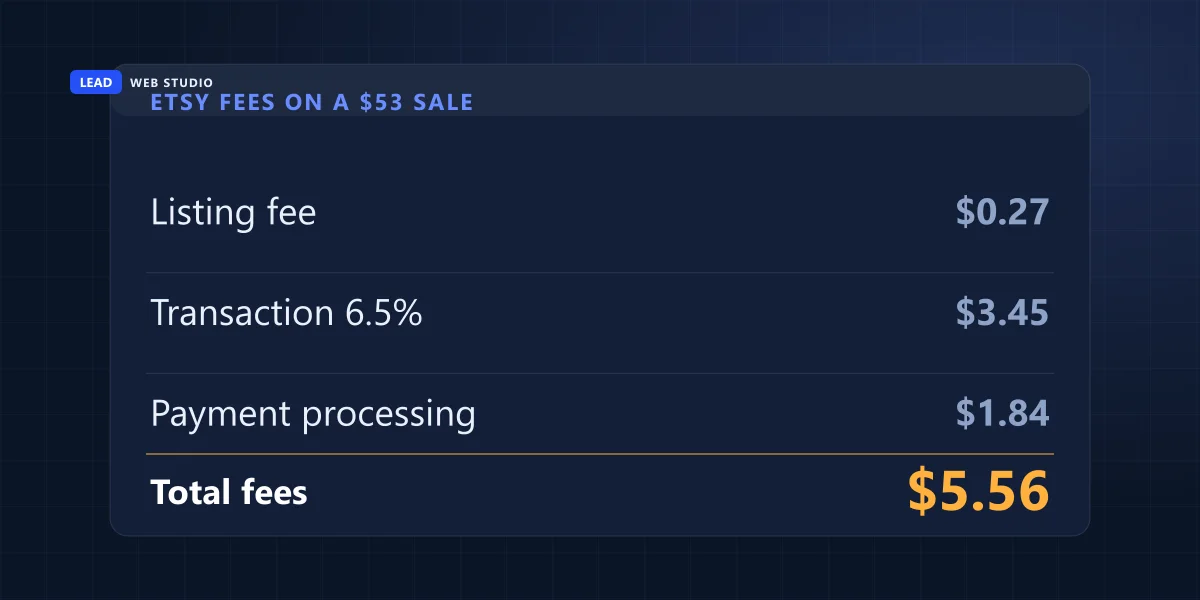
Here's the number nobody shows you up front: what a marketplace actually takes on a real sale. Say you sell a $45 jar of honey with $8 shipping — $53 CAD total. I pulled Etsy's own published Canadian seller fees to run the math: a listing fee of roughly $0.27 per item, a 6.5% transaction fee on the item price plus shipping, and 3% + $0.25 payment processing. Add it up and Etsy takes about $5.56 off that one sale — before you've paid for the honey jar, the label, or your own time.
Now compare that to a payment processor like Stripe bolted onto your own website: a flat 2.9% + $0.30 CAD per transaction, no listing fee, no marketplace cut. On that same $53 sale, that's about $1.84 — roughly a third of what Etsy takes — and it's the exact same rate whether you sell one jar a month or a hundred. Shopify's own pricing page lists its cheapest Basic plan at $37-49 CAD a month with a 2.8% + 30¢ card rate on top — cheaper per-transaction than Etsy, but you're paying that subscription every single month, sales or no sales.
Stretched over real volume, the gap gets hard to ignore:
| At this volume… | Own site + Stripe | Shopify Basic | Etsy |
|---|---|---|---|
| 10 orders/week (~40/month) | ~$74/mo in fees | ~$120/mo (incl. $49 plan) | ~$222/mo in fees |
| 50 orders/week (~200/month) | ~$368/mo in fees | ~$405/mo (incl. $49 plan) | ~$1,112/mo in fees |
That's not a knock on Etsy as a discovery tool — it's a warning against treating it as your permanent checkout once you have real, repeat volume.
When it's genuinely fine to skip checkout entirely
If you're doing local pickup, know most of your buyers by name, and you're under roughly 15-20 orders a week, a shopping cart is solving a problem you don't have yet. A clean product page with real photos, clear pricing, and an "order by text or email" button costs nothing beyond your website, and e-transfer settles in minutes. You lose real-time inventory tracking and instant payment capture — that's the honest trade-off, not a hidden catch.
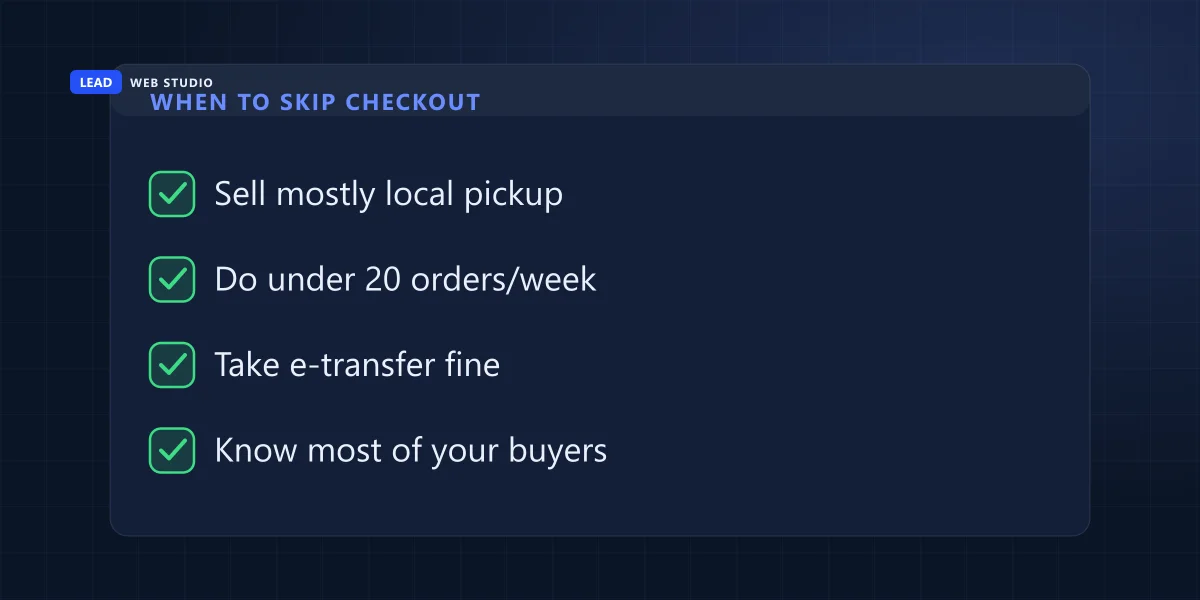
- Most of your orders are local pickup or farm-gate, not shipped across the province.
- You're under about 15-20 orders a week — past that, manually tracking orders in a notebook starts costing you more time than a cart would save in fees.
- You're comfortable with e-transfer or cash on pickup as payment, not only card.
- You know most of your buyers — a repeat farmers'-market crowd, not cold traffic from strangers.
When to add real checkout to your own site
Once orders get steady enough that manual tracking becomes the bottleneck, or you're shipping regularly instead of doing pickup, a real checkout on your own site starts paying for itself. It's a bigger one-time build — a catalogue without checkout starts at $899, a full storefront with payments runs $1,499 to $2,999 one-time — but from that point on you're only paying Stripe's flat processing rate, not renting software every month regardless of sales. See what I build for e-commerce and online stores — or, if you sell in the city, e-commerce website design in Toronto — and the full pricing breakdown if you want the exact tiers.
When a marketplace like Etsy actually earns its keep
Etsy isn't the enemy here — it's genuinely good at one job: putting your product in front of buyers who have never heard of you. Where it stops making sense is as your only or permanent checkout once you have a repeat customer base, because every one of those repeat sales keeps paying the same discovery fee for a customer you no longer need to be discovered by. The honey farm I built the site for takes orders through a simple form on its own site, not a shopping cart, because that fits its actual volume — see the honey farm & food producer page for what that setup looks like in practice. I've also written about the deeper risk of relying on a platform you don't own in do you still need a website if you have Instagram — the ownership argument there applies just as directly to Etsy as it does to social media.
The one thing to own no matter which door you pick
Whichever of the three you choose today, this part isn't optional: own your domain and keep your own customer list somewhere that isn't rented software. A marketplace account can be suspended without warning — real sellers have lost accounts overnight with no appeal that moved fast enough to save the season. Your own site never can be.
| Your own domain + site | Marketplace/social shop only | |
|---|---|---|
| Customer list | Yours, exportable | The platform's, not exportable |
| Can be suspended | No | Yes |
| Ranks under your own brand | Yes | No — ranks under theirs |
| Migrating later | Straightforward | Starting over from zero |
That's the whole case for owning your own website even if you sell most of your product through Etsy or a farmers' market today. It's your fallback, not a competing channel.
A 60-second gut-check
Run through these five questions honestly before you spend a dollar on a cart you might not need yet:
- Am I doing more than 15-20 orders a week?
- Am I shipping regularly, or is it mostly local pickup?
- Do I need real-time inventory so I don't oversell a limited batch?
- Am I paying a marketplace fee on repeat customers who already know me?
- Do I have somewhere — a domain, an email list — that isn't rented software?
Two or more "yes" answers to the first four is a genuine signal to add real checkout. A "no" on the last one is worth fixing this week, regardless of your answer to the rest.
If you only do one thing this week: count your actual orders from the last four weeks and divide by four. That number, not a website checklist, tells you which of the three doors you're actually standing in front of.
Frequently asked questions
Do small producers need an online store to sell online?+
No. Most producers can start with a simple product page and take orders by text, email or e-transfer with zero platform fees. A real checkout or a marketplace only earns its cost once your order volume or shipping complexity goes up.
Is Etsy or my own website better for a small producer?+
Etsy gets you in front of buyers you don't already have, but you rent that audience and pay roughly $5.56 CAD in combined fees on a $53 sale. Your own site costs about $1.84 in payment fees on that same sale no matter your volume, and you keep the customer relationship.
What does Etsy actually cost Canadian sellers in 2026?+
A roughly $0.27 CAD listing fee per item, a 6.5% transaction fee on the item price plus shipping, and 3% + $0.25 CAD payment processing. On a $53 CAD sale that's about $5.56 in total fees.
Can I sell online without a shopping cart at all?+
Yes, and for many small producers it's the right call, not a shortcut. A product page with an order-by-text or order-by-email button works fine under roughly 15-20 orders a week, especially for local pickup.
Should a small producer use Shopify or a custom website?+
Shopify makes sense if you need cart and inventory software running today. A custom site costs more upfront ($899-$2,999 one-time) but carries no monthly software rent afterward — only payment fees on sales you actually make.
Not sure which door fits your business?
I build everything from a simple $899 ordering page to a full $2,999 storefront — and I'll tell you honestly which one you actually need, not the bigger one.
Get My Free Quote
10+ years building websites for small food producers and online stores, including a real Ontario apiary. Read my full bio · Get in touch