
A customer sends you a link with "is this you?" and you click it. It's a competitor across town, and the paragraph about your warranty is your paragraph, comma for comma. Sometimes it's your photos too, with your truck in the background. If someone copied your website, the urge is to fire off an angry email within the minute. Don't. Spend twenty minutes collecting proof first, then knock on four doors in the right order. Below is that order, with what Canadian law actually makes each door do, because most guides online quote American rules that don't apply to a host in Toronto.
What should I do first when I find a copy?
Save the evidence before anyone knows you've seen it. Take a full-page screenshot of the copy with the address bar and date showing, save the page as a PDF, note your own page that was copied, and find proof that yours was online first. Copiers often edit or delete the page once they're contacted.
Keep it all in one simple record. A spreadsheet row per copied page is enough. A finished row for a made-up painting company reads like this:
The photo files straight off your phone carry the date they were taken. Keep the originals, not only the resized copies on the site.
The "came first" line is the one people can't fill in after the fact. A host or a lawyer will ask for it. If your site gets backed up every day, you already have dated copies of every page; with my website maintenance and support the daily backups are part of the package, and I'd pull the dated file for you.
Is it really copying, or something you can live with?
Not every copy is worth a week of your time. Before you write to anybody, decide which of these four you're looking at. The last one is often fine, and the first one rarely hurts you at all.
| What you found | How you can tell | Worth chasing? |
|---|---|---|
| A junk site that scraped you | Ads everywhere, dozens of unrelated topics, your internal links still inside the text | Only if it shows above you in Google |
| A rewrite with their name on it | Your structure and examples, words shuffled, no link to you | Yes, if it's a business in your field |
| A competitor's copy of your service text or photos | Same city, same trade, your wording or your job photos | Yes, start at door one today |
| A quote with a link back | A sentence or two in quotation marks, your name or a link | Usually not, that's how the web is meant to work |
The quick test for the first row: put one of your sentences in quotation marks into Google. If your page comes up above the copy, the copy is mostly an annoyance. If the copy comes up first, move it up your list.
What three months of my own server logs say about copiers
I wanted to know whether you can catch a copier in the act, so I read the access logs of this website from 26 August to 22 November 2026: 536,575 lines. I removed the addresses of my own checking tools first, and I kept no visitor addresses in the results.
Two things follow from those numbers. A copy almost never loads your pictures from your server, it takes its own copy, so you can't spot copies by watching for strangers using your images. And the visitors who read a whole site in a day mostly don't announce themselves: the most common name they gave was an ordinary Windows desktop browser, then a Mac one. Some were SEO tools, some I can't name. That's also why "disable right click" plugins are a waste of time: none of these visitors right-clicked anything. I wrote more about who reads a small site in my count of the bots crawling my website.
So the honest answer is that you can't stop copying. You can make it easy to find and easy to prove, which the last section of this guide covers.

Four doors, in this order
Each door has a different power, and skipping to the last one costs money you may not need to spend. Most copies end at door one or two.
Write to the site owner
Use the contact form or email on their site. Name the pages, link your originals, say when yours went up, and ask them to remove the copied text and photos within 7 days. Keep it short and calm; a lot of copies were done by a cheap freelancer the owner paid, and the owner is as surprised as you.
Limit: they can ignore you, and a junk site has no real contact at all.
Send a notice to their web host
Look up who hosts the site (a WHOIS or "who hosts this site" lookup shows the network owner) and use the host's abuse or copyright address. In Canada this is the notice and notice system, covered in the next section.
Limit: a Canadian host must pass your notice on, not delete the page. Many remove it anyway under their own rules.
Ask Google to drop the copy from search
Google's copyright form takes the address of your original and the addresses of the copies. Google says web form requests take about 6 hours on average.
Limit: the page stays online; only the search result goes.
A lawyer's letter
For a competitor who took a whole site, or keeps copying after being asked, a demand letter from a copyright lawyer changes the tone quickly. It's the door where the law's damages, below, come into play.
Limit: it costs money, so save it for copies that cost you customers.
Canada's notice and notice: what a host has to do
American guides tell you to send the host a DMCA takedown. That's a United States law. A host in Canada works under sections 41.25 to 41.27 of the Copyright Act, which is a forwarding system, not a takedown one.
Under section 41.26, when a host gets a notice that follows the rules, it must forward it "as soon as feasible" to the customer who runs the site, tell you whether it did, and keep the records that identify that customer for six months (a year if you start a court case and tell them). A host that ignores those duties can be ordered to pay you between $5,000 and $10,000. Nothing in that section makes the host remove the page.
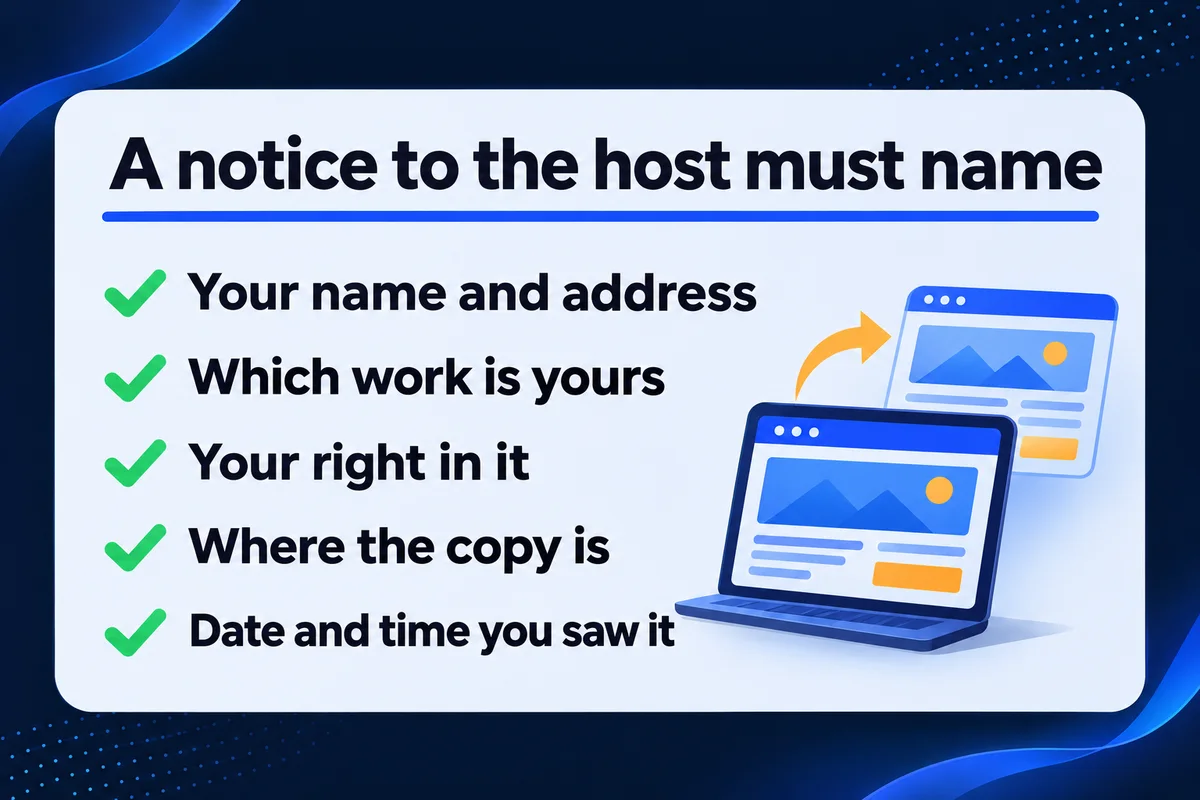
Section 41.25(2) lists what your notice has to contain. Written out as a short letter, it looks like this:
To the abuse team of [host name]: this is a notice of claimed copyright infringement under section 41.25 of the Copyright Act.
- My name and address: [your name, business name, mailing address, email].
- The work: the text and two photographs on [your page address].
- My right: I wrote the text and took the photographs for my business, and I own the copyright.
- Where the copy is: [their page address].
- The infringement: the copied page reproduces three paragraphs of my text word for word and both photographs, without permission.
- Date and time: I saw it on [date] at [time, time zone].
Please forward this notice to your customer as section 41.26 requires.
[Your name], [date]
The seventh item in the Act is "any other prescribed information", so check the current text before you send. One rule is easy to break by accident: section 41.25(3) says a notice must not contain an offer to settle, a demand for payment or a request for personal information, not even as a link. Leave money out of it completely.
Google's form removes the result, not the page
Google handles copyright requests for Search under the American DMCA, from anywhere. Its copyright removal FAQ says it delists pages from Search, sends a copy of qualifying requests to the public Lumen database, and lets the other side file a counter-notice. That last part matters: a request with your name on it becomes public, and a false claim can come back at you, so file only for pages that really copied you.
| Notice to the host | Google copyright form | Lawyer's letter | |
|---|---|---|---|
| Takes the page offline | Only if the host chooses to | No | Often, once they read it |
| Hides it from Google search | No | Yes, for the addresses you list | No |
| Reaches the person who copied | Yes, the host must forward it | Not always | Yes |
| Cost to you | Your time | Your time | A lawyer's fee |
For the lawyer column, it helps to know what's at stake. Section 38.1 of the Copyright Act lets a court award statutory damages of $500 to $20,000 per work when the copying was for commercial purposes, which a competitor's sales page usually is. Section 43.1 generally gives three years to start. I'm a web designer, not a lawyer, so take those two numbers as a reason to call one, not as advice on your case.
A copied site is also a good moment to read who owns the pieces of your own site. If your designer holds your domain or hosting, sending notices gets awkward fast; my guide on who owns your website lists what should be in your name.
Make the next copy easy to catch
You won't prevent copying. You can make the next one cheaper to deal with:
- Put links to your other pages on words inside your text. Scrapers copy them along with everything else, and every copy then sends readers and a little credit back to you.
- Keep dated backups, and check once in a while that they restore. My guide to testing a website backup takes about an hour.
- Pick one unusual sentence from each page that sells, and search it in quotation marks twice a year.
- Keep the original photo files from your phone in one folder. They are the cleanest proof you took the pictures.
And if the copy is of photos you bought or found online, check you had the rights first. The reverse situation, where you're the one with the wrong picture, is in my guide to website image copyright.
Questions about copied website content
Do I need to register my copyright before I complain about a copied website?+
No. In Canada copyright in your own text and photos exists from the moment you create them. Registration is optional. What you do need is proof that the work is yours and that it was online before the copy, such as dated backups or old archive snapshots.
Does a Canadian web host have to delete a copied page when I send a notice?+
Not under the notice and notice rules. Section 41.26 of the Copyright Act makes the host forward your notice to its customer and keep records that identify them for six months. Many hosts still remove the page under their own terms of service, but the law itself only requires forwarding.
Will Google punish my site because a copy exists?+
Usually not. Google tries to show the original, and most scraped copies sit on junk sites nobody visits. Search one of your sentences in quotes: if your page comes up first, the copy is a nuisance, not a ranking problem. Act fast if the copy outranks you.
Can I stop people from copying my website at all?+
No. Anything a browser can show, a tool can save. Blocking right click stops honest visitors, not copiers, who download the whole page. Make copies easy to prove and find instead: dated backups, links on words inside your text, and a search for your own sentences now and then.
How long do I have to take legal action over copied content in Canada?+
Section 43.1 of the Copyright Act generally gives three years from the copying, or from when you knew or should have known about it. A lawyer will tell you how it applies to your case, so do not let a copy sit for years while you decide.
Sources, read on 22 November 2026: Copyright Act, section 41.25; Copyright Act, sections 41.26, 41.27 and 43.1; Copyright Act, section 38.1; Google, Search removals due to copyright infringement FAQs. Log figures: the access logs of leadlls.com from 26 August to 22 November 2026, with my own tools' addresses removed and no visitor addresses kept.
Found your website on someone else's domain?
Send me both links. I'll tell you who hosts the copy and which of the four doors fits your case.
Get My Free Quote
I build and look after websites for small businesses around the GTA, and I write every page by hand, which is why copies of them annoy me personally. Read my full bio · Get in touch