3D Rendering Website Design in Toronto
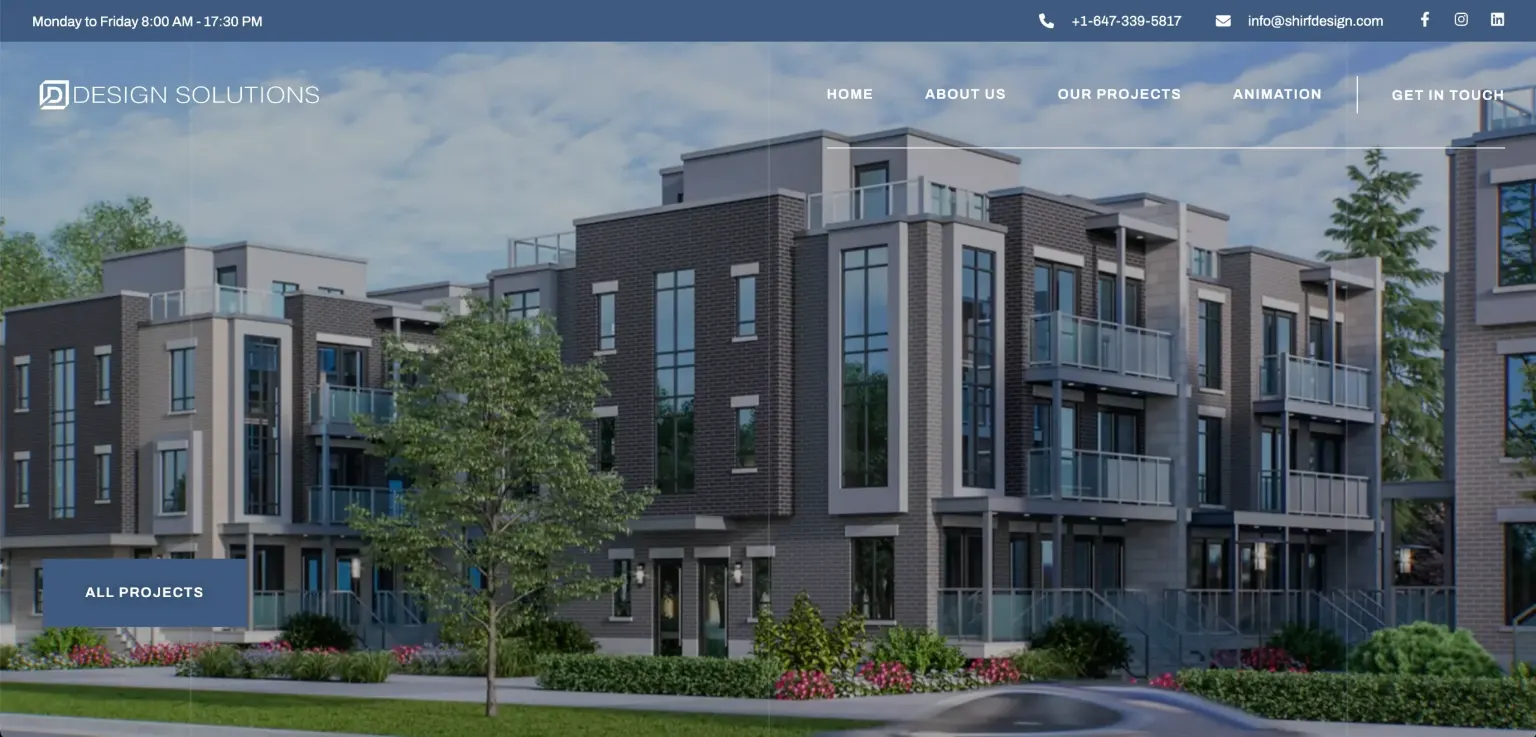
I designed and built the website for a 3D rendering and architectural visualization studio based right here in Toronto — a site built around one idea: get out of the way and let the renderings do the selling. That same full-fidelity, portfolio-first approach is what I bring to rendering and visualization studios across Toronto.
A rendering only earns its price once it reaches "Final" — a portfolio site has to display that fidelity honestly, at full resolution, without slowing down.
Short answer
Lead Web Studio builds websites for 3D rendering, architectural visualization and design-viz studios in Toronto — custom-coded, portfolio-first, mobile-first, and structured so full-resolution renderings load sharp and fast instead of forcing a trade-off. A site costs $899–$2,999 one-time and goes live in 5–7 days once the work is selected and supplied at full resolution.
Why Does a Rendering Studio's Website Get Judged in the First Two Seconds?
An architect or developer scanning a rendering studio's site is asking one question in the first two seconds: does this look as sharp and current as the work I need done — and does it load fast enough to keep scrolling? A 3D rendering studio's site is deliberately quiet — minimal interface, generous space, typography that stays out of the way — because every decorative flourish competes with the thing the visitor actually came to see: the renderings themselves.
A Portfolio at Full Fidelity
A 3D rendering studio's renderings are the product, so they load fast, display sharp and fill the screen. The portfolio is organized by project type, so a developer or architect can find relevant work in a few clicks instead of scrolling a single undifferentiated feed.
A Still Render and a Walkthrough Animation Need Different Pages
A gallery built only for single hero stills buries an animation reel, and a gallery built only for reels underplays a strong still — the portfolio has to organize by deliverable, not just by project.
Animation & Walkthrough
A sequence sold as motion — the portfolio needs a filmstrip preview and a way to play the reel without leaving the page.
Single Hero Still
One frame carrying the entire pitch — the portfolio needs it displayed at true resolution, uncropped, with room to breathe.
What Each Project Type Needs the Page to Prove
| Project Type | What the Client Needs to See | Page I'd Build |
|---|---|---|
| Pre-construction exterior & massing | How the building will actually read on the street, not a diagram | Large hero stills, day/dusk lighting variants, context shots |
| Interior & residential visualization | Whether the mood and materials match the sales brochure's promise | Room-by-room gallery, material close-ups, warm lighting studies |
| Aerial & site plan renders | How the whole development sits in its surroundings | Full-bleed aerial stills with a simple site-plan overlay |
| Commercial real estate marketing | Fast turnaround and consistent quality across many units | Filterable gallery by unit type, case studies with named projects |
| Product & industrial visualization | Precision and finish accuracy at extreme close-up | Zoomable stills, turntable or short animation embed |
Toronto's Visualization Market
Toronto's condo and mixed-use development cycle keeps a steady stream of pre-construction marketing work moving through the city's rendering and visualization studios — every sales centre and pre-construction landing page needs exterior stills, interior mood shots and often a flythrough before a single unit is sold. That demand is dense downtown, where architecture and design firms cluster around the Financial District and the King St W design corridor near Liberty Village and the Junction, and it stretches into the boutique visualization shops working alongside smaller residential architects across North York and Etobicoke.
A studio competing in that market is judged by a portfolio that looks and loads like the finished renders it's selling — a slow, generic template undercuts the pitch before an architect reads a single word of copy.
Everything a Visualization Studio Needs Online
Design & Experience
A quiet, image-forward design that lets the work speak for itself.
- Full-width, full-fidelity portfolio displays
- Project-type and deliverable-type organization
- Modern image formats and per-breakpoint sizing
- Mobile-first responsive layouts
- Fast-loading galleries, even at high resolution
Growth & Functionality
Built to win visualization and rendering contracts.
- Project inquiry and commission forms
- Capability and turnaround presentations
- SEO for rendering and visualization searches
- B2B credibility signals for architects and developers
- SEO-optimized structure from day one
For a rendering studio the website has one job: show the work at full strength and add nothing. Every decorative flourish I could add competes with the thing the visitor came to see. — Liubomyr Lukaniuk, Lead Web Studio
Which Package Fits Your Studio
| Package | Best for | What's included |
|---|---|---|
| Startup — $899 | A solo artist or small studio needing one strong portfolio | Up to 10 pages, mobile-first design, basic on-page SEO, inquiry form |
| Growth — $1,499 | A studio splitting work into project categories or client types | Up to 20 pages, advanced SEO, filterable galleries, per-category pages |
| Enterprise — $2,999 | A studio wanting a client portal or large searchable archive | Unlimited pages, fully custom UI/UX, advanced local SEO foundation, schema markup |
Toronto 3D Rendering Website FAQ
Have you built a 3D rendering website in Toronto before?+
Yes. I designed and built the website for a 3D rendering and visualization studio based in Toronto — a full-fidelity portfolio site organized by project type rather than dense service copy.
What does a 3D rendering studio's website actually need?+
A portfolio that loads sharp and fast at full resolution, work organized by project type so architects and developers find relevant examples quickly, a quiet way to enquire or commission, and SEO for rendering and visualization searches.
Why does image loading speed matter so much for a rendering portfolio?+
A rendering studio's images are the pitch. Handled properly — modern formats, per-breakpoint sizing, lazy loading below the fold — they load quickly without looking compressed; handled poorly, a slow gallery quietly signals the same carelessness a client fears in the actual renders.
How much does a rendering studio website cost?+
$899 one-time for up to 10 pages, $1,499 where there are large collections or project categories to structure, $2,999 where a filterable gallery or client portal is involved. See my website design packages.

10+ years designing SEO-ready websites for design and creative businesses, including a 3D rendering studio. About the studio · Get in touch
Need a website for your rendering or visualization studio?
I'll build a portfolio-first site that lets the work sell itself — see my website design packages from $899.