Trucking Company Website Design in Brampton
I build websites for trucking companies, freight carriers and owner-operators in Brampton — sites organised around the two people who actually visit a carrier's website and want opposite things from it: the shipper checking whether your authority is current, and the driver checking what the job is. My anchor project is a cross-border carrier dispatching out of Dieppe, New Brunswick and Calgary, Alberta, so I'll say plainly that there is no Brampton carrier on my portfolio yet. What carries over is the structure, and the structure is the same in every province.
What a broker reads first
The side of a trailer says it in four lines. A carrier homepage usually takes four screens to say less. Those numbers belong in the header and the footer of every page — not on an About tab a broker has to go looking for.
Short answer
Lead Web Studio builds websites for trucking companies and freight carriers in Brampton — hand-coded, mobile-first, and split into a shipper path and a driver path that never get in each other's way. A build costs $899–$2,999 one-time and goes live in 5–7 days once the authority numbers, equipment specs and lane coverage are confirmed. The proof is a carrier site I designed and built from an empty folder: nine pages, three spam-protected forms and 100/100 desktop Lighthouse on every page.
What does a trucking company website have to answer before anyone calls?
For a shipper, three things: what you haul, where you run, and whether your operating authority is current and checkable. For a driver, one thing: what the job actually is — the equipment, the lanes and the home time. Put those in the first screen and the calls that follow are the useful ones.
Almost every carrier site I am asked to look at answers neither. It opens with a photograph of a truck at sunset, describes coverage as "North America", and leaves the authority numbers on an About page. Then it treats hiring as an afterthought: a careers link that opens an email client. None of that is a design problem. It is a decision about what goes on the page first, and it is the same decision I make on a HVAC site or a fire protection site — name the thing the visitor came to verify before anything you would rather talk about.
A Carrier Site Is Really Two Sites
Most transport websites are built for one visitor and then quietly asked to serve two. Written as one page, each audience reads half a message and neither is convinced. Build two front doors instead, and separate them at the navigation.
Shippers & brokers
Qualifying you without picking up the phone.
- Authority numbers on every page, not on an About tab
- Equipment, trailer types and rated weights in one table
- A service page per freight type instead of one "Services" list
- A quote form that asks for the lane, the ready date and the commodity
- Terminal or dispatch contacts by region, not one generic inbox
Drivers & owner-operators
Deciding whether this is a job worth applying for.
- A careers section with its own entry in the navigation
- Separate pages for company drivers and owner-operators
- Plain answers on the equipment and the kind of running
- An application form that finishes on a phone, protected against bots
- Speed on a weak signal, because applications come from truck stops
The two paths share a brand and a phone number and nothing else. That is why either visitor can land cold and reach the right form in one click.
Built from an empty folder for a cross-border carrier
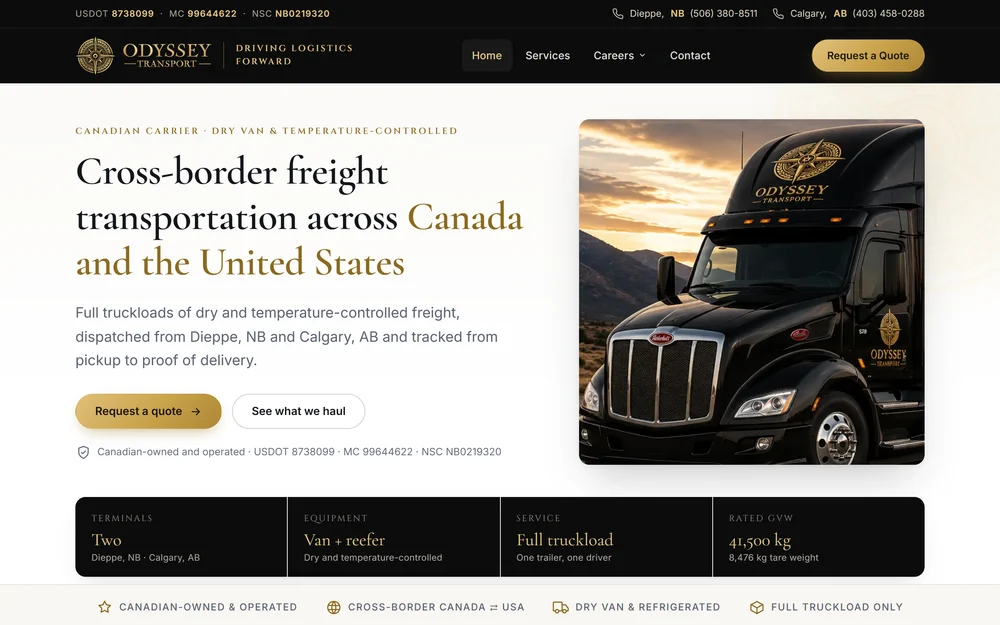
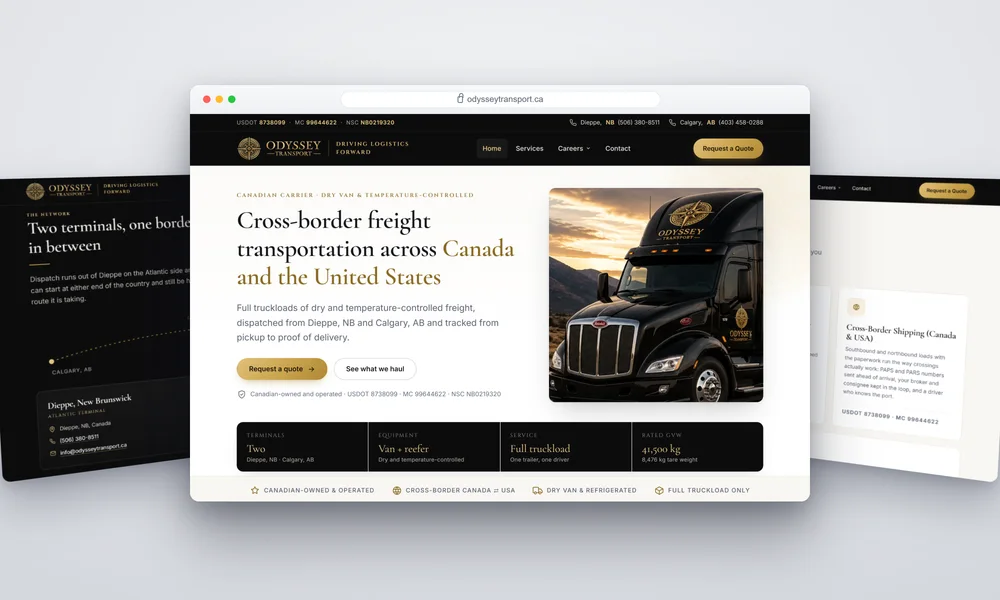
The domain pointed at a bare WordPress install with a half-built header — no service pages, no equipment detail, no way to request a quote. I designed and hand-coded the whole site instead of finishing it: nine pages, with the USDOT, MC and NSC numbers repeated in the top bar, the hero, the equipment table and the footer, because the first question a broker asks is whether the authority checks out. Three forms — quote, driver application and contact — run Cloudflare Turnstile plus a honeypot and a per-IP rate limit. Every page scores 100 on desktop Lighthouse.
The client is Odyssey Transport, hauling dry van and refrigerated freight between Canada and the United States. Read the full case study →
What a Broker Checks, and Where It Usually Hides
A broker qualifying a new carrier works through a short list. Everything on it is public or should be; the only variable is how long your website makes them look.
| What they check | Where it usually sits | Where it belongs |
|---|---|---|
| Operating authority (USDOT, MC) | On an About tab, or nowhere | In the header and the footer of every page, as selectable text |
| Provincial registration (CVOR in Ontario) | Missing entirely | Beside the authority numbers, named so an Ontario shipper recognises it |
| Insurance | "Fully insured" | The coverage types you carry, and who to ask for a certificate |
| Equipment | A paragraph and a stock photo | A table: trailer type, how many, rated capacity, temperature range where it applies |
| Coverage | "North America" | The provinces and states you actually run, and the crossings you use |
| Safety record | Not mentioned | A plain line pointing at the public record — they will look it up anyway |
US authority and safety data are public in the FMCSA SAFER system, and Ontario operators are registered under the province's Commercial Vehicle Operator's Registration. Publishing your own numbers does not reveal anything a broker cannot already look up — it just decides whether they do it on your website or on a competitor's.
Every Service You Run Is a Different Question
| Service | What the shipper is actually asking | Page I'd build |
|---|---|---|
| Dry van, full truckload | "Do you have a trailer free on my lane this week?" | A lane page naming the corridors you run and the equipment behind them |
| Refrigerated (reefer) | "What can your equipment actually hold, and for how long?" | A reefer page stating the rated temperature range and the commodities you take |
| Cross-border Canada–US | "Is the paperwork going to be my problem?" | A customs page naming your bond and ACE/ACI setup and the crossings you use |
| LTL & partial loads | "Will you take three skids, or is it truckload only?" | A partial-load page with the minimum you accept and how it is priced |
| Flatbed & specialized | "Who handles the securement and the permits?" | An equipment page with deck types, usable dimensions and what needs a permit |
| Drayage & intermodal | "Can you pull a container off the ramp on short notice?" | A container page naming the terminals you serve and your chassis arrangement |
One page each, not six bullet points on a "Services" page. A shipper searching "reefer carrier Brampton" should land on the reefer page, and there has to be one for them to land on.
The Careers Section Is Half the Website
On the carrier build, hiring got the same treatment as sales rather than a mailto link at the bottom of the page: a careers section split into company drivers and owner-operators, each with its own application form protected by Turnstile and a honeypot, and plain answers on the equipment and the kind of running. It is mobile-first for a specific reason — driver applications come from phones, often on a weak signal in a parking lot, and a form that stalls there does not get finished later on a laptop.
The same discipline that gets a booking finished gets an application finished — see the appointment booking case study for the same problem in another trade.
What Does a Driver Look for on a Carrier's Careers Page?
Six things, and all six are answerable in one screen: the equipment, the lanes, the home time, how pay is structured, what it takes to qualify, and whether the application will work on a phone. A page missing any of them sends the driver to the next carrier's, and there are plenty of those in Brampton.
A driver builds a picture of the job from the truck before anything else. Name what they would be driving, roughly how old the fleet runs, and whether it is assigned or slip-seated. This one line does more work than a page of culture copy.
Regional, long-haul or cross-border is the first filter, and "Canada and the US" fails it. Say which corridors you run and whether the border is part of the job — a driver without a FAST card rules themselves out in five seconds, which saves you both a phone call.
"Great home time" means nothing and everybody writes it. "Home most weekends" or "out two weeks, home four days" is a fact a driver can measure against their own life, and it is the single line most often left off a careers page.
You can state the structure without publishing a rate: per mile, percentage of the load, hourly, or salaried, and what is paid separately — waiting time, border crossings, drops. Drivers compare structures long before they compare numbers.
Licence class, years of experience, endorsements, abstract and criminal-record requirements, and any border documentation the lane needs. Stating them filters applications down to the ones you would have hired anyway.
Short fields, a file upload that accepts a photo of an abstract rather than demanding a scan, and no required field that has no explanation. If it fails on a phone it is not completed later — it is abandoned.
Brampton Sits Inside the Freight, Not Beside It
Highway 410 runs the length of the city and drops onto the 401; Highway 407 crosses the south end; Airport Road and Torbram Road run down past Toronto Pearson, which is immediately over the municipal line. East of Bramalea the Steeles Avenue and Dixie Road industrial belt is warehouse after warehouse, and Highway 50 marks the boundary where Peel hands over to Vaughan. A carrier headquartered here is inside a ring of distribution space with three highways and the country's busiest airport within twenty minutes — which is exactly why there are so many carriers here, and why the local search results for them are crowded.
Crowded search results change what a website has to do. When a shipper opens four carrier sites in four tabs, the one that wins is rarely the one with the better photography — it is the one where the authority number, the equipment list and the coverage area were readable without scrolling. That is ordinary Brampton SEO work done at write time rather than bolted on afterwards, and it is the same principle behind every Brampton web design project I take on.
The second search is for drivers, and it deserves its own page rather than a link in the footer. Brampton's driver pool is a very multilingual one, which is a practical argument for short sentences and no idioms: a careers page written plainly is easier to finish for a driver whose first language is not English, and plain writing costs nothing. Say where your boundary really is, too. A shipper searches by where their freight sits — the 401 corridor and the Airport Corporate Centre in Mississauga, the warehouse belt running north-east into Bolton, Milton and Halton to the west — not by where your registration was filed. Listing the areas you genuinely serve is how those searches find you at all.
A Carrier Site Built for Two Audiences
Nine pages, designed and hand-coded from an empty folder — no theme, no page builder, nothing to update or patch later.
For shippers & brokers
Everything needed to qualify a carrier without a phone call.
- USDOT, MC and NSC numbers on every page
- Equipment, trailer types and rated weights in one table
- Service pages for dry van, reefer, cross-border and FTL
- A quote form that asks for the lane and the ready date
- Terminal contacts by region, not one generic inbox
For drivers
A separate path that does not compete with the sales one.
- Split careers section: company drivers and owner-operators
- Application form protected by Turnstile and a honeypot
- Plain answers on equipment and the kind of running
- Mobile-first, because applications come from phones
- Fast on a weak signal at a truck stop
"Two people have to be convinced by a carrier's website and they want opposite things. The expensive mistake is writing one page and hoping it does both." — Liubomyr Lukaniuk, on building trucking company websites
Which Package Fits a Trucking Company
| Package | Best for | What's included |
|---|---|---|
| Starter — $899 | Up to 10 pages | Home, services, equipment, coverage, careers and contact, with a protected quote form and basic local SEO |
| Full Site — $1,499 | A larger structure | Separate service and careers sections — a page per freight type, split company-driver and owner-operator pages, deeper local SEO |
| Advanced — $2,999 | Booking, payments or portals | Load or document portals, online payment, unlimited pages, priority support |
One-time pricing, fixed in writing before I start. Google Business Profile setup or optimisation is separate, from $149 — see full pricing.
Trucking Company Website FAQ, Brampton
Have you built a trucking company website before?+
Yes. I designed and hand-coded a cross-border freight carrier's site from an empty folder — nine pages, three spam-protected forms and 100/100 desktop Lighthouse on every page. That carrier dispatches out of New Brunswick and Alberta rather than Ontario, so I will not call it a Brampton job. The structure is what carries over.
How long does a trucking company website take?+
Five to seven days of build time once the content is settled. On a carrier site the slow part is never the code — it is confirming the authority numbers, the equipment specs and the lane coverage, because every one of those has to be exact.
Should driver recruiting live on the same website?+
Same website, separate path. Drivers and shippers want opposite things, so the careers section gets its own entry in the navigation, its own pages for company drivers and owner-operators, and its own application form. Sharing a site keeps your search authority in one place; sharing a page loses both visitors.
Do the forms actually stop spam?+
Yes. All three — quote, driver application and contact — run Cloudflare Turnstile plus a honeypot and a per-IP rate limit. A bot that cannot solve the challenge never reaches the mail step, so the inbox stays useful.
What does a trucking company website cost?+
$899 one-time up to 10 pages, $1,499 for a larger structure with separate service and careers sections, $2,999 where booking, payments or portals are involved. Fixed price agreed in writing before work starts. See my website design packages.

10+ years designing SEO-ready websites for local businesses, including a cross-border freight carrier's first real website. About the studio · Get in touch
Running a carrier without a real website?
I design and hand-code the whole thing — a shipper path, a driver path and forms that survive a phone. Packages from $899.