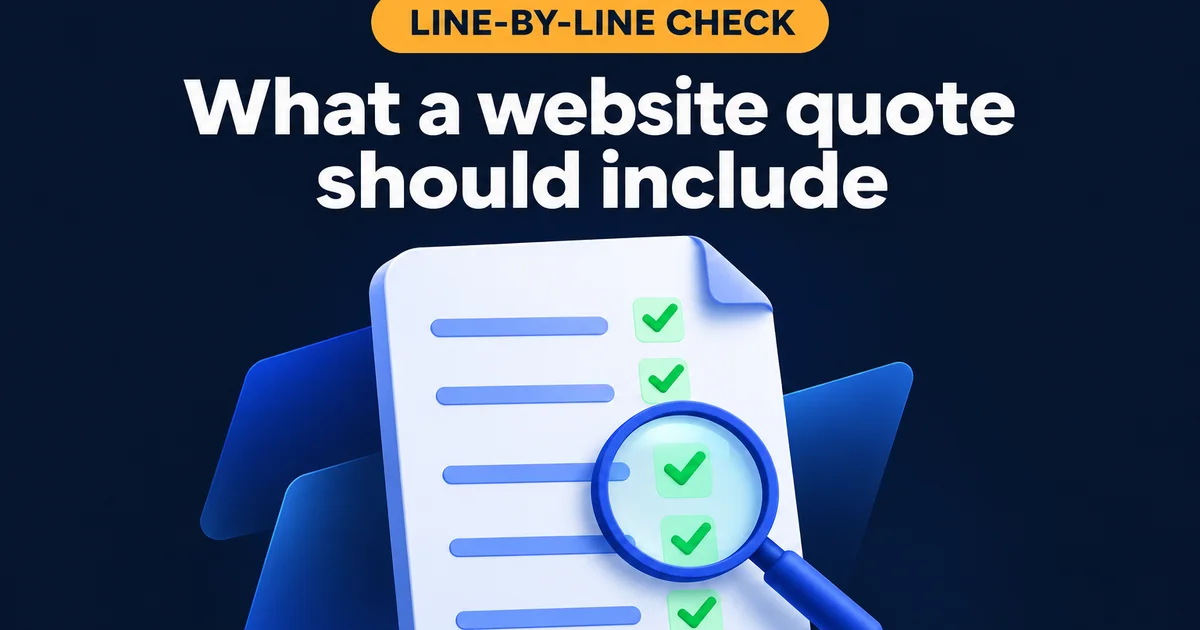
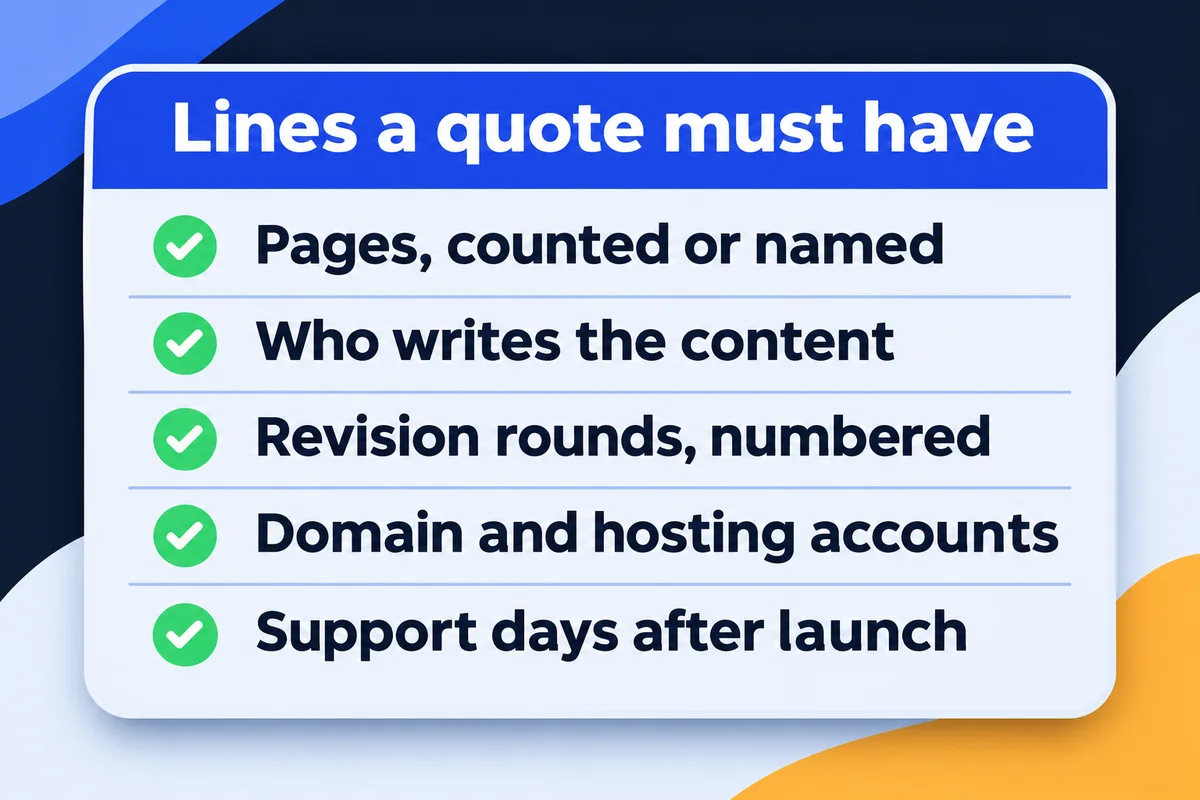
Ask three designers for a price and you'll often get three documents that can't be compared: one runs two pages, one is a table, and one is a single line that says "Website, 5 pages" and a number. The single line is the easiest to read, so it tends to win. It's also the one that tells you the least about what you're paying for. A website quote is the only document you get before money moves, so it should tell you exactly what you're buying. Below is the quote I'd want to receive, line by line, with a note on what each line has to say.
- Design and build, up to 10 pagesA number of pages, or a list of them by name. "A full website" is not a number.
- Text for each pageWho writes it, you or them. If it's you, the date they need it by, because late text is the most common reason a launch slips.
- Photos and graphicsYours, stock they license, or a photographer. Stock photos used without a licence are your problem later, not theirs.
- Revisions: two rounds on designA count. "Unlimited revisions" sounds generous and usually means nobody has decided when the job ends.
- Contact form, map, click-to-callEach feature named. Booking, payments or a shop are different jobs and should be separate lines with their own price.
- Domain registered in your business nameWhose name and whose login. This one line decides who can move the site later.
- Hosting: provider, account holder, yearly priceEven if the designer doesn't sell hosting, the quote should say where the site will live and who pays.
- Support after launch: 30 daysA number of days, and what counts: fixing their mistakes, or also your small changes.
Lines 1 and 8 in that example are copied from my own pricing page, where the Startup website is up to 10 pages with 30 days of support after launch. I didn't make up a quote to look good. I wrote the lines I'd hold anyone to, me included.
What should a website quote include?
A website quote should name the number of pages, who supplies the text and photos, how many rounds of revisions you get, every feature by name, whose name the domain is in, where the site is hosted and who pays for it, how long support lasts after launch, the payment schedule, and whether HST is added. If a line is missing, assume it costs extra.
Most quotes I see get the first line right and go quiet after that. These are the ones that go missing, and what each gap tends to turn into a few months later:
- The content line
- Nobody said who writes the text, so the designer waits for you, you wait for the designer, and the site sits half-built with lorem ipsum on the services page. I've written a whole guide on writing a website brief that gets you honest quotes, and the content question is the first one in it for a reason.
- The domain and hosting lines
- The quote says "hosting included". Included where, in whose account, for how long? Year two arrives with a renewal at three times the price, from a company you've never heard of. The tricks hosting checkouts play are in my piece on hosting hidden fees.
- The support line
- "Ongoing support" with no number of days. Three weeks after launch you ask for a phone number to be changed and get an invoice for an hour.
- The feature that was "obviously" included
- You assumed online booking came with the site. The designer assumed it didn't. Neither of you wrote it down, so it becomes a change order at their hourly rate.
The HST line, and why the higher number can be the cheaper quote
In Ontario the HST is 13%, so whether a quote adds tax changes the real total more than most price haggling ever will. A quote should say one of three things: tax is added on top, tax is already in the price, or the seller isn't registered and charges none. Compare the totals after tax, never the headline numbers.
Here's the same comparison done two ways. Both quotes are made-up round numbers so the arithmetic is easy to follow:
| Build | $2,000.00 |
| HST 13% | $260.00 |
| You pay | $2,260.00 |
| Build | $2,200.00 |
| HST | $0.00 |
| You pay | $2,200.00 |
Quote B looks $200 dearer and is $60 cheaper. If your business is registered for HST and can claim back the tax it pays, Quote A works out cheaper for you, because the $260 comes back as an input tax credit. That's why the line has to be there: the same two quotes rank differently for different buyers.
"No HST charged" is not a scam, by the way. The Canada Revenue Agency's page on when to register for and start charging the GST/HST says a business that doesn't go over $30,000 over four consecutive calendar quarters is a small supplier and doesn't have to register. Plenty of honest freelancers are exactly that.
When tax is charged, check one more thing. The CRA says a supplier must put its GST/HST account number on receipts, invoices and contracts for taxable supplies of $100 or more, and you can confirm that number in the CRA's GST/HST Registry before you pay. A quote that adds 13% with no account number anywhere is a quote I'd ask about.
Fixed price or hourly: read the wording
The words around the total tell you whether it's a price or a guess. Four common phrasings, and what each one commits the designer to:
| The quote says | What it commits to | Ask before signing |
|---|---|---|
| "Fixed price: $X for the scope above" | The total, as long as the scope doesn't change | What counts as a change, and what one costs |
| "Estimated at $X" | Nothing firm. It's a forecast | The hourly rate, and a cap you approve before it's passed |
| "Starting from $X" | The lowest possible number, not yours | The price for your actual page list |
| "$X, plus third-party costs" | The build only | Which third parties, and a yearly figure for each |
I fix every price in writing before any work starts, and that's the standard I'd ask of whoever you hire. Hourly billing isn't wrong for open-ended work like a web app. For a ten-page site for a plumber, though, a designer who can't name a fixed number hasn't finished thinking about the job.
Add up three years, not the first invoice
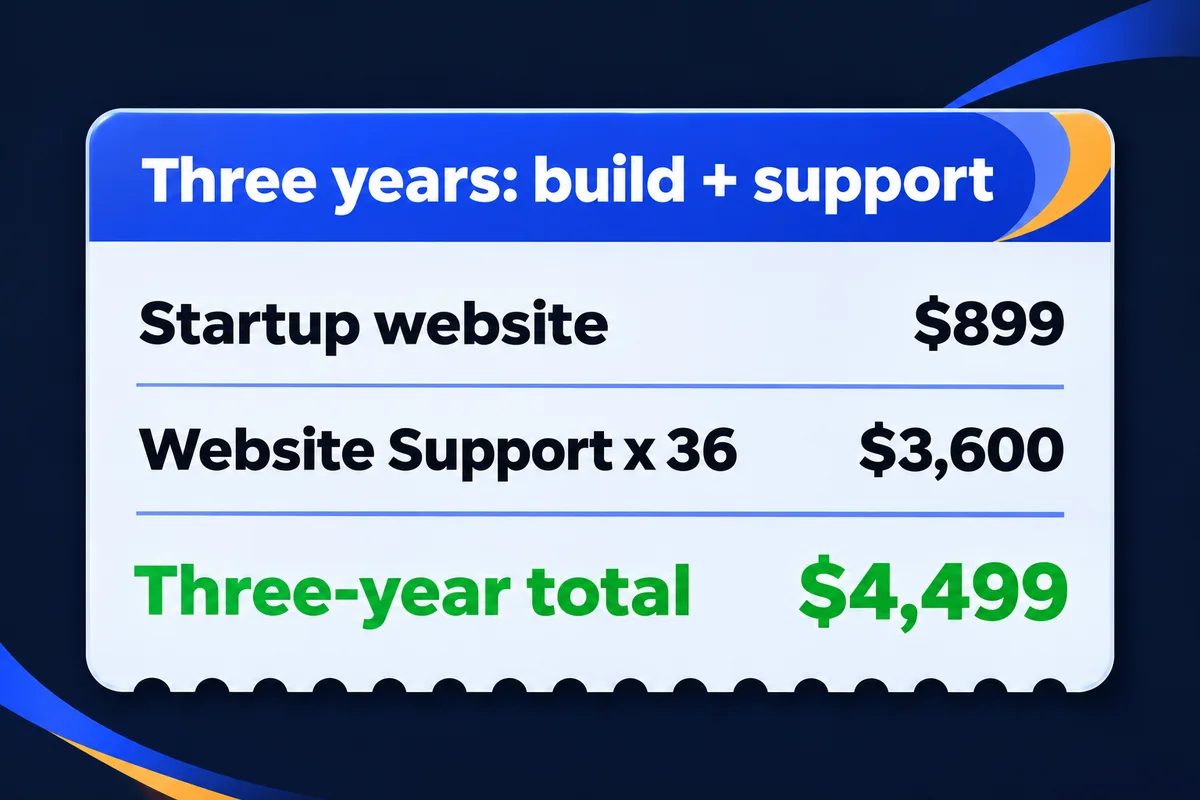
The build is paid once. Everything after it is paid every month or every year, and over three years the recurring lines usually add up to more than the build itself. Put each quote through the same sum before you compare them.
| Line | How often | My prices, as an example |
|---|---|---|
| Website build, up to 10 pages | Once | $899 |
| Website Support plan (updates, backups, security, small edits) | Monthly, $100 x 36 | $3,600 |
| Build and support over 36 months | Three years | $4,499 |
| Domain renewal | Yearly | from the quote |
| Hosting | Monthly or yearly | from the quote |
| Paid plugins, booking or email tools | Monthly or yearly | from the quote |
The support line is optional with me: the monthly plans have no contract, and your domain, site and Google profile stay in your name whether you keep one or not. What each month of support covers is on the website maintenance and support page. Whoever you go with, fill the blank rows with their numbers and compare the three-year totals side by side. That's usually when the quote that looked cheapest stops looking cheapest.
Send these questions back before you sign
You don't need to argue with a quote. Reply to it with questions and see how fast and how plainly the answers come back. That reply tells you more about the next three months than the quote does.
- Can you list the pages by name?
- Who writes the text and supplies the photos, and by what date do you need them?
- How many rounds of revisions are included, and what does an extra round cost?
- Whose name will the domain be registered in, and who holds the hosting login?
- Is HST added, included or not charged? If it's charged, what's your GST/HST account number?
- What does support after launch cover, and for how many days?
- How much is the deposit, and what has to be finished before the next payment?
Once the answers are in and you've picked someone, the next document is the contract, and that has its own traps: late fees, ownership, what happens if the work stalls. I go through them in ten web design contract clauses to check.
Quote questions owners ask me
Should a website quote include HST?+
It should say plainly whether tax is added on top, already included, or not charged. In Ontario the HST rate is 13%, so on a $2,000 build that one sentence is worth $260. A designer who is not registered for GST/HST charges none, and that is legal for a small supplier.
Is a one-line website quote a red flag?+
Not always a dishonest one, but it is one you cannot compare. A single line like Website: $3,000 hides the page count, the revisions, the content and the support. Ask for the same total split into lines before you decide anything.
Should the domain and hosting be on the website quote?+
Yes, even when the designer does not sell them. The quote should name who registers the domain, in whose name, where the site is hosted, whose account that is, and the yearly price. These are the lines that decide who controls the site later.
How long should a website quote stay valid?+
Long enough for you to compare it with the others, and the date should be written on it. A quote with no expiry date leaves you guessing whether the price still holds when you call back three weeks later.
Can I ask a designer to break down a lump-sum quote?+
Yes, and a designer who has actually planned the job can do it in ten minutes. Ask for the pages, the revision rounds, who writes the content, the support period and the tax as separate lines. If they cannot split it, they have not planned it yet.
Sources, read on 15 November 2026: CRA, GST/HST rates; CRA, when to register for and start charging the GST/HST; CRA, confirming a GST/HST account number. Prices in the examples: my own pricing page. This is not tax advice; your accountant knows your situation.
Want a quote with every line filled in?
Tell me what your business does and how many pages you think you need. You'll get a fixed price in writing, split into lines like the ones above.
Get My Free Quote
I build hand-coded websites for small businesses around the GTA and write quotes with a fixed price on every line. Read my full bio · Get in touch