A website brief is one page that tells a designer what your business sells, what the site has to do, which pages and features it needs, who writes the words, and what you can spend. Write it before you ask anyone for a price. Without it, three designers quote three different websites, and you end up comparing a bicycle to a minivan.
Most first emails I get say some version of "I need a website, how much?" That's a fair question, and I can't answer it. It's like phoning a contractor and asking how much a renovation costs. Of what? A bathroom or the whole basement? So I ask ten questions back, the owner answers four, and we both lose a week. Below is the page that skips all of that. It's filled in for a made-up business, so you can see what a finished one looks like and copy the shape.
Website brief: Birch Lane Plumbing
sample, the business is made up
- The business
- Two vans, residential plumbing in Etobicoke and Mississauga. Most money comes from drain cleaning and water heater replacement. About half of new customers find us on Google Maps.
- What the site must do
- Get the phone to ring. Second job: a quote form for non-urgent work like bathroom rough-ins.
- Pages
- Home, Drain cleaning, Water heaters, Sump pumps, Bathroom rough-ins, Service area, About, Contact. Eight in total.
- Features
- Click-to-call on every page, one quote form with photo upload, our Google reviews shown on the site. No online booking, no shop.
- Words and photos
- I'll write rough notes for each service. I have about 40 job photos on my phone. I need help turning the notes into page text.
- What we have now
- A one-page site from 2017, domain registered in my name. I can log in to the registrar.
- Sites I like
- Two competitors' sites (links attached): I like that the phone number is huge on one and that the other shows prices for drain cleaning.
- Budget
- $1,000 to $2,000 for the build. Open to a monthly plan for updates if it's under $150.
- Deadline
- Live before March, when basement flooding calls start.
- Who decides
- Me. I reply to emails within two working days.
What does a website brief need to include?
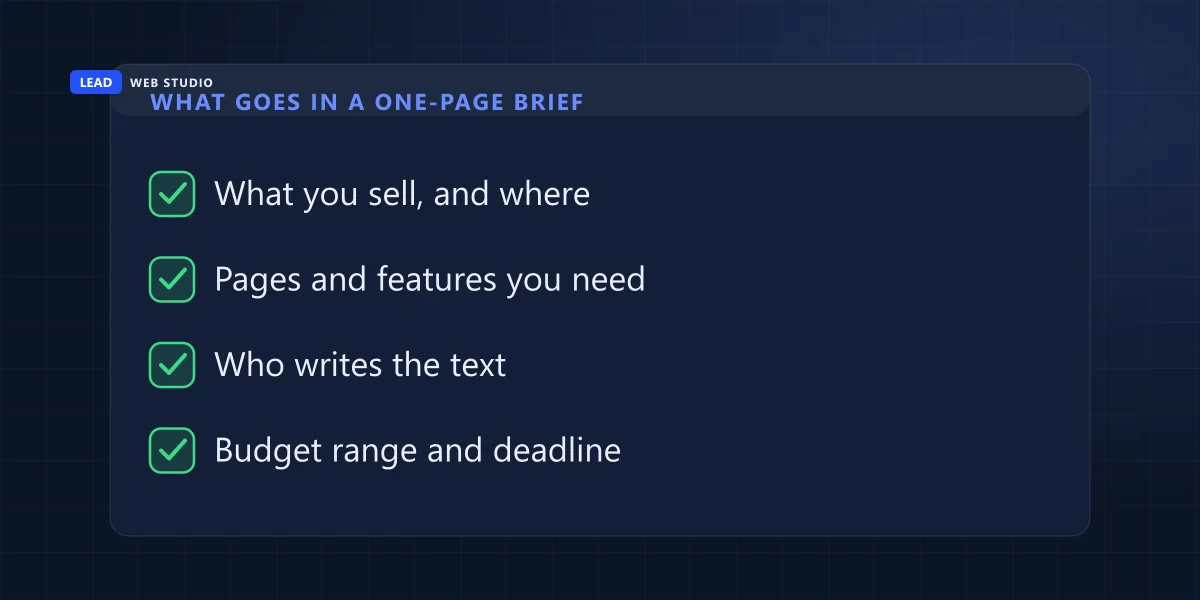
Ten lines are enough: what you sell and where, the one job the site does, the pages, the features, who supplies words and photos, what exists today, sites you like, a budget range, a deadline, and who approves. Each line answers a question the designer would otherwise ask you by email, one at a time, over two weeks.
On my side of the desk, each of those lines answers a pricing question:
- The business line tells me which pages earn money. Birch Lane's drain cleaning page gets more care than the About page, because that's where the phone calls come from.
- "Get the phone to ring" changes the design. A site built for calls puts the number everywhere and keeps the form short. A site built to sell products is a different animal.
- The page list is the single biggest driver of the price, so count them. If you're unsure, my guide on how many pages a website needs walks through it service by service.
- Features are where surprise invoices come from. A photo upload on a form is small. Online payments or a booking calendar are not.
- The words line is the one owners skip, and it's the one that stalls projects. Pages wait for text far more often than text waits for pages. The content and photo checklist tells you what to gather.
- "What we have now" tells me whether there's a domain to keep, an email to protect and old pages that already rank. That changes the first week of work.
The last four lines (sites you like, budget, deadline, who decides) are covered further down, because each one has a trap of its own.
Which lines of the brief change the price?
The number of pages and three features: a blog, online booking and online payments. Design taste, colours and fonts barely move a fixed quote. Below is how a brief lands on my own packages, so you can see the mechanics with real numbers instead of "it depends".
| What your brief says | What it means for the build | Package it lands in |
|---|---|---|
| Up to 10 pages, a contact form, Google Maps on the contact page | A standard business site, mobile layout, basic on-page SEO | Startup, $899 |
| 11 to 20 pages, or a blog you plan to keep writing | More templates to design, a blog section, a training session so you can post | Growth, $1,499 |
| More than 20 pages, booking or selling online | Booking or shop features, custom forms, schema markup | Enterprise, $2,999 |
| "Modern", "clean", your logo colours | Design choices inside the same package | No change |
The made-up Birch Lane brief has eight pages, a form and no booking, so it sits in the first row. That's why its budget line of $1,000 to $2,000 is useful: it tells me the owner has room for help with the text, which a lot of small sites need more than they need another page. Full details of what each package includes are on the pricing page, and every quote I send is fixed in writing before any work starts.
Should I tell a web designer my budget?
Yes, as a range. A designer who knows you have $1,500 proposes the best site for $1,500. One who doesn't know guesses, and guesses tend to land high, because quoting low and then adding extras is a reputation nobody wants. A range also screens out the designers who were never going to fit.
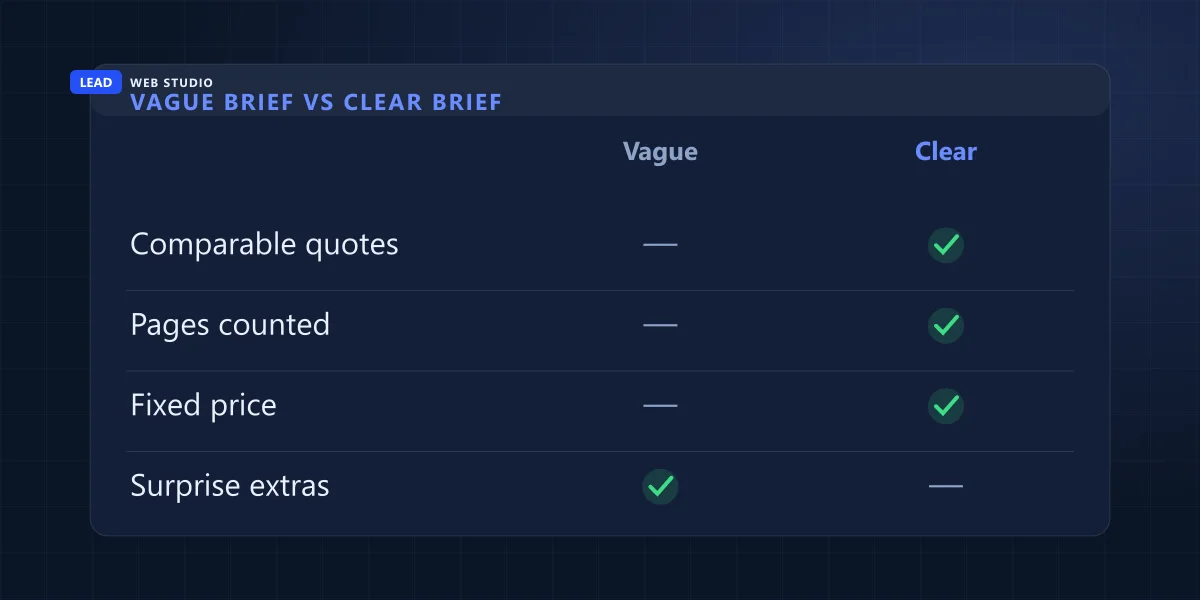
The fear behind hiding the budget is that the quote will magically match the top of the range. It happens. The fix isn't secrecy, it's a brief detailed enough that the quote has to itemise what you get. If you wrote "eight pages, one form, no booking" and someone quotes $5,000, you can ask which part of eight pages costs $5,000. A vague brief gives them no such corner to be held to.
Put two more money lines in while you're at it. Say whether you want a monthly plan after launch for updates and backups, and roughly what you'd pay for it. And say what you already pay for hosting and the domain, because a surprising number of owners are paying far more than they should for those, which I covered in the guide to hosting cart add-ons.
The sentences owners send, and what to write instead
These are the lines I see most often in first emails, next to the version a designer can actually price.
What owners write
"Something modern and clean."
Write this instead
Two links to sites you like, and one sentence on what you like about each one.
What owners write
"A few pages."
Write this instead
A numbered list of page names. Eight is a number. "A few" can be four or fourteen.
What owners write
"And SEO, of course."
Write this instead
The services and towns you want to be found for. "Drain cleaning in Etobicoke" is something a designer can build a page around.
What owners write
"Customers should be able to book."
Write this instead
Book what, and do they pay at booking? A request form that you confirm by phone and a live calendar with deposits are very different jobs.
What owners write
"ASAP."
Write this instead
A date and the reason for it, like a trade show or the start of your busy season. A reason helps the designer decide what can wait for a second phase.
Notice that "SEO, of course" gets fixed by writing down services and places. That one line does more for your future rankings than any amount of keyword talk in a sales call, and it's free.
Does my brief need to mention accessibility rules in Ontario?
If your business or non-profit has 50 or more employees in Ontario, yes. Since January 1, 2021, the AODA has required your public website to meet WCAG 2.0 Level AA, with two exceptions for live captions and pre-recorded audio descriptions. Put that in the brief, because it shapes colours, forms and every image on the site.
The requirement is spelled out on the Government of Ontario's page on making websites accessible, and it applies to web content published after January 1, 2012. Under 50 employees, it isn't legally required, but I'd still write "accessible to screen readers and keyboard users" in the brief. It costs little at the start and a lot to retrofit. If you're in the 50-plus group and the current site fails, accessibility compliance work is its own project, and the brief should say whether it's in scope.
Other lines that belong in the brief for legal reasons: whether you collect personal information through forms (you'll need a privacy policy), and whether you're in a regulated profession with its own advertising rules, like health care or law. A designer can't guess those, and finding out after launch means rewriting pages.
How many designers should get the same brief?
Two or three. Send all of them the same page, word for word, and ask each one to price it line by line. Then the quotes are comparable, and the differences you see are real differences in what's offered, not in what each designer guessed you meant.
When the quotes come back, read them against the brief, not against each other:
- Does each quote name every page from your list, or does it say "up to X pages" with no names?
- Is the text writing included, or did your words line quietly disappear?
- Who registers and owns the domain and hosting account? It should be you.
- What happens after launch, and what does a small text change cost then?
- Did they ask you questions? A designer who asks about your busy season has read the brief. One who sends a PDF price list in four minutes has not.
Before you sign, check the paperwork too. My guide on what a web design contract should say covers ownership and payment terms, and vetting a web designer covers the phone calls to their past clients that most people skip.
Questions owners ask me about website briefs
Do I need a brief for a small five-page website?+
Yes, and it can be half a page. Small sites are where a missing line hurts most, because one forgotten booking form or a blog can move the job into a different price bracket.
Should the brief go to the designer before or after the first call?+
Before. Send it with your first email. The call then goes on the questions the brief raised instead of on reading your business out loud, and the quote that follows is built on paper you both have.
What if I don't know which pages I need?+
List what customers ask you on the phone. Each service you sell and each question you answer every week is usually a page. Write that list and let the designer turn it into a site map.
Can the brief change after I get the quote?+
It can, and the quote changes with it. That is the point of writing it down: when you add a shop halfway through, both sides can see it was not in the original brief, and nobody argues about whether it was promised.
Is the brief the same thing as a contract?+
No. The brief says what you want. The contract says what the designer agrees to deliver, for how much, and who owns the result. A good contract should point back to the brief or copy its page list.
Source, read on 18 October 2026: Government of Ontario, How to make websites accessible, for the 50-employee threshold, WCAG 2.0 Level AA, the January 1, 2021 date and the two exceptions. Package prices and inclusions are from my pricing page on the same date. Birch Lane Plumbing is made up for this guide.
Got a brief, or half of one?
Send it as it is. On a free 20-minute strategy call I'll fill the gaps with you and send back a fixed quote for the website design it describes.
Get My Free Quote
I build websites for service businesses around Toronto, and I read a lot of first emails from owners who need one. Read my full bio · Get in touch