Two years after the shoot, you decide to wrap the van. You send your favourite frame to the sign shop, and a week later the photographer emails to ask what your licence covers. That is usually the first moment a business owner finds out that the question who owns the photos of your business has an answer, and that the answer is not "I paid, so I do". In Canada it is almost always the photographer — and paying the invoice did not change that.
The short version
- The photographer owns the copyright by default. The Act: "the author of a work shall be the first owner of the copyright therein."
- Your money bought a licence and some files, not the rights. That is normal and usually fine — as long as you know what the licence says.
- Nothing moves ownership without paper. "No assignment or grant is valid unless it is in writing signed by the owner."
- The one exception written for the person who paid excludes you: it covers "private or non-commercial purposes". Your homepage is neither.
- Read the file before you email anyone. Photographers embed the creator, the copyright notice and the usage terms inside the image itself.
- An unwritten deal cannot be exclusive, so the same photos may legally end up on a competitor's site.
- An employee's photos are yours; a freelancer's are not. Same camera, same room, opposite answer.
I build websites and shoot photos for clients — I am not a lawyer, and nothing here is legal advice. Everything below is quoted from the Copyright Act and from Canada's own intellectual property office so you can check me, and where the answer depends on your specific paperwork I say so rather than guessing.
This comes up on nearly every build. A client sends me a Dropbox folder, I ask where the photos came from, and often the honest answer is "a guy did them a few years ago". That is not a criticism — nobody hires a photographer expecting a rights conversation. But the folder is about to become the public face of a business, and it is worth ten minutes to know what you are standing on.
Do I own the photos I paid a photographer to take?
Usually not. Canada's Copyright Act, section 13(1) says "the author of a work shall be the first owner of the copyright therein", and for a photograph the author is the photographer. Paying the invoice buys you files and permission to use them. Ownership only moves if a signed document says it does.
That last part is not a formality anyone can wave away later. Section 13(4) lets an owner assign their rights "either wholly or partially", carve them up "relating to territory, medium or sector of the market", or licence them instead — and then closes the door: "no assignment or grant is valid unless it is in writing signed by the owner of the right in respect of which the assignment or grant is made, or by the owner's duly authorized agent."
So a friendly verbal "yeah, they're yours, do what you like" is worth exactly what it costs. It may well reflect what both of you intended. It cannot transfer copyright, because the statute says a transfer that is not written and signed is not valid. And if it ever came to an argument, section 34.1 sets the starting position: unless the contrary is proved, the author "shall … be presumed to be the owner of the copyright". You are the one who has to produce something.
So what did my money actually buy?
A licence, plus the files. The Canadian Intellectual Property Office draws the line in one sentence each: an assignment "is the transfer of some or all of your rights to another party", while a licence "gives another party permission to use your work under certain conditions, but you keep ownership and maintain your rights." Most commercial shoots are the second thing, and most of them are never written down.
Here is where the mismatch usually sits. On the left, what the invoice says. On the right, what the client assumed it meant.
| What the invoice line says | What people hear | What it actually is |
|---|---|---|
| "Half-day commercial shoot" | I bought the photos | You bought the photographer's time, and permission for the use you discussed |
| "25 edited images delivered" | 25 images are now mine | 25 files are now yours. The copyright in them is not a file |
| "Full rights included" | I own them outright | Ambiguous, and unsigned. "Full rights" is not a defined term anywhere in the Act |
| "Web use licence" | Anything online | Whatever the two of you meant by "web" — which is why it belongs in a sentence, not a phrase |
None of this makes photographers the villains. Licensing is how the profession works, the same way I licence a font rather than buying the typeface. The problem is silence: a business that cannot say what it is allowed to do will either under-use photos it paid good money for, or find out its limits from a sign shop.
Where do I find out what I'm allowed to do?
Open one of the files and read its properties before you email anybody. Professional photographers embed rights information inside the image itself, using the IPTC standard: who took it, who owns it, how it must be credited, and what you may do with it. On Windows that is right-click → Properties → Details. It takes about thirty seconds.
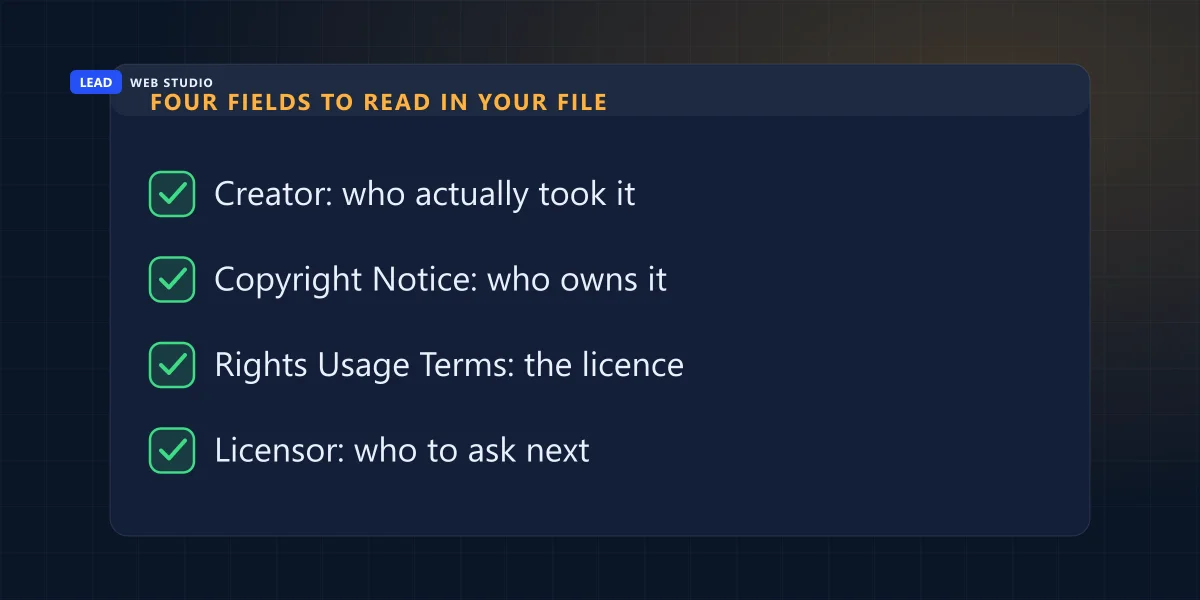
The IPTC photo metadata standard is the one professional photography actually runs on, and four of its fields answer most of the question:
| Field | What it tells you | Why it matters |
|---|---|---|
| Creator | Name of the person who took the photo | IPTC notes this field "is shown in the Image Credits of a photo in the results of a Google image search" |
| Copyright Notice | "The name of the current copyright holder, whether an individual or a company" | If it carries somebody else's name, that is your answer |
| Rights Usage Terms | "Free-text instructions on how the image may be legally used" | This is the licence, travelling inside the file |
| Licensor | Contact details for whoever is "authorised to licence the image" | Who to email if you want to widen the use |
IPTC's own worked example of a Rights Usage Terms field shows exactly how narrow a real licence can be: "Image to be used One-time only, non-exclusive use in English Language Edition Magazine as inside image, to be used no larger than a full page in color. Additional third party rights to be negotiated with … in advance. All other rights are reserved except those specifically granted."
That last sentence is the one that matters. Rights are granted one at a time, and anything not listed stays with the photographer. If your files come back with those fields blank, you have learned something too — it means nothing was recorded, and the only place the terms exist is in an email thread you should go and find.
Your photo files are carrying their own paperwork. Open one and read it before you email anybody.
What does the law give the person who paid?
One narrow thing, and it is not for business use. Section 32.2(1)(f) lets an individual use a photograph they commissioned "for private or non-commercial purposes". Wedding albums, yes. Your homepage, your flyer, your Facebook ads — no. The single exception written for the person who paid excludes commercial use by name.
The full wording is worth having, because people quote half of it at each other: it is not an infringement "for an individual to use for private or non-commercial purposes, or permit the use of for those purposes, a photograph or portrait that was commissioned by the individual for personal purposes and made for valuable consideration, unless the individual and the owner of the copyright in the photograph or portrait have agreed otherwise."
Three qualifiers, and a commercial shoot fails at least two of them. "Private or non-commercial purposes." "Commissioned by the individual for personal purposes." A restaurant booking a photographer to shoot its dining room is not an individual acting for personal purposes, and putting the results on a menu page is the commercial use the clause carves out. Whatever protection this section offers, it is not aimed at you.
My employee took the photos. Is that different?
Yes — it is the one common case where you own them outright with no paperwork at all. Section 13(3) gives the employer first ownership where the author "was in the employment of some other person under a contract of service or apprenticeship and the work was made in the course of his employment", absent any agreement to the contrary.
The distinction that matters is employment, not who paid. A freelancer sending you an invoice is not in your employment, however many times you have hired them. Same camera, same room, opposite answer:
| Who pressed the shutter | Who owns the copyright by default | What you need in writing |
|---|---|---|
| You, on your own phone | You | Nothing |
| Your employee, during work | You, under s.13(3) | Nothing — but a line in the employment agreement removes the argument |
| A freelance photographer | The photographer | A signed licence, or a signed assignment |
| Your web designer or agency | Whoever took them | Same as above — and check whether the agency itself has the right to pass anything on |
| A customer who tagged you | The customer | Written permission, and it is worth asking rather than reposting |
That fourth row catches people who think their contract with the agency settles it. It settles what the agency owes you. It cannot bind a photographer who never signed it — the same structural point I make about images pulled off the web in who pays when a photo on your site turns out to be someone else's, and the same reason it is worth knowing exactly what your builder hands over before the site goes live.
When was the shoot? Anything before November 2012 may follow a different rule
Go and look at the invoice date. Subsection 13(2) — the old provision for commissioned engravings, photographs and portraits — was repealed, and the current Act simply prints "(2) [Repealed, 2012, c. 20, s. 7]". But the repeal was not retroactive, and that is the part almost nothing written about Canadian photo rights mentions.
Section 60 of the Copyright Modernization Act is one sentence long: subsection 13(2) "as it read immediately before the coming into force of section 7, continues to apply with respect to any engraving, photograph or portrait the plate or original of which was commissioned before the coming into force of that section 7." That came into force on 7 November 2012, the date the bulk of that Act took effect.
I am not going to summarise a repealed subsection from memory, and you should be suspicious of any page that does without quoting it. What I will tell you is the practical consequence: if the photos you are worried about were commissioned before 7 November 2012, the rule that governs them is not the one in the rest of this article, and that single question is worth ten minutes of a lawyer's time with the old text in front of them. For anything shot since, everything above applies.
I own the copyright now — can I crop it and add my logo?
Not automatically, and this surprises people who have just paid extra for an assignment. Moral rights sit alongside copyright and cannot be sold. CIPO states it plainly: "Moral rights cannot be assigned or transferred, but can be waived." The Act agrees — an assignment of copyright "does not by that act alone constitute a waiver of any moral rights."
Section 14.1(1) gives the author the right to the integrity of the work, and the right "where reasonable in the circumstances, to be associated with the work as its author by name". Integrity is not infinite: section 28.2(1) says the right is infringed "only if" the work is changed to the prejudice of the author's honour or reputation — specifically, "distorted, mutilated or otherwise modified", or "used in association with a product, service, cause or institution."
In real life this is not what will bite you. A tasteful crop for a hero banner is not an attack on anyone's reputation. What it means in practice is that the moral-rights waiver belongs in the same email as everything else, because it costs nothing to ask for at the start and is awkward to chase two years later. CIPO adds a detail worth knowing before you sign anything as a photographer yourself: "Once moral rights are waived, they cannot be reacquired."
Can the photographer license my photos to a competitor?
If they own the copyright and your licence is not exclusive, yes — and there is a clean statutory reason why a handshake can never be exclusive. Section 13(7) says a grant of an exclusive licence "constitutes the grant of an interest in the copyright by licence". Section 13(4) says no grant of an interest is valid unless it is in writing, signed.
Put those together and the conclusion is not a matter of interpretation: an arrangement nobody wrote down cannot be exclusive. Whatever both sides believed, the photographer remains free to licence the same frames to a stock library, a trade magazine, or the shop two doors down. For a restaurant whose dining-room photos are its whole first impression, that is not a theoretical problem — it is the reason exclusivity is worth paying for on a handful of key images rather than on the whole set.
One related trap, and I will keep it short because it belongs to a different article: a licence from the photographer covers the photographer's rights and nothing else. It says nothing about the recognisable face of the customer in frame three, or the branded delivery van parked behind your crew. Those are releases, not licences, and I covered where that line falls in the image copyright guide.
What should the photography agreement actually say?
Eight lines, in an email, before the shoot. You do not need a lawyer to draft this and you do not need the photographer to sign a contract they have never seen — an email that both of you reply to in writing is exactly what section 13(4) is asking for, and most photographers will answer it in ten minutes because it makes their job easier too.
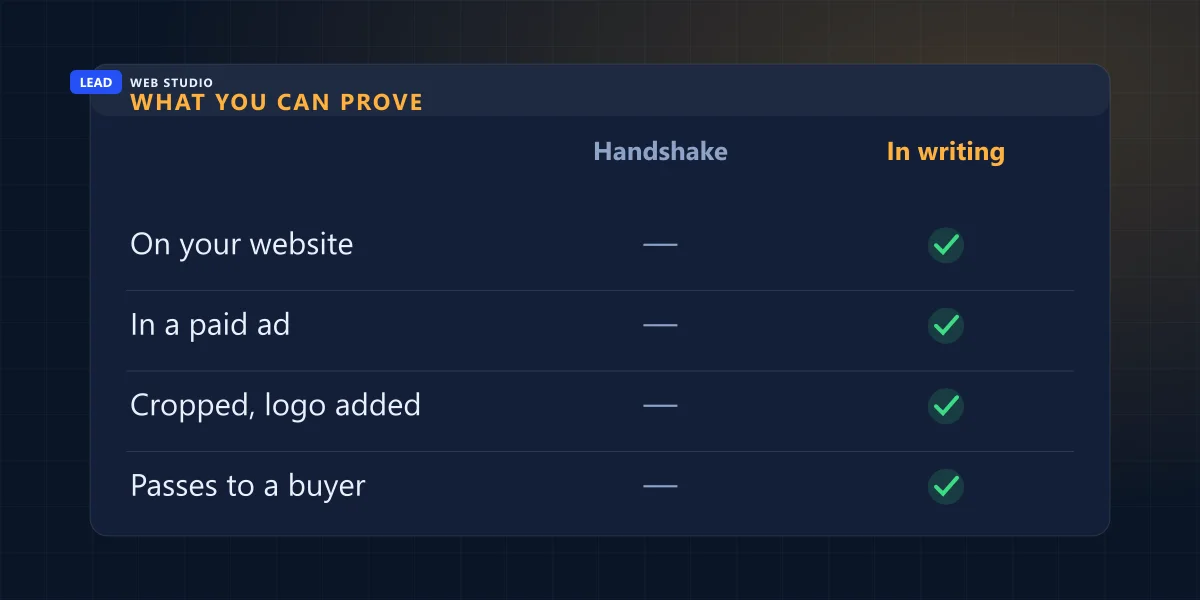
- Who owns the copyright — say it out loud either way. "You keep the copyright" is a perfectly good answer as long as the next seven lines are right.
- What I may use them for — website, social media, Google Business Profile, print, paid advertising, vehicle graphics, trade shows. List the ones you can imagine, not the ones you have booked.
- For how long, and where — "perpetual, worldwide" is the phrase you want. A licence that quietly expires after three years is a licence to rebuild your website in three years.
- Exclusive or not — and if not, whether there are any frames the photographer agrees not to licence elsewhere.
- Whether I may edit and crop — with a moral-rights waiver in the same sentence.
- What files I get — full-resolution finished JPEGs at minimum, and say whether RAWs are included. Most photographers will say no to RAWs; that is normal, so ask before you assume.
- Credit — whether a credit line is required, and where. Cheap to give, awkward to discover later.
- What happens if I sell the business — a licence that cannot transfer with the company is a snag in a future sale that nobody notices until due diligence.
Those eight lines fit in one short paragraph, and the reply you get back is the document section 13(4) is asking for. Keep it somewhere you will find it in five years — with the invoice, not in the inbox. The paperwork is not there for the good case.
I already have the photos and no paperwork. What now?
Send one polite email, today, while the photographer still remembers you and still likes you. This is a far easier conversation before there is a dispute than after. Ask plainly, offer to pay for the wider scope, and treat a price as a good outcome — a number is something you can make a decision about.
- Read the metadata first so you are not asking a question the files already answer.
- Find the original email thread and the invoice. Whatever was agreed is probably in there in ordinary English, which is enough to work from.
- Write down what you are actually doing with the photos now — every place, including the ones you forgot: the Google profile, the old flyer, the trade-show banner in the storage room.
- Ask for confirmation in writing of exactly that list, plus anything you can foresee. Offer to pay for the extension; it is usually less than a reshoot and always less than an argument.
- If nobody answers — the photographer has moved on, closed the business, or cannot be found — treat those photos as a known risk rather than a settled asset, and plan a reshoot for anything you are about to spend real money printing.
That last one is the honest answer nobody likes. An unreachable rightsholder does not grant permission by being unreachable. It is the same practical logic as knowing who holds your domain and hosting before you need them, which I go through in who really owns your website.
The one thing to do today: open your website's About or Team page, right-click the first photo, save it, and read its Details tab. If the Copyright Notice carries a name that is not yours, you have just found the single most useful sentence in this article — and you found it in under a minute. If it is blank, go and find the email thread instead.
Frequently asked questions
Do I own the photos if I paid the photographer?+
Usually not. Canada's Copyright Act says "the author of a work shall be the first owner of the copyright therein", and for a photograph the author is the photographer. Paying the invoice buys you the files and permission to use them. Ownership only moves to you if there is a document, in writing and signed, that says so.
Can my photographer stop me using the photos later?+
They can object to uses your licence never covered. If the shoot was booked for a website and you later put a frame on a truck wrap, a billboard or a paid ad, that is a new use. Whether it is covered depends entirely on what was agreed — which is why the scope belongs in writing before the shoot rather than after the argument.
Does the photographer have to give me the RAW files?+
Only if your agreement says so. Copyright and the files are separate things. Many photographers will not hand over RAW originals at any price, because the edit is part of what they sell. If you want the full-resolution finished files, or the RAWs, ask for it in the same email that sets out the licence.
I own the copyright now. Can I crop the photo and add my logo?+
Not automatically. Moral rights are separate from copyright and cannot be sold. CIPO states that "moral rights cannot be assigned or transferred, but can be waived", and the Copyright Act adds that an assignment "does not by that act alone constitute a waiver of any moral rights". Ask for a written waiver alongside the assignment.
Can the photographer license my photos to a competitor?+
If they own the copyright and your licence is not exclusive, yes. An exclusive licence is a grant of an interest in copyright, and the Act says no grant is valid "unless it is in writing signed by the owner". So an arrangement nobody wrote down cannot be exclusive, whatever either side intended.
What about photos taken before November 2012?+
A different rule may apply. Subsection 13(2) of the Copyright Act, the old provision for commissioned photographs, was repealed by the Copyright Modernization Act. Section 60 of that Act keeps the repealed subsection in force for any photograph "commissioned before" it came into effect on 7 November 2012 — so the date on the invoice matters.
Sources, all quoted above and worth reading yourself: the Copyright Act, s.13, s.14.1, s.28.2 and s.32.2; section 60 of the Copyright Modernization Act; the Canadian Intellectual Property Office's Guide to Copyright and Transfer ownership pages; and the IPTC Photo Metadata User Guide.
Not sure what you're allowed to put on your own website?
Send me the folder and I'll read the metadata on every file and tell you what it says — free, nothing to sign. If the answer is "these are fine", you get to stop worrying. If it isn't, you find out now rather than from a sign shop. I'm in North York, so when a build needs real photographs rather than stock I can come and take them myself. See what a build includes on the web design page, what it costs on the pricing page, or how it plays out for a specific trade like restaurants.
Get My Free Quote
10+ years building websites for GTA trades, clinics and service businesses — which means opening a lot of client photo folders and asking the awkward question about where the pictures came from. Read my full bio · Get in touch