A guy emailed me last month asking what I charge to "get his business into ChatGPT." I told him the honest answer: nobody can sell you that, and anyone who says they can is selling you a feeling, not a result. But there's a real, unglamorous thing underneath the hype that actually does help, and I use it on every single guide on this blog — including this one, so you can click through and check my work instead of taking my word for it. It's called answer-first writing. It's not a trick. It's paying attention to how a machine skimming a page for one usable paragraph actually decides which paragraph to lift.
The short version
- Answer-first means the direct, complete answer sits in the first few sentences under the heading — not three paragraphs of setup later.
- Ranking #1 on Google helps, but it's not the whole game: Ahrefs found only 12% of AI citations come from a page ranking in Google's own top 10, and 80% aren't in the top 100 at all.
- Google's own documentation says there's no special file or markup required to appear in AI Overviews — most "AI SEO" upsells are repackaged good writing.
- The unit that gets lifted is one self-contained passage, not a whole article. Write every section so it could be the only paragraph someone reads.
- FAQ schema stopped earning a rich Google result in 2026, but the FAQ format — a real question, a short answer — is still one of the cleanest things you can hand an AI. See what schema markup still does.
What does "answer-first" content actually mean?
It means the direct answer to the question in your heading shows up immediately after it — in the first two or three sentences, in plain language, with no wind-up. The explanation, the caveats, the backstory — all of that comes after. If someone read only that first block and nothing else on the page, they'd still walk away with the real answer.
Most business blog posts do the opposite, and for a long time that was fine. A human skimming with a finger on the scrollbar would eventually find the answer buried in paragraph four. But a search engine's snippet extractor and an AI assistant's passage retriever don't scroll patiently — they grab a fixed window of text, and if your actual answer isn't inside that window, it doesn't get picked. It's not personal. It's just how the extraction works.
Does ranking #1 on Google get you quoted by AI?
Not reliably. Ahrefs analyzed 15,000 long-tail queries across ChatGPT, Gemini, Copilot and Perplexity and found that on average only 12% of AI-cited pages ranked in Google's own top 10 for that exact query — and 80% of AI citations didn't appear anywhere in Google's top 100 at all. Ranking well still helps. It's just not the whole game anymore, and treating it as one is how you end up disappointed by a strategy that used to work.
The breakdown by assistant is worth knowing too: Perplexity's citations lined up with Google's top 10 about 28.6% of the time — the closest of the four — while ChatGPT's in-text citations lined up only about 8%. Different assistants are pulling from different pools, using their own retrieval, not simply reading off Google's results page. That's a real methodology shift, not a rumor — the study is public and I've linked it below rather than just asserting the number.
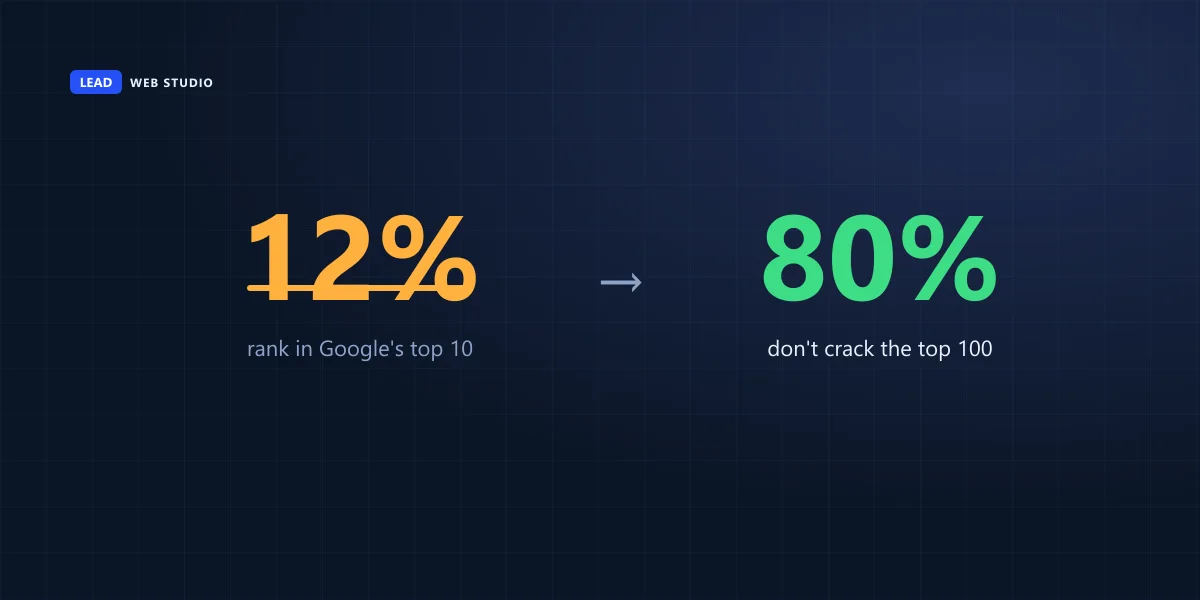
Source: Ahrefs, "How Much Do AI Citations Overlap With Google Rankings?" (Aug 2025, 15,000 long-tail queries).
I used to operate on "rank #1 and the rest takes care of itself." Four out of five AI citations in that Ahrefs study don't show up anywhere in Google's top 100, never mind page one. Same content, different retrieval — you just have to structure it so a machine skimming for one paragraph can actually find the right one.
So what actually gets a passage picked?
A block of text that fully answers one specific question on its own — the claim and the support for it sitting in the same few sentences, not scattered across a whole article the reader has to piece together themselves. And according to Google itself, there's no secret markup that unlocks this. Its own Search Central documentation states plainly: "There are no additional requirements to appear in AI Overviews or AI Mode, nor other special optimizations necessary… You don't need to create new machine readable files, AI text files, or markup to appear in these features."
Read that again next to whatever "AI SEO audit" pitch landed in your inbox this month. Google is telling you, in writing, that the lever is ordinary good writing structured so a machine can lift one clean piece of it — not a file you buy, not a badge you install.
| Habit | Old SEO habit | Answer-first habit |
|---|---|---|
| Where the answer sits | After two paragraphs of setup | First 2-3 sentences under the heading |
| How headings are written | Clever or brand-flavoured | The literal question a person asks |
| Where numbers and prices live | Mixed into a paragraph | In a labeled table |
| Who it's really written for | Whoever's still scrolling | Whoever reads exactly one paragraph |
The answer-first format I actually use — you can check it
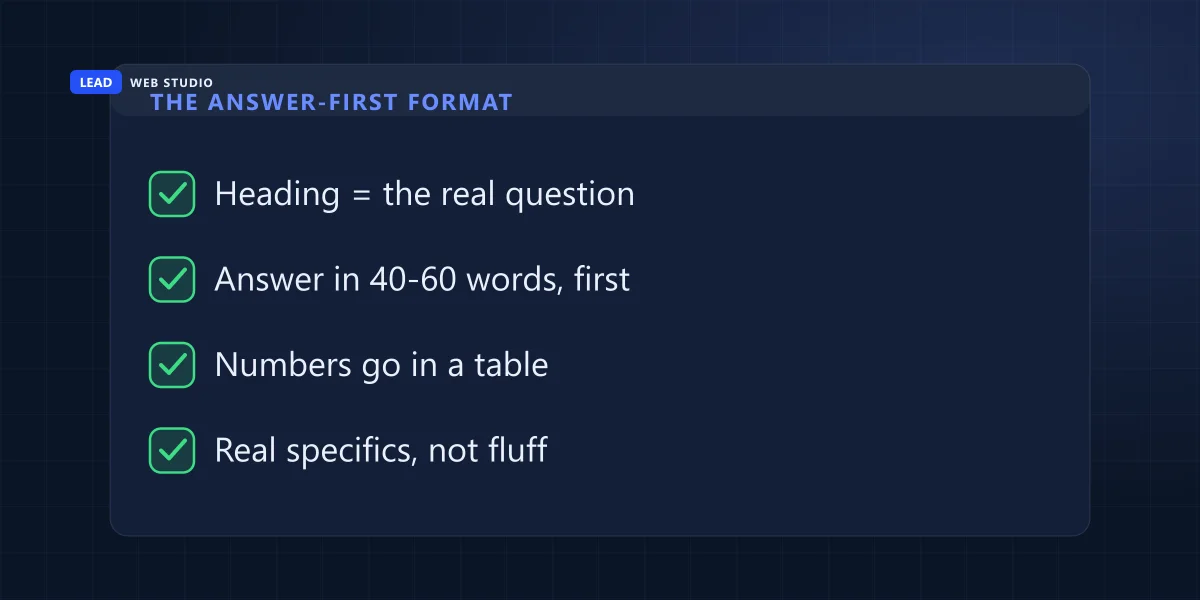
This is the checklist every guide on this blog runs through before it publishes, this one included. None of it is exotic:
- Every question-style heading is phrased the way a person actually asks it — not a clever variation, the plain question.
- The first 2-3 sentences under it are a complete, standalone answer — I aim for roughly 40-60 words, as a discipline that forces me to actually finish the thought, not because a model is counting.
- Every number, price or spec goes in a labeled table, never buried mid-paragraph where it's easy to miss and easy to misquote.
- At least one real, checkable specific — a number, a name, a source link — not a vague claim nobody can verify.
- The deeper explanation and caveats come after the answer, never before it.
Where FAQ format and schema still matter
FAQ markup stopped earning a special rich result on Google in 2026, but the FAQ format itself — a real question as a heading, a short answer directly under it — is still one of the easiest ways to hand an AI assistant a clean, extractable passage. Keep writing FAQ sections. Just don't expect the little accordion snippet back on the search results page; I go through exactly what changed and why in what schema markup actually does in 2026.
The "AI SEO" services you probably don't need to buy
Not everything with "AI" in the name is a scam, but a fair amount of it is a repackage of things that already have documented, unremarkable effects — or none at all. Here's what I've actually seen sold, next to what it does:
| What's being sold | What it actually does |
|---|---|
| An llms.txt file, often $150-300 one-time | A plain text list nothing requires you to have — no documented ranking or citation effect |
| An "AI schema" add-on | Not a real schema.org type — usually your existing FAQ or Article schema, relabeled |
| A monthly "AI visibility" retainer | Sometimes real analysis, sometimes just someone rewriting the first sentence under each of your headings |
None of this means "do nothing." It means the actual work is the writing, and the writing is something you can evaluate yourself with the checklist above — you don't need to take a vendor's word for whether it's happening.
A real example, taken apart
Rather than describe the format abstractly, here's an actual passage from another guide on this site, so you can see it and then go verify it in context. From what content and photos a designer needs before a build starts, under the heading "What does my web designer actually need from me?":
"Realistically: your services with a real description of each (not just a title), pricing or an honest range, your logo, an About Us story, contact details and hours, a few testimonials if you have them, and photos of your actual work — not stock. Bring that on day one and a normal build starts immediately instead of stalling for weeks."
That's 56 words. It answers the heading completely, on its own, with real specifics ("pricing or an honest range," not "competitive pricing"). If you read only that paragraph, you'd know exactly what to send a designer. Everything after it — the ten-item breakdown, the photo specs — is detail for someone who wants more, not a prerequisite for understanding the answer. That's the whole format. It isn't more complicated than that; it's just easy to skip when you're excited to explain the nuance first.
Run this 10-minute test on your own homepage
Pick one page — your homepage, your top service page, whatever gets the most traffic — and check whether it actually does this:
- Pick the one question your customers ask most often on the phone or in your first email back and forth.
- Find where your site currently answers it — search the page for the topic if you have to.
- Time how long it takes to reach the real answer. More than two sentences of setup first is the problem.
- Rewrite it as a standalone answer, 40-60 words, with the actual answer in the first sentence.
- Read it out loud. If it sounds like marketing copy instead of an answer to a question, cut the marketing copy.
Do that for your five most-asked questions and you've rewritten the pages that matter most — no vendor, no retainer, no llms.txt required. If you'd rather have someone who does this for a living run through your whole site, that's the actual substance behind the content work inside my SEO plans, and it's the same discipline I build into every new site from the ground up — see how I approach web design for the rest of it.
Want a second pair of eyes on it? My free website audit checks your on-page structure for free, no signup. If you'd rather talk it through, get in touch and I'll tell you honestly whether your content needs a rewrite or just a reorder.
Frequently asked questions
Does answer-first writing help my Google ranking too, or only AI?+
Both. Google has extracted featured snippets from clear, self-contained answers for years — answer-first writing is the same discipline. It's not a separate AI trick, it's ordinary good writing that happens to also work for AI extraction.
Is there an exact word count AI wants for an answer?+
No, and be skeptical of anyone who states one as a rule. I aim for 40-60 words as a practical writing discipline that forces a genuinely complete, standalone answer — not because a model is counting words.
Do I need an llms.txt file to show up in AI answers?+
No. Google's own documentation states there are no special files or markup required to appear in AI features. An llms.txt file costs nothing to add and won't hurt, but nobody has shown it changes whether you get cited.
Will ChatGPT send me traffic the way a Google ranking does?+
Sometimes, with a citation link, but expect far less click-through than a search result — a chat answer often satisfies the question on the spot. Treat an AI citation as a trust signal and a brand touch, not a traffic channel.
Should I still write FAQ sections if they don't get a rich result anymore?+
Yes. Google stopped giving FAQ markup a special rich result in 2026, but a real question as a heading with a short answer under it is still one of the cleanest, most extractable formats there is — for people scanning and for AI alike.
Want your whole site rewritten this way?
This is the same content discipline behind every page I build. Tell me about your project and I'll tell you honestly what needs it most.
Get My Free Quote
10+ years writing and building for GTA businesses, and every guide on this blog follows the exact format described above. Read my full bio · Get in touch