People usually search for affordable website design right after a quote that felt wrong in one direction or the other. I build small-business websites in Toronto for a living, so here is what an affordable website actually costs, what the money should buy, and the four lines in a quote that separate an affordable website from a cheap one.
Short answer first, because you have a business to run: a custom small-business website costs about $899 to $3,000 once, plus roughly $100–200 a year for the domain and hosting. A quote far below that range is usually missing something you will pay for later. A quote far above it should come with a feature you can point at and say "that's what the extra money is for".
The short version
- Affordable is the three-year bill, not the sticker. My $899 site costs $1,124–$1,424 over three years with a plain domain and hosting.
- The same site on a hosting cart padded with add-ons ($400–500 a year) costs $2,099–$2,399 over three years. The extra money buys nothing you can see.
- Spend on mobile speed, a clear way to contact you, basic SEO and a working contact form. Skip animations, video backgrounds and features "in case I need them".
- Every quote needs four lines: the domain in your name, the files handed to you, a fixed price in writing, and a list of the pages and features.
- Custom, SEO-ready sites start at $899 one-time — fixed quote, no monthly rental.
How much does affordable website design cost for a small business?
For a custom small-business website, affordable means roughly $899 to $3,000 one-time, depending mostly on how many pages you need and whether you sell or take bookings online. Running it costs about $100–200 a year for a domain and hosting, or around $100 a month if you want someone else keeping it updated and backed up.
Here is what each budget buys on my own price list. It is one studio's numbers, not the whole market, and every line below is on my pricing page.
| One-time budget (CAD) | Pages | What's in it | Fits |
|---|---|---|---|
| $899 | Up to 10 | Custom design, mobile layout, basic on-page SEO, Google Maps on the page, contact form, SSL, speed work, 30 days of support | New businesses and most local service businesses |
| $1,499 | Up to 20 | Adds advanced SEO, a blog section, service or portfolio pages, Core Web Vitals work, a training session, 60 days of support | Businesses with several services to explain |
| $2,999 | Unlimited | Adds fully custom UI/UX, e-commerce or booking, custom lead forms, schema markup, 90 days of support | Businesses that sell or book online |
If you want the wider market picture, including the $3,000–$5,000+ range for bigger stores, I broke that down in how much a website costs in Toronto. For most service businesses, though, the honest answer is the first row. A plumber does not need unlimited pages. A plumber needs a phone number that dials when someone taps it.
What does an affordable website cost over three years?
Add the running costs before you compare quotes. An $899 site with a domain ($15–25 a year) and plain hosting ($60–150 a year) costs $1,124–$1,424 over three years. Put the same site on a hosting cart padded with add-ons at $400–500 a year and it costs $2,099–$2,399, for no visible difference.
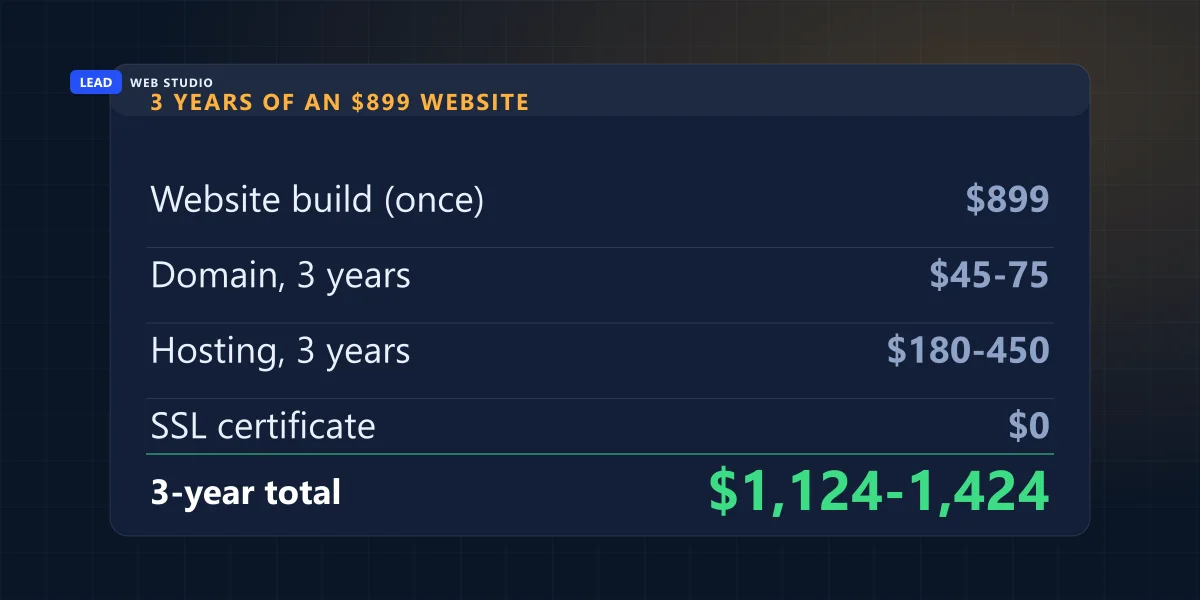
The build price is the number everybody compares. It is also the only number on the bill that doesn't repeat. Here is the same $899 website run three different ways:
| The same $899 website, run with… | Per year | 3-year total |
|---|---|---|
| Plain domain + hosting, SSL free | $75–175 | $1,124–$1,424 |
| A hosting cart with the add-ons left ticked | $400–500 | $2,099–$2,399 |
| A $100/month support plan (updates, backups, small edits), plus the domain | $1,200 + domain | $4,499 + domain |
Read the rows for what they are. The third one is the most expensive and it is not a trap: you are paying a person to do the updates, backups and small edits so you don't have to. Whether that is worth $100 a month depends on whether you would actually do those things yourself.
The second row is the only one where the extra money buys nothing. Hosting checkouts love to pre-tick "premium security", paid SSL and "SEO boosters", and that is how a $90 hosting plan becomes a $400 renewal. I took one of those carts apart line by line in web hosting hidden fees.
And for comparison with the do-it-yourself route: Wix's own published plans run $17 to $159 a month, and Squarespace's $16 to $99, before apps and transaction fees. The entry plan really is cheap for year one. The question is which plan you will be on by year three, which I worked through in Wix and Squarespace vs a custom site.
What's the difference between cheap and affordable website design?
A cheap website hits its price by leaving things out, and you find out which things after you have paid. An affordable website hits its price by limiting scope — fewer pages, fewer features — while keeping the parts that make a site work: speed on a phone, an obvious way to contact you, basic SEO, and you owning it.
Same budget, very different outcome. With an affordable site, you know exactly what you're not getting, because the quote lists it. With a cheap one, you discover the missing parts one at a time: the contact form that emails nobody, the domain registered in someone else's account, the "SEO" that turns out to be a separate monthly invoice.
Watch out for "free" website builders. They're free until you want a custom domain, remove their ads, unlock e-commerce, or actually rank on Google. Add those up and the "free" site quietly becomes a monthly subscription you can never cancel without losing everything.
What should an affordable website quote include?
Four lines, in writing: the domain registered in your name, the site's files handed over to you, a fixed price, and a list of the pages and features that price covers. A quote missing any of those can look cheaper on the day and still end up costing you more.
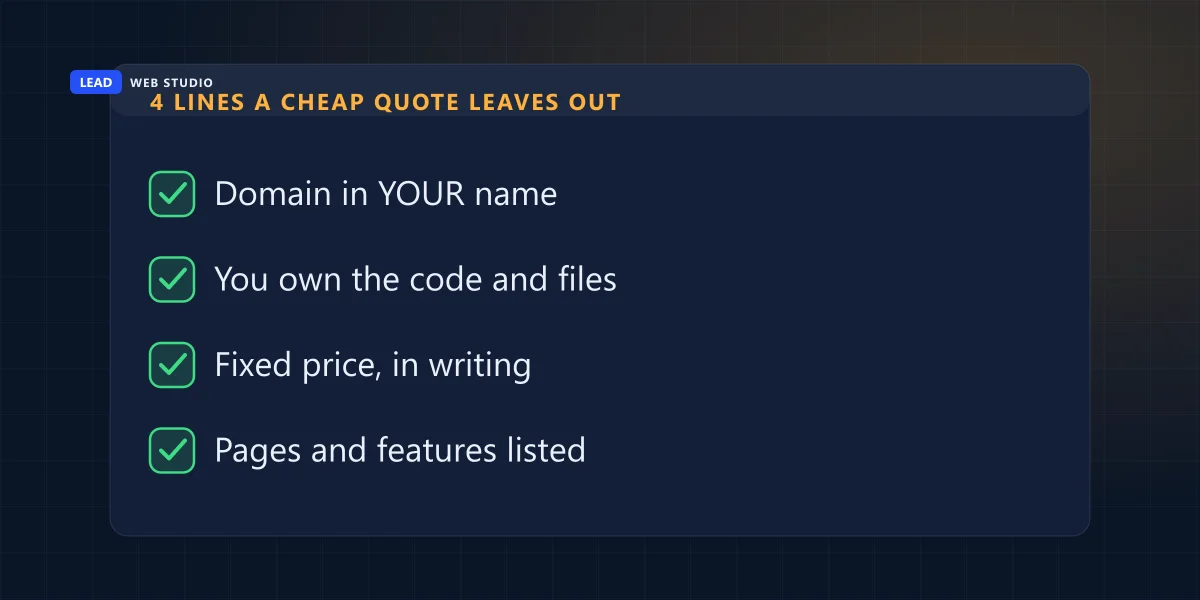
| Line in the quote | Why it matters | Ask this |
|---|---|---|
| Domain registered in your name | Whoever controls the domain controls your website address and your business email | "Which account is the domain registered in?" |
| Files and code handed to you | If the designer disappears, you can move the site to any other host | "Do I get a copy of every file on launch day?" |
| Fixed price, in writing | Hourly billing on a small site has no ceiling | "Is this the total, before tax?" |
| Pages and features listed | "A website" with no page count lets both sides remember different things | "Which pages, and is the contact form included?" |
The first line is the one that bites hardest. I have written a whole piece on who actually owns your website, because the phone call where an owner learns their domain sits in an ex-designer's account is not a hypothetical one for me. If you want the rest of the vetting process, there is how to vet a web designer and what a web design contract should say.
What actually drives the cost of a website?
Price isn't random. Four things move it, and knowing them lets you spend where it counts:
- Page count & content complexity — a 5-page brochure site costs less than a 30-page catalogue. On my list, 10 pages, 20 pages and unlimited pages are the $899, $1,499 and $2,999 tiers.
- Special functionality — booking systems, e-commerce, or member logins add real work. Selling or booking online is what moves a site into the top tier.
- Whether SEO is built in — page titles, descriptions and a sensible page structure cost almost nothing during the build and a lot more to retrofit.
- Ongoing support — updates, backups, and security, handled for you vs. left to you. Mine includes 30 to 90 days after launch, then it's an optional maintenance plan.
How to get real quality on a small budget
You don't save money by buying less quality — you save it by buying less stuff at full quality. Here's the playbook I give every startup client:
| Spend your budget on | Skip (for now) |
|---|---|
| Fast, mobile-first design | Fancy animations nobody asked for |
| Clear calls-to-action | A 12-page "About" section |
| Local SEO foundation | A custom blog you'll never update |
| Professional copy & photos | Stock video backgrounds |
| A working contact/booking flow | Features "in case I need them" |
Start lean, launch, and let the site earn its next upgrade. You can always add the online store once the phone is already ringing — see how I scale packages as businesses grow.
An $899 site on a padded hosting cart costs $975 more over three years than the same site on plain hosting.
Does a cheaper website hurt my Google ranking?
It can — not because of the price, but because of the corners cut to hit it. Slow load times, no mobile optimization, and thin content all drag you down in search. Google is explicit that page experience — speed, mobile-friendliness, stability — is part of how it ranks pages. An affordable-but-well-built site checks those boxes; a cheap one usually fails them, which is why SEO belongs in the build, not as an afterthought.
Quick tip: before you approve any quote, ask "is SEO included?" If the answer is "that's extra," you're not looking at an affordable website — you're looking at a cheap one with an upsell attached.
When is a cheap website the right call?
When you are testing an idea and don't know yet whether it will become a business. A website builder's entry plan at $16–23 a month gets you online this weekend with no build cost. Once customers start calling, move to a site you own before you have built a year of content on someone else's platform.
I would rather you spend $17 a month proving people want the thing than $2,999 on a site for a business that turns out to be a hobby. Starting cheap is fine. What costs money is staying on the starter plan for three years, adding an app every time you need a feature, and then discovering there is no export button to take your site with you.
Where cheap goes wrong is when it pretends to be the finished thing: a "professional website" quote with no page list, no mention of who owns the domain, and SEO sold separately. The missing pieces arrive later, as separate invoices.
Frequently asked questions
How much should a small business website cost?+
For a professional custom site, expect roughly $899 to $3,000 as a one-time project, depending on pages and features, and more for a large online store. Mine start at $899. Add about $100–200 a year for the domain and hosting. Monthly website rentals can look cheaper upfront but cost more over a few years.
What does an affordable website cost over three years?+
An $899 website with a domain at $15–25 a year and plain hosting at $60–150 a year costs $1,124 to $1,424 over three years. The same site on a hosting plan padded with add-ons at $400–500 a year costs $2,099 to $2,399.
Is an $899 website actually any good?+
Yes — because it's scoped to do the essentials well: custom design, mobile-first speed, SEO foundation, and a clear path to contact you. You add advanced features as your business grows, not before you need them.
Why not just use Wix or Squarespace myself?+
You can, and for testing an idea it is a sensible start. For a business that is already busy, the hidden costs are your time, a monthly plan that climbs as you add features, and the fact that a builder site cannot be exported: moving off it means rebuilding it.
Are there any hidden or monthly fees?+
No. You get a fixed, written quote before I start. Optional add-ons like hosting, maintenance, or SEO are clearly priced and entirely your choice.
Do I have to pay monthly for a website?+
No. The build is a one-time cost. You do need a domain and hosting, which together run about $100–200 a year. A monthly support plan, $100 a month with me, is optional: it pays someone to handle updates, backups and small edits.
Can I get an affordable website redesign?+
Usually, yes. A redesign is scoped like a new site, by page count and features, so the same budget ranges apply. It is worth it when the old site is slow on phones or makes it hard to contact you. Keep the page addresses and the content that already ranks, so Google does not have to start over.
Want quality that fits your budget?
Tell me your goals and I'll send a clear, fixed quote — no pressure, no jargon.
Get My Free Quote
Affordable, SEO-ready websites for small businesses. Read my full bio · Get in touch