There are six pages on this website that tell you to pick the right Google Business Profile categories. Not one of them tells you how. I went looking this morning for the page where I explain it, could not find it, and realised I had been handing out the same instruction everyone else hands out — the one that sounds like advice and contains no information. So I went and read the list instead.
Google publishes its category list through the Business Profile API, and you can page through the whole thing. On 6 September 2026 the Canadian list held 4,031 categories. The American one held 4,046, and the two are almost the same list — only two entries exist in Canada and not the US (Chinatown and Provincial park), and seventeen the other way. It is not really a Canadian list at all. The first entry alphabetically is "Aadhaar center", an Indian government identity office, and the fourth is "Aboriginal and Torres Strait Islander organisation", which is Australian. Every one of those 4,031 options is offered to a plumber in Etobicoke.
The short version
- There is a full list, and Google does not publish it as a page. It lives in the Business Profile API. On 25 September 2026 the Canadian list held 4,032 categories. The exact names for 23 common trades are in the table below.
- The primary category is the one that matters. Google's API calls it the category that "best describes the core business this location engages in". The additional ones are footnotes to it.
- A category says what you are, not what you do. Google's own words: "A category describing what this business is (not what it does)."
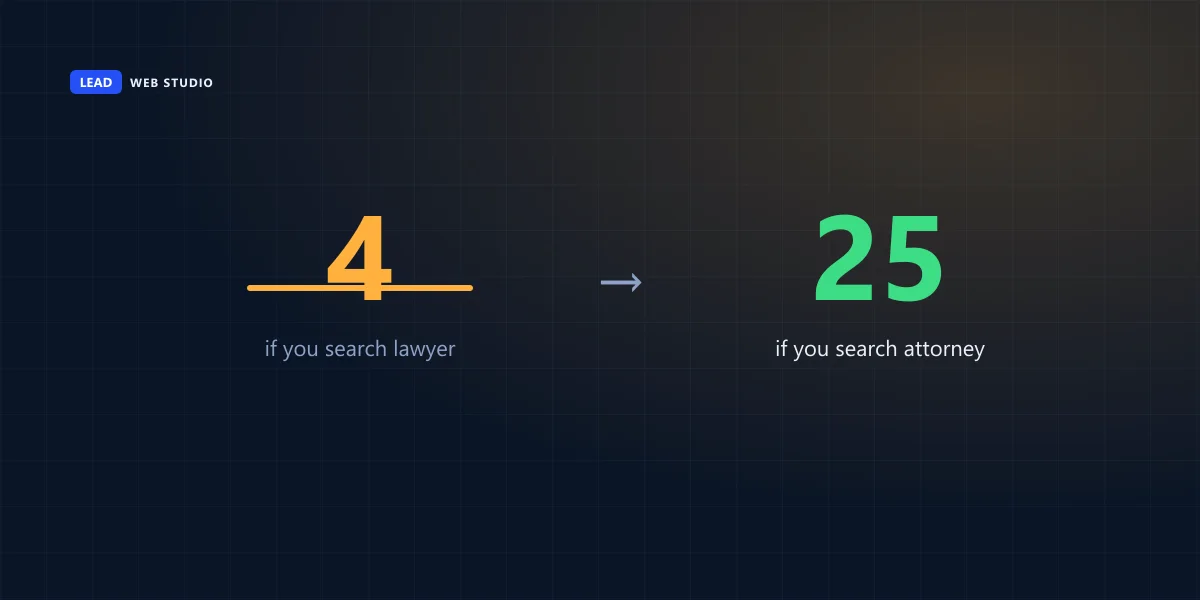
- The search box matches letters, not meaning. Search "lawyer" in the Canadian list and 4 categories come back. Search "attorney" and 25 do.
- Your primary category decides which fields you get. I counted 53 predefined services on Auto repair shop, 30 on Notary public, 3 on Website designer, 0 on Waterproofing service.
- Fewer is the instruction, not more. Google: "Choose the fewest number of categories it takes to describe your overall core business." Across 19 profiles I manage the average is 2.3 extra categories.
Is there a full list of Google Business Profile categories?
Yes, but Google does not publish it as a web page. The full list sits inside the Business Profile API and behind the category picker in your dashboard. I paged through the Canadian list on 25 September 2026 and it held 4,032 categories. The exact names for the trades I get asked about most are in the table below.
Most of the list is not for you. Five words finish 1,566 of the 4,032 names: restaurant (391), service (388), store (367), supplier (239) and shop (181). There are 391 kinds of restaurant, from Acaraje to Zhejiang, and exactly one category for a handyman, which Google spells Handyman/Handywoman/Handyperson, slashes included. For a service business the useful part is much smaller: 44 names end in "contractor", and many trades are a single noun such as Plumber, Electrician or Locksmith.
Here are the exact names, copied from the list as the API returned it. Where a trade has several, I have listed the ones a GTA service business is most likely to be, not every entry that happens to share a word.
| Trade | Exact category names in Google's list | Worth knowing |
|---|---|---|
| Plumbing | Plumber | Only 2 names contain "plumb"; the other is Plumbing supply store |
| Electrical | Electrician · Electrical installation service · Electrical repair shop | 21 names contain "electric", and most of them are stores and dealers |
| Roofing | Roofing contractor | Searching "roofing" also returns Waterproofing service |
| Heating & cooling | HVAC contractor · Heating contractor · Air conditioning contractor · Furnace repair service | 12 names match HVAC, heating, furnace or air conditioning |
| Basement waterproofing | Waterproofing service | No category contains the word "basement" |
| Renovation | General contractor · Remodeler · Kitchen remodeler · Bathroom remodeler | No category contains "renovation"; search "remodel" |
| Landscaping | Landscaper · Landscape designer · Lawn care service · Snow removal service | 12 names contain "landscap" or "lawn" |
| Cleaning | House cleaning service · Carpet cleaning service · Window cleaning service · Air duct cleaning service | 20 names contain "clean" |
| Painting | Painter | Searching "paint" also returns Paintball center and Paint store |
| Handyman | Handyman/Handywoman/Handyperson | One category, written exactly like that |
| Restoration | Water damage restoration service · Fire damage restoration service · Building restoration service | The other 5 "restoration" names are for antiques, art, cars, dolls and photos |
| Law | Law firm · Attorney · Family law attorney · Personal injury attorney · Real estate attorney · Immigration attorney | Search "attorney", not "lawyer" (see the next section) |
| Paralegal | Paralegal services provider | The only name containing "paralegal" |
| Notary | Notary public | Notaries association is a trade body, not a notary |
| Dental | Dentist · Dental clinic · Cosmetic dentist · Emergency dental service | "dent" also appears in 10 names that have nothing to do with teeth, from Student dormitory to Auto dent removal service |
| Accounting | Accountant · Chartered accountant · Accounting firm · Bookkeeping service · Tax preparation service | Tax preparation and Tax preparation service are two separate entries |
| Real estate | Real estate agent · Real Estate Agency · Real estate appraiser | 13 names contain "real estate", including Real estate attorney |
| Insurance & claims | Insurance agency · Insurance broker · Loss adjuster | No category contains "public adjuster" |
| Auto repair | Auto repair shop · Mechanic · Car repair and maintenance service · Auto bodywork mechanic | Searching "mechanic" also returns Mechanical engineer and Mechanical contractor |
| Pools | Swimming pool contractor · Swimming pool repair service · Pool cleaning service | Searching "pool" also returns Carpooling location |
| Moving | Mover · Moving and storage service | Piano moving service and Pet moving service are separate categories |
| Web & marketing | Website designer · Internet marketing service · Marketing agency | No category contains "SEO" or "web design" |
| Restaurants | Restaurant, plus 390 more that end in "restaurant" | Pick the cuisine if one fits; it is the more specific category |
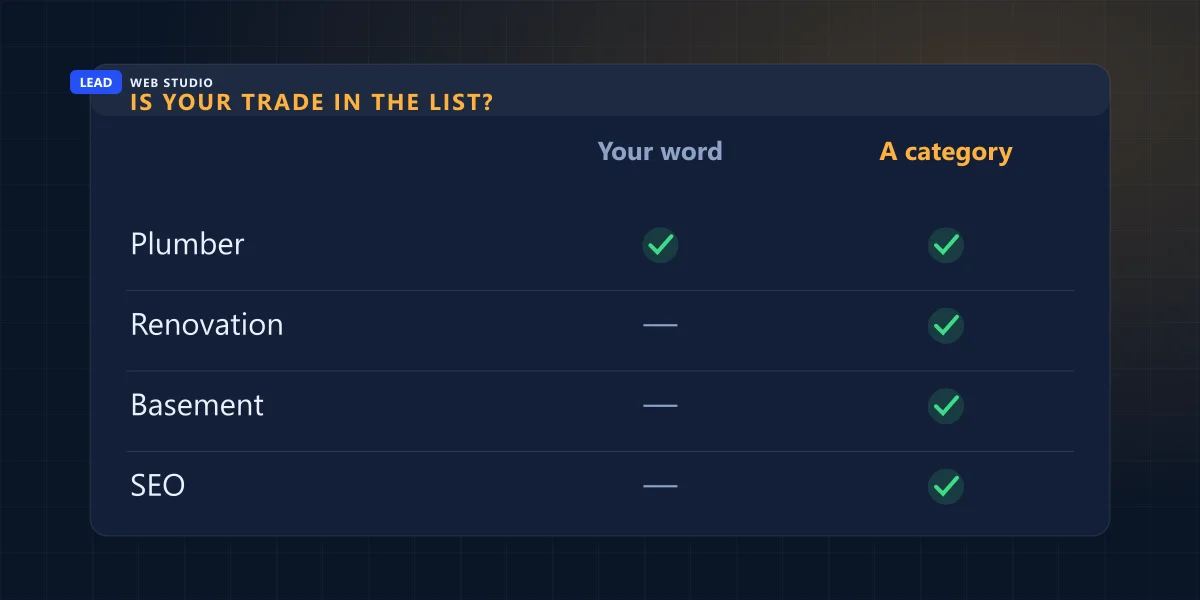
The four rows in bold are trades whose own word is not in the list at all. A basement waterproofing company searching "basement" gets zero results, and it would be easy to conclude there is no category for it. There is: Waterproofing service. An SEO agency typing "SEO" into Google's own category search gets two results, Spa and Zoo. I ran it twice because I did not believe it either. No category name contains "SEO" or "web design"; the closest are Internet marketing service, Marketing agency and Website designer. When your word is missing, pick the closest thing the business is, then write the specific service into the services field and the description, where your own words are allowed.
If you want every one of the 4,032 names, the only first-party copy is the categories.list method of the Business Information API. It needs a Google Cloud project with Business Profile API access, which is not a weekend job for a bakery. Copies on other websites are someone's snapshot, and the list moves: it held 4,031 when I first read it on 6 September and 4,032 when I read it again nineteen days later. For picking a category, search the picker in your own dashboard, and search it the way the next section describes.
What is a Google Business Profile category, and why does the primary one matter most?
It is the field that tells Google what kind of business you are. You get one primary category and up to a handful of additional ones. Google's developer reference is unusually blunt about the primary: it is "Required" and it is the "Category that best describes the core business this location engages in". The rest of your profile is read inside that frame.
The single most useful line I found is in the same reference, in the definition of a category itself: "A category describing what this business is (not what it does)." Nine words that explain most of the mistakes I see. "Emergency drain repair" is something you do. "Plumber" is something you are. People go hunting for a category that matches their best-selling service, cannot find one, pick something adjacent, and end up describing a business that does not exist.
The reason it carries weight is relevance. On the help page where Google explains local ranking, it lists three factors — relevance, distance and prominence — and defines the first as "how well a Business Profile matches what someone is searching for". Distance you cannot change. Prominence takes years. Relevance is the one that is sitting in a dropdown menu waiting for you, and the same page is equally blunt that "There's no way to request or pay for a better local ranking on Google", which means the free field is the lever.
Why can't I find my category in Google's list?
Because the search box matches the letters you typed against the letters in the category name. It does not know what you meant. If Google's list uses a different word for your trade than you do, your category exists and is invisible to you, and nothing on screen suggests you should try a synonym.
Here is the sharpest case I found. I searched the Canadian list for lawyer: four results, and they are Divorce lawyer, Medical lawyer, Tax attorney and Lawyers association — three narrow specialisms and a trade body. Then I searched attorney: twenty-five results, including Family law attorney, Employment attorney, Estate planning attorney, Bankruptcy attorney and Criminal justice attorney. Each of those five is a category an Ontario law firm might legitimately be, and not one of the five contains the letters "lawyer" — so not one of them appears if that is the word you type. Exactly one category shows up in both searches: Tax attorney.
It runs in the other direction too. Searching roofing returns three categories, and the third one is Waterproofing service — because the letters r-o-o-f-i-n-g appear inside the word "waterproofing". The match is a plain substring, anywhere in the name.
| What you type | Categories returned | What that tells you |
|---|---|---|
lawyer | 4 | Overlaps the "attorney" list by one entry |
attorney | 25 | The word Google's list actually uses |
roofing | 3 | One of them is "Waterproofing service" |
designer | 11 | None of the 11 starts with the word |
That last row is worth a footnote, because Google's own documentation says it should not happen. The API reference for the category endpoint states that "Search only matches the front of a category name (that is, 'food' may return 'Food Court' but not 'Fast Food Restaurant')". I ran exactly that example. Searching food in the Canadian list returned 34 categories, 21 of which do not start with the word — and one of the 21 is "Fast food restaurant", the specific result the documentation promises you will not get. The doc was last updated in October 2024. The behaviour has moved on and the sentence has not.
I mention it because it is the difference between an assumption and a measurement. If you had trusted that line, you would have typed only the first word of your trade and concluded the category did not exist. In practice you should type the middle of the word: proofing finds the waterproofing category, plumb finds the plumbing ones, and short fragments beat whole phrases every time.
How many categories should I actually use?
Fewer than you want to. Google says it twice in two different places, and both times the instruction is to subtract. The public guidelines say to "Choose the fewest number of categories it takes to describe your overall core business", and the API reference repeats it: use "as few categories as possible", and pick ones that are "as specific as possible, but representative of your main business".
This is the opposite of the advice that circulates. The usual version is to fill every additional slot on the theory that each one is another door into your profile. I do not have a Google statement that says extra categories hurt you, and I am not going to invent one. What I do have is what Google asks for, and what the profiles I look after actually run on.
I read the category field on all nineteen Business Profiles I am authorised to manage, on 6 September 2026, through the API rather than by clicking through nineteen dashboards. Here is the shape of it.
| Across 19 profiles I manage | Result |
|---|---|
| Profiles with no primary category | 0 |
| Additional categories used in total | 44 |
| Average additional categories per profile | 2.3 |
| Most on any one profile | 5 |
| Profiles using only a primary and nothing else | 5 |
Five of the nineteen run on a primary category alone. The busiest, a law firm, uses four extras — Notary public, Immigration attorney, Criminal justice attorney and Paralegal services provider — and every one of those is a service the firm genuinely provides to walk-in clients, which is the test. Not "could we plausibly do this", but "would a customer who searched for this and turned up be in the right place".
If you are still deciding whether the profile is worth the effort at all, that is a separate question and it has its own answer — whether you actually need a Google Business Profile covers the eligibility rules first, because there is no point optimising a listing you are not entitled to.
What does the primary category actually unlock?
Fields. Google attaches a list of predefined services to each category, described in the API as "a list of all the service types that are available for this business category". Those are the tick-box services that appear on your profile. The number attached varies enormously, and you inherit whatever your primary category happens to carry.
I counted them across the categories my clients and I actually use. This is the part that surprised me most.
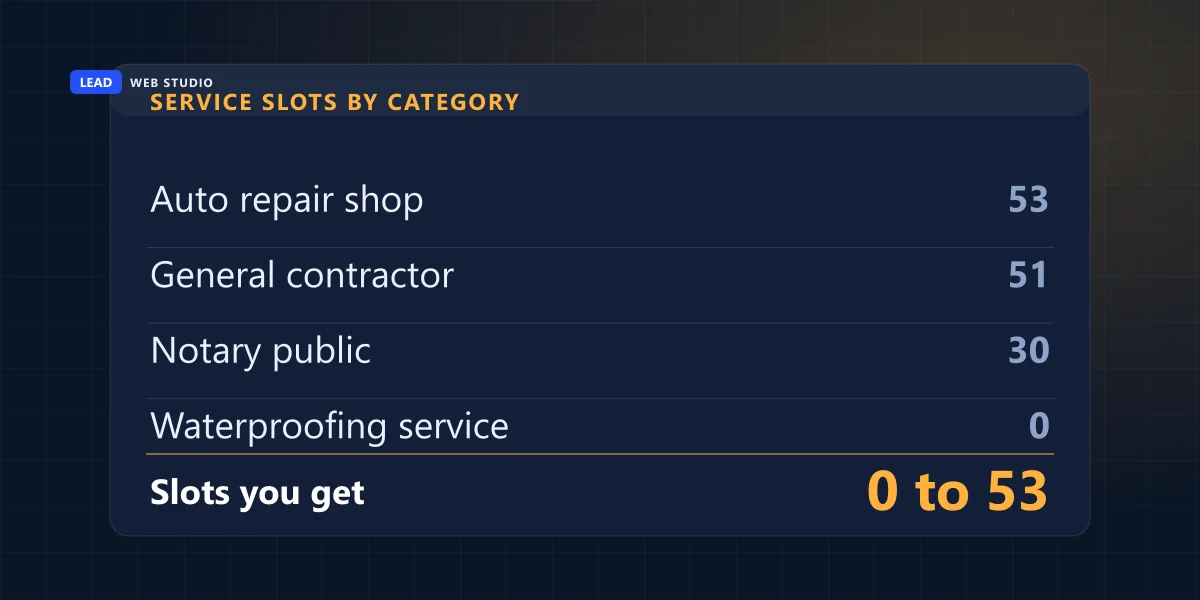
| Category | Predefined services Google attaches |
|---|---|
| Auto repair shop | 53 |
| General contractor | 51 |
| Landscaper | 34 |
| Notary public | 30 |
| Electrician | 26 |
| Plumber | 22 |
| Roofing contractor | 13 |
| Website designer | 3 |
| Dentist | 1 |
| Waterproofing service | 0 |
Eight of the nineteen profiles I manage sit on Waterproofing service, which has none. Their owners are not doing anything wrong and there is no better category available — waterproofing is what those businesses are. But it does mean that on those eight profiles the services section has to be typed out by hand rather than ticked, and that is worth knowing before you sit down to fill one in and wonder why the list is empty.
One honest limit on this number. When I read the category list at full detail, Google returns the correct count of service slots but hands back the labels blank. So I can tell you Auto repair shop carries 53 and Dentist carries 1. I cannot tell you from this endpoint what all 53 are called, and I am not going to guess at them.
Dentist carrying exactly one is not a mistake in my reading, incidentally — I checked it twice. Some very large, very obvious categories have almost nothing attached, and some narrow ones are richly furnished. There is no rule you can derive from the size of the industry.
What happens if the primary category is wrong?
You compete for the wrong searches. Relevance is Google matching your profile against a query, so a category that describes a neighbouring trade puts you in a neighbouring race. You also lose the service fields attached to the category you should have had, and the profile ends up thinner than a competitor's without anyone being able to say why.
The failure I see most often is a business picking the category that sounds biggest. A renovation company that mostly does kitchens choosing General contractor because it feels more established. A window cleaner choosing Cleaning service. It is understandable and it is backwards: Google asks for the most specific category that is still representative, and the specific one is the one that matches the search a customer actually types. That is the same reasoning behind how "near me" searches get matched, where the phrasing of the query does most of the work.
Getting it wrong is not fatal and it is not permanent. The category is an editable field like your hours. Change it deliberately, once, rather than cycling through options — and expect your services section to change underneath you when you do, because that list belongs to the category rather than to you.
How to pick yours in ten minutes
Four steps, in this order. The order matters because step one stops you searching for the wrong thing.
- Write down what you are, in one noun. Not the service you sell most of, and not the phrase on your van. Plumber. Notary public. Art gallery. If the noun needs an "and" in it, you probably have a primary category and an additional one rather than one category.
- Search the picker on fragments, not phrases. Type
plumb, not "emergency plumbing repair". Then try the synonym you would never use yourself —attorneyif you say lawyer,storeif you say shop,serviceif you say company. The list matches letters, so a short fragment reaches more of it. - Check what the category unlocks before you commit. Save it, then open the Services section. If a predefined list appears, that category carries service types and you should fill every one that applies. If the section is empty, you are typing them in yourself.
- Add extra categories only for things a walk-in customer could ask for. If someone found you under that category and arrived expecting it, would you serve them today? No is a no. That test removed more candidate categories from my clients' profiles than any rule about counts.
What I would not bother doing
- Do not fill every additional slot for the sake of it. Google's instruction is to use as few as describe the business, and the profiles I look after average 2.3. Nothing in my set needed nine.
- Do not pick a category to describe a service. "What this business is (not what it does)" is Google's line and it settles most arguments. Services go in the services field, which is a different field with its own list.
- Do not pick a bigger category to look bigger. The specific category is the one that matches the specific search, and specific searches are the ones with a customer attached to them.
- Do not conclude a category does not exist because the box came back empty. Try the middle of the word, try the American spelling, and try the word your industry stopped using twenty years ago. Google's list had 4,032 entries on 25 September and it is older than your vocabulary.
What this looks like when somebody is watching it
The category field is set once and then forgotten, which is exactly why it drifts. Google occasionally retires or renames categories, businesses change what they mostly sell, and a profile set up in 2019 by whoever had the phone at the time is often still describing that version of the company. Nobody is notified when the fit stops being right, because nothing has broken.
If you want to see where yours stands without me, the free Google Business Profile audit reads what is public on your listing and tells you what is missing, in about two minutes. If the map side is meant to be somebody's job — the categories, the services, the posts, the review replies — that is Google Maps management, and the rates are on the pricing page before you have to speak to anyone. If the profile does not exist yet at all, start with Google Maps setup and get the category right the first time, which costs nothing extra and saves the re-do.
Not sure your category is the right one?
Send me your business name and city and I will look at what your profile is currently telling Google you are, and what the alternatives in the list actually offer. Free, and if the answer is "your category is correct, leave it alone", that is what you will get.
Get My Free QuoteFrequently asked questions
Is there a full list of Google Business Profile categories?+
Yes, but Google does not publish it as a web page. It lives in the Business Profile API and behind the category picker in your dashboard. On 25 September 2026 the Canadian list held 4,032 categories, up from 4,031 on 6 September, so any copy you download elsewhere is a snapshot of a list that keeps changing.
What if my trade is not in the Google category list?+
Pick the closest category that describes what the business is, then name your specific service in the services field and the description. There is no category containing basement, renovation or SEO, but there are Waterproofing service, Remodeler and Internet marketing service. Search a fragment of the word before you conclude it is missing.
What is the primary category on a Google Business Profile?+
It is the single category Google treats as what your business is. Google's own API reference calls it the category that best describes the core business this location engages in. Everything else on the profile is a detail; this one field sets the frame Google reads the rest of the profile inside.
How many Google Business Profile categories should I use?+
As few as genuinely describe the business. Google's guidelines say to choose the fewest number of categories it takes to describe your overall core business. Across the 19 profiles I manage the average is 2.3 additional categories and the highest is 5, and none of them is short of anything because of it.
Why can't I find my category in Google's list?+
Because the search box matches letters in the category name, not the meaning of what you typed. Search lawyer in the Canadian list and 4 categories come back. Search attorney and 25 come back. If the word Google used is not the word you use, your category is invisible to you.
Does the primary category change what I can put on my profile?+
Yes. Google attaches a list of predefined services to each category, described in its API as all the service types that are available for this business category. I counted 53 on Auto repair shop, 30 on Notary public, 3 on Website designer and 0 on Waterproofing service. Same profile, same effort, different number of fields to fill.
Can I change my Google Business Profile category later?+
Yes, the category is an editable field like your hours or your phone number. Change it deliberately rather than repeatedly, and expect the services section to change with it, because the predefined service list is attached to the category rather than to your business.
Will adding more categories help me rank for more searches?+
Not reliably, and Google asks you to do the opposite. Its guidance is to use as few categories as possible and to choose ones that are specific but representative of your main business. Adding categories you do not really serve dilutes what the profile says you are.
Sources, all read in full on 6 September 2026: Google — Business Information API, categories.list reference · Google — Business Information API, Location and Category reference · Google — Guidelines for representing your business on Google · Google — Improve your local ranking on Google. The 4,031-category count, the search results and the nineteen-profile figures are my own measurements, taken read-only through the Google Business Profile API on 6 September 2026 across the profiles I am authorised to manage. The full-list section, the 4,032 count and the trade table come from a second read-only pass over the whole Canadian list on 25 September 2026.

10+ years building websites for GTA trades, clinics and service businesses, and looking after the Google Business Profiles that sit beside them — which is how I ended up paging through four thousand category names on a Sunday to answer a question I had been ducking. Read my full bio · Get in touch