Adding a second language to your website is worth it when a real share of the people who call you already speak that language, and it's required by law only if your business has an address in Quebec or works in a federally regulated sector. Everyone else is making a business decision, and the cheapest version done properly beats the expensive version done with a translate button.
I get this question a lot, partly because I work in Ukrainian and Russian myself and owners assume I'll say yes to everything. I won't. A second language is a second set of pages somebody has to keep true, and a second stream of enquiries somebody has to answer. Below is how I decide, which pages I translate first, and the three lines of code that tell Google the two versions belong together.
Do I legally need French on my website?
In Ontario, no: the province's French Language Services Act covers the government and the agencies it names, not a private plumber or bakery. In Quebec, yes, if your business has an address there and sells to Quebecers. Banks, airlines and other federally regulated businesses have their own federal rules, which are a question for your lawyer.
A private business in Ontario
No language rule for your website. The French Language Services Act lists ministries, provincial boards and designated agencies.
Decide on customers, not on law.
A business with an address in Quebec
A French version is required if you offer products or services to Quebecers. Other languages are allowed next to it. After a warning, the OQLF can fine $3,000 to $30,000 for each day the offence continues.
French first, and the whole buying path in French.
A federally regulated business
Banking, telecoms, air transport and similar sectors carry federal official-language duties that depend on the sector and the region.
Ask your lawyer before you build anything.
The Quebec rule is about more than a homepage. According to Éducaloi's summary of the Charter, a business selling online to Quebec customers needs everything a buyer uses in French: the product or service details, the order form, the invoice and the receipt. A French homepage with an English checkout doesn't count. I'm a web designer, not a lawyer, so if you're near the line (say a Toronto company with a small Gatineau office), get a real legal answer before you pay anyone to translate.
Which second language is worth adding?
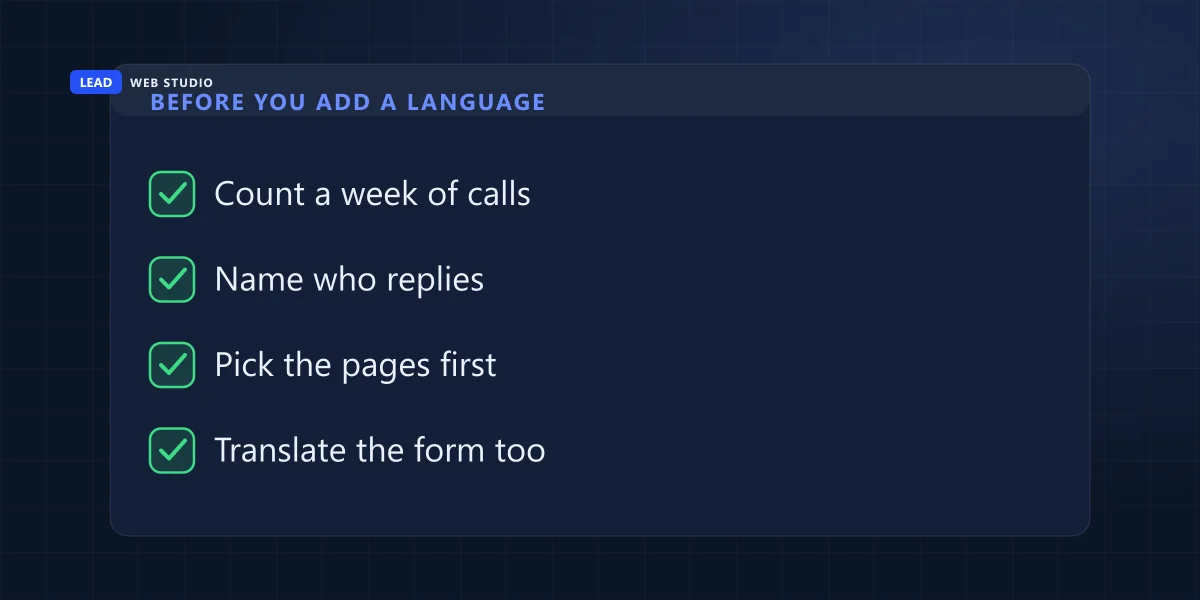
The one your existing customers already use with you. Census numbers tell you a language is common in your city; your own calls, forms and reviews tell you whether those people are buying from you. Count a normal week before you decide, and only add a language that shows up in your own numbers.
The census figure is big enough to make the question fair. Statistics Canada reports that in the Toronto area 26.3% of people speak predominantly a language other than English or French at home. That's one person in four. It isn't one language, though, and it isn't your customers. A Polish-speaking renovator in Mississauga and a Tamil-speaking accountant in Scarborough are looking at very different groups inside that number.
So keep a tally for one ordinary week. Paper next to the phone is fine.
The last row is the one owners forget, and it's often the loudest signal. A customer who starts in English and relaxes into Ukrainian the moment they hear your accent was never going to read your English service page carefully. If one language turns up in a good share of a week, it's a candidate. If it turns up twice a month, a line on your contact page ("we also speak Punjabi") gets most of the benefit for nothing.
And before any of this, answer one question honestly: who will reply to the email that arrives in that language at 7 pm? If the answer is "nobody, really", stop here. A translated site that leads to an English-only phone line annoys people more than an English site does.
Which pages should I translate first?
The pages a customer needs to decide and to reach you: the homepage, the main service pages, the contact page with its form, and the about page if trust matters in your trade. Long blog archives, old news and legal fine print can wait or stay in English, as long as the link to them says it's in English.
| Page | Verdict | Why |
|---|---|---|
| Homepage | Translate | It's where the language switch lands, and where people decide whether to stay. |
| Main service pages | Translate | This is the part people actually read before they call. |
| Contact page and form | Translate | Labels, error messages and the thank-you text, all of it. A form that errors in English loses the lead. |
| About and team | Translate if trust sells | For trades, clinics and anyone who comes into your home, the people matter. |
| Long applications, portals, booking tools | Link in English | Often run by another company. Say "this form is in English" on the link. |
| Photo gallery | Link in English | Photos don't need translating. Captions can come later. |
| Blog archive | Leave out | Translate a post only when it answers a question that language group asks. |
| Privacy policy and terms | Ask first | A legal text translated by guesswork is a risk of its own. Ask whoever wrote them, and in Quebec ask a lawyer. |
What this looked like on a real build, this week
A roofing and siding company near Chicago, owned by Ukrainians, wanted to speak to the Ukrainian community there. The English site has dozens of pages. The Ukrainian edition got nine: home, residential roofing, insurance claims, siding, gutters, windows, financing, about and contact. Each one was written for Ukrainian readers with its own layout, not run through a translator.
Two things stayed English on purpose. The financing application belongs to the lender, and the photo gallery speaks for itself, so the Ukrainian pages link to both and say they're in English. The Ukrainian form sends to the same office inbox as the English one, with the language of the site written at the top of every enquiry, so whoever opens it knows to call back in Ukrainian.
Nine pages sounds small next to the English site. It's the right size: every one of them is a page somebody reads before calling. If you're working out how many pages your main site needs in the first place, how many pages a small business website needs walks through the same logic for one language.
How does Google know the two versions belong together?
Each language version needs its own web address, and every version lists all the versions in its code with hreflang tags, including itself. The links have to go both ways. If the English page names the Ukrainian one and the Ukrainian page doesn't name the English one, Google ignores the pair.
On the English homepage of a site with a Ukrainian edition, the head of the page carries these three lines. The Ukrainian homepage carries the same three, word for word.
<link rel="alternate" hreflang="en" href="https://example.ca/">The English page names itself. Google asks for this, and it's the line people drop most often.
<link rel="alternate" hreflang="uk" href="https://example.ca/ua/">The Ukrainian version. The code is "uk", the ISO code for the language, which trips people up because it looks like Britain. "ua" is fine in the address and wrong in the tag.
<link rel="alternate" hreflang="x-default" href="https://example.ca/">Where to send someone whose language matches neither. For a GTA business that's the English page.
The rest of the rules, straight from Google's page on localized versions and its multilingual site guide, in the order I check them:
- One address per language, such as /ua/ or /fr/ inside your own domain. Google recommends separate addresses over showing a different language from a cookie or the browser setting.
- Language codes from ISO 639-1, with an optional region from ISO 3166-1 (fr-CA). Made-up codes are ignored.
- No automatic redirect based on the visitor's browser language. Let people choose, and let them switch back.
- Translate the content, not only the menu. Google warns that translating only the navigation while the text stays in one language makes a poor experience.
- Write the page in the language it claims. Google works out a page's language from the visible text, not from the lang attribute or the address.
Point five catches more sites than you'd think. A page tagged Ukrainian whose headings are Ukrainian but whose service descriptions are still English reads to Google as an English page with a strange menu.
Can I just add a Google Translate button?
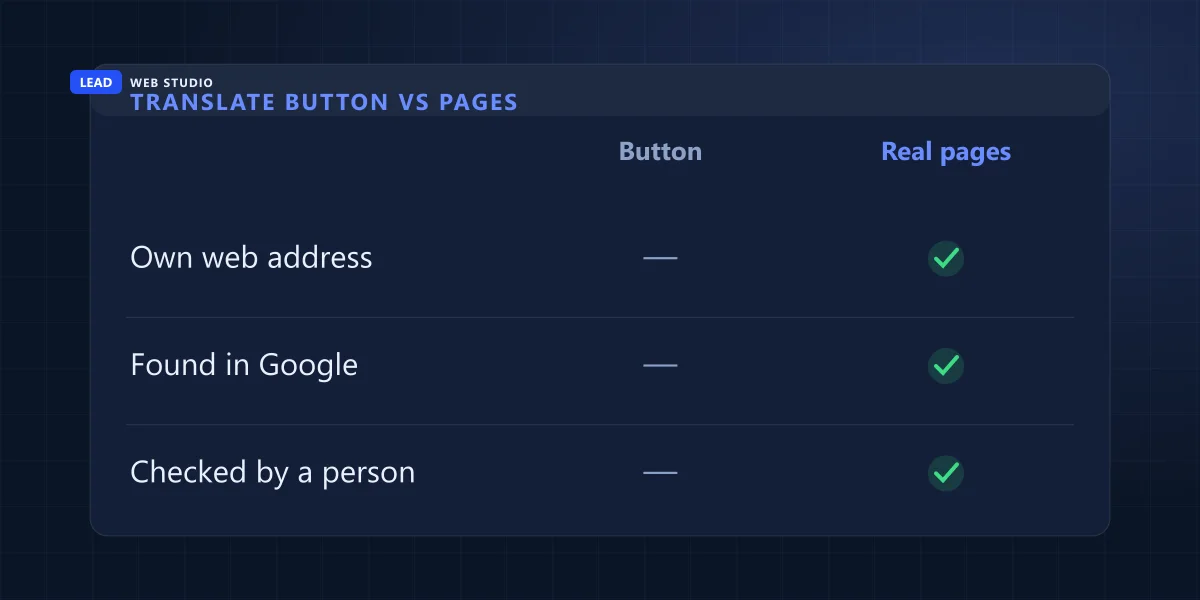
You can, and it helps a visitor who's already on your page. It does nothing for search. The translated text exists only in that visitor's browser, at no address of its own, so Google never sees it and nobody searching in that language finds you. It also translates your prices, warranty terms and service names with no one checking.
The opposite shortcut is worse. Running the whole site through a translation tool and publishing hundreds of pages nobody read is listed in Google's spam policies under scaled content abuse, which names "automated transformations like synonymizing, translating" as an example. Machine translation as a first draft, corrected by someone who speaks the language, is a different thing and perfectly fine. The difference is whether a fluent person read every page before it went live.
The part after the click: the enquiry in another language
This is where most bilingual sites I'm asked to look at fall over, and it isn't technical. The Ukrainian page is lovely, the form underneath it says "Name, Email, Message", the error says "Please fill in this field" in English, and the automatic reply arrives in English with an English signature. Fix three things: the form's own words in the page language, a note at the top of each enquiry saying which language it came from, and a reply, automatic or human, in that language. The rest of what makes a form reliable is in how to capture leads on your website.
If the language you're adding is Ukrainian or Russian, I'll do the writing as well as the build, since I speak both. The Ukrainian-speaking web designer page has the details. For any other language, budget for a fluent writer who knows your trade, and plan for them to check the pages again whenever the English ones change.
What owners ask me about a bilingual website
Should the second language go on a separate domain?+
For a small business, almost never. A folder on your own domain, such as /fr/ or /ua/, is one site to host, renew and look after, and Google treats folders, subdomains and separate domains as valid for different languages. A second domain is a second renewal and a second thing to forget.
Will a second language improve my Google rankings in English?+
No. The new pages can show up for searches typed in that language, which your English pages never appeared for. Your English pages rank exactly as they did before. Anyone who promises the English side will rise because you added French is guessing.
Do I have to translate every page?+
No, outside Quebec. Translate the pages a customer needs to decide and to contact you, and link the rest in English with a note saying so. In Quebec, everything a customer needs to buy has to exist in French.
What is hreflang in plain words?+
A short line of code in the head of each page that tells Google "this page also exists in these languages, at these addresses". Every version lists every version, itself included, and the links must go both ways, or Google ignores them.
Should my Google Business Profile be in two languages too?+
Your profile has one business name and one description, so you can't keep two full versions. What you can do is say in the description which languages you serve customers in, reply to each review in the language it was written in, and write posts in either language.
Sources, read on 16 October 2026: Google Search Central, localized versions of your pages and managing multi-regional and multilingual sites; Google spam policies; Éducaloi, language laws and doing business in Quebec; Ontario French Language Services Act; Statistics Canada, 2021 Census map of non-official languages. The roofing case is a site I built, finished in October 2026.
Thinking about a second language?
Send me your website and the language you have in mind. I'll tell you which pages I'd start with and whether your site can carry a second version as it is. How I build sites is on the web design page, and the plans are on the pricing page.
Get My Free Quote
Web designer in Toronto. I build and look after websites for GTA service businesses, and I work with owners in English, Ukrainian and Russian. Read my full bio · Get in touch