Website Design for Car Dealerships in Oshawa
This is the fifty-third industry I have written a page for on this site, and the first where the regulator sets the type hierarchy. Three Ontario instruments decide which number on a vehicle listing has to be the largest, which number has to match it in size, and what happens to the page the day the car sells. That is a layout brief, so I start with the price block rather than with the homepage.
A worked specimen. The sizes below are the ones the rules push you to, and the numbers in them are illustrative figures for a made-up car rather than a real listing.
OMVIC's position is that an as-is listing carries the full statutory paragraph: the vehicle is not represented as being in road worthy condition, mechanically sound or maintained at any guaranteed level of quality, may not be fit for use as a means of transportation, may require substantial repairs at the purchaser's expense, and may not be possible to register in its current condition.
Five lines, five sources. Two of them are written as typographic instructions, which is unusual enough that it is worth reading them literally.
- 1The price has to be the total, and it has to be prominentThe amount a buyer would be required to pay plus all other charges related to the trade, including freight, inspection before delivery, fees, levies and taxes, set out in a clear, comprehensible and prominent manner.O. Reg. 333/08, s. 36 (7)
- 2Tax and licensing may sit outside it only if you say soThe exclusion is allowed where the advertisement indicates, in a clear, comprehensible and prominent manner, that those amounts are not included. So the line sits at body size, in the same block as the price.O. Reg. 333/08, s. 36 (10)
- 3The rate has to be as prominent as the paymentWhere an advertisement discloses an interest rate or a payment amount, the annual percentage rate shall be disclosed as prominently as the most prominently disclosed of those two. This is a font-size rule in a regulation.O. Reg. 17/05, s. 61 (2) and (4)
- 4A finance offer has to carry the cash price and the termThe same section requires the length of the term and, for a supplier credit agreement on an identified vehicle, the cash price. OMVIC adds that where a cash price and a finance price differ, one way to demonstrate compliance is to have the prices in the same size font and located close to each other.O. Reg. 17/05, s. 61 (2); OMVIC, 26 January 2026
- 5Certification is either in the price or priced in the adSafety belongs in the all-in price unless the listing carries a mandated unfit or as-is statement. For an unfit vehicle the wording OMVIC asks for is that the vehicle is not drivable and not certified, and that certification is available for a stated amount.OMVIC advertising guideline, revised 3 November 2023
Sources read on 10 September 2026: O. Reg. 333/08 under the Motor Vehicle Dealers Act, 2002 · O. Reg. 17/05 under the Consumer Protection Act, 2002 · OMVIC advertising guideline · OMVIC on all-in price advertising.
Short answer
A dealership website in Ontario is advertising, and three instruments decide how its numbers are set: the advertised price must be the all-in total, the annual percentage rate must be as prominent as the payment beside it, and a sold vehicle has to come off the advertising. I build the price block, the disclosure lines and the listing lifecycle as components rendered from one source, so the rule is satisfied by the template rather than by whoever typed the last listing.
I have not built a car dealership website. The closest work I have is an e-commerce build for a Toronto electric bike brand, where the job was a catalogue of high-ticket items people compare before buying. The catalogue architecture transfers; the OMVIC layer and the inventory feed do not, and I say which is which in the section on the anchor project below.
Is a dealership website an advertisement under Ontario law?
Yes, and the regulator says so in its own words. OMVIC's advertising guideline defines an advertisement as any inducement by a dealer for a consumer to buy or lease a vehicle, and the list of places one might appear begins with newspapers and flyers and then names "Online, on websites or in social media". Section 36 of O. Reg. 333/08 applies to it without any reduction.
The reason this matters more online than it does on a lot sign is in subsection 36 (3). There is an exemption from the registered-name-and-contact requirement, and it is written for media with a practical limit on how much information they can carry: a classified advertisement in a newspaper or magazine, a radio or television broadcast, a billboard, a bus board, "or any other medium that has similar practical limitations". A web page has no such limit, and OMVIC removes the doubt directly: the requirement covers the registered name, address and phone number of the location approved by the Registrar, and it "applies equally to dealers with physical locations and those who operate primarily or entirely online."
Two more facts set the stakes. OMVIC's own guideline opens by saying that advertising-related questions and concerns are among the most common type of inquiries it receives. And its March 2026 note on what to expect during an inspection says all registered dealers are inspected regularly, and that a dealer may be asked to help the inspector reach past advertisements from online accounts. Advertisements already removed from the site can still be asked for.
Figures from OMVIC's 2025 annual report release (published 4 May 2026) and OMVIC's own description of what it regulates; the penalties are section 32 (3) of the Act. I have quoted the report only where it states a number, and I have not repeated the claim, common in secondary coverage, that all-in price advertising was the single most frequent violation — the release does not say that, so this page does not either.
What the advertisement has to say, and what only the contract has to say
The two lists are different lengths, and they overlap far less than they look. Section 42 of the regulation lists twenty-five facts about a vehicle that have to be disclosed in the contract of sale. Section 36 lists what an advertisement has to carry. Exactly one item appears in both, and the advertisement has two requirements of its own that are nowhere in the twenty-five.
Maximum odometer distance at delivery, for a new vehicle on an identified car
The same for a new vehicle where the contract identifies no specific car, or an initialled statement that nothing is specified
Total distance driven, for a used vehicle, where the dealer can determine it
Distance as of a past date, with a statement that the total is believed to be higher
A statement that the total distance is unknown and may be substantially higher than the odometer reading
An odometer that is broken, faulty, replaced, rolled back, or reading in miles
Previous use: a daily rental, a police cruiser or emergency services vehicle, or a taxi or limousineAlso required in the ad — s. 36 (5)
Damage caused by fire
Damage caused by immersion in liquid reaching at least the interior floorboards
Structural damage, or repairs, replacements or alterations to the structure
An anti-lock braking system that is not operational
Airbags missing or not operational
Repair required in the engine, transmission or power train, subframe or suspension, computer equipment, electrical system, fuel operating system, or air conditioning
A vehicle materially different from the original or advertised production specifications
Two or more adjacent non-bumper panels that have been replaced
The trim level
The make, model and model year
A badge or other indication that relates to a different model than the vehicle actually is
Repair costs from an incident exceeding $3,000, and the total where the dealer knew it
A cancelled manufacturer's warranty
A vehicle declared a total loss by an insurer, whether or not it was classified irreparable or salvage
Equivalent registration or trading outside Ontario, and which jurisdictions, subject to the seven-year exception
How the vehicle was last classified under section 199.1 of the Highway Traffic Act: irreparable, salvage or rebuilt
A vehicle recovered after being reported stolen
Any other fact that, if disclosed, could reasonably be expected to influence a reasonable buyer's decision on those terms
Section 36 (2) requires a registered name and contact information of the dealer in every advertisement that attempts to induce a trade. Section 36 (6) requires an advertisement that discloses a current or immediately previous model year to state that the vehicle is used, where it is. Neither appears in the list above, because the contract already names the dealer and the buyer already knows what they are signing for.
Summarised from section 42 of O. Reg. 333/08; the statutory wording governs, and the rows above are shortened for reading. Disclosure in the contract has its own timing and format rules — OMVIC's disclosures guideline states that disclosures must be clearly, comprehensibly and prominently written on the contract and presented in a timely manner so the consumer can review them before signing, and that providing disclosure verbally does not meet the requirements of the Act.
What I do with that on a vehicle page
The page is the advertisement, so item 07 and the used-model-year line are not optional and they cannot live in a collapsed panel. I put them in the listing template as fields with their own slot, above the specification table, because a field that exists in the template gets filled and a sentence that somebody has to remember to type does not.
The other twenty-four are a choice, and I think the choice is worth making deliberately. OMVIC's online sales guideline notes that the Act does not require a cooling-off period in Ontario. Whatever is not on the listing is disclosed later, in the contract, which is the first time the buyer reads it. Publishing the damage history on the page costs one template field and moves that reading forward.
So the listing template I would build has three bands: the price stack at the top, the required disclosures immediately under it, and the voluntary condition report below that, each one a structured field rather than free text. The specification table goes last, because it is the part a buyer can check on any other site.
What happens to a listing the day the car is sold?
Three things. Section 36 (12) says an advertisement must not indicate a price unless the vehicle is available at that price during the time the advertisement applies. OMVIC's guideline adds that once a vehicle has been sold, dealers shall make every effort to remove it from any continuing advertising. The page, the syndicated feed and the search index each need their own answer.
- The page
- Not published. No price shown anywhere, including a preview URL that is reachable without a login.
- The feed
- Excluded by a published flag, not by the absence of a photograph.
- The index
- Out of the sitemap. Nothing owed.
- The page
- Available at the price shown for as long as the listing is up. Where only a limited number is available at that price, section 36 (13) requires the number to be stated.
- The feed
- Same price, same disclosures. The dealer is responsible for advertising carried out on their behalf.
- The index
- In the sitemap, with a last-modified date that moves when the price does.
- The page
- Price removed the same day, not the same week. If the page stays up for its search traffic, it stays up without a number.
- The feed
- Pulled from every third-party listing site in the same action, because each of those is a separate advertisement in your name.
- The index
- Dropped from the sitemap. The URL will still be fetched for a while, which is exactly why the price has to be gone from the page itself.
- The page
- A deliberate end: either a kept page describing a vehicle you no longer have, or a redirect to the model's category. A soft 404 that still renders a price is the outcome to avoid.
- The feed
- Gone, and provably gone — the feed log is the record if anyone asks.
- The index
- Whatever you chose in state 03, applied consistently, so the archive an inspector asks for matches what the site says.
OMVIC also urges dealers to display clearly and prominently when a vehicle is not immediately available in stock, which is a fourth thing a listing template needs a field for. On the availability question specifically: the expectation that advertising be clear, comprehensible and prominent applies equally to vehicles that are not currently on the lot.
Can a dealership site use a manufacturer photograph of the car?
It can, with a disclosure attached. OMVIC's guideline says dealers should disclose if a picture in an advertisement is not of the actual vehicle for sale, such as a stock photo or a manufacturer's photo showing a potentially different trim level or colour, and that where a different picture is used the advertisement should provide the detail and the all-in price for the vehicle in the picture.
VIN-matched to this listing
No disclosure owed. The photograph is the vehicle, so the gallery can be as short or as long as you like and the alt text can name the trim with confidence.
Nothing in the guideline to satisfy.
Trim and colour may differ
Disclosure owed, in the listing rather than in a site-wide footer, plus the detail and all-in price of the vehicle shown if it is not the one for sale. A component that silently falls back to a manufacturer render cannot meet that, because nothing in the page knows a fallback happened.
OMVIC advertising guideline, "Images".
The practical consequence is a build decision, and it is the first one I would make. The image field on a listing has to carry a source flag — own photograph or supplied image — and the template has to render the disclosure from that flag. A gallery that treats every image the same cannot render that disclosure, and nothing on the page will report the gap.
The pages I would build for an Oshawa dealership
Seven pages plus the listing template. The order is deliberate: everything that carries a number or a name comes before anything that carries a photograph, because the numbered pages are the ones with a rule attached.
| Page | What it carries | What it answers |
|---|---|---|
| Inventory index | Filters on the fields a buyer narrows by — body type, price ceiling, year, distance driven, certified or as-is — with the all-in price on every card and no card that lacks one | Do you have something in my range, and is the number on the card the number I pay? |
| Vehicle listing template | The price stack, the two required advertisement disclosures, the voluntary condition report, the image source flag, and the availability line | What is this car, what happened to it, and what will it cost me in total? |
| Financing | Representative examples written to section 61: the annual percentage rate as prominent as the payment, the term, the cash price, and a note where a figure is representative | What will a payment actually be, and what is the rate behind it? |
| Trade-in | A short form, a plain statement of what you do with the information, and the three things you need before a number is possible | What is my car worth to you, and how long will this take? |
| As-is and unfit vehicles | The statutory as-is paragraph in full, the unfit wording with the certification cost, and a plain explanation of the difference | What am I buying, and what am I taking on? |
| About and registration | The registered name exactly as it appears on the public registry, the registration number, the approved business address and telephone number, and a link to the registry lookup | Is this a registered dealer, and is it the one I think it is? |
| Contact and hours | The approved address, the telephone number used in advertising, and directions that make sense from the 401 | Where do I go, and when are you open? |
| Careers | Salesperson roles written so the dealership affiliation is explicit, and a process note on who may post a vehicle | Who will I be dealing with, and do they work for you? |
That registry link is worth putting on the page. OMVIC publishes a dealer and salesperson search, and section 27 of the regulation requires the Registrar to publish the legal name, the registered name, the class of registration, the business address and telephone number, any conditions on the registration, and the contents of discipline committee orders. A buyer can check all of that in one search. If the name in your header does not match the name in that record, the check fails for a reason that has nothing to do with your business.
What is different about selling cars in Oshawa and Durham Region
Oshawa is the largest urban municipality in Durham Region, about 143 square kilometres, and the City's economic development office describes it as the eastern gateway to the Greater Toronto Area, less than 60 kilometres from downtown Toronto. That geography is the shape of the catchment: Whitby, Ajax and Pickering are within the same short drive, so a listing here is read alongside listings from the next municipality over.
So the inventory index is the page that does the work, and what it has to support is comparison. That means filters that do not lose state when someone hits back, an all-in price on every card so nothing needs a second click to become comparable, and a page that loads quickly on a phone. None of that is unusual for a catalogue. What is specific to cars is that the number on the card has a legal definition.
Durham Region has eight local area municipalities, and they are worth naming on a coverage page rather than writing "serving Durham Region and the GTA", because the names are what people type. North Durham is mostly rural on the Region's own description, and a Brock or Scugog buyer is travelling a genuinely different distance than an Ajax one.
The local industry context is real and I would use it once, on the about page, not as a theme. Oshawa Economic Development calls the city one of the top three mid-sized advanced manufacturing clusters in North America, names General Motors and its Canadian Technical Centre among the key companies, and lists automotive engineering degrees at Ontario Tech University.
- Oshawa
- Whitby
- Ajax
- Pickering
- Clarington
- Scugog
- Uxbridge
- Brock
The eight local area municipalities of Durham Region, from the Region's own list. City facts from Oshawa Economic Development on proximity to markets and its advanced manufacturing page. If you are looking for the general service page rather than this niche, it is Oshawa web design, with Oshawa SEO and Google Maps setup for Oshawa beside it.
The closest project I have actually built, and what it does not cover
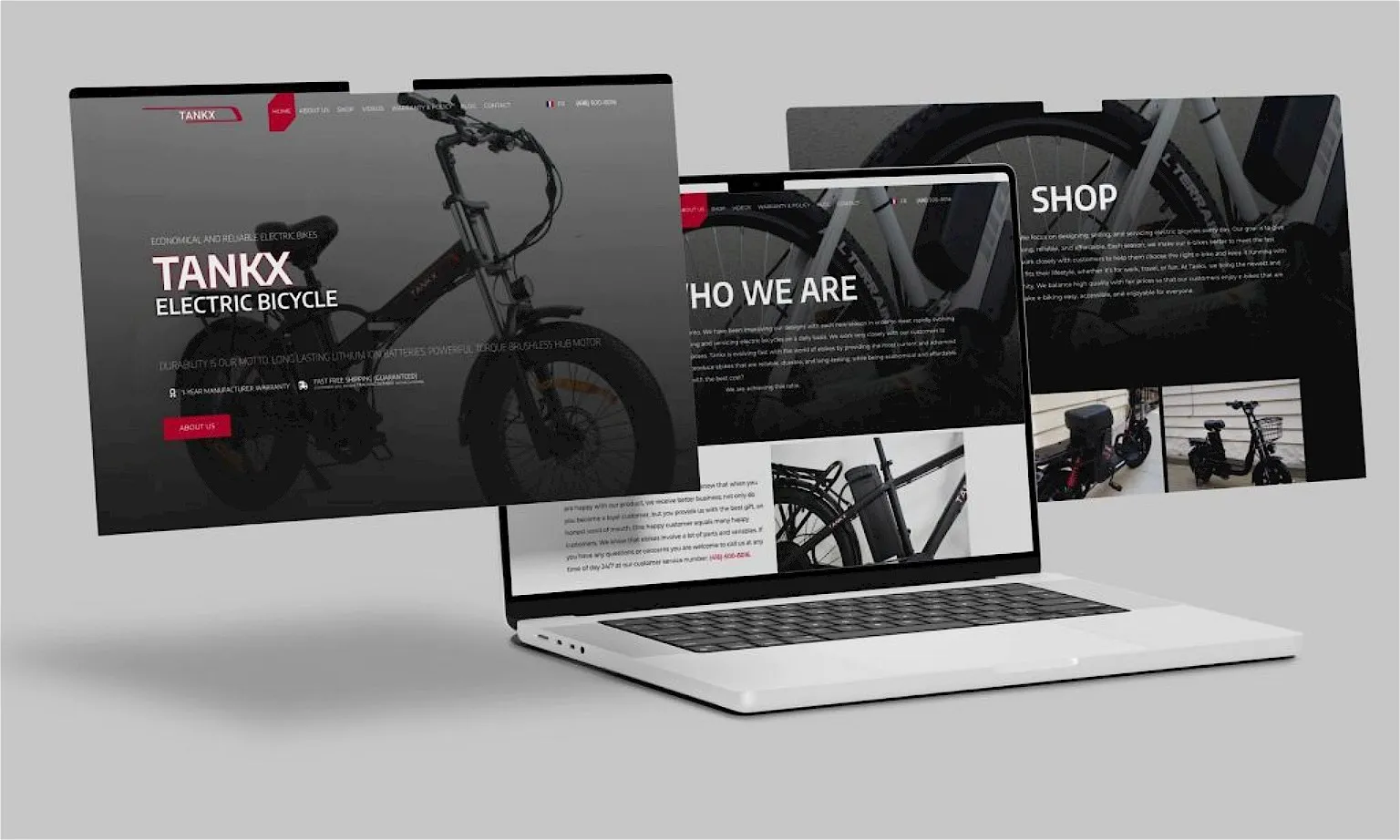
An online store sells electric bikes and scooters in Toronto — high-ticket items people research, compare on specifications and then buy. I designed and hand-coded the site: product collections for cargo, foldable and hybrid models, spec comparison layouts, a filtered catalogue and product structured data, with the checkout working properly on a phone. The live site is at this link and the write-up is the e-commerce case study.
A dealership inventory is the same architectural problem with one difference: every item is unique, and each one carries a legal disclosure set. The catalogue work transfers. The regulated layer is new, and I would rather price it as new than pretend it is solved.
| Part of the build | Carries over | New work, priced as new |
|---|---|---|
| Catalogue architecture | Collections, a filtered index, a detail-page template and URL structure that survives the catalogue changing every week | — |
| Specification layouts | Spec tables built for comparison, and structured data on the item | Mapping a vehicle's fields to the disclosure set rather than to a product feed |
| Mobile performance | Hand-coded pages, no page builder, images sized for the box they render in | — |
| Price presentation | — | The all-in total, the tax-and-licensing line, and the rate-beside-payment rule as a single component |
| Inventory source | — | A feed from a dealer management system, or a hand-entry admin if there is no feed, plus syndication to third-party listing sites |
| Finance and trade-in | — | Forms that handle credit information carefully, and representative examples written to section 61 |
| Compliance surface | — | The registration block, the as-is and unfit wording, the image source flag, and the sold-listing lifecycle |
One honest note about scope. Several dealership platforms already handle the feed and the listing template, and if you are on one of them the useful work is often the pages around it — the registration block, the as-is page, the financing explanations and the local pages — rather than a replacement. I would rather tell you that at the quoting stage than find it out halfway through. The same logic runs through website maintenance and support and website migration.
Six things I would get wrong if I built this page from a template
Each one is a rule from the paragraphs above, written as the thing I would have done instead. They are my own failure modes: every one is something I would have shipped before reading the regulation.
- Mistake 01Setting "plus HST and licensing" in 11px grey under a 40px price
Section 36 (10) allows the exclusion only where the advertisement indicates it in a clear, comprehensible and prominent manner. It goes at body size, directly under the price.
- Mistake 02Making the bi-weekly payment the display number and the rate a footnote
O. Reg. 17/05 s. 61 (4) requires the annual percentage rate to be disclosed as prominently as the most prominently disclosed of the rate and the payment, and the same section requires the term and the cash price. Two numbers at the same declared size, side by side, settles it.
- Mistake 03A gallery that falls back to a manufacturer render when a photo is missing
The guideline asks for a disclosure when the picture is not of the actual vehicle. A silent fallback produces exactly that situation with no way for the page to know, so the image field needs a source flag and the template needs to render the disclosure from it.
- Mistake 04Leaving a sold listing live because it ranks well
Section 36 (12) ties the price to availability, and the guideline asks dealers to make every effort to remove a sold vehicle from continuing advertising. Keeping the page for its search traffic is fine. Keeping the price on it is not, and the feed copies have to go in the same action.
- Mistake 05Hiding the as-is paragraph behind a tooltip or a "details" link
OMVIC's disclosures guideline is explicit that fine print does not satisfy the requirement and that verbal disclosure does not meet the Act. A seventy-word paragraph has to be designed for, which usually means the as-is listing gets a taller card than the certified one.
- Mistake 06A staff page whose salesperson profiles do not say where they work
The guideline says a salesperson advertising a vehicle through their dealership should disclose that affiliation and shall not pose as a private vendor, on their own social pages as much as on Facebook Marketplace, Kijiji or Autotrader, and should get the dealer's approval first. A staff profile is the simplest place on the site to state it.
What you get, and what it costs
| Item | Included | Notes |
|---|---|---|
| Hand-coded pages, no page builder | Yes | Seven pages plus the listing template, written as components so a rule is satisfied once rather than per page |
| Price block built to s. 36 and s. 61 | Yes | The all-in total, the tax and licensing line, and the rate beside the payment at the same declared size |
| Disclosure fields in the listing template | Yes | Previous use, used-model-year, availability, image source flag, and the voluntary condition report |
| On-page SEO and local pages | Yes | Titles, descriptions, schema, and a coverage page naming the Durham municipalities rather than the region |
| Inventory feed integration | Quoted | Depends entirely on what your dealer management system exports; a hand-entry admin is the fallback |
| Third-party listing syndication | Quoted | You remain responsible for advertising in your name on those sites, so the removal step is part of the build |
| Google Business Profile management | From $149/mo | Priced separately — see Google Maps management |
| Vehicle photography | No | I do not shoot on site. Your own photographs are also the ones that need no disclosure |
| Legal review of your wording | No | I build to the published regulation and guidelines and cite them. I am not your lawyer or your compliance consultant |
A build of this scope is $899 to $2,999 one time and goes live in 5 to 7 days once content is ready — the same range and timeline as every other build on this site. Full numbers are on the pricing page.
Common questions
Is a car dealership website an advertisement under Ontario law?+
Yes. OMVIC's advertising guideline defines an advertisement as any inducement by a dealer for a consumer to buy or lease a vehicle and lists "Online, on websites or in social media" among the places one might appear. Section 36 of Ontario Regulation 333/08 then applies to it in full, which is why the price block and the disclosure lines on a vehicle page are regulated content rather than design choices.
What has to be included in an advertised price in Ontario?+
Under section 36 (7) of Ontario Regulation 333/08 the price shown must be the total of the amount a buyer would have to pay plus all other charges related to the trade, including freight, pre-delivery inspection, fees, levies and taxes. OMVIC's all-in price page lists administration fees, OMVIC transaction fees, government levies, safety and pre-installed products among them. Only HST and licensing may sit outside the price, and only if the advertisement says so clearly and prominently.
Can a bi-weekly payment be the biggest number on the page?+
Not on its own. Section 61 of Ontario Regulation 17/05 under the Consumer Protection Act, 2002 requires that where an advertisement discloses an interest rate or a payment amount it also disclose the annual percentage rate, the length of the term and the cash price, and subsection (4) requires the annual percentage rate to be disclosed as prominently as the most prominently disclosed of the rate and the payment. A payment in display type with the rate in small print does not meet that.
Does the registered dealer name have to appear on the website?+
Yes. Section 36 (2) requires an advertisement that attempts to induce a trade to include a registered name and contact information of the dealer in a clear, comprehensible and prominent manner. OMVIC's guideline states that the requirement covers the registered name, address and phone number of the location approved by the Registrar, and that it applies equally to dealers with physical locations and to those operating primarily or entirely online.
What should happen to a vehicle page once the car is sold?+
Section 36 (12) says an advertisement must not indicate a price unless the vehicle is available at that price during the time the advertisement applies, and OMVIC's guideline adds that once a vehicle has been sold dealers shall make every effort to remove it from any continuing advertising. In practice that means the price comes off the page, the listing is pulled from every syndicated feed, and the URL is given a deliberate end state rather than being left live.
Do stock photos need a disclosure on a dealership website?+
OMVIC's advertising guideline says dealers should disclose if a picture appearing in an advertisement is not of the actual vehicle for sale, such as a stock photo or a manufacturer's photo showing a potentially different trim level or colour, and that if a different picture is used the advertisement should provide the detail and the all-in price for the vehicle that appears in it. That decides whether a gallery component may fall back to a manufacturer image at all.
Have you built a car dealership website before?+
No. The closest project I have is an electric bike retailer in Toronto, where I built product collections, spec comparison layouts and product structured data for high-ticket items people research before buying. What transfers is the catalogue architecture, the filtered index and the detail-page template. What does not transfer is the OMVIC layer, the inventory feed and the finance application, and I price those as new work rather than as something I have already solved.
How much does a dealership website cost and how long does it take?+
A build of this scope is $899 to $2,999 one time and goes live in 5 to 7 days once content is ready, which is the same range and the same timeline as every other build on this site. The variables are the number of vehicles, whether inventory arrives as a feed or is entered by hand, and whether finance and trade-in forms are in scope. Google Business Profile management is priced separately from $149 per month. Photography is not included, because I do not shoot on site.

10+ years designing SEO-ready websites for Ontario businesses, including regulated trades where a statute decides which components a page must carry. About the studio · Get in touch · Packages and pricing
Oshawa is the first city page for this niche — start at the car dealership web design hub. Closest related work: auto repair shops · towing and vehicle storage · trucking · e-commerce · windows and doors in Oshawa. Or browse all industries.
Send me one of your current listings and I will mark up what the rules want changed before I quote
A single vehicle page tells me how your inventory arrives, what the price block is doing, and how much of the build is new work. Packages from $899.