Website Design for Towing & Vehicle Storage Companies
Towing is one of the very few trades in Ontario where the website is named in the rules. A certified tow operator has to display its legal name, its operating name, an email address, a telephone number and a copy of its certificate on any website or social media it maintains; a storage operator adds its address, hours and current maximum rate schedule. So the brief starts from a published list rather than from a mood board — and that list turns out to be the same set of facts a stranded driver is trying to establish about you at eleven at night. There is no towing company in my portfolio yet, and I would rather write that than imply otherwise. The nearest work is a cross-border freight carrier and a restoration contractor whose leads all arrive mid-emergency.
Short answer
Lead Web Studio designs and hand-codes websites for towing and vehicle storage companies across Ontario — mobile-first, structured for local search, no template and no page builder. Every site carries the identity block and certificate copy the province requires on the website itself, a rate page written from the maximum rate schedule filed with the Ministry of Transportation, a storage page that answers the release and notice questions before anyone phones, a coverage page naming real highways and towns, and a roadside path a stranded driver can finish one-handed on a dying phone. A build is $899–$2,999 one-time and goes live in 5–7 days once content is ready.
What Ontario Certifies, and What It Puts on Your Site
Provincial oversight of towing and vehicle storage took effect on 1 January 2024. Three certificate types exist, two of them carry publishing obligations that land on the website, and every one of them gives a customer something to check you against.
Tow operator
$575 per yearPuts the legal name, operating name, email address, telephone number and a copy of the certificate on any website or social media the operator maintains — and the name and certificate number on every tow truck.
Tow driver
$195 for three yearsHeld by the person at the roadside. At least a full G licence, a criminal record and judicial matters check dated within 90 days, and the mandatory training. The driver's certificate number belongs on the consent document.
Vehicle storage operator
$575 per yearPosts the certificate, legal and business names, telephone, business address, email and hours of operation, plus the current maximum rate schedule — at the yard and on any website or social media maintained.
Operators also hold minimum insurance of $2 million liability, $100,000 consumer vehicle and $50,000 cargo liability. Sources: Get a towing or vehicle storage certificate and Towing and vehicle storage requirements, Government of Ontario.
What Has to Be on the Website Itself
Blue markers come with the tow operator certificate. Dark markers are what a vehicle storage operator adds. If you tow and store, you carry both lists on one site.
- Legal name — exactly as it reads on the certificate, including the Inc. or Ltd.
- Operating name, where it differs from the legal name
- Telephone number — one number, the same one everywhere
- Email address, maintained and monitored
- A copy of your certificate, readable rather than decorative
- Business address of the storage facility
- Hours of operation for the yard
- Current maximum rate schedule, with the date it took effect
Ontario's customer-facing guidance adds the same point from the other direction: rates are posted at the office or place of business, on the website if there is one, and at the location where the vehicle is stored. See Know your rights when getting a tow.
The Work These Pages Are Built On
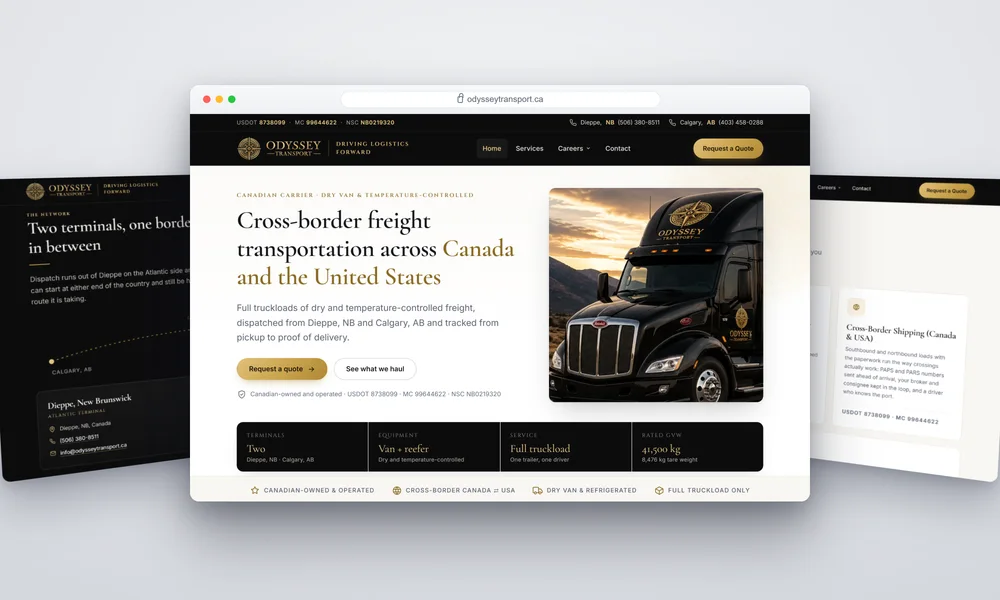
This client is a cross-border freight carrier dispatching out of Dieppe, New Brunswick and Calgary, Alberta, live at this link — nine pages designed and hand-coded from an empty folder, scoring 100 on desktop Lighthouse throughout. It was organised around one problem: a stranger has to verify a licensed transport business before handing anything over, so the USDOT, MC and NSC numbers repeat in the top bar, the hero, the equipment table and the footer.
Swap those numbers for a tow operator certificate and a filed rate schedule and the structure barely changes. What does change is the visitor's condition — outdoors, standing, one hand, low battery — which is where the second reference project comes in: a restoration contractor whose leads all arrive mid-emergency. Between them they cover the two halves of a towing site. I would rather point at those than invent a towing case study.
The Pages a Towing Company Actually Uses
One page per thing a customer, a driver or the ministry needs to establish — not one page per truck in the fleet.
| Page | Who lands on it | What it has to answer |
|---|---|---|
| Home | Somebody standing beside a stopped car. | Who you are, that you are certified, what you tow, where you run, and one button that dials. Nothing above it. |
| Rates | Callers who check before they phone, and anyone reconciling an invoice afterwards. | The filed maximum rate schedule as text, with the effective date and a link to the province's published rates so it can be checked independently. |
| Certificates | Anyone deciding whether you are a real business. | Legal name, operating name, certificate copy, and the numbers that also appear on your consent forms and invoices. |
| Storage yard | Someone whose vehicle is already there. | Address, hours, how a release works, what to bring, who counts as an authorised person, and the 15-day notice rule. |
| Accident recovery | A driver at a collision scene, or their family. | What happens in what order, that consent is documented, and that they choose the destination unless police direct otherwise. |
| Roadside assistance | Flat tires, boosts, lock-outs and fuel calls. | That these sit outside the towing and storage rules, and what you charge for them. |
| Private property towing | Property managers, and drivers who came back to an empty space. | How a vehicle gets released, and what a landlord or manager has to have in place before you attend. |
| Coverage | People in the towns and on the highways around you. | Named highways, exits and towns rather than a radius, so local search has something concrete to match. |
Everything a Towing Site Needs
Built for somebody outdoors, on one hand, in a hurry — and for the quieter reader who checks you afterwards.
Answered before anyone calls
The facts a stranger has already filtered on, in the first screen.
- Legal name, operating name and certificate, published where required
- Rates taken from the schedule you filed, dated, and linked to the province's
- What you tow: light duty, heavy duty, accident recovery, motorcycles, equipment
- Storage address, hours and what to bring to collect a vehicle
- What is and is not covered by the towing rules, said plainly
- Your own photographs of your own trucks, not stock
Built into the code
The parts nobody sees, which decide whether the rest gets found.
- A tap-to-call button that stays on screen at every size
- Roadside intake that asks for location first and everything else later
- Pages per highway corridor and per town, naming real places
- Fast on a weak signal — no hero video, no chat bubble over the call button
- Service and local business schema with a consistent name, address and phone
- A Google Business Profile carrying exactly the same details
What a Towing Company Website Costs
One payment, fixed in writing before I start, and about 5 to 7 days once the content is ready.
| Package | Best for | What's included |
|---|---|---|
| Starter — $899 | Up to 10 pages | Home, services, rates, storage, certificates, coverage and contact, with the required identity block, a protected enquiry form and local SEO from day one |
| Full Site — $1,499 | A page per service and per area | Separate pages for light and heavy-duty towing, accident recovery, roadside assistance, private-property towing and storage, plus a page for every town and corridor you cover |
| Advanced — $2,999 | Dispatch and release tooling | Roadside intake with location capture, a rate lookup built from your filed schedule, a storage release request form, unlimited pages and priority support |
Google Business Profile work is separate and starts at $149. See full pricing and Google Maps management.
Towing Website Design Near You
Dedicated local pages for towing and storage companies in specific Ontario cities. More added as I take on work in each area.
Related industries I already build for: trucking & freight carriers · restoration companies · appliance installation · handyman services. Already have a site somewhere else? See website migration and maintenance & support.
Towing Website FAQ
What should a towing company website include in Ontario?+
Start with what the certificate requires on the site itself: legal name, operating name where it differs, a monitored email address, a telephone number and a copy of the certificate. Then the rate page written from the maximum rate schedule you filed, a storage page with the yard address, hours, release process and the 15-day notice rule, a coverage page naming real highways and towns, and one tap-to-call button that never leaves the screen.
Do towing rates have to be on the website?+
Ontario's customer rights page says rates are posted at the office or place of business, on the website if there is one, and at the location where the vehicle is stored — and vehicle storage operators are specifically required to post the current maximum rate schedule at the yard and on any website or social media they maintain. Nothing may be charged that is not on the filed schedule, and changing a rate takes 30 days to take effect.
Can a towing company advertise under a second brand name?+
No. Offering services under another business name or different contact information is listed among the things a tow operator, driver or storage operator is not allowed to do. That rules out the separate campaign brand and the second phone number that usually get built for advertising. One legal name, one operating name and one number — on the truck, on the site, in the ads and on the Google Business Profile.
What certificates does an Ontario towing business need?+
A tow operator certificate at $575 a year, a vehicle storage operator certificate at $575 a year, and a tow driver certificate at $195 renewed every three years. Drivers need at least a full G licence, a criminal record and judicial matters check dated within 90 days, and the mandatory training. Operators must hold $2 million in liability insurance, $100,000 in consumer vehicle insurance and $50,000 in cargo liability. Details on Ontario's certificate page.
Is roadside assistance regulated the same way as towing?+
No. Roadside assistance such as changing a tire or boosting a battery is not covered by the towing and storage rules, and consent and invoice requirements do not apply to service that is free of charge or prepaid — through an automobile club membership, for instance. A company selling both needs that line drawn on the website, because customers arrive expecting one set of rights and sometimes receive another.
Have you built a website for a towing company before?+
Not yet, and these pages say so rather than implying otherwise. The nearest work is a cross-border freight carrier at this link, hand-coded from an empty folder around authority numbers a stranger can verify, and a roofing and restoration contractor at this link, built for leads that arrive mid-emergency. What neither carried is a rate schedule filed with a ministry and published where the customer can read it.
What does a towing company website cost?+
$899 one-time for up to 10 pages, $1,499 for a larger site with a page per service and per coverage area, and $2,999 where roadside intake, a rate lookup or a storage release request is involved. One payment, fixed in writing before work starts, and about 5 to 7 days once the content is ready. Google Business Profile work is priced separately from $149. See my website design packages.

10+ years designing SEO-ready websites for local businesses, including transport, trades and emergency-service companies across Ontario. About the studio · Get in touch
Does your site carry what your certificate requires it to?
I'll write the identity block, the rate page and the storage page from your filed schedule first, then design around them. Packages from $899.