Towing Company Website Design in Cambridge
Almost every trade website in Ontario is a marketing decision from top to bottom. Towing is the exception. Since provincial oversight began on 1 January 2024, a certified tow operator has to display its legal name, its operating name, an email address, a telephone number and a copy of its certificate on any website or social media it maintains — and a storage operator has to post its certificate, address, hours and current maximum rate schedule as well. Those are conditions attached to the certificate, not preferences a designer gets to argue about. There is no towing company in my portfolio yet, and I would rather write that than imply otherwise. The nearest work is a cross-border freight carrier and a restoration contractor whose leads all arrive mid-emergency.
Name and certificate number. That is the entire list for a tow truck.
ACT
- Legal name
- Operating name, if different
- Email address
- Telephone number
- A copy of your certificate
Wording condensed from Ontario's published requirements for tow operators. A vehicle storage operator posts more again: certificate, business address, hours and the current maximum rate schedule.
The website carries more than the door does. A site with a phone number, a hero photo and nothing a stranger can check is not merely thin — it is short of what the certificate asks for.
Short answer
Lead Web Studio designs and hand-codes websites for towing and vehicle storage companies in Cambridge and across Waterloo Region — mobile-first, structured for local search, and written around what Ontario already requires you to publish. That means the identity block and certificate copy the province asks for, a rate page built from the maximum rate schedule you filed with the Ministry of Transportation, a storage page that answers the 15-day notice question before anyone phones about it, and a dispatch path a stranded driver can finish one-handed at the roadside. A build is $899–$2,999 one-time and goes live in 5–7 days once content is ready. There is no towing company in my portfolio yet; this page says so.
What Does Ontario Require on a Towing Company's Website?
Five items, and they are not optional. A tow operator must display its legal name, its operating name where that differs, an email address, a telephone number and a copy of its certificate on any website or social media it maintains. A vehicle storage operator posts its certificate, business address, hours and current maximum rate schedule as well.
I have built sites for trades where compliance sits somewhere off to the side — a licence number in the footer, a certificate image somewhere on an About page. Towing does not work like that. The requirements Ontario publishes for tow and vehicle storage operators name the website directly, alongside the truck and the premises, as a place the same information has to appear. The obligation to maintain and monitor an email address is on the same list. So is the instruction not to offer services under another business name or different contact information — which rules out the separate brand name that often gets invented for a landing page.
This changes the order I write a towing site in. On most projects the identity block is the last thing anyone thinks about; here it is the first, because it is the only part with a rule attached. Then the rates, then the storage yard, then dispatch, and only then the things every website has — the coverage map, the equipment, the photographs. A designer who starts from the photographs ends up bolting the required items into a footer nobody reads, and the certificate ends up as a JPEG somebody has to pinch-zoom.
There is a second reason to put it first, and it is commercial rather than legal. Everything the province asks you to publish is exactly what a stranger at the side of Highway 401 at eleven at night is trying to establish about you before deciding whether to call: that you are a real, certified business, that the number they are about to call belongs to you, and that what you charge is written down somewhere neither of you can edit afterwards. The compliance list and the list of things that win the call are, on this one page, the same list.
Which Certificate Puts Which Item on the Page?
Two different certificates, two overlapping lists, and one website that has to satisfy both if you tow and store. Below is every item Ontario names, which certificate it comes with, and where I would actually put it.
| What has to appear | Comes with | Where it belongs on the site |
|---|---|---|
| Legal name | Tow operator · storage operator | Footer on every page and the contact page, spelled exactly as it appears on the certificate — including the Inc. or Ltd. that marketing usually drops. |
| Operating name, if different | Tow operator · storage operator | Beside the legal name. Operators are not allowed to offer services under another business name or different contact information, so a second brand for ads is a real problem, not a stylistic one. |
| Telephone number | Tow operator · storage operator | Header, footer, and one tap-to-call button that stays on screen. One number, not a different one per landing page. |
| Email address | Tow operator · storage operator | Published and monitored — the requirement is to maintain and monitor it. An address that bounces or goes to a person who left is a compliance item, not an inconvenience. |
| A copy of your certificate | Tow operator · storage operator | A readable image or PDF on its own page, linked from the footer. Certificate numbers also belong on consent forms and invoices, so the page is worth writing once and referencing everywhere. |
| Business address and hours | Storage operator | The storage page, matching the sign outside the yard and the Google Business Profile exactly. Hours decide whether an after-hours release is even possible. |
| Current maximum rate schedule | Storage operator · and rates generally | Its own page, as HTML rather than a scan, with the date it took effect. Ontario's consumer guidance says rates are posted at the office, on the website if there is one, and at the storage location. |
Source: Towing and vehicle storage requirements and Know your rights when getting a tow, Government of Ontario.
The Work This Page Is Built On
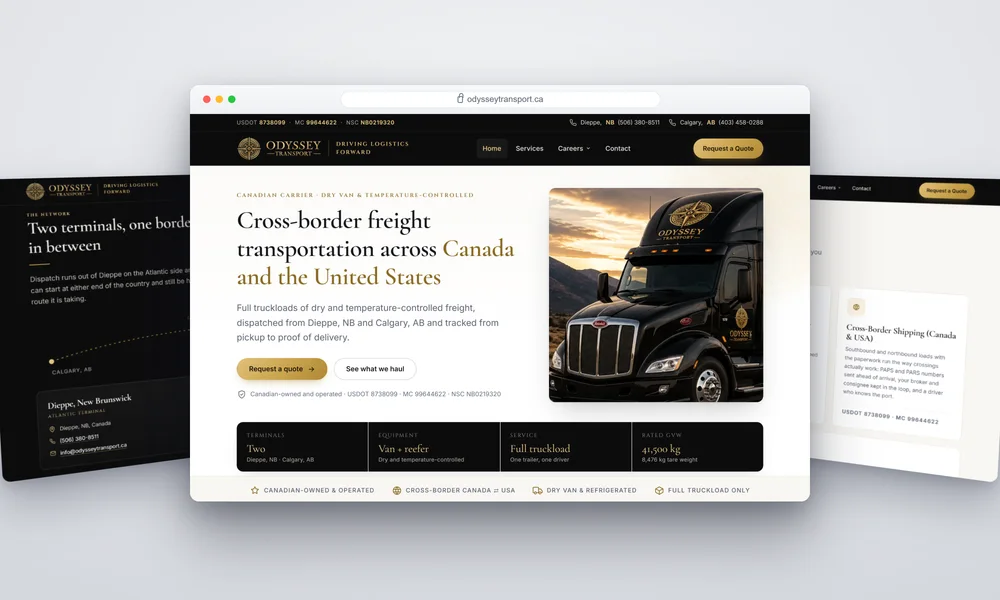
This client is a cross-border freight carrier dispatching out of Dieppe, New Brunswick and Calgary, Alberta, live at this link. There was a bare WordPress install and half a header; I designed and hand-coded nine pages from an empty folder, and the desktop Lighthouse score is 100 on every one of them.
The reason it transfers to towing is the thing that site was organised around: a stranger has to verify a licensed transport business before they will hand anything over. The USDOT, MC and NSC numbers sit in the top bar, the hero, the equipment table and the footer, because that is the first question a broker asks. Swap those for a tow operator certificate number and a filed rate schedule and the brief barely changes — a number a stranger can check, repeated where they are already looking.
See the full case study → · trucking web design in Brampton →
Why Does a Tow Customer Arrive Already Suspicious?
Because the province publishes what you charge. Tow and storage operators file their maximum rates with the Ministry of Transportation through a self-service portal, and those rates are published for customers to look up alongside certificate status. A website that quotes a figure the filed schedule does not carry is contradicted by a government page one search away.
Three rules follow from that, and all three land on the website rather than on the truck. You cannot charge for a service unless it appears on your maximum rate schedule. You cannot charge more than the maximum you filed for it. And changing an existing rate takes 30 days before the new figure takes effect — so a price typed onto a web page the day it changed is wrong for a month, in the direction that gets complained about.
What that argues for is not a shorter pricing page. It argues for a pricing page written from the schedule itself: the same service names, in the same order, with the effective date printed at the top and a link to the published rates so a customer can confirm it against the ministry rather than against you. It costs nothing to be the operator whose site says check this yourself.
The invoice below is the other half of it. Ontario requires an itemised invoice showing the services provided, the cost of each and the total, and requires it before payment is requested — a sequence worth putting on the page in plain words, because it is the exact moment most roadside arguments start.
Round figures I picked so the arithmetic is visible — not a rate card, and not a survey of Cambridge operators. The two struck lines are the point: an administration fee and a fuel surcharge are the kind of lines that get added without much thought, and neither one is chargeable here.
What Is the Customer Owed Before They Say Yes?
Ontario gives a stranded driver a specific set of things before consent is even requested, and every one of them is easier to hand over if the website has already explained it. This is the table I would build the service pages from.
| At the roadside | What Ontario requires | What the site should have answered first |
|---|---|---|
| Your rates | The driver or operator must give the customer the maximum rate schedule when requesting consent to tow. | The same schedule, published as a page. Handing over a document the customer has already read makes for a much shorter conversation than explaining it from scratch. |
| A list of their rights | The driver must give the customer a list of their rights as a customer before requesting consent. | Say plainly that you hand it over, and link to the province's own page, so the visitor knows what the roadside conversation will contain before it happens. |
| Choice of company and destination | The customer chooses who tows and where it goes, except in a restricted tow zone or where police direct the tow. | Where your trucks run, and the fact that on Highway 401 through Cambridge the choice is still theirs. |
| A consent document | Before towing starts or immediately after: the operator's name, the driver's certificate number and the destination the customer chose. Never a blank form. | A redacted sample of the form, so the first time they see it is not on a shoulder in the rain. If consent was not obtained, there can be no charge for the tow. |
| An itemised invoice | Services provided, cost of each service and total cost — shown before payment is requested, with a receipt after payment. | A sample invoice on the site, matching the schedule line for line, so the format is familiar before the real one is handed over. |
| The payment method they choose | Operators must accept multiple payment methods, such as commonly used credit cards, debit cards and cash. | One sentence naming what you take. The requirement is to accept more than one method, so saying which ones settles it in advance. |
| Their own belongings | Drivers must let customers retrieve personal property from a towed vehicle at no charge; yards must allow access during regular hours, free. | On the storage page, with the hours next to it. Ask people to bring identification and say so in advance rather than at the gate. |
What Should the Page About Your Storage Yard Say?
Address, hours, how to get the vehicle back, what to bring, and what happens if nobody was reached. After a vehicle arrives, a storage operator must take steps to tell the owner where it is being held, how to retrieve it and who to contact — by email, in person, by mail or by courier.
In most cases, if the storage operator does not notify the owner within 15 days after the day it receives the vehicle, what the owner has to pay is limited to the cost of towing and storing the vehicle for that period. Storage operators also hold a lien under the Repair and Storage Liens Act and may require payment before releasing a vehicle.
Four things belong on that page and rarely are. The first is the yard's real hours, because a release that has to wait until Monday is the difference between an annoyed customer and a complaint. The second is what to bring — ownership, identification, and who counts as an authorised person — written before the drive out rather than explained at the gate. The third is the fee for access outside regular hours, if you charge one, stated as a number that also appears on your filed schedule. The fourth is the sentence above about the 15 days, in your own words, because a customer who reads it on your site instead of on the province's rights page reads it as competence.
What Makes Cambridge Different for a Towing Company?
The restricted tow zones are a Greater Toronto and Hamilton Area program. Cambridge sits outside it — so on the Highway 401 that crosses the north end of the city, the driver still chooses the company and the destination, and what they are choosing from is a phone screen.
Ontario's Tow Zone Program covers 15 restricted zones on sections of the 400-series highways and the QEW in the GTHA, and the Highway 401 portion of it runs between Highway 400 and Highway 412. Inside those zones only a company under contract to the Ministry of Transportation may tow, and the stranded driver calls 511 rather than a company. Cambridge is well west of that boundary. The practical effect is that on the 401 here, and on every road in the city, the first thing that happens after a collision or a breakdown is a search — and the site that answers it is the one that gets the job.
That stretch is also busy in a way the rest of Waterloo Region is not. The province widened Highway 401 between Hespeler Road and Townline Road from six lanes to ten, a roughly five-kilometre stretch that also crosses the Speed River, and the interchanges at Highway 8, Hespeler Road, Franklin Boulevard and Townline Road are the four points where that highway meets the city. Off the highway the city is still three towns wearing one name: Galt, Preston and Hespeler were amalgamated with parts of North Dumfries and Waterloo townships on 1 January 1973, and all three names remain in everyday use for neighbourhoods, businesses and addresses. A coverage page that lists "Cambridge" and stops leaves out three words people also type.
There is no towing company on my portfolio and no Cambridge client on it either, so I will not pretend to local relationships I do not have. What I can point at is a freight carrier site built around verifiable authority numbers and a restoration site built for people who are already having a bad day — the two halves of this brief, done for real clients, just not in this city.
What a Cambridge coverage page should name
- Highway 401 across the north end — the interchanges at Highway 8, Hespeler Road, Franklin Boulevard and Townline Road, and the widened stretch between the last two.
- The three cores by name — Galt, Preston and Hespeler, because that is what residents call home, not "Cambridge".
- Hespeler Road and Franklin Boulevard — the commercial strips, worth naming as addresses rather than leaving implied by the city name.
- Dundas Street, King Street and Water Street — the older cores down by the Grand and Speed rivers, named street by street rather than folded into one city name.
- The towns you will actually drive to — Kitchener, Waterloo, Guelph, Ayr, Paris and Puslinch, listed as places rather than as a radius.
- 138,479 residents at the 2021 census — a real figure to put on the coverage page instead of "serving the Cambridge area and surrounding".
Built for Someone Already Having a Bad Day
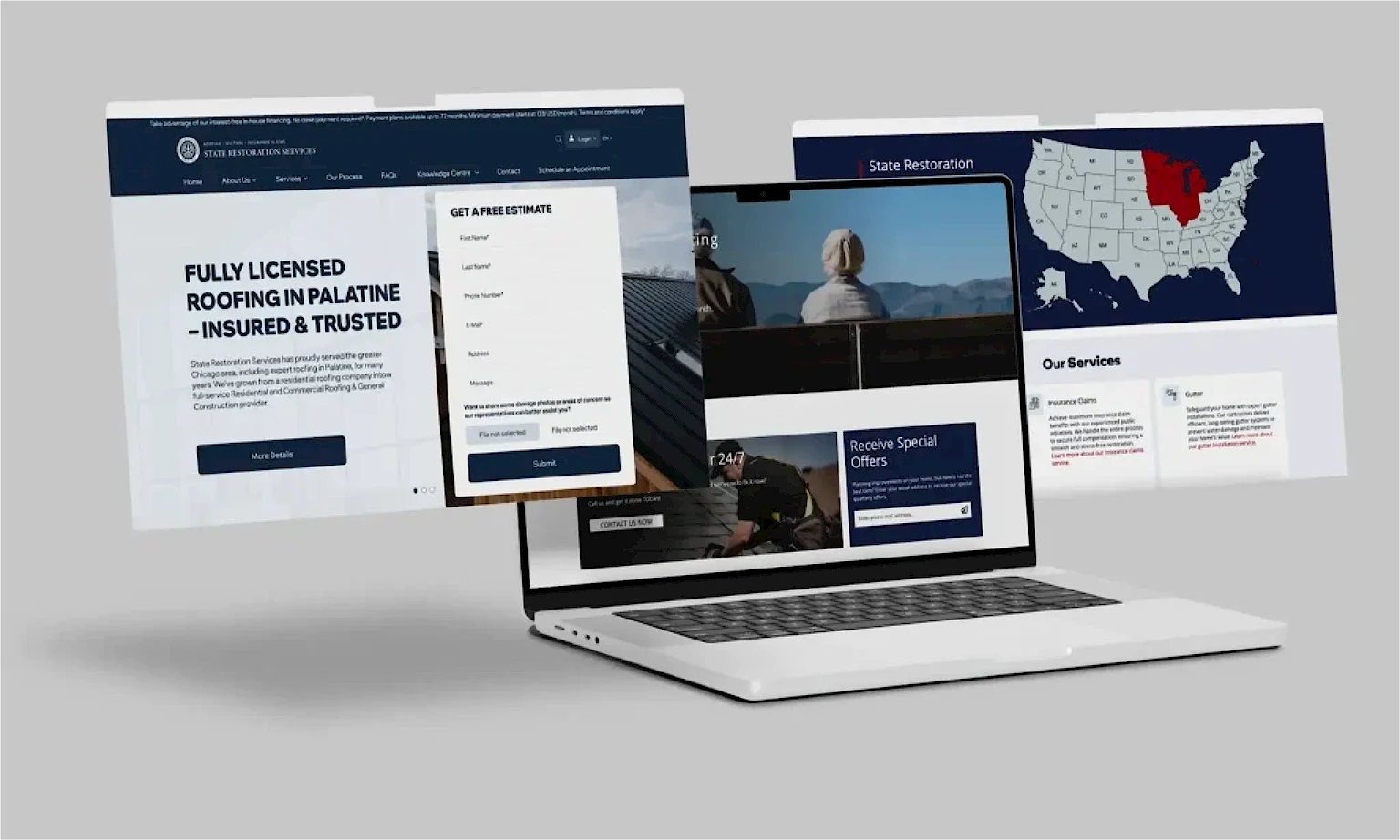
This client is a roofing and restoration contractor in Illinois, live at this link. Every lead that site takes arrives mid-problem: water coming through a ceiling, a roof opened up by hail, an insurance company already involved. Nobody browses. So the whole structure is short paths — the phone number never off screen, forms that ask for the minimum, and pages that load on a phone with two bars.
A towing site has the same visitor with less patience and worse conditions: outdoors, standing up, one hand, a phone that may be nearly flat, and often at night. That rules out a lot of what gets built by default — a hero video, a six-field quote form, a live-chat bubble that covers the call button, an address buried on a contact page. It also raises the value of the boring parts. The coverage list, the rate page, the certificate page and the storage hours are what somebody reads while they wait for the truck to arrive.
Which of Your Services Are Even Covered by the Rules?
Not all of them, and the difference surprises customers more than it surprises operators. Roadside assistance sits outside the towing and storage rules entirely, and consent and invoice requirements do not apply to a tow that is free or prepaid — through an automobile club membership, for instance.
| Requirement | A paid tow the customer arranges | A prepaid or free tow (auto club, dealer or lease plan) | Roadside assistance — boost, tire, lock-out, fuel |
|---|---|---|---|
| Consent document required | Yes, unless police direct the tow. No consent means no charge for the tow. | No — the consent requirement does not apply to free or prepaid service. | No. These services are not covered by the towing and storage rules. |
| Itemised invoice before payment | Yes — services, cost of each, total, then a receipt. | No — the invoice requirement does not apply. | No. |
| Maximum rate schedule applies | Yes. Nothing may be charged that is not on the schedule you filed. | Ontario states the exemption for consent and invoice requirements. What you may charge a club or a plan sits in that contract — confirm it rather than assume it. | Not part of the towing rate regime. |
| Certificate rules | Operator, driver and storage certificates as applicable. | Certificates are a separate question from consent and invoicing, with their own published full and partial exemptions. | Separate question again — check the exemptions rather than assume. |
| What the website has to make clear | Rates, rights, the consent form, the invoice, and where the vehicle goes. | Which clubs and plans you actually accept, and what the member is entitled to versus what they are not. | That a boost is not a tow. A customer who has read the rights page and then gets a battery call feels short-changed unless you have already drawn the line. |
Five Sentences That Cannot Go on an Ontario Towing Site
Each of these is ordinary marketing copy somewhere else in the trades. Each one collides with a rule that applies specifically to towing and vehicle storage, and each has a version that says the same useful thing without the collision.
Injured in the collision? We'll put you in touch with a personal-injury lawyer.
Why it goes: tow operators and drivers are not allowed to refer anyone to legal or health care services. Instead: say nothing about lawyers or clinics at all, and use the space for what happens to the vehicle and how to reach it tomorrow morning.
We'll take it straight to our preferred body shop — they look after our customers.
Why it goes: nobody may receive compensation or a benefit for advice or information that leads to further towing, storage, appraisal, repair or wrecking work, and any interest you hold in a business you refer someone to has to be disclosed. Instead: "We tow to the shop you name. If you don't have one, we'll tell you which shops we're connected to and which we aren't."
Also trading as [Your Second Brand] Towing — call our other line.
Why it goes: operators are not allowed to offer services under another business name or different contact information. Instead: one legal name, one operating name, one number, everywhere — including the ads, the truck and the Google Business Profile.
Tows from $75 — fuel surcharge may apply.
Why it goes: fuel surcharges are named among the charges an operator may not make. Instead: publish the hook-up rate and the per-kilometre rate straight from your filed schedule, so the "from" is a real number rather than an opening bid.
Flat $89 any tow, any distance, 24/7 — beat that.
Why it goes: you cannot charge for a service that is not on your maximum rate schedule, you cannot exceed the maximum you filed, and a rate change takes 30 days to take effect — so a headline price invented for a campaign is either unenforceable or unchangeable. Instead: publish the schedule, date it, and link to the ministry's published rates so the customer can check it against the province.
What a Towing Company Website Costs in Cambridge
One payment, fixed in writing before I start, and about 5 to 7 days once the content is ready.
| Package | Best for | What's included |
|---|---|---|
| Starter — $899 | Up to 10 pages | Home, services, rates, storage, certificates, coverage and contact, with the required identity block, a protected enquiry form and local SEO from day one |
| Full Site — $1,499 | A page per service and per area | Separate pages for light and heavy-duty towing, accident recovery, roadside assistance, private-property towing and storage, plus pages for Cambridge, Kitchener, Waterloo, Guelph and the townships |
| Advanced — $2,999 | Dispatch and release tooling | Roadside intake with location capture, a rate lookup built from your filed schedule, a storage release request form, unlimited pages and priority support |
Google Business Profile work is separate and starts at $149. See full pricing and Google Maps management.
Towing Website FAQ — Cambridge
What does Ontario require on a towing company's website?+
A certified tow operator must display its legal name, its operating name if that is different, an email address, a telephone number and a copy of its certificate in any premises open to the public and on any website or social media it maintains. A vehicle storage operator posts the same identity details plus its business address, hours of operation and its current maximum rate schedule. The customer rights page repeats the rate point from the other side: rates are posted at the office, on the website if there is one, and at the storage location.
Do tow truck rates have to be published in Ontario?+
Yes. Operators file their maximum rates with the Ministry of Transportation through a self-service portal, and the rates are published so customers can look them up along with certificate status. You cannot charge for a service unless it appears on your schedule, you cannot charge more than the maximum you filed, and a change to an existing rate takes 30 days to become effective. A pricing page therefore has to be written from the schedule, not beside it. See Ontario's requirements for operators.
Can a customer in Cambridge choose which tow truck company comes?+
Yes, unless police direct the tow or the vehicle is inside a restricted towing zone. Those zones are a Greater Toronto and Hamilton Area program — 15 zones on sections of the 400-series highways and the QEW, with the Highway 401 portion running between Highway 400 and Highway 412. Cambridge is outside it, so on the 401 past Hespeler Road and Franklin Boulevard the driver still picks the company and the destination. Which is exactly why the website has to be findable at eleven at night.
What certificates does a towing business need in Ontario?+
Three types. A tow operator certificate and a vehicle storage operator certificate are $575 a year each and renew annually; a tow driver certificate is $195 and renews every three years. Drivers need at least a full G licence, a criminal record and judicial matters check dated within 90 days, and the mandatory training. Operators must carry $2 million in liability coverage, $100,000 in consumer vehicle insurance and $50,000 in cargo liability. Details are on Ontario's certificate page.
Is roadside assistance covered by Ontario's towing rules?+
No. Ontario states that roadside assistance such as changing a tire or a battery boost is not covered by the towing and storage rules, and that consent and invoice requirements do not apply to towing or storage that is free of charge or prepaid — through an automobile club membership, for example. If you sell both, the website has to draw that line, because a customer who has just read the province's rights page and then gets a boost call feels short-changed even though nothing was done wrong.
What should a towing website say about the storage yard?+
The address, the hours, how to get the vehicle back and what to bring. After a vehicle arrives the operator must take steps to tell the owner where it is held, how to retrieve it and who to contact, by email, in person, by mail or by courier. In most cases, if the owner is not notified within 15 days after the day the vehicle arrives, what they must pay is limited to towing and storage for that period. Personal belongings must be retrievable during regular hours at no charge, and the yard holds a lien under the Repair and Storage Liens Act.
Have you built a website for a towing company before?+
Not yet, and this page says so rather than implying otherwise. The nearest work is a cross-border freight carrier, live at this link, designed and hand-coded from an empty folder around authority numbers a stranger can verify — and a roofing and restoration contractor at this link, built for leads that arrive mid-emergency. What neither of them carried is a rate schedule filed with a ministry and published where the customer can read it.
What does a towing company website cost in Cambridge?+
$899 one-time for up to 10 pages, $1,499 for a larger site with a page per service and per coverage area, and $2,999 where roadside intake, a rate lookup or a storage release request is involved. One payment, fixed in writing before work starts, and about 5 to 7 days once the content is ready. Google Business Profile work is priced separately from $149. See my website design packages.

10+ years designing SEO-ready websites for local businesses, including transport, trades and emergency-service companies across Ontario. About the studio · Get in touch
Related industries I already build for: trucking & freight carriers · restoration companies · handyman services · appliance installation. Nearby in the west end: Waterloo and Guelph. Also see all service areas.
Does your site carry what your certificate requires it to?
I'll write the identity block, the rate page and the storage page from your filed schedule first, then design around them. Packages from $899.