
"Should we start a blog?" turns up on nearly every project, usually about ninety seconds after the price. And whether you need a blog has one honest answer, which annoys people because it's another question: do your customers ask things your service pages have no business answering? Most small-business blogs I inherit are graveyards — four posts from 2021, one of them a Christmas greeting, and an "Uncategorized" category page that Google has dutifully indexed and no human has ever opened. So here is the version nobody sells you: what a blog can and can't do, the one test that settles it, what a post really costs in hours, and a mistake of my own that cost me two rankings at the same time.
The short version
- A blog is for questions, not for freshness. If nobody is asking anything, skip it and fix your service pages.
- The test: could this question sit on a service page without ruining it? If yes, put it there. If no, that's a post.
- A post can hurt you. Mine competed with my own service page — 17 shared queries, positions 28 and 45, zero clicks.
- One honest post is about 4h 45m. Know that number before you promise yourself "one a week".
- Frequency is not a ranking signal. Twelve useful posts a year beat fifty-two thin ones, and cost less.
- AI assistants quote pages that answer in the first three sentences. Padding is now actively expensive.
Do I need a blog for my business?
Only if your customers ask questions that don't belong on a service page. A blog earns its place when it answers the things people genuinely type into Google before they buy — prices, comparisons, "why is this happening to my house". If nobody is asking anything, a blog is homework nobody marks, and those hours belong on your service pages instead.
That's the whole decision. Notice what isn't in it: how often you post, whether Google "likes fresh content", or what your competitor's agency told them. I've watched businesses publish weekly for a year and get nothing, because every post answered a question no customer had ever asked.
What a blog can do — and what it can't
A blog is one specific tool: it catches people who are searching for an answer rather than for a supplier. That's genuinely valuable, because someone researching today is someone buying in three weeks. It is not a general-purpose ranking machine, and it will not rescue a site that has bigger problems.
| What people hope a blog does | Real? | What's actually going on |
|---|---|---|
| Answers a question people type into Google | Yes | This is the entire job. Everything else is a side effect. |
| Gets you found for "web design Toronto" | No | That's a service page's search. A post competing for it usually loses to your own page. |
| Gives your sales conversations something to send | Yes | Underrated. "I wrote this up, have a read" closes more than a brochure does. |
| Keeps the site "fresh" so Google ranks it higher | No | Publishing on a schedule is not a ranking signal. Publishing something useful is. |
| Brings leads on its own, quickly | Slowly | Months, not weeks — and only for posts that match a real search. |
| Shows a stranger you actually know the job | Yes | The one benefit that works even with zero traffic, because prospects read it after you send it. |
Google's own guidance on creating helpful, people-first content includes a self-assessment worth reading before you write anything. One of its questions asks, more or less, whether you're producing lots of content across lots of topics in the hope that some of it happens to perform. If the honest answer is yes, you've described most small-business blogs, and Google is telling you plainly that this isn't the plan.
The one test: does the question already have a page?
Before writing a post, ask where that question would naturally live. If it belongs on a service page — "HVAC repair in Toronto", "cost of a new website" — put it on the service page and make that page better. A blog post is for the question a service page can't answer without derailing its own job of selling.
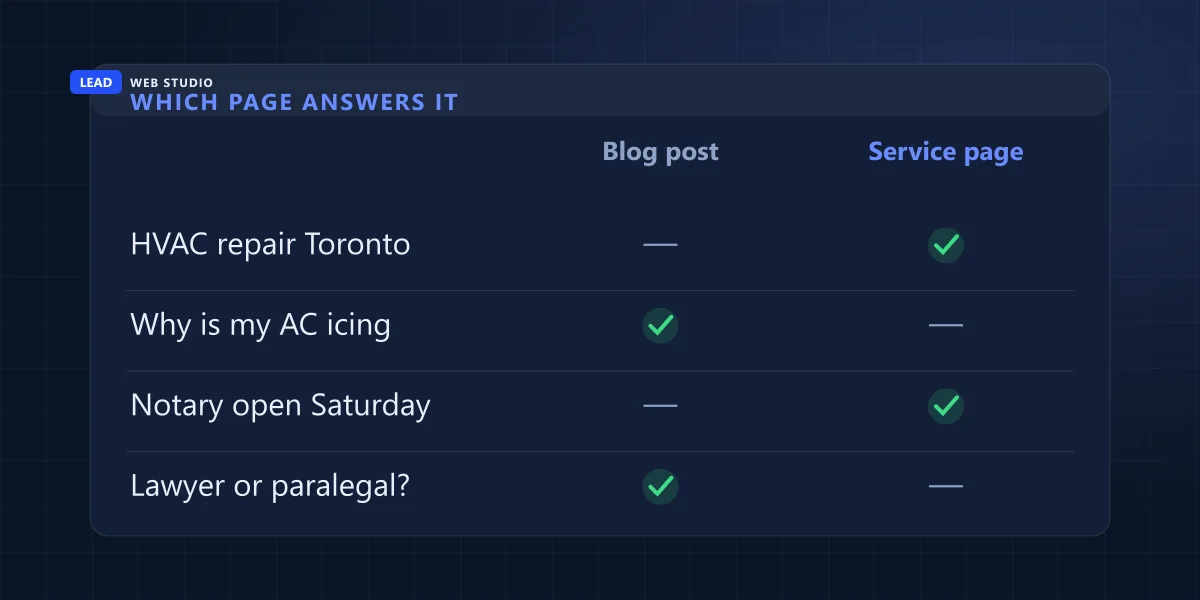
The signal is the searcher's state of mind. Someone typing "emergency plumber Etobicoke" wants a phone number in four seconds; a 1,500-word essay is an obstacle. Someone typing "why does my basement smell after rain" wants an explanation, and if you give them a good one you're the plumber they call on Thursday.
| What they typed | Blog post | Service page |
|---|---|---|
| "HVAC repair Toronto" | No | Yes |
| "why is my AC icing up" | Yes | No |
| "kitchen renovation cost GTA" | Yes | Either — one page, not both |
| "notary near me open Saturday" | No | Yes |
| "do I need a lawyer or a paralegal" | Yes | No |
Row three is the trap, and it's where I fell in. When a question could plausibly live on either, it must live on exactly one. Two pages chasing one search don't double your chances — they split them.
The post I published that competed with my own service page
Here's mine, since I'd rather hand you the receipt than a theory. I had a service page at web design in North York, doing its job. Then I wrote a blog article on essentially the same subject and published it at a second URL, because more content sounded like more coverage.
It wasn't. Google found both, couldn't decide which one answered the search, and hedged. The two URLs ended up sharing 17 queries between them, stuck at positions 28 and 45. Not one click, for months. Two pages, each half as convincing as the single page I'd started with.
Two pages chasing one search don't double your chances. They split the evidence, and Google backs neither.
The fix was one line in a config file: a 301 redirect from the article to the service page, folding everything the article had earned back into the page that should have had it. A redirect is the strongest way to tell Google two things are really one thing. Worth saying honestly: positions wobble for a few weeks afterwards while Google re-attributes, so it's not a free move — it's just cheaper than leaving the split in place.
What I'd tell my past self: before publishing anything, list the searches your existing pages already own and check that your new post isn't queuing up behind one of them. This is the single most common way a blog quietly makes a site worse, and it's also why I now check every new page against the site's existing ones before it goes live. If your traffic has flattened for no obvious reason, that's one of the suspects I'd check first — I went through the others in why your website gets no traffic.
What one honest blog post actually costs you
Nobody quotes this number, so here's mine, measured on the posts I write for this site. Not a "content calendar" fantasy — the real clock, from opening a blank file to the page being live, checked and linked.
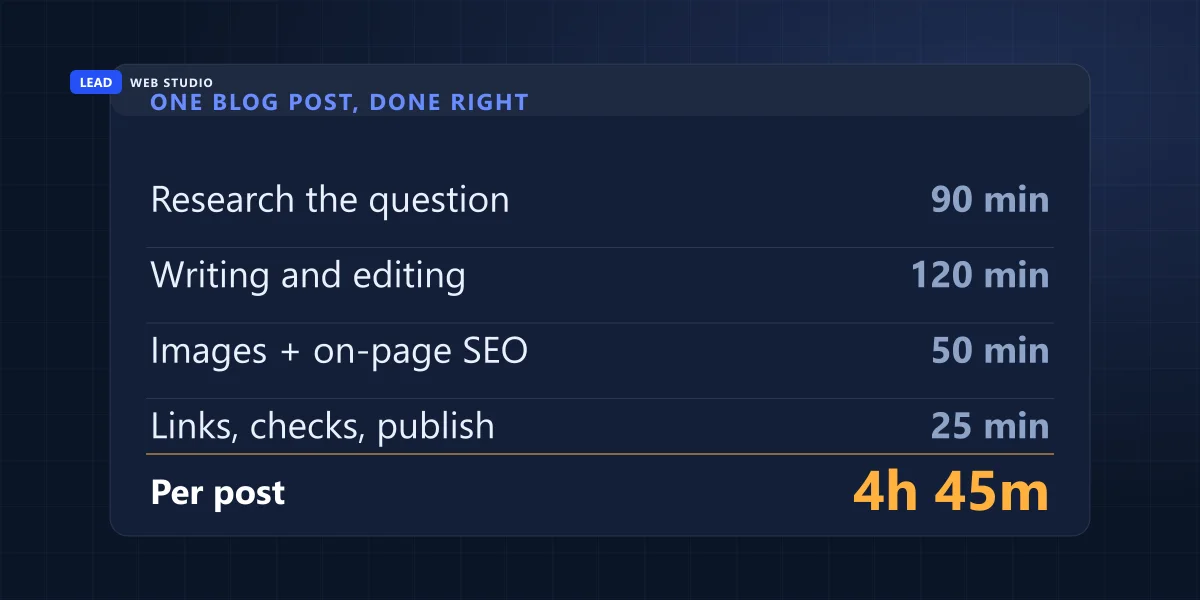
Four and three-quarter hours. Call it most of a working day once you've been interrupted twice. Now do the arithmetic on "we'll post once a week": that's roughly 19 hours a month, or about a full week of your year. If that time comes out of doing the actual work you get paid for, price it honestly — it isn't free just because no invoice arrives. I put content time into the same column as everything else in the small-business website and marketing budget.
This is also why "just use AI to pump out thirty posts" ends badly. Google's spam policies now name scaled content abuse directly: mass-producing pages mainly to game rankings is a violation whether a human, a machine, or both together made them. The policy is about intent and usefulness, not about which tool typed it. Thirty pages that nobody needed is a risk to the whole domain, not a shortcut.
The five posts worth writing before any others
If the test says yes and you're staring at an empty blog, don't start with "5 Tips for Spring". Start with the five questions you have already answered out loud this month, because those are the ones with proven demand — you've been the search engine for them.
- The price question you get asked on every call. Write down the real ranges and what moves them. Most competitors won't, which is exactly why this one works.
- The "should I do X or Y" comparison. Repair or replace, lawyer or paralegal, buy or lease. Take a side and say why.
- The thing customers get wrong. The mistake you fix twice a month. You already have the photos on your phone.
- What actually happens when they hire you. Day one to handover, with timings. It removes the fear that stops people booking.
- The seasonal question. The one that arrives every March or every first frost, written once and refreshed each year.
Each of those has a buyer at the end of it, which is the difference between a blog and a diary. And each one should point somewhere useful — my own posts link to the SEO work or the relevant industry page where the reader can see what the fix actually costs, rather than leaving them at a dead end.
How to tell whether the blog is working — and when to stop
Give a post six months, then judge it on two numbers from Search Console: is it getting impressions for the question you wrote it for, and is anyone clicking. Impressions with no clicks means the title and description need rewriting. No impressions at all after six months means nobody was asking.
What you don't judge it on: pageviews in month one, time on page, or whether it "feels" successful. And the honest part — stopping is allowed. A blog with twelve good posts that answer twelve real questions is worth more than one publishing weekly into a void. If yours has been going a year with no impressions, the answer isn't more posts, it's a different problem, and it usually lives on your service pages or your Google profile. Local SEO for a service business covers where that attention usually pays better.
What changes when an AI reads it instead of a person
Increasingly the first thing to read your post is an assistant summarising it for someone who never visits your site. That rewards a specific kind of writing: a direct answer in the first three sentences under each heading, real numbers in a table, sources named. It punishes the 300-word warm-up before the point.
This is genuinely good news for honest small businesses, because the old game favoured whoever could pad longest. Now the page that says "about $4,500, here's what changes it" gets quoted and the page that says "costs vary depending on many factors" gets skipped. I broke down that format in answer-first content that Google and AI actually quote, and it's how every guide on this site is now structured — including this one.
If you take one thing from this page: don't start a blog to have a blog. Start it because you have five questions you're tired of answering by phone. If you're not sure your site is even ready for that, the website itself comes first — and you can see what that costs on the pricing page before you ever speak to me.
Frequently asked questions
Do I need a blog for my business?+
Only if your customers ask questions that don't belong on a service page. A blog earns its place when it answers the things people genuinely type into Google before they buy. If nobody is asking anything, a blog is homework nobody marks, and the same hours are better spent on your service pages.
How often should a small business publish blog posts?+
Publish when you have a question worth answering, not on a calendar. Frequency by itself is not a ranking signal, and Google's own guidance warns against producing lots of content on many topics hoping some of it performs. One useful post a month beats four thin ones.
Can a blog post hurt my rankings?+
Yes, if it targets a search your service page already targets. I did exactly this: my North York article and my North York service page split the same 17 queries and stalled at positions 28 and 45 with zero clicks between them. One 301 redirect merged them back into a single page.
How long does one blog post actually take?+
About four and three-quarter hours if you do it properly. My own timings are roughly 90 minutes of research, 120 minutes of writing and editing, 50 minutes for images and on-page details, and 25 minutes for internal links and publishing. Anything much faster is usually a post nobody needed.
Do blogs still matter now that AI answers the question?+
They matter differently. AI assistants quote pages that state a clear answer in the first few sentences and back it with specifics. Vague, padded posts get skipped. Write the answer first, put your real numbers in a table, and name your sources.
Not sure whether your site needs a blog or better service pages?
Tell me what people ask you on the phone and I'll tell you straight which pages are worth building — including when the answer is "none".
Get My Free Quote
10+ years building websites for GTA trades, clinics and service businesses — including the content that decides whether a page ever gets found. Read my full bio · Get in touch