
You bought a domain last month, the new host wants it moved, and the registrar says no for another few weeks. Can you get a domain transfer done before the 60-day lock runs out? Sometimes. It depends on which of three clocks you started, and most pages answering this question get at least one of them wrong. I read the policy itself this morning, plus the public registry records of 22 domains I look after, and this is the plain version, with dates you can count.
Can I transfer a domain before 60 days are up?
For a .com or another ICANN domain, it depends on what started the clock. After a new registration or a previous transfer, the current registrar may refuse, and it may also let you go. After you change the owner's name, organisation or email, the registrar must refuse, unless you opted out before making the change.
The difference between "may" and "must" is the whole answer, so here it is as a table.
| What started the clock | What the current policy says | Can it end early? |
|---|---|---|
| You registered the domain | The registrar may deny a transfer for 60 days from the creation date | Only if your registrar agrees. Many won't, and some registry contracts set 60 days for every name |
| The domain moved to this registrar | The registrar may deny another transfer for 60 days | A move back to the old registrar is allowed when both registrars agree |
| You changed the owner's name, organisation or email | The registrar must deny, if it applied the 60-day lock and you didn't opt out first | No. The opt-out only works before the change, and registrars don't have to offer it |
Two lines of ICANN's Transfer Policy decide it. Read the verbs.
"The transfer was requested within 60 days of the creation date as shown in the registry RDDS record for the domain name."
Section I.A.3.7.5, listed under the reasons a registrar may deny
"The Registrar imposed a 60-day inter-registrar transfer lock following a Change of Registrant, and the Registered Name Holder did not opt out"
Section I.A.3.8.5, listed under the reasons a registrar must deny
So when a hosting company's help page tells you the new-registration lock is absolute and nobody can lift it, that's not what the policy says. In practice it often works out that way, because your registrar has no reason to make an exception for a customer who is leaving. Asking costs you one support ticket.
How do I find out when my lock ends?
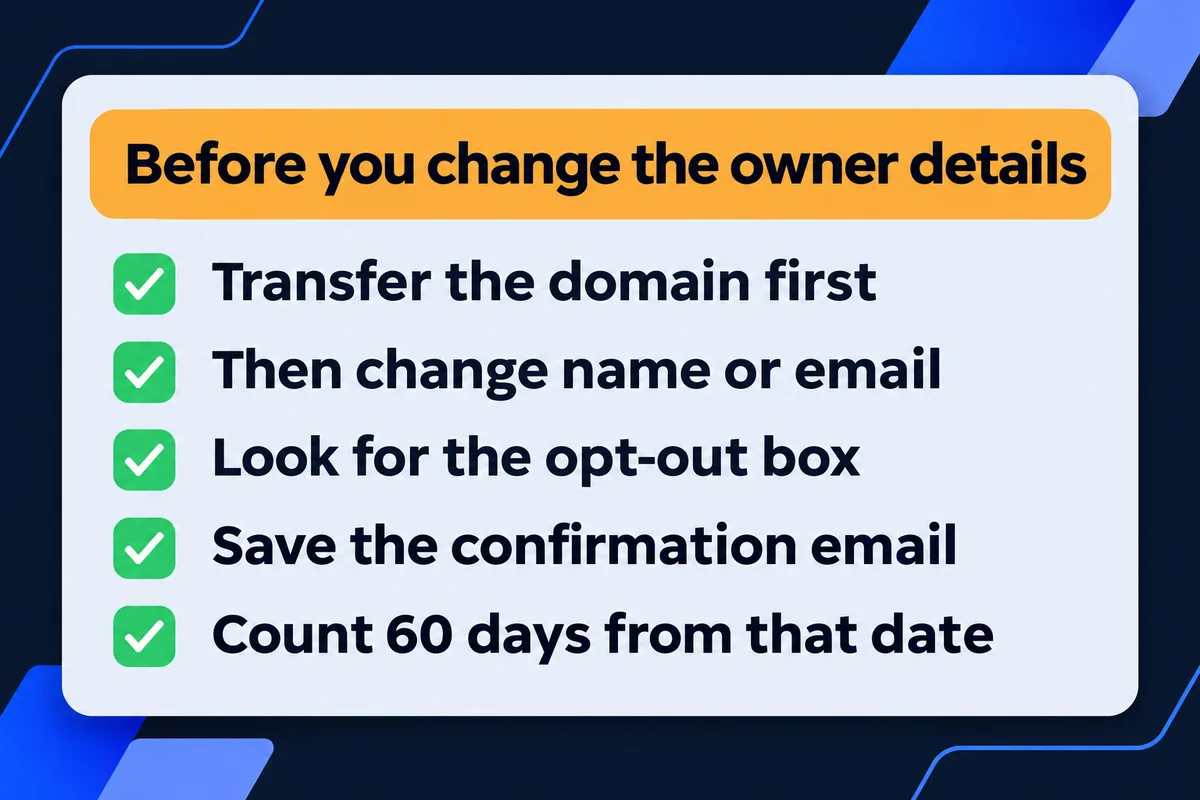
Count it yourself from the dates in the domain's public record. No lookup tool shows a "60-day lock" status, so don't wait for one to appear. Take the creation date, or the date of the last transfer or owner change, and add 60 days. The clock runs from the date in the registry record, not from the day you paid.
- Look the domain up in ICANN's registration data lookup. It reads the registry's own record, so there's no reseller in the way.
- Write down the registration date. That's the creation date the policy counts from.
- If the domain moved registrars recently, your account history or the registrar's support team will have the transfer date. The public record I read doesn't list it.
- If you or anyone else changed the owner's name, organisation or email, find the date in your registrar's email confirming the change.
- Add 60 days to the latest of those dates. Then add a day of slack. The registry keeps its dates in UTC, and I'd rather you weren't refused on a technicality at 9 p.m.
A worked example, using a real .com from the records below, registered on 16 October 2026:
- Creation date in the registry
- 16 Oct 2026
- 15 days left in October
- 31 Oct
- 30 days of November
- 30 Nov
- 15 more days
- 15 Dec
- First day a transfer can't be refused for its age
- 15 Dec 2026
What 22 real records showed
I read the public registry records of 22 .com and .ca domains I look after, one at a time. Every one of them shows "client transfer prohibited", which is the ordinary registrar lock you switch off in your account. Not one shows anything that marks a 60-day window. The newest was registered 22 days ago and still sits inside it. Its record looks the same as a domain registered in 2005:
A .com registered in 2005
- Status
- client transfer prohibited
- Registered
- 12 Jan 2005
- Inside a 60-day window?
- No
A .com registered 22 days ago
- Status
- client transfer prohibited
- Registered
- 16 Oct 2026
- Inside a 60-day window?
- Yes, until 15 Dec
Same status line, very different answer. That's why "my domain shows as locked" tells you almost nothing. Switching the registrar lock off fixes the first domain and does nothing for the second. Twelve of the 22 also carried "client update prohibited" and five "client renew prohibited". That's how some registrars set up their protection, not a sign of trouble. Two .us names I tried couldn't be read this way, because IANA's list of registry servers has no entry for .us.
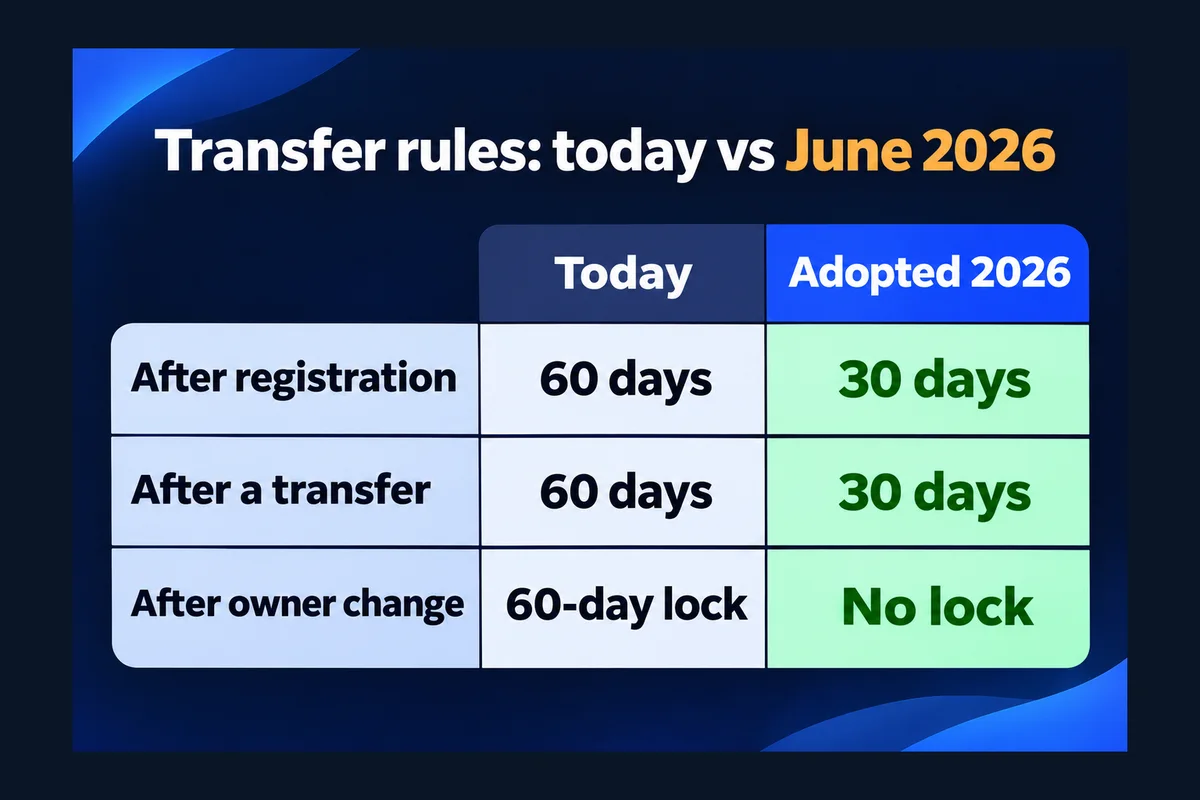
What changes when ICANN's new transfer rules start?
The ICANN Board adopted 47 recommendations from its Transfer Policy Review on 7 June 2026. They cut both windows from 60 days to 720 hours, which is 30 days, make them the same for every registrar, and remove the lock after an owner change entirely. ICANN hasn't published a start date. Until it does, the 60-day rules above apply.
| Situation | Rule in force today | Rule adopted in June 2026 |
|---|---|---|
| After a new registration | Registrar may refuse for 60 days | Registrar must refuse for 720 hours |
| After a transfer | Registrar may refuse for 60 days | Registrar must refuse for 720 hours, with a short list of early exits |
| After an owner name, organisation or email change | 60-day lock unless you opted out first | No lock. The registrar sends a notice within 24 hours instead |
Notice the swap: the windows get shorter but turn from "may" into "must". Under the new rules nobody gets an exception after a fresh registration, however nicely they ask. The 30 days after a transfer can be lifted early, but only on a specific request from the owner, with a reason like the ones the working group listed:
- a documented, clearly intentional request from the owner
- both registrars agree to send the domain back where it came from
- an escrow service needs it to finish a sale
- a documented purchase, such as an aftermarket sale or merging a portfolio
- the registrar releases a domain whose use breaks its own terms or local law
The registrar has to keep a record of the request for 15 months after the domain leaves. So "please, I'm in a hurry" will probably still get you a polite no.
Does the 60-day rule apply to .ca domains?
Yes, but it comes from CIRA, the .ca registry, not from ICANN. CIRA's Registrant Agreement (version 2.3, 1 August 2025) says you may change registrars "at any time once 60 days has elapsed from the date of registration of the Domain Name". The ICANN change in June doesn't touch .ca, so a new .ca keeps its 60 days.
One page I read this morning lists .ca among the extensions with no transfer lock. Nine of my 22 test domains are .ca, so I'll take CIRA's word over theirs.
What you can do while the clock runs
Most people asking to transfer early don't actually need the transfer. They need the website or the email to work somewhere else, and that's a different job with no lock on it.
- Point the domain instead of moving it. Changing nameservers or DNS records at the current registrar works on day one, and ICANN's own registrant FAQ suggests exactly this. My guide on moving a domain without the site or email going down walks through which records to copy first.
- Move the website now and the registration later. A website migration only needs the domain to point at the new server.
- Set up mail on the new provider before you touch the domain. The records for business email on your own domain can change while the domain sits at the old registrar.
- If the domain is changing hands, transfer it first and change the owner details after, at the new registrar. Doing it the other way round is how people start a second 60-day clock.
- If you can't wait, open a ticket with the current registrar and ask for the date it will release the domain. Under today's rules it's allowed to say yes earlier.
For what it's worth, the domains I set up for clients are registered in the client's own name, so they can move them any day the registry allows. If your web designer holds the domain in their account, that's a separate problem from the 60 days, and a worse one.
Short answers on the 60-day transfer lock
Does changing nameservers start a 60-day lock?+
No. The lock after an owner change is tied to the owner's name, organisation and email. Nameservers, DNS records and the technical contact can change without it, which is why pointing the domain somewhere else is the usual way round the wait.
Does renewing a domain reset the 60 days?+
No. The policy counts from the creation date, the last transfer or the last owner change. A renewal is none of those, so renewing a domain you registered three years ago doesn't stop it moving.
Can ICANN unlock my domain for me?+
No. ICANN writes the policy, and the registrar applies it to each domain. Your current registrar is the only one that can tell you the exact release date or agree to an exception.
When do the 30-day rules start?+
There's no date yet. The Board adopted them on 7 June 2026 and asked ICANN to implement them. The policy has to be drafted and registrars given time to change their systems, so plan around 60 days until ICANN publishes an effective date.
I bought a domain from someone else. When can I move it?+
Ask the seller whether the owner details were changed into your name before the handover. If they were and nobody opted out, the 60 days run from that change. If not, only the creation date and the last transfer count.
Sources, read on 7 November 2026: ICANN, Transfer Policy; ICANN, FAQs for registrants on transferring a domain; ICANN Board resolutions, 7 June 2026; Transfer Policy Review final report, recommendations 3, 18 and 26.4; CIRA Registrant Agreement 2.3, section 3.6. Registry records of 22 domains read through each registry's public RDAP server the same morning.
Stuck between an old registrar and a new host?
Send me the domain and where it needs to go. I'll tell you what can move today and what has to wait.
Get My Free Quote
I hand-code websites for service businesses around the GTA and keep their domains in the owners' names, so moving them is never a hostage negotiation. Read my full bio · Get in touch