
If your domain expired, log in to your registrar today and renew it. For weeks after the expiry date the name is still yours to recover: first as an ordinary renewal, then for a 30-day redemption window with a restore fee. After that it goes back on the open market, and getting it back means competing with strangers for it.
The rules for that window are not a registrar's mood. For .com and the other generic domains they come from ICANN's Expired Registration Recovery Policy; for .ca they come from CIRA. Below is what each set of rules lets you do, day by day, and the order I would do things in if the site and the inbox both went quiet this morning.
Is my domain expired, or is something else down?
Two signs point at the domain. Your website and your business email stopped on the same day, and the address now shows either "server not found" or a registrar page saying the name has expired. ICANN requires that parking page to say the registration expired and how to renew it. Anything else is probably a different layer.
To be sure in two minutes, look the name up. ICANN Lookup shows the expiry date, the registrar and the current status for a .com; for a .ca, CIRA's own search on cira.ca does the same. If the expiry date is in the future, the domain is fine and you want the full website-down triage instead of this page.
How long do I have to get an expired domain back?
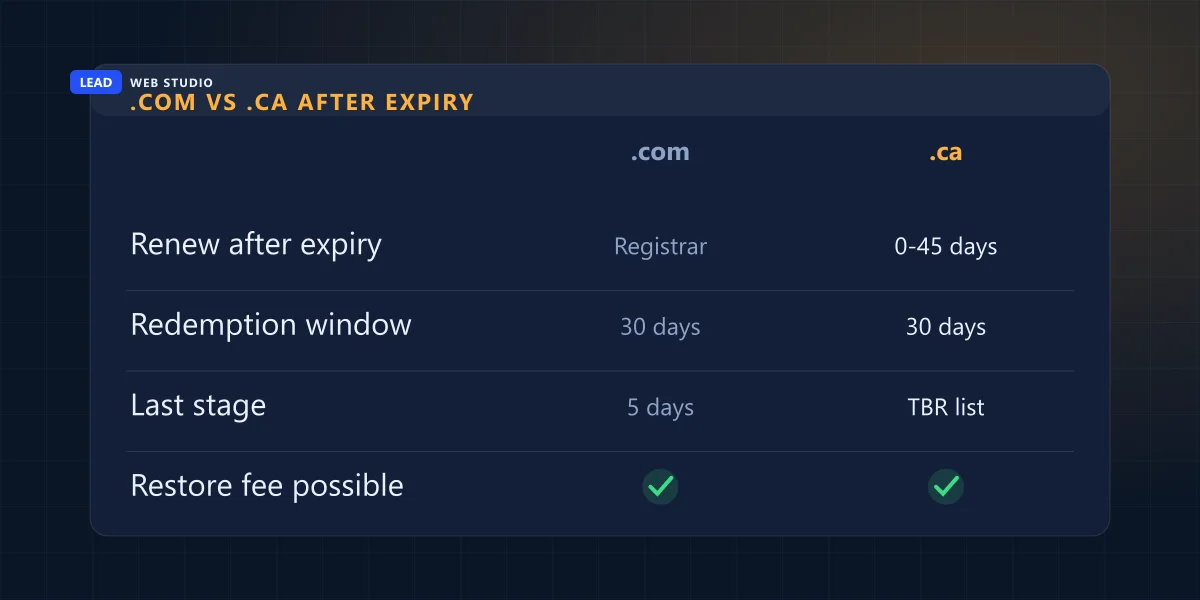
For a .ca, CIRA's timeline is up to 45 days of auto-renew grace, then 30 days of redemption, and the name lands on the release list 32 to 78 days after expiry. For a .com, the registrar decides when to delete it, then a 30-day redemption period and about 5 days of pending delete follow.
.com and other generic domains (ICANN)
- About 1 month and 1 week beforeYour registrar must send at least two reminders. ICANN accepts 26–35 days and 4–10 days before expiry.
- Day 0: expiryYou can still renew. The registrar may delete the name at any time from here on.
- Within 5 days afterAt least one more notice with renewal instructions, if you have not renewed.
- At least the last 8 days before deletionThe registrar must cut the domain's DNS, so site and email stop. ICANN's own example: expires 1 October, deleted 20 October, DNS off from 12 October at the latest.
- After deletion: 30 days of redemptionOnly the registrar that deleted it can restore it. DNS is off and transfers are blocked.
- Then about 5 days of pending deleteNo restore is possible. Afterwards the name is purged and anyone can register it.
.ca domains (CIRA)
- The day or week beforeCIRA says to expect a warning email from your registrar.
- Day 0: expiryCIRA renews the name for a year and bills your registrar.
- Up to 45 days: auto-renew graceThe registrar asks whether you want to keep it. CIRA notes some registrars skip this step, and a cancelled auto-renewal can switch off the site and email.
- 30 days: redemption graceThe domain is not active. Your last chance to have the registrar redeem it; depending on the registrar, with a recovery fee on top.
- 2.5 to 9.5 days on the TBR listStatus changes to pending delete. The list shows the release session for each name.
- Wednesday, 19:00 UTCCIRA's weekly To Be Released session puts the name back up for registration. That is 3 p.m. in Toronto in summer time, 2 p.m. in winter.
Notice what the .com column does not promise: a fixed number of days before deletion. ICANN's policy says registrars "may delete registrations at any time after they expire", as long as the DNS cut-off and the notices happen. That is why your registrar's own terms matter, and why "I'll deal with it next week" is a worse plan for a .com than it sounds.
What does my domain's status mean?
The status line in the lookup tells you which stage you are in and who can still fix it. Lookup tools spell the codes with spaces, such as "redemption period"; ICANN's documentation writes the same code as redemptionPeriod. Find yours in the table and do what the right-hand column says.
| Status you see | What it means, per ICANN | What you do |
|---|---|---|
| auto renew period | The registry renewed the name automatically after it expired; the status is set "for a limited time" | Pay the renewal at your registrar |
| client hold | Your registrar told the registry not to put the domain in DNS, so "it will not resolve"; ICANN lists non-payment as a usual reason | Renew, or settle whatever the registrar is holding it for |
| server hold | Set by the registry itself; the domain is not active in DNS | Ask your registrar why; it is the only one who can talk to the registry for you |
| redemption period | The registrar asked the registry to delete the domain; it is held in this status for 30 days | Call the registrar today and pay renewal plus the restore fee |
| pending restore | Your restore was requested; the registry waits for the registrar's paperwork, in what ICANN calls a "frequently defined seven day period" | Check the status daily; if it falls back to redemption period, call the registrar |
| pending delete, on its own | The 30 days of redemption ran out; "after five calendar days" the name is purged and available | Too late to restore. Plan for a backorder or a new name |
One status is missing from that table on purpose: no record at all. If the lookup says the name is not registered, it has already been released, and the first person to buy it gets it. If that is you, buy it now and read the rest later.
How do I renew a domain that already expired?
Find the registrar in the lookup, log in to that account, renew from the domain list, and pay. During redemption, ask the registrar to restore the name, because a normal renewal button will not cover it. Then confirm the site and email resolve again, which the registrar must allow "immediately or as soon as is commercially reasonable".
- Find out who your registrar is. The lookup shows it. It is often not the company that built your site, and sometimes not the company that sends you the hosting invoice either.
- Log in to the registrar account. If you never had a login, the domain may be registered in someone else's account. ICANN's policy gives the recovery rights to the registered name holder at the moment of expiry, so if that is your former designer, the registrar will deal with them, not you. Who owns your website covers how to fix that for good.
- Renew the domain, and only the domain. Checkout pages love to add privacy upgrades, a site builder and three "matching" names to the cart. You came for one line. Renew for several years while you are there; CIRA allows up to 10 years for a .ca.
- If the status is redemption period, ask for a restore. ICANN requires registrars to publish their renewal, post-expiration and restore fees on their website, so find the fee page before you call and you will know the number before they say it.
- Confirm DNS is back. ICANN's notes allow a delay when the restore needs a manual step or lands on a holiday. Check the next morning before you assume anything.
The login trap. If your registrar account's email address is on the domain that just expired, the password-reset email has nowhere to land. Call or chat with registrar support and prove who you are another way. Then change that login email to one on a different domain, which is exactly what ICANN's GNSO recommends: a secondary contact "that is not associated with the domain name itself".
What happens to my email and my Google rankings while it is down?
Both depend on DNS, so both stop. Your mailbox and the messages already in it are untouched, but new mail cannot find your server while the domain is off. Google treats DNS errors like server errors, and says unreachable pages already in its index "will be removed from Google's index within days".
That second sentence, from Google's guide to network and DNS errors, is the real reason a lapsed domain is urgent even if nobody visits your site on a Tuesday. A week of "server not found" can undo pages that took months to get indexed. After the renewal, Googlebot has to recrawl them before they can come back; how long Google takes to index a page gives you a realistic idea of that wait, and the Pages report in Search Console shows you when they return.
Email is the quieter loss. A sender's mail server may keep retrying for a while and deliver late, or give up and bounce the message back to the sender. Either way, you have no list of who tried. Ask your regular customers and suppliers whether anything bounced that week, and read why emails go undelivered if mail still misbehaves after the domain is back.
Why didn't I get the expiry warnings?
You probably did, at an address you do not read. Registrars must send the notices to the registered name holder at the contact on file, about a month and a week before expiry. If that contact is an old employee's mailbox, a designer's email, or an address on the expiring domain itself, the warnings arrived exactly where nobody looks.
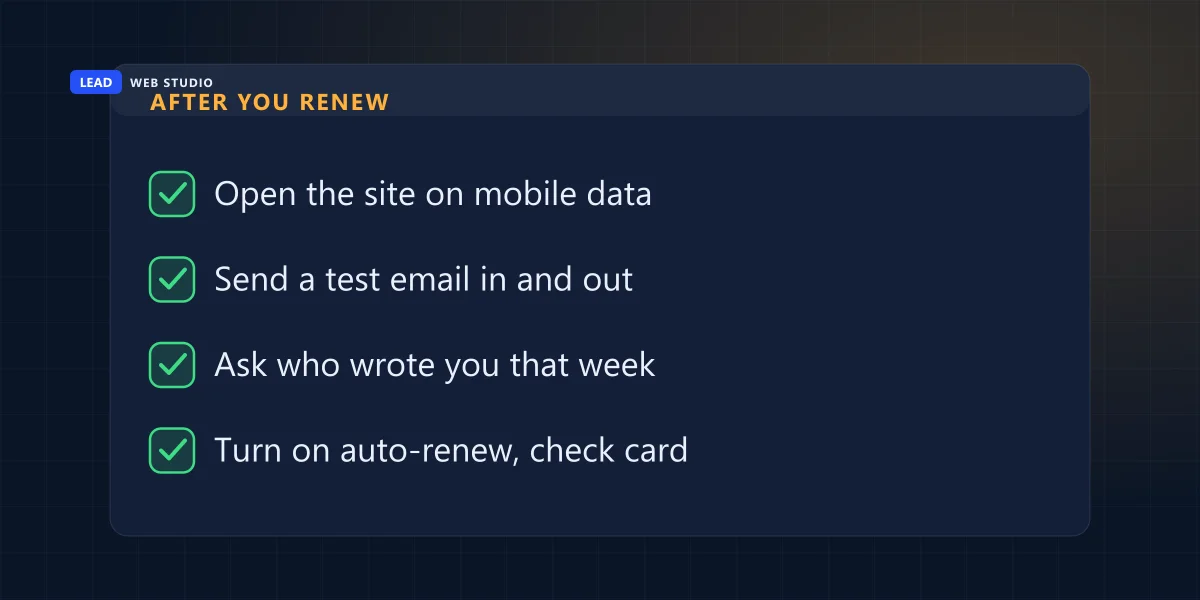
- Check the contact email on the domain in your registrar account today. It should be an address you read every day, on a different domain.
- Save the registrar's sending address as a safe sender. ICANN's policy notes suggest registrars tell you that address so the reminders don't end up filtered as spam.
- Check the card on file. Auto-renew on a card that expired last spring is the same as no auto-renew.
- Put the expiry date in your own calendar, a month ahead. It costs nothing, and it is the only reminder that does not depend on someone else's email.
If the domain was registered by a web designer who has since gone quiet, those reminders went to them, and so will the next ones. What to do when your web designer stops replying walks through getting the account moved into your name.
Somebody else registered my expired domain. Now what?
Before release, a .ca can be backordered; CIRA suggests it if you used the name actively, with no guarantee it works. Once someone else owns it, you can offer to buy it, choose a new name, or, if they took it in bad faith over your trademark, ask a lawyer about a dispute.
The disputes have names, the UDRP for .com and CIRA's CDRP for .ca, and both are about bad-faith registrations, not about who had the name first. Whether you have a case is a question for a lawyer, not for me; I build websites. The practical route for most small businesses is a new domain, chosen with the checks in how to choose a domain name, and every place the old address was printed updated in one afternoon: Google Business Profile, invoices, vehicle lettering, social profiles.
Three settings to change once the domain is back. Auto-renew on, with a card that outlives the domain. The registrant contact email on a different domain from the one it protects. And a multi-year renewal, so the next expiry date is far enough away to plan for. Ten minutes in the registrar's panel, and this page becomes something you never need again.
Frequently asked questions
Can I get my domain back after it expires?+
Usually, yes, if you act within the recovery window. Until the registrar deletes the name you can renew it like any other renewal. After deletion, a .com or .ca sits in a 30-day redemption grace period in which only your registrar can restore it, normally for an extra fee. After that it is released and anyone can register it.
How much does it cost to renew an expired domain?+
Before deletion, usually the normal renewal price, although some registrars charge a separate post-expiration renewal fee. During the redemption period you pay the renewal plus a restore fee. ICANN requires registrars to publish their renewal, post-expiration and restore fees on their website, so check your registrar's fee page before you call.
Why did my email stop working when my domain expired?+
Your mail is routed by DNS records that live under your domain. When the registrar interrupts the domain's DNS after expiry, other mail servers can no longer find where to deliver your mail, so it stops arriving even though your mailbox and its old messages are untouched.
Will my Google rankings come back after I renew my domain?+
Google says already indexed URLs that are unreachable will be removed from its index within days. Once the domain resolves again, Googlebot has to recrawl the pages before they can return. Renewing fast limits the damage; nobody can promise the old positions come back exactly as they were.
Can I transfer an expired domain to a different registrar?+
Not during the redemption grace period: ICANN's policy says the registry must prohibit attempted transfers while a deleted name is in redemption. Before deletion it depends on the registrar. The safe order is to renew or restore the domain where it is now, and move it once it is active again.
How long before an expired .ca domain is released to the public?+
CIRA says a .ca appears on its To Be Released list between 32 and 78 days after the expiry date if the registrant does not redeem it. CIRA releases those domains in a session every Wednesday starting at 19:00 UTC, and other people can place backorders for them through registrars.
Sources, read on 2 October 2026: ICANN Expired Registration Recovery Policy (updated 21 February 2024) for the notices, the DNS interruption, the 30-day redemption grace period, the transfer block, the fee disclosure and the GNSO best practices; ICANN — EPP Status Codes: What Do They Mean for every status in the table; CIRA — About To Be Released and CIRA — Your domain name expired. What now? for the .ca timeline; Google — Debug network and DNS errors for Google's crawlers for what happens to indexed pages.
Domain back, but the site or the email still isn't right?
Broken DNS records after a restore, a mailbox that stopped syncing, a site that needs moving to an account you actually own: that is website maintenance & support and website migration work. Prices are on the pricing page.
Get My Free Quote
10+ years building websites for GTA trades, clinics and service businesses, and keeping their domains, hosting and email running once the site is live. Read my full bio · Get in touch