The argument against putting prices on your website is always the same one, and it is not a stupid argument: every job is different, a number without context looks wrong, and you would rather explain it on the phone. I have heard it from roofers, from lawyers, from a moving company and from a photographer, all in the last year. Then they ask what I do, and I have to admit that my own pricing page lists package prices starting at $899, which makes me a poor witness for the defence.
So instead of arguing, I went and measured it. This morning I pulled 90 days of my own Search Console data and counted how many people arrived at my site through a search with money in it. The number surprised me, and the shape of it surprised me more. Here is what I found, what the usability research says, and the four ways to publish a price so it does the work instead of doing damage.
The short version
- Publish a range, not a single number, and say what moves it. That is the version that survives a job being genuinely different every time.
- Most price shoppers never type the word "price". On my own site, 491 of 788 price-related impressions came from affordable, cheap and budget — not from price or cost.
- You can check your own in five minutes. Search Console → Performance → three months → filter the query list twice. Steps below.
- The research is old and boring and still true. NN/g: "Participants go to competitors' sites when websites do not show prices."
- If your jobs really are all different, publish three representative jobs and what each one cost. That is the documented alternative, not silence.
- Google will take a price on your Business Profile too — in the price field, never in the service name.
- It will not lift your rankings. My pricing page averages position 3 and earned exactly one click in 90 days. The number changes who calls, not where you sit.
Should you put prices on your website?
For most service businesses, yes — a range with the things that move it, rather than one flat number. It answers the question people actually arrived with, it screens out the enquiries you were going to turn down anyway, and it works at eleven at night when nobody is answering the phone.
The part worth being honest about is what it costs you. A published number is readable by everyone, including the company down the road, and it will lose you a few people who would have been talked round on a call. That is a real price and I am not going to pretend otherwise. The question is whether the people you lose that way outnumber the people who leave silently because they could not find out what anything costs — and that second group is invisible to you, which is exactly why it is easy to ignore.
Who is actually reading that number?
Three different people read a price on a website, and they want three different things from it. Lumping them together is what makes the decision feel impossible, because a number that helps one of them looks like a mistake to another.
| Who is reading | What they want from the number | What silence does to them |
|---|---|---|
| Someone ready to buy | Confirmation they are in the right shop before they spend effort on a form | They keep looking, because checking one more site is cheaper than an awkward call |
| Someone comparing three quotes | A rough position — cheap, mid, expensive — so they know whether to bother | They assume expensive and drop you from the shortlist without telling you |
| A competitor | Your number, to sit just under it | Nothing. They will find out from your customer within a week anyway |
The competitor row is the one that gets used to justify silence, and it is the weakest of the three. In a trade where customers collect three quotes, your pricing is already circulating on paper among the people you compete with. Hiding it from your website hides it from buyers, not from rivals.
How do I know if people are already price-shopping me?
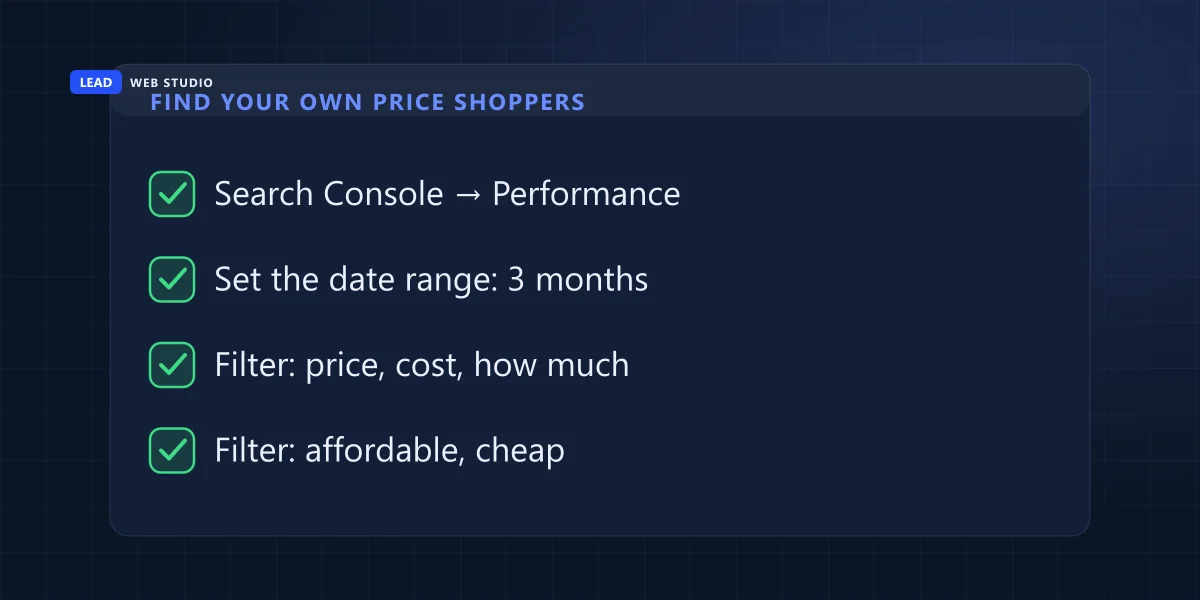
Stop guessing and read it. Search Console records the actual words people typed before your site appeared, so you can count your own price shoppers instead of debating whether they exist. Open Performance, set the range to three months, and filter the query list — twice, which is the step almost everybody skips.
- Search Console → Performance → Search results. If you have never opened it, I walk through the whole screen in the guide to reading Search Console.
- Set the date range to the last 3 months and turn on the Impressions and Average position boxes as well as Clicks.
- Filter the queries for price, then cost, then how much. Note the impressions each time.
- Now filter for affordable, cheap and budget. This is the half that gets missed, and on my site it was the bigger half.
Here is my own run, so you know what the output looks like on a small site. Property leadlls.com, 2 June to 30 August 2026: 1,293 distinct queries and 19,526 impressions. Of those, 83 queries carried a money word — 788 impressions, and zero clicks.
| 90 days on leadlls.com | Queries | Impressions | Clicks |
|---|---|---|---|
| Adjective shopping — affordable, cheap, budget | 36 | 491 | 0 |
| Price-word shopping — price, cost, how much, quote, fee | 47 | 297 | 0 |
| Everything else | 1,210 | 18,738 | 7 |
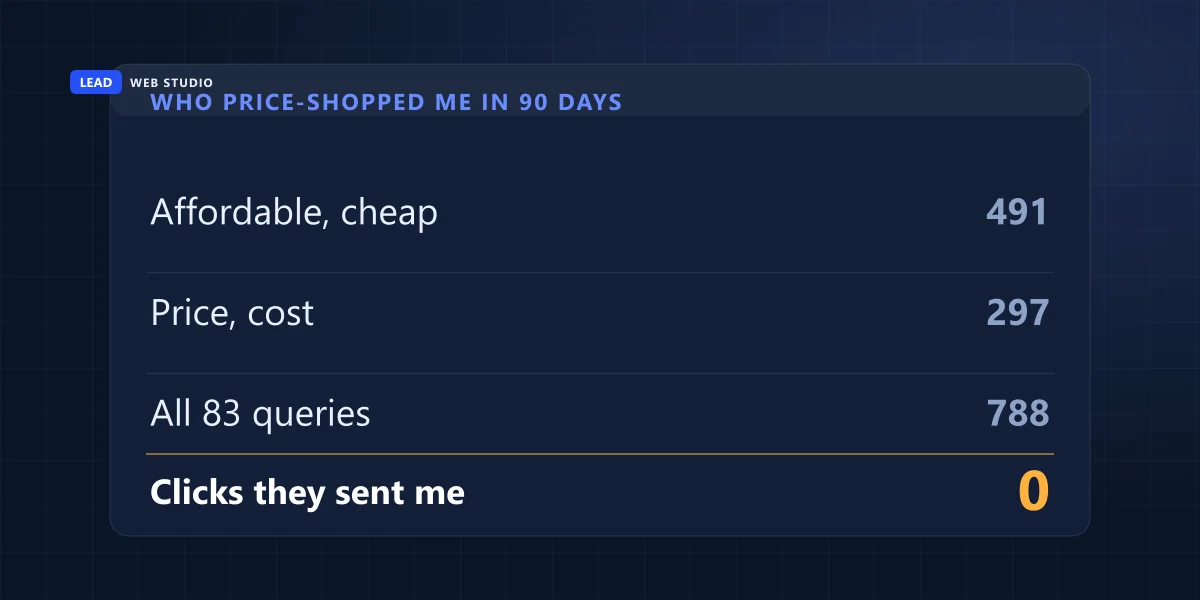
Two things jump out. The first is the split: 62% of the price-shopping impressions used an adjective rather than a price word. "Affordable web design mississauga" alone was 110 impressions. If I had filtered for price and cost and stopped there, I would have measured a third of my own demand and concluded the problem was small.
The second is the zero. Not one of those 788 impressions produced a click, and the reason is not the copy — it is that those queries average position 40 and worse. Nobody scrolls to page four. I am showing you an unflattering number on purpose, because it is the honest shape of this measurement on a site that has not yet won those terms: demand is real and measurable long before it is winnable, and knowing it exists is what tells you the page is worth writing.
A price shopper who cannot find your number does not phone you to ask. They open the next tab, and you never learn they were there.
Two caveats about the method, because a measurement you cannot trust is worse than none. Google hides rare queries, so the query table adds up to less than the page table on the same site and dates — 19,526 against 29,573 impressions here. And a keyword filter catches junk: mine flagged how much money does he make, which is somebody researching a person, not my rates. My first version of the filter also matched neurofeedback because it searched for "fee" without word boundaries, which is a good reason to read the list rather than trust the total.
What the usability research says about hiding the number
This is not a new fight, and it has been tested. Nielsen Norman Group has been running usability studies on business websites since the 1990s, and their finding on pricing has not moved: hiding it does not delay the decision, it relocates it.
Hoa Loranger's 2013 write-up of NN/g's B2B testing puts it in one line: "Participants go to competitors' sites when websites do not show prices." The same article reports that "Business customers report pricing as the top most needed piece of information online" — ahead of everything else they were asked to rank. And Jakob Nielsen had already published the escape hatch for complicated pricing in 2006: "if you can't show exact prices or your price list is extremely complicated, offer users some representative cases and their prices."
I am quoting research from 2006 and 2013 deliberately. It is old enough that if it were wrong, twenty years of websites would have disproved it by now.
The four ways to publish a price
"Publish your prices" is not one decision, and the version that fits a photographer does not fit a restoration contractor. There are four formats in common use and each one buys something different.
| Format | Looks like | Fits | The catch |
|---|---|---|---|
| Exact price | "Logo design — $600" | Fixed, repeatable deliverables | You cannot flex it later without looking like you made it up |
| From-price | "Websites from $899" | Packages with a real floor | Only honest if a real job has actually gone out at that number |
| Range plus drivers | "$3,000–$8,000, depending on rooms, access and disposal" | Most trades and services | The drivers have to be the ones you genuinely charge for |
| Representative jobs | "A 2-bed condo in Etobicoke: $4,200. A semi in Barrie: $7,800." | Work that is never the same twice | Needs three real past jobs you are willing to describe |
The one to avoid is the from-price with no floor behind it. If "from $899" is a number nobody has ever paid, the first quote you send undoes the trust the page just built, and you have spent your credibility on the cheapest possible thing. My own $899 is the actual starting package price and it is on the pricing page next to what is in it — which is the only version of a from-price that survives contact with a customer.
When you genuinely should not publish a number
There are real exceptions, and they are narrower than most people want them to be. Skip the number when the price is set by someone other than you, when publishing it would be misleading rather than merely uncomfortable, or when it is fixed by rules you do not control.
- The scope is unknowable before an inspection. Water damage behind a wall, a legal matter that could settle or run three years. Publish what the assessment costs instead — that number is knowable and it is the one the caller is actually deciding on.
- You are bidding against a tender document. If the buyer sets the format, your website is not where the number goes.
- A regulator or a professional body governs how you may advertise fees. Check the rule that applies to you rather than a general marketing article, this one included.
- Every price is negotiated per contract. Then say that in one sentence on the page. "We quote per contract" is information; an empty pricing page is not.
What is not on that list: "our work is premium so we do not discuss price." That reads to a stranger as expensive-and-evasive, and it is the one case where NN/g's finding bites hardest, because the reader has no way to tell an expensive specialist from someone who will not say.
Where the number goes once you decide to publish it
Not only on the pricing page. A pricing page catches the people who already went looking; the number has to also sit where the deciding happens. Three places, in the order I would do them.
- On the service page itself, in the copy, near the description of what is included — so the reader gets it while they are still interested rather than after a second click.
- On the homepage, as one line with a link. This is part of what belongs on a service-business homepage, and it is usually missing.
- On your Google Business Profile. Google's help page for managing services says you can "add info such as price and description" to each service. One rule from that same page: the number goes in the price field, because Google tells you to "avoid including profanity, gibberish, personal information, prices, or phone numbers in custom service names".
And whatever you publish, make it easy to act on straight away. A price that lands next to a dead-end contact form is worse than no price, and that pipeline breaks more often than people think — I have written up the three places it fails in the guide to capturing leads on your website.
Do this before you write a single number: run the Search Console filter above on your own site and write down the two totals. If the adjective half is bigger than the price-word half — as it was on mine, 491 against 297 — then the people shopping you are shopping on affordable, and your page needs to answer that word, not just carry a figure.
Will publishing prices help me rank on Google?
Not on its own. A price is not a ranking factor. My own pricing page averages position 3 on a small number of impressions and earned exactly one click in those 90 days, while the price-shopping queries I would actually like to win — "web design toronto price", "toronto website design pricing" — sit past position 40 where nobody looks.
What a number does is change what happens after somebody arrives. It makes the page answer the question the search was really asking, which is the whole idea behind writing answer-first content. Ranking for those terms is a separate job that takes months, and it is what SEO work is for. Adding a price today does not start that clock. It just stops you losing the people who already found you.
Not sure which format fits your work?
Send me your site and what you actually charge for, and I will tell you which of the four formats fits and where the number should sit — including "leave it off, here is why" if that is the honest answer. Free, no pitch. If the site itself is the thing holding you back, a fast, honest website is what I do for a living, and you can see what that costs on the pricing page before you ever speak to me.
Get My Free QuoteFrequently asked questions
Should I put prices on my website?+
For most service businesses, yes — a range with the things that move it, rather than one flat number. It answers the question people actually arrived with, it screens out the enquiries you were going to turn down anyway, and it works at eleven at night when nobody is answering the phone.
Will publishing my prices scare customers away?+
It will lose you some, and those are mostly the ones who could never have paid. What a number does not do is quietly keep the rest. Nielsen Norman Group's testing found that participants go to competitors' sites when websites do not show prices — so the alternative to a scary number is usually a silent exit, not a phone call.
How do I know if people are already price-shopping my business?+
Open Search Console, go to Performance, set the range to three months and filter the query list twice: once for price, cost and how much, and once for cheap, affordable and budget. The second filter is the one people forget, and on my own site it carried most of the volume.
What if every job I quote is genuinely different?+
Then publish representative jobs instead of a price list. Jakob Nielsen's advice from 2006 still holds: if you cannot show exact prices or your price list is extremely complicated, offer users some representative cases and their prices. Three real jobs with what each one cost tells a reader more than a rate card.
Can I put prices on my Google Business Profile too?+
Yes. Google's own help page says you can add info such as price and description to the services on your profile. One warning from the same page: keep the number in the price field, because Google tells you to avoid including profanity, gibberish, personal information, prices, or phone numbers in custom service names.
Does adding prices help my Google ranking?+
Not on its own. A price is not a ranking factor, and my own pricing page averages position 3 on tiny volume while the price-shopping queries I would like to win sit past position 40. What the number changes is who calls you after they read the page, which is a different and more useful thing.

10+ years building websites for GTA trades, clinics and service businesses — and reading the search data behind them afterwards, which is how I know what people typed before they landed on a page. Read my full bio · Get in touch