Daycare and Child Care Website Design in Burlington
I do daycare website design in Burlington and across Halton, and I build the site around the one screen a parent is actually looking for: whether there is a space, in their child's age group, and what it costs. Everything else on a child care website — the philosophy, the gallery, the mission statement — is read after that question is answered, or not at all. I have not built a site for a licensed child care centre yet, and I would rather say that than borrow someone else's. The closest work in my portfolio is a youth soccer academy whose site exists to let a parent pick a program by age and register on a phone, plus two healthcare builds where the person deciding is a family member rather than the client.
Waitlist
Sept
Now
Waitlist
A worked example of the element, not any centre's real numbers.
This is the screen the search was for. A parent looking for care is not comparing philosophies yet. They are trying to find out which centres can take a child of that exact age, roughly when, and for how much — and if the site does not say, their next move is another centre's site rather than your phone line.
Short answer
Lead Web Studio designs and hand-codes websites for daycares and licensed child care centres in Burlington, Ontario — mobile-first, structured for local search, organised around the province's licensed age groups, with availability, waitlist rules, daily fees and CWELCC status written in plain text instead of hidden behind a contact form. A build is $899–$2,999 one-time and goes live in 5–7 days once content is ready. There is no child care centre in my portfolio yet; the reference work is a youth sports academy and two healthcare sites, and this page says so rather than implying otherwise.
What Does a Daycare Website Have to Answer Before a Parent Will Book a Tour?
Three things, in this order: is there a space for a child of my age, when, and at what daily fee. A parent searching for care is running a shortlist, not reading a brochure. A site that answers availability, timing and price on the page earns the tour. A site that answers "contact us to learn more" gets skipped for the one that answered.
This is the unusual thing about the trade. Many licensed centres already receive more enquiries than they have spaces, so the website is doing something most local business sites never have to do: it has to sort. It should tell a family with a fourteen-month-old that the infant room is full until next summer, and tell a family with a three-year-old that there are two preschool spaces now — quickly enough that neither of them has to phone to find out, and honestly enough that the ones who do phone are the ones you can actually help.
That sorting is worth real money in both directions. Every enquiry about a room that has no space costs a director a phone call, an email and a difficult conversation. Every family that gives up before finding out you had a space is a space left unfilled. A site organised by room, with an availability line and a date on each one, reduces both — and it does it without a single extra feature, because it is a content decision rather than a software one.
The second half of the job is money. Fees in Ontario are no longer a simple number, because participation in the federal-provincial fee reduction changes what a family actually pays. That belongs on the page in plain language too, and it is set out further down.
How Should a Child Care Site Be Organised by Age Group?
By the province's own licensed age categories, because that is how a parent thinks and how your licence is written. Ontario defines six of them, each with its own staff-to-child ratio and maximum group size. Building one page per room means every page matches a real search, a real room and a real waitlist.
| Age group | Ontario's definition | Ratio & max group | What that room's page has to say |
|---|---|---|---|
| Infant | Younger than 18 months | 3 staff to 10 children · group of 10 | Sleep and feeding routines, how the day is reported back, and the honest waitlist position — this is the room families queue longest for |
| Toddler | 18 months to under 30 months | 1 to 5 · group of 15 | Toilet learning, the move up from the infant room, and what a first week apart looks like |
| Preschool | 30 months to under 5 years | 1 to 8 · group of 24 | The daily programme, outdoor time, and what the year before kindergarten actually covers |
| Kindergarten | 5 years to under 7 years | 1 to 13 · group of 26 | Before and after school hours, which schools you collect from, and how PA days and holidays are handled |
| Primary/junior school age | 7 years to under 10 years | 1 to 15 · group of 30 | Pick-up arrangements, homework time, and the full-day camp weeks that fill the school breaks |
| Junior school age | 10 years to under 13 years | 1 to 20 · group of 20 | What older children actually do there, said in a way that a ten-year-old would not be embarrassed by |
Age ranges, ratios and group sizes as set out in the Ministry of Education's Child Care Centre Licensing Manual, Part 3, under O. Reg. 137/15. Your licence states which of these groups you are approved for and at what capacity — the site should not claim any others.
What Is Already Written Down for Parents That Belongs on the Website?
Most of the fees page is already sitting in your parent handbook. Ontario requires a licensed centre to give parents a handbook at no cost, and to include four specific things in it. Each one is also the answer to a question people type into a search box before they call.
The single most valuable sentence you can publish. Participation is voluntary and a family's fees are only reduced if you take part, so "we are enrolled in the Canada-Wide Early Learning and Child Care system" — or a plain statement that you are not — answers the question every enquiry starts with.
A daily or monthly figure per room, dated. A number that can be wrong later is still better than no number, because a parent who cannot price you cannot shortlist you. Put the review date beside it and the risk of looking stale disappears.
Which payment methods you take, when payment is due, and how refunds and notice periods work. Families comparing two centres at the same price often decide on this, and publishing it removes the last unknown before someone commits.
Statutory holidays, the winter closure, any professional development days. Two working parents plan their year around these, and a closure list on the site quietly proves you are organised in the way a parent hopes their centre is.
That is four sections of a document you are already obliged to write, moved onto the website. It is the least expensive content work available here, and it gives a search engine or an assistant something concrete to quote when a parent asks which Burlington centres take part in the fee reduction.
The Closest Work in My Portfolio to a Child Care Centre
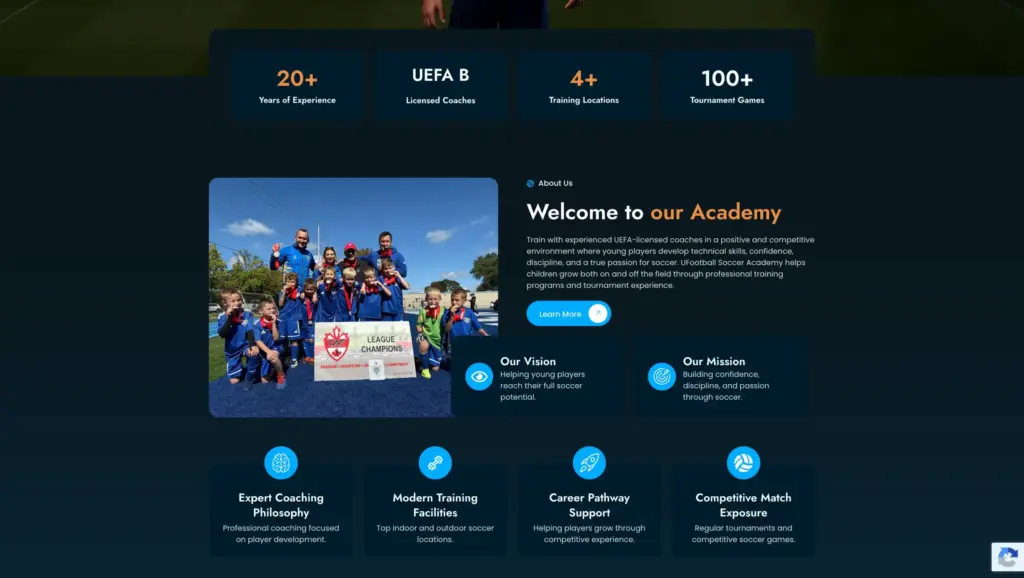
A soccer academy in Etobicoke is a youth club, not a daycare, and the difference matters — but the decision on the other side of the screen is the same one. A parent arrives knowing their child's age and almost nothing else, needs to find the group that fits, needs to see when it runs and where, and then needs to complete a registration on a phone while the child is in the room. So the site was built as program pages by age band with schedules and locations attached, and a registration form that finishes without a phone call.
Two healthcare projects sit beside it for the same reason: in home care and in psychotherapy the person reading the site is often deciding on behalf of someone they love, which changes what the writing has to do. What transfers to a licensed child care centre is not a look. It is the discipline of sorting visitors by the child's age before selling anything, and of putting the awkward facts — cost, availability, what happens if it does not work out — on the page instead of behind a form.
The Six Pages a Daycare Website Is Made Of
One page per job, each hung where a parent expects to find it. Everything after these six is optional.
Spaces & waitlist
Availability by room with a date, how the waiting list is ordered, and how a family learns where they stand. The page that saves you the most phone calls and loses you the fewest families.
Fees & CWELCC
The daily fee per room, whether you are enrolled in the fee reduction system, what is included, and where a Halton family applies for subsidy. Dated, so it never reads as a guess.
The rooms
Infant, toddler, preschool, kindergarten, school age — the categories your licence already uses. Each with its own hours, routine, educators and availability line.
A day here
Arrival, outdoor time, meals and who cooks them, rest, pick-up. This is the page a parent reads at eleven at night, and the one that decides whether the tour gets booked.
Licence & safety
Your licensee name and licence written as text so a parent can look you up, plus staffing qualifications, allergy and medication policy, and how families are notified when something happens.
Book a tour
Real times a parent can pick, the child's date of birth as a field so the enquiry arrives pre-sorted by room, and a confirmation that arrives before they have put the phone down.
What Parents Check, and Where It Tends to Hide
Six things a family checks before they will spend a morning on a tour, and where each one belongs if you want the tour rather than the phone call.
| What they are checking | Where it usually ends up | Where it belongs |
|---|---|---|
| Is there a space for my child's age | Nowhere — answered only by phoning | A line on every room page with a date, updated when it changes |
| What it costs a day | "Contact us for current rates" | A figure per room on the fees page, with the date it was last reviewed |
| Whether you are in CWELCC | Inside a PDF handbook, or a logo | One sentence in text near the top of the fees page, either way |
| Whether you are licensed | A badge image with no text | The licensee name in text, and a link to the province's licensed child care search |
| How the waiting list works | A form that confirms nothing | A short written policy: the order of admission, and how a family learns their position |
| Food, allergies and closures | Mentioned on a tour | On the day-here page and the fees page, where a parent planning a year can read them |
On waiting lists specifically: a licensee may not charge a fee or deposit for placing a child's name on a list, and must have a written policy covering the order in which children are offered admission and how a parent is told their child's position while other families' privacy is kept. See the Ministry's Child Care Centre Licensing Manual, Part 11. An enrolment fee is a different thing and can only be charged once a space has actually been offered.
A Programme Page and a Room Page Are the Same Page
This is the schedule side of the academy build — the level below the homepage, where a parent has already found the right age band and is checking whether the times and the location work for their week. It carries one group: when it runs, where it runs, who runs it, and what to do next. Nothing on it is trying to persuade anybody of a philosophy.
A child care centre's room page is the same object. One room, its hours, its ratio, its educators, its current availability and one next step. Five of those beat a single "Our Programs" page, because each one matches a phrase a parent types — infant care, toddler room, before and after school — and because a page about the exact room their child would be in reads as competence rather than marketing. Once it is live it needs keeping current, which is what website maintenance and support covers, and it needs to work for every parent, which is what accessibility compliance covers.

Five Things That Quietly Cost a Centre Enrolments
Availability that only exists on the phone
If the site cannot say which rooms have space, every parent has to ring to find out, including the ones you have nothing for. Those calls take real time, and the families making them lose patience. A dated availability line per room fixes both, and it takes a minute a week to keep honest.
A fee page that says "contact us"
Price is one of the two filters a shortlist is built from. A centre that will not publish a figure is quietly asking to be left off the list by anybody with a budget, which is everybody. Publish the number with the date it was set, and revisit the date rather than removing the number.
No answer on the fee reduction
Since participation in the Canada-Wide system is voluntary, a family cannot assume anything. Leaving it unsaid means every enquiry opens with the same question and some never open at all. One sentence in text settles it, and it is the kind of concrete fact a search engine or an assistant can quote.
A waitlist form that confirms nothing
A parent who submits a form and hears nothing assumes it failed. The form should confirm on screen and by email, restate that no fee is charged for joining the list, and say plainly how the order works and when they will hear from you next. None of that costs anything beyond writing it down once.
Stock photographs of other people's children
They are recognisable, and consent to photograph the children in your care is not always something you have. Photograph what you can: the rooms empty and set up, the yard, the kitchen, the sleep area, the sign-in desk, your educators. A parent wants to see the actual space their child would spend nine hours a day in.
Where Does a Burlington Daycare's Catchment Actually Begin?
At the morning commute, not at a radius on a map. Families do not choose the closest centre to home. They choose the one that fits between the house, the highway or the GO platform, and the office — which means a Burlington centre's real catchment is a corridor, and the site should be written for the corridor rather than for the postcode.
Burlington runs about fifteen kilometres along the lake and climbs to the escarpment, and it does not behave as one market. The QEW and the 403 cut across the south end, the 407 crosses the north, and three GO stations — Aldershot, Burlington and Appleby — put a large share of working parents on the Lakeshore West line every morning. A centre on Fairview Street near Burlington GO and a centre off Dundas Street in Alton Village are serving parents with completely different morning routes, and the website is where that difference should be stated.
The age profile changes with the geography too. Alton Village, north of Dundas Street between Walkers Line and Appleby Line, and the Orchard just south of it are the newest parts of the city, built from the late 1990s onward, and they carry the youngest households — which is where you would expect the heaviest infant and toddler demand. Aldershot, the downtown streets off Brant Street, Roseland and the older lakeside neighbourhoods tend to have more established families, which usually means more before-and-after-school demand than infant demand. Tyandaga, Headon Forest, Millcroft and Tansley Woods sit in between. Kilbride and Lowville, up past the 407, are rural enough that the nearest option may be in a different part of town entirely.
There is one more thing a Burlington site should carry that a Toronto one would not. Child care in Burlington is planned and funded through Halton Region, which is the service system manager for Burlington, Oakville, Milton and Halton Hills and which runs the child care fee subsidy for eligible families. A fees page that names the Region and links to the subsidy application answers the question that follows every price — and can we get help with it? — instead of leaving a family to discover the answer somewhere else.
Worth saying plainly on the page: which schools you collect from, whether you take children from Aldershot or Waterdown across the boundary, and what your latest pick-up time really is. Those three facts decide more enrolments than any statement of philosophy. See also Burlington web design, Burlington SEO and Google Maps setup in Burlington.
Newest housing in the city, north of Dundas Street between Walkers Line and Appleby Line. The youngest households in the city, and where you would expect the heaviest infant and toddler demand.
Established subdivisions between Upper Middle Road and Dundas. A mixed catchment: preschool rooms plus steady before-and-after-school demand.
Older lakeside streets off Brant Street and Lakeshore Road. More school-age care than infant care, and the quickest access to the QEW.
Plains Road and the Aldershot GO catchment, with Waterdown and west Hamilton close enough that families cross the boundary in both directions.
Rural Burlington above the escarpment. Say whether you take these families, because the drive is a real decision for them.
"Put the room, the date and the fee on the page. Then the phone rings when you can actually help a family, and it stops ringing when you can't — which is worth as much to a director as the enrolment is." — Liubomyr Lukaniuk, on building websites for centres that already have a waiting list
What Does a Daycare Website Cost in Burlington?
$899 one-time for up to 10 pages, $1,499 for a fuller site with a page per room and a proper fees and waitlist section, and $2,999 where tour booking or parent portals are involved. One payment, fixed in writing before I start, and about 5 to 7 days once the content is ready.
| Package | Best for | What's included |
|---|---|---|
| Starter — $899 | Up to 10 pages | Home, the rooms, fees, a day here, licence and safety, about and contact, with a protected enquiry form and local SEO in place from day one |
| Full Site — $1,499 | A page per room, fees and waitlist done properly | Individual room pages with availability lines, a dated fee page with CWELCC and subsidy information, a written waitlist policy page, staff profiles and deeper local SEO |
| Advanced — $2,999 | Booking, waitlist intake or portals | Online tour booking with real time slots, a waitlist intake that confirms by email and sorts by the child's date of birth, a parent area, unlimited pages and priority support |
Google Business Profile work is separate and starts at $149 — for a business people find by searching "daycare near me" it does at least as much as the website. See full pricing and Google Maps management.
Daycare Website FAQ, Burlington
What pages does a daycare website actually need?+
Six pages carry a child care site: a spaces and waitlist page that answers availability by age group; a fees page stating the daily rate and your CWELCC enrolment status; a page per room built on the licensed age categories; a page describing the day itself, including food and outdoor time; a licence and safety page naming the licensee so a parent can look you up; and a tour booking page that finishes on a phone. Everything after those six is optional.
Can an Ontario child care centre charge a fee to join its waiting list?+
No. Under the child care regulations a licensee cannot charge fees or deposits for placing a child's name on a waiting list, and must have a written policy setting out the order in which children are offered admission and how a parent can learn their child's position while other families' privacy is protected — see the Ministry's licensing manual, Part 11. An enrolment fee is a different thing and can only be charged once a space has actually been offered. Both facts are worth stating on the waitlist page, because a parent who reads them trusts the list.
Should a daycare website say whether it is in the CWELCC system?+
Yes, either way. Participation in the Canada-Wide Early Learning and Child Care system is voluntary, and if a provider is not enrolled the family's fees are not reduced. Since January 1, 2025 fees for children under six at participating centres have been capped at $22 a day, with the province reporting an average of about $19 and working toward $10. A family will find out eventually, so the site may as well answer it plainly on the fees page — it is also the kind of concrete fact a search engine or an assistant can quote.
How does a parent check that a centre is licensed?+
Through the province's Licensed Child Care Website, which lists licensed programs along with licence and inspection information. The licence itself must also be posted in a conspicuous place accessible to parents at the centre. Because it is independently checkable, it is one of the strongest things you can put on a website — written as text, with the licensee name exactly as it appears on the licence, rather than as a badge image that neither a search engine nor a screen reader can read.
Can an unlicensed home daycare have a website?+
Yes, and it has one extra obligation the website should respect. An unlicensed provider may care for a maximum of five children under 13 — counting their own children under four, and no more than three children under two — and must tell parents in writing that the programme is not licensed, in the words "This child care program is not licensed by the Government of Ontario." See the province's child care rules. Putting that sentence on the site rather than burying it reads as straightforwardness, and it prevents the enquiry that ends badly.
Have you built a website for a daycare before?+
Not yet, and I would rather say so than borrow someone else's work. The closest project in my portfolio is the soccer academy in Etobicoke — a youth club whose site exists so a parent can pick a programme by their child's age, check the schedule and register on a phone. A home care agency and a psychotherapy practice sit beside it, both cases where the person reading the site is deciding for someone they love. The academy case study shows how it was handled there.
What does a daycare website cost in Burlington?+
$899 one-time for up to 10 pages, $1,499 for a fuller site with a page per room and a proper fees and waitlist section, and $2,999 where online tour booking, waitlist intake or parent portals are involved. One payment, fixed in writing before I start, and about 5 to 7 days once the content is ready. Local SEO and Google Business Profile work are priced separately, starting at $149. See my website design packages.

10+ years designing SEO-ready websites for local businesses, including youth programmes, healthcare and family-facing services across the GTA. About the studio · Get in touch
Does your site say which rooms have space this month?
I'll build a page per room with an availability line, put the fee and your CWELCC status in plain text, and give the waiting list a policy a parent can read. Packages from $899.