A call tracking number won't hurt your local SEO by itself. What causes trouble is where it ends up and whose account it lives in: scattered across directories, hard-coded into your website, or rented by an agency in the agency's name. Keep your real number in the code and in your citations, and keep the account yours.
Somebody selling you ads or SEO will eventually say "let's add call tracking so we can prove the calls". It's a fair request. Phone calls are the lead most small businesses care about, and they're the hardest to count. The worry that follows is also fair: Google matches your business by its name, address and phone number, so a second number sounds like a way to confuse it. Both sides are partly right, and the answer depends on the place. So let's go place by place.
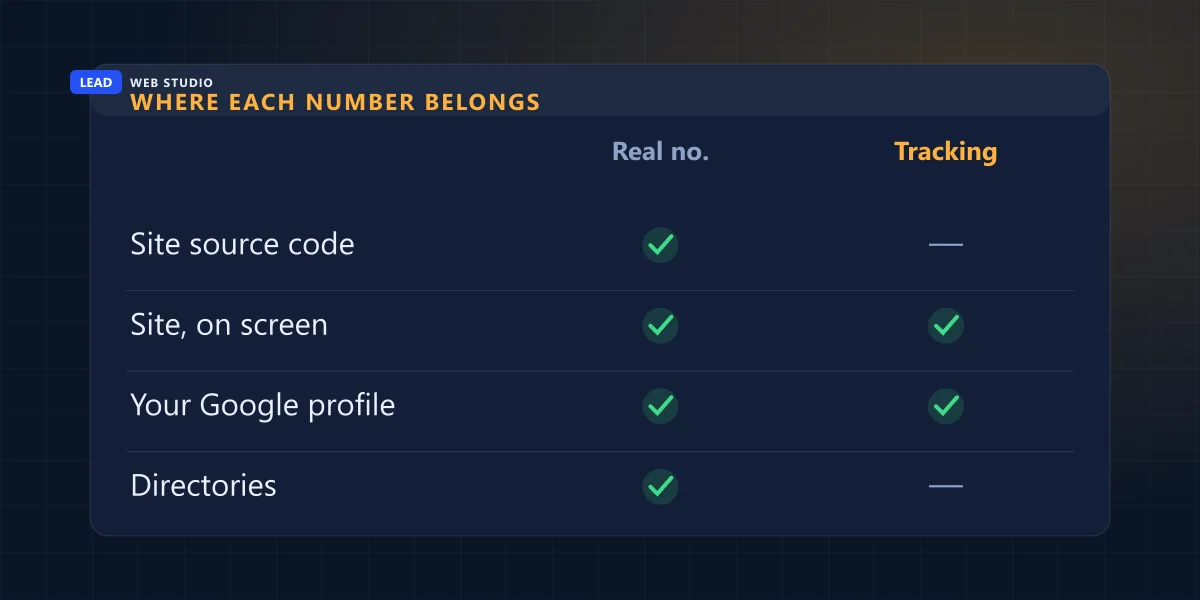
Your website's code
Your real number
This is the copy search engines and directory scrapers read. It stays your own line, always.
Your website, as visitors see it
A tracking number is fine
A small script can swap the number on screen for a visitor who arrived from an ad. The code underneath keeps your real one.
Google Business Profile, primary phone
Tracking, only in your own account
Possible if the number rings your business directly and you control it. Your real line then goes in an additional phone field.
Directories and citations
Your real number
Yelp, YellowPages, the chamber of commerce, the data aggregators. These copy each other, so one stray number spreads.
Trucks, signs, flyers
Your real number, usually
Paint lasts years. A rented number on a van door outlives most marketing contracts.
Google Ads call assets
Google's own forwarding number
Ads can swap in a Google forwarding number for you. You don't buy anything for this.
Does a call tracking number hurt local SEO?
Not when it's set up so search engines still see your real number. The safe pattern is a script that swaps the number only on the visitor's screen while your own line stays in the page code, plus your real number in every directory. The damage people fear comes from hard-coded tracking numbers that leak into citations and stay there.
The swapping trick is called dynamic number insertion. Your page is built with your real number, say 416-555-0100. When someone lands from a Google ad, a script from the tracking company replaces what they see with a rented number that forwards to your line and logs the call. Someone who arrives another way sees your normal number. Search engines read the page as it was built.
The version that does cause a mess is the lazy one: somebody types the tracking number straight into the website footer. Directory scrapers copy it, the aggregators pass it along, and two years later the number is on twelve sites you've never logged into. If the tracking contract ends, those twelve listings point at a dead line, and correcting them one directory at a time is slower than anyone expects. The process is in how local citations work in Canada, and the first step is always the same: decide which number is the real one and write it down.
Creating one tracking number per directory sounds clever. You'd see exactly how many calls Yelp sends. In practice you pay monthly for a dozen numbers, the report says most directories send close to nothing, and you've broken your own consistency to learn it.
What do Google's rules say about phone numbers on a Business Profile?
Google's guidelines don't mention call tracking by name. They ask for a number that connects to your individual location, under the direct control of the business, local rather than a central call centre where possible, never premium-rate, and never one that redirects people somewhere else. A tracking number can pass all of that, or fail it.
These are the lines that matter, as they read on Google's guidelines for representing your business today, with what each one means for a tracking number:
"Provide a phone number that connects to your individual business location"
The forwarded call has to ring at your business, not at a sales desk or a shared answering service three provinces away.
"The phone number must be under the direct control of the business."
This is the one owners miss. A number rented in your agency's account is under the agency's control. Put the tracking account in your own name.
"Use a local phone number instead of a central call center helpline number whenever possible."
Pick a tracking number with your own area code, 416 or 647 or 905. A toll-free number is allowed but reads like a call centre.
"Do not provide phone numbers or URLs that redirect or 'refer' users to landing pages"
A number that plays a recording and sends people to a website, or a lead broker's line that sells the call on, fails here.
"Premium phone numbers are not acceptable regardless of the rate charged to the caller."
Not usually a tracking problem, but worth knowing if a vendor offers a "vanity" number with a per-minute charge.
The profile itself takes your primary number and, according to Google's help page on adding a phone number, up to 2 more. The common setup puts the tracking number in the primary field and your real line in an additional one, so Google still connects the profile to the number on your website. One warning about the edit itself: an edit that pushes a profile out of line with the guidelines is one of the common ways a profile gets suspended, sometimes months later. Change the number on its own, on a quiet day, and don't change the name, category and address in the same sitting. If it does go wrong, what to do when a Google profile is suspended walks through the appeal.
Do you need call tracking at all, or will the free counts do?
Start with the free counts. Your Google profile already counts taps on its call button, Google Analytics can count taps on the phone link of your website, and Google Ads can count calls from ads. Rented tracking numbers earn their monthly fee when you need the call itself: who rang, from which campaign, whether anyone answered.
On this website, every tap on my phone number is logged in Google Analytics as an event called phone_click. It costs nothing, it uses no second number, and it tells me which page the caller was on. If you have Analytics set up already, it's a small addition; Google Analytics for a small business covers the basics of events. Each count has a blind spot, though, and they're different blind spots:
| The count | What it sees | What it misses | Cost |
|---|---|---|---|
| Calls in your Google profile's Performance | Taps on the call button of your profile | Anyone who reads the number on a laptop and dials it by hand | Free |
| A tap event on your website's phone link | Taps on the number, and the page they happened on | Whether the call connected, and anyone who dials by hand | Free |
| Google Ads call reporting | Calls from your ads and their length | Every call that didn't start at an ad | Free with Ads |
| A rented tracking number | The call itself: time, length, caller's number, often a recording | Calls to any number it doesn't replace | A monthly fee per number |
Google's own wording on the profile metric is short: Calls is "the number of times a customer clicked on the call button on your Business Profile", per its performance help page. That's a tap, not a conversation. Treat it as "people who tried", which is still useful for spotting a month that fell off a cliff.
The Ads column trips people up more than any other, because a click on the call button and a counted call conversion are different numbers in different columns. I wrote that one up separately in why Google Ads shows zero conversions, including how long a call has to last before it counts.
My rule of thumb: if you spend money on ads and your phone rings more than your inbox fills, a tracking number pays for itself in arguments avoided. If you're a two-person shop getting most work by referral, the free counts and a question at the end of each call ("how did you find us?") tell you nearly as much.
Who should own the tracking number?
You should. The account that rents the number should be in your business's name, with your card on it, and your agency added as a user. Google asks for a number under the business's direct control, and the practical reason is bigger than the rule: whoever owns the account owns every call that number collects.
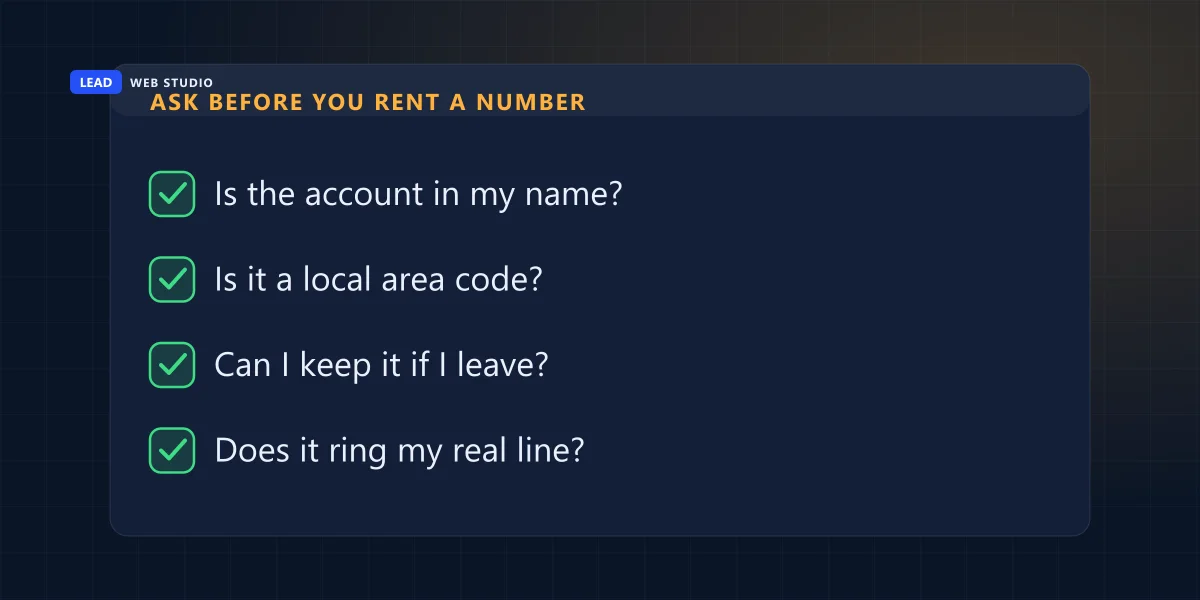
This is the same problem as a website registered in the designer's name, which I've written about in who actually owns your website. It feels like a detail until the relationship ends. Then the old agency cancels its account, the number on your Google profile goes dead on a Friday afternoon, and nobody tells you. Ask these before anyone rents a number for you:
- Whose name and card is the account under, and can I log in to it myself today?
- Does the number have my local area code?
- If I leave the provider, can I take the number with me, and what does it cost? Get the answer in writing.
- Does the call ring straight through to my existing line, or does it pass through a menu or a recording first?
- Are calls recorded, and does the caller hear that before the conversation starts?
- Is the swap done by a script, so my real number stays in the website's code?
The last two questions are the ones vendors answer fastest, because they're proud of the features. The first three are the ones that decide who you're stuck with in two years.
What happens to printed numbers when you cancel
Usually the number stops working, and some providers hand it to the next customer after a while. A website updates in a minute. A van wrap, a lawn sign and four thousand flyers in a drawer do not. That's why the map above keeps print on your real number. If you want to measure a flyer drop, give that one campaign its own number and accept that it expires with the campaign.
Setting it up without scattering numbers
Done in this order, call tracking takes an afternoon and leaves nothing to clean up later:
- Write down the one real number of the business, and check that it's the one in your website's footer code, on your Google profile and in your main directories.
- Open the tracking account in the business's name. Add your marketer as a user, not as the owner.
- Rent local numbers only for the sources you'll actually compare, usually ads and the Google profile. Two or three is plenty for a small business.
- Install the swapping script on the website and test it: visit from an ad link and from a normal search, and check the number changes only in the first case.
- If you put a tracking number on the Google profile, move your real line to an additional phone field in the same edit, and change nothing else that day.
- Leave every directory, sign and printed piece on your real number.
Then call each number yourself from a mobile phone and make sure it rings where it should. You'd be amazed how often the first person to discover a forwarding mistake is a customer, and how rarely they mention it. If you'd like someone else to keep an eye on the profile side, phone fields included, that's part of what Google Maps management covers.
Questions owners ask me about tracking numbers
Will Google suspend my profile for using a call tracking number?+
Google's guidelines don't ban tracking numbers. They require a number that rings your location and that the business controls. The bigger risk is a careless edit: change the phone on its own, keep your real number in an additional field, and keep the tracking account in your own name.
Should the tracking number be on my website or only on my Google profile?+
On the website, only as a number swapped on screen by a script, with your real number left in the page code. On the Google profile it can sit in the primary field if you own the account. Directories and print stay on your real number.
Does a toll-free tracking number hurt local rankings?+
Google asks for a local number instead of a central helpline whenever possible. A toll-free number isn't forbidden, but a local area code fits that guideline better and looks more like a local business to the person calling. Choose local when the provider offers it.
Can I keep my tracking number if I switch providers?+
Sometimes. It depends on the provider and the kind of number, so ask before you print it anywhere and get the answer in writing. If the answer is no, keep the tracking number off anything you can't change in a minute.
Is call tracking worth it for a small business?+
When you pay for ads or SEO and most leads arrive by phone, usually yes, because it settles which spending brings calls. For a small shop that lives on referrals, the free counts in your Google profile and website analytics, plus asking callers how they found you, are often enough.
Sources, read on 22 October 2026: Google's guidelines for representing your business on Google for the phone number rules quoted above; Google Business Profile help on adding a phone number (up to 2 more numbers) and on profile performance for the Calls metric. The phone_click event is on this website and can be seen in its page source.
Not sure which number sits where?
Send me your website and your Google profile link and tell me what you're trying to measure. Setting up and looking after the profile, phone fields included, is part of Google Maps setup.
Get My Free Quote
I build websites and set up Google profiles for service businesses in the GTA, and I spend a fair part of each month answering one question for them: which calls came from where. Read my full bio · Get in touch